
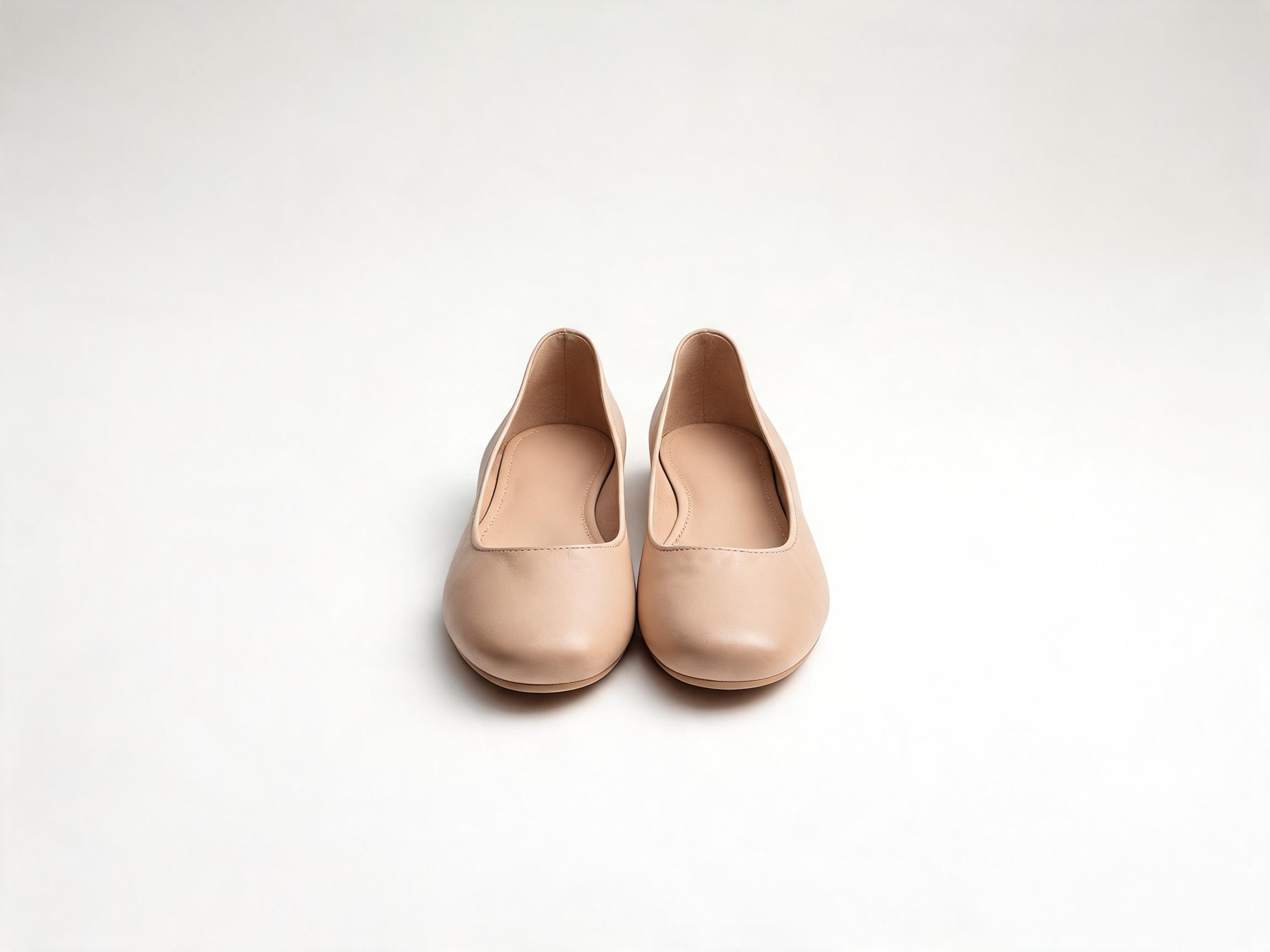
A practical guide for B2B buyers building a ballet flats program: upper material selection, elastic topline fit behavior, color and size range planning, and how ballerinas fit into retail-chain core assortments.
Transparency note: This guide was written by the Aurevia team, and the reference style discussed throughout — the Nude Leather Ballet Flats — is a style we currently supply.
Ballerinas are a core SKU for many women's footwear ranges, but they behave differently from pumps or sneakers across sizing, fit, and color planning. This guide covers the decisions that matter when building a wholesale ballet flats range: upper leather selection, elastic topline behavior, color and size coverage, and how the style slots into a retail-chain core program — including how the reference style is actually produced, checked, sampled, packed, and serviced.
Key takeaways
- Soft nappa leather is a common upper specification for ballet flats because it drapes to the foot with minimal break-in; price-led programs often use synthetic alternatives.
- Elastic binding topline holds the shoe without pressure, but changes how between-size customers should choose their size.
- Nude, black, and white are the three color anchors for a core range; custom colors extend the line by season.
- EU 35–41 is the working size range for the reference style; plan size curves based on your market's foot distribution, not a flat multiplier.
- Ballerinas fit best as a year-round core program with seasonal color refreshes rather than a single-season drop.
In this guide
- Why soft nappa leather is a common upper for ballet flats
- Elastic topline fit behavior and between-size customers
- Color coverage: nude, black, white, and custom
- Size range planning: EU 35–41
- Slotting ballerinas into a retail-chain core program
- From our production floor: process and quality control
- Sampling, packaging, warranty, and after-sales
- FAQ for wholesale buyers
Why soft nappa leather is a common upper for ballet flats
When buyers specify a ballet flat for a women's range, the upper material decision usually comes down to one question: will the shoe mold to the foot quickly enough to sell without returns. In comfort- and material-led mid-to-premium programs, soft nappa leather answers that question more reliably than stiffer leathers for this silhouette; in price-led programs, synthetic uppers remain a common alternative.
Nappa is a full-grain or top-grain leather finished to stay supple. In a ballet flat, where there is no lacing or strap to adjust fit, the upper itself has to do the work of holding the foot. A soft nappa upper drapes and flexes with the foot from the first wear, which reduces the break-in friction that stiffer leathers create in a slip-on style—though a short settling period is still normal for most leather footwear.
For wholesale planning, the practical implications are:
- Consistent drape across sizes: nappa's suppleness means the shoe behaves similarly at EU 35 and EU 41, so your size curve does not need to account for a stiff-leather break-in at the larger end.
- Finish options: nappa takes dye and finish well, which is what makes a broad color range — nude, black, white, and custom shades — practical within one upper specification.
- Care positioning: leather uppers carry a care expectation that synthetic uppers do not. If your retail channel sells on material quality, nappa supports that story; if it sells on price, the material decision should be made with that trade-off in view.
The reference style in this range uses soft nappa leather with an elastic binding topline, a cushioned insole, a flexible rubber outsole, and a flat heel of approximately 1 cm. For buyers comparing upper options, the material page for the nude leather ballet flats lists the full construction details.
Elastic topline fit behavior and between-size customers
The elastic binding topline is the single feature that most changes how a ballet flat fits — and how your customers should size it. Unlike a rigid topline, which can gap at the heel or press across the instep, an elastic binding holds the shoe to the foot without pressure points. That is the design intent, and it is why the style works as a true slip-on.
The fit consequence buyers need to plan for is the between-size customer. Because the leather softens with wear and the elastic topline allows some give, a customer who measures between two sizes will often find the smaller size the better long-term fit on this last and construction. This between-size guidance is specific to the reference style's last and elastic-binding construction — it is not a category-wide rule for ballet flats, and other lasts or constructions can size differently. Customers with high insteps or very wide feet are the main exception and should be fit-tested before you publish sizing guidance. A half-size-up recommendation that works for a rigid pump can produce a ballet flat that feels loose after a few wears.
For a wholesale program, this translates into concrete planning decisions:
- Size guidance at retail: if your channel publishes fit notes, state that between-size customers should consider the smaller size on this construction — noting that this applies to this style's last and construction, not to ballet flats as a category — and that high-instep and wide-foot customers should be fit-tested separately. This is a merchandising decision, not a manufacturing one, but it affects return rates.
- Size curve weighting: plan the curve so the middle sizes carry the volume. If your historical data shows between-size customers sizing down, the demand will concentrate slightly below the midpoint of the range.
- Sampling: fit approval should include a wear test, not just a try-on. The elastic topline and nappa upper both change with wear, and a fresh sample does not show the settled fit.
Buyers who want to confirm how the topline behaves on a specific production run should ask the supplier for a fit sample and a wear-test note before signing off on the range.
Color coverage: nude, black, white, and custom
Color planning for ballerinas follows a different logic from fashion-led styles. The ballet flat is often bought as a wardrobe basic, so the core colors carry the volume and seasonal colors carry the interest. A workable structure for a wholesale range is:
| Color tier | Role in the range | Planning note |
|---|---|---|
| Nude | Core anchor; the color most associated with the ballet flat silhouette | Carry across all sizes; nude is the shade most sensitive to skin-tone matching, so confirm the shade against your market's expectation |
| Black | Core anchor; the default for formal and workwear use | Carry at full size depth; black is the least color-risk SKU in the line |
| White | Core or seasonal depending on market | Strong in spring/summer and bridal-adjacent assortments; plan for shorter sell-through windows in some channels |
| Custom | Seasonal extension and differentiation | Use custom shades to refresh the range each season without changing the core construction; confirm color approval against a physical swatch before production |
The practical rule is that nude, black, and white should carry the full size range, while custom colors can run on a narrower size curve. This keeps the core program simple to replenish and gives the seasonal layer room to test without carrying full-size depth on every shade.
Size range planning: EU 35–41
The reference style runs EU 35–41. That range is a common core for European and export markets, but how well it covers your specific customer base depends on your market data—it does not automatically cover every foot distribution. The size curve inside that range is not uniform either. Buyers should build the curve from their own sell-through data rather than applying a flat multiplier across all sizes.
Two planning points matter for ballerinas specifically:
- Between-size behavior shifts demand: as noted above, customers who measure between sizes often prefer the smaller size on this construction. If your market data shows a high share of between-size customers, weight the curve accordingly.
- Elastic topline and narrow fits: the elastic binding holds the foot without pressure, but customers with very narrow feet may still find the fit loose. If your market skews narrow, confirm the topline tension on a fit sample before committing to the full range.
For markets outside the EU sizing convention, confirm the conversion chart with the supplier before printing size labels. Size conversion is a labeling decision as much as a fit decision, and it should be settled before production.
Slotting ballerinas into a retail-chain core program
For a retail chain, the ballet flat works best as a core program rather than a one-season drop. The construction is stable, the color logic is predictable, and the style sells across seasons in most women's footwear assortments. That makes it a candidate for the kind of SKU that stays on the shelf year-round with periodic color refreshes.
A practical structure for a retail-chain core program looks like this:
- Core construction: one upper specification (soft nappa), one topline construction (elastic binding), one outsole specification. Keeping the construction stable is what allows replenishment without re-approval.
- Color architecture: nude, black, and white as the permanent core, with two to four custom shades per season. The core colors carry full-size depth; the seasonal shades run narrower.
- Size coverage: EU 35–41 across the core colors, with the curve weighted to your market's foot distribution.
- Replenishment rhythm: the core colors should be reorderable without a new development cycle. Lead time for the reference style is 25–35 days after order confirmation; confirm current replenishment terms with the sales team before finalizing the program.
This structure keeps the program simple to manage: one construction to approve, one fit to validate, and a color layer that refreshes without re-opening the core specification.
From our production floor: process and quality control
Because we supply the reference style ourselves, we can describe how it is actually made and checked rather than leaving those details to guesswork. Each pair goes through eleven production steps: pattern grading, leather cutting, upper stitching, elastic topline insertion, toe lasting, cementing, sole pressing, cooling, de-lasting, inspection, and packing. Of these, elastic topline insertion and toe lasting are the steps most directly tied to the fit behavior described earlier — the first sets the give in the top line, the second shapes the toe over the last.
Quality control runs at three stages. Incoming material is checked for leather thickness, color, and grain before cutting. During production, in-line checks follow the construction through stitching and lasting. Finished shoes are inspected for symmetry, bonding strength, cleanliness, and packing accuracy. Spot checks include a forefoot flex test, color fastness testing, and sole adhesion testing.
Third-party inspection is welcome: buyers are free to appoint their own inspection agency to verify goods before shipment, and we will coordinate with the inspector on site.
Sampling, packaging, warranty, and after-sales
Sampling and timeline. Stock samples of the reference style can be dispatched within 3–5 days. Custom samples — with your chosen colors, logo, or packaging details — are completed about 7–12 days after the specification is confirmed. As noted in the fit section, sample approval should include a wear test, not just a try-on.
Packaging and cartons. Each pair weighs approximately 0.45 kg including its individual box, and each export carton holds 24 pairs. Retail boxes can be printed with the buyer's logo, and cartons ship with moisture-proof paper and shoe trees to protect the shoes.
Warranty and after-sales. The reference style carries a 6-month warranty against manufacturing defects, and after-sales inquiries are answered within 48 hours.
Trade terms are available on an EXW, FOB, or CIF basis; confirm the applicable terms and current conditions for your market with the sales team.
FAQ for wholesale buyers
What upper material should I specify for a ballet flat range?
Soft nappa leather is a common specification for a ballet flat because it drapes to the foot and reduces break-in friction in a slip-on style. The reference style in this range uses soft nappa leather; confirm material options with the supplier if your program requires an alternative.
How does the elastic topline affect sizing?
The elastic binding holds the foot without pressure and allows some give as the leather softens. Between-size customers often prefer the smaller size on this style's last and construction — this is specific to the reference style, not a category-wide rule. Fit should be confirmed on a wear-tested sample before range sign-off.
What color range should a core ballet flat program carry?
Nude, black, and white are the three core anchors. Custom colors extend the range by season and can run on a narrower size curve. Confirm custom shades against a physical swatch before production.
What is the size range for the reference ballet flat?
The reference style runs EU 35–41. For markets using a different sizing convention, confirm the conversion chart with the supplier before printing size labels.
What are the minimum order quantities and lead times?
MOQ for the reference style starts at 100 pairs per color, and sizes can be mixed within the same color. Lead time is 25–35 days after order confirmation. Exact terms depend on the color, size curve, and order structure of your program — confirm current MOQ, lead time, and trade terms (EXW/FOB/CIF) with the sales team before placing an order.
Planning a ballerina range for your retail program? Review the nude leather ballet flats construction details, then contact the sales team to confirm MOQ, lead time, and color options for your market.