
A procurement execution guide for buyers placing a wholesale leather shoes order. It covers how to verify leather grade on samples, how to keep bulk production consistent with the approved sample, and how to judge supplier reliability before committing. Two published Aurevia styles, a full brogue and a cap-toe oxford, illustrate the checkpoints.
Procurement execution guide
Placing a wholesale leather shoes order fails in three familiar places: the leather grade looks right in the showroom and wrong at the warehouse, the bulk shipment drifts from the approved sample, and the supplier stops answering questions once the deposit clears. This guide walks through the checks that catch those problems before the order is placed, not after. It is written for buyers who have already shortlisted suppliers and now need to execute a purchase of genuine leather shoes, from brogues to oxfords.
Key takeaways
- Verify leather grade on samples by asking what hide was used and comparing cut panels, not by trusting a label.
- Bulk consistency depends on matched-hide cutting for left and right pairs, batch shade control, and sample-to-bulk comparison.
- Ask how inspection is staged: incoming material, in-line, and finished-shoe checks tell you where defects are caught.
- Lock the size grid, branding, packaging, and trade terms before the order, not during production.
What this guide covers
Verifying leather grade on samples
Leather grade is the first thing buyers try to confirm and the easiest to misread. A sample can be presented as full-grain and still be a lower layer that has been finished to look like it. Since the leather is only as good as the hide behind it, treat grading as a set of buyer-side questions and visual checks, not as a claim you accept.
Ask directly what hide was used on the sample: full-grain, top-grain, or a corrected-grain surface. Then inspect the cut panels yourself. Look at the grain pattern across the toe, vamp, and quarter. Natural full-grain shows a soft, irregular pore pattern that changes across the hide. If every panel has an identical, perfectly uniform texture, the surface may have been corrected or embossed rather than left in its natural state.
Edge finishing is the second checkpoint. On a quality build, the cut edges are clean and tight against the leather, with the lining sitting flush. On a lower-grade build, edges look fuzzy, thick, or heavily painted to hide a loose fibre structure. Run a fingernail lightly along an edge, and look at the underside of a cut panel where it is exposed.
Watch for over-finished surfaces. Heavy coating, strong gloss, and a plastic-like feel can mask a lower grade of leather. If you cannot see the pore structure at all, ask why. Compare cut panels from the same sample against each other and against a reference swatch you keep on file. That comparison is more reliable than any single photograph.
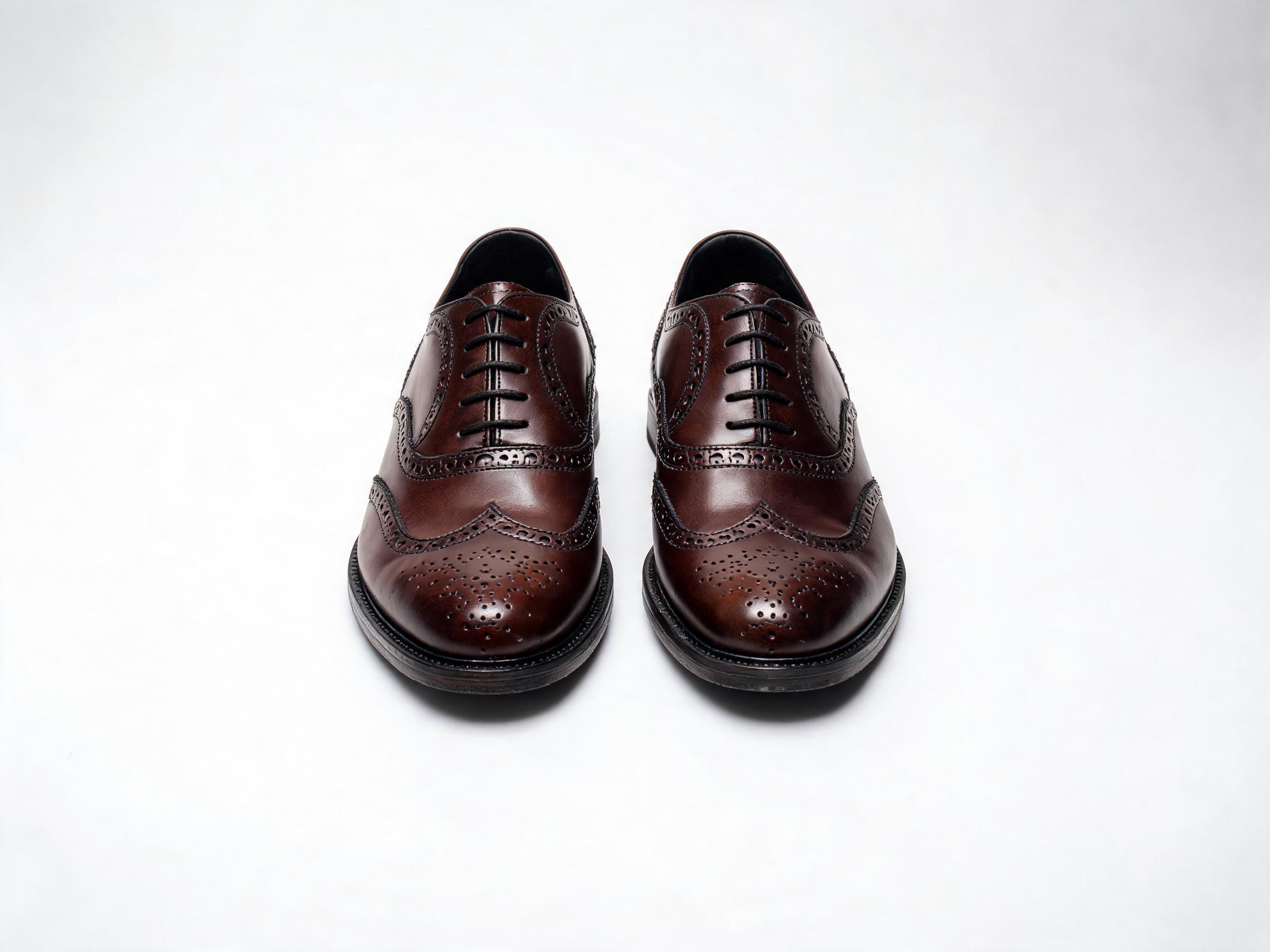
On a decorative style, perforation quality becomes a fast grade test. The Dark Brown Full Brogue Shoes use a burnished full-grain leather upper with full wingtip perforations and a decorative toe medallion, plus a leather lining, cushioned footbed, and stitched leather/rubber sole in EU sizes 39 through 45. When you review a brogue sample, check that the perforation holes are evenly spaced, cleanly punched, and consistent on both shoes. If the holes look torn or the line wanders, the same cutting or finishing weakness may appear in the bulk run.
Keeping bulk leather shoes consistent
A good sample proves what a factory can do once. Bulk consistency proves what it can repeat. That gap is where most wholesale leather shoes orders go wrong, and it is why the sample-to-bulk comparison matters more than the sample itself.
Matched-hide cutting for left and right pairs
Left and right shoes in a pair should be cut from hides that match in grain, tone, and stretch. Ask whether the factory cuts pairs in matched sets. If the two shoes in a sample pair show different grain or a noticeable colour difference in daylight, that will multiply across a bulk order.
Batch shade control
Leather varies from hide to hide, and a bulk run often draws from several batches. Ask how the factory controls shade across a single order. Good practice is to cut a single order from as few matched batches as possible and to sort finished shoes into shade groups before packing. Ask whether they do that, and ask to see the sorting step on your next visit or video review.
Sample-to-bulk comparison and staged inspection
The order should be checked against the approved sample at more than one point. A practical factory will run staged inspection rather than a single end-of-line look. At Aurevia Footwear, inspection runs across three stages: incoming material, in-line production, and finished-shoe checks, with inspection reports available on request and third-party inspection welcome. Those three stages each catch different problems.
| Inspection stage | What it catches | What the buyer should ask for |
|---|---|---|
| Incoming material | Wrong hide, wrong colour batch, weak or damaged panels | How incoming leather is checked against the approved swatch |
| In-line | Stitching faults, misaligned panels, perforation errors, bonding issues before assembly closes | Where in the line checks happen and what is rejected |
| Finished shoe | Shade drift, sole bonding, fit and finish, branding and packaging errors | Finished-shoe reports and whether third-party inspection is allowed |
Forefoot flex and bonding checks
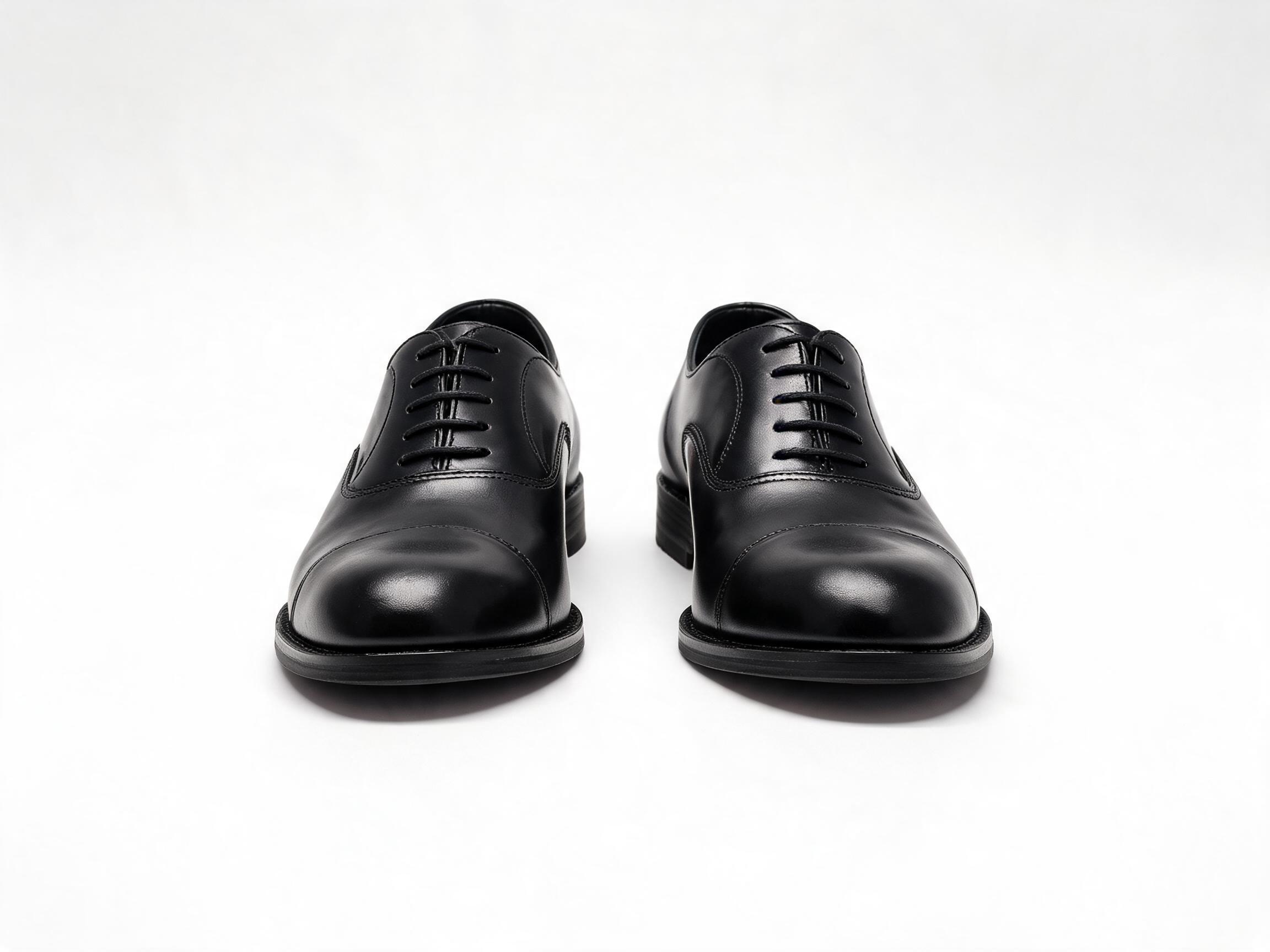
Two checks belong in every leather shoe inspection. First, flex the forefoot by hand and watch the sole and upper move together without gaps or creaking. On a stitched-and-cemented build like the Dark Brown Full Brogue, the bond should hold along the whole sole edge. Second, check the bond lines at the toe and heel for separation, and check the stitch row for skipped or doubled stitches. A Black Cap-Toe Oxford Shoes sample is a good place to test this, since the cap-toe panel has a clean stitched line and closed lacing that make misalignment obvious.
Evaluating supplier reliability
Reliability is mostly visible before the order. How a supplier handles sampling, paperwork, and questions tells you how they will handle a production problem.
Start with sampling discipline. Ask whether the sample you receive is the same construction that will be produced in bulk. Some factories sample one way and produce another. Ask what changes between sample and bulk: leather source, lining, sole, or assembly method. If the answer is vague, treat it as a risk to confirm before committing.
Then look at documentation. Ask for inspection reports from recent production and check whether they cover all three stages. Ask whether third-party inspection is accepted and whether the factory will share reports on request. A supplier that resists an independent inspector is telling you something important before any money moves.
Communication quality is the third signal. Send a technical question, a change request, and a packaging question in one message and see how the reply comes back. Clear, specific answers, especially about what the factory will not do, are a better sign than fast, vague enthusiasm. For a manufacturer and exporter like Aurevia Footwear (founded 2011, based in Quanzhou, China, with in-house design and pattern teams and OEM/ODM and private label support), those technical questions land with the people who actually run production, so the answer you get is a fair preview of the working relationship.
Where judgment depends on the supplier, keep it as a question to confirm: who cuts matched pairs, who signs off the shade sorting, who writes the inspection report, and who is your single point of contact after the deposit.
What to lock before placing the order
Most post-order disputes come from items that were left open. Close these before the purchase order is issued.
- Size grids for your target market. Confirm the size range and fit grading for each destination. Both published Aurevia men's styles run EU sizes 39 to 45, so confirm how that maps to the sizing your market expects, and approve a size set before production.
- Branding and packaging. Confirm logo application, label placement, box style, and packing format. Ask how branded items are checked against the approved artwork.
- Trade terms. Agree the delivery term that suits your logistics. Aurevia offers EXW, FOB, and CIF, so decide which one you are buying on and confirm what is included in each.
- Approved sample and reference swatch. Sign off the sample and keep a leather swatch on file as the bulk reference. Inspection is only meaningful against a fixed standard.
Once these four items are locked and the inspection stages are agreed in writing, the purchase order has something concrete to be checked against. That is what protects the shipment, not the promise made during the sales call.
If you are comparing genuine leather styles for an upcoming order, Aurevia Footwear can share product details, current specifications, and inspection documentation on request.