A practical OEM sampling walkthrough for chestnut-tone suede mini winter boots — material selection, Pantone dye consistency, small-order lead times, and the inspection points wholesale and private-label buyers in Europe, North America, and the Middle East should lock down before bulk production.
Chestnut-tone suede mini boots sit in a narrow band of the winter footwear market: short shaft, warm lining, a colour that has to look consistent across a whole run, and a buyer who needs to see a physical sample before committing to bulk. For wholesale and private-label buyers in Europe, North America, and the Middle East, the question is rarely "can this be made?" — it is "can it be sampled fast, matched to our colour, and then repeated at scale without drifting?" This guide walks through the OEM sampling workflow for chestnut-tone suede mini winter boots, using verifiable material and process facts, so you can brief a factory and read its response with confidence.
Key takeaways
- Sampling lead time and bulk lead time are separate commitments — confirm both before you approve a colour.
- Chestnut tone depends on matched hides and Pantone colour matching, not on a dye name alone.
- Approve zipper function and sole adhesion on the sample; these are exactly the points a three-stage inspection checks in production.
- Ask the factory to confirm MOQ per style, and to state trade terms (EXW / FOB / CIF) in the quotation.
What this guide covers
- Why chestnut-tone mini boots are a sampling-first category
- Material selection: leather, lining, and hardware
- Colour and dye consistency: matched hides and Pantone control
- The OEM sampling workflow, step by step
- Small-order lead times and how to read them
- Inspection points that decide approval
- FAQ for wholesale and private-label buyers
Why chestnut-tone mini boots are a sampling-first category
A chestnut tone is one of the harder colours to buy blind. It is a warm mid-brown that reads differently under retail lighting, daylight, and phone cameras, and it sits close to neighbouring browns — tan, cognac, dark brown — that buyers also stock. If your sample and your bulk run do not sit on the same reference, the mismatch shows up as a colourway that looks like a different SKU next to last season's stock.
The mini-boot silhouette adds a second constraint: shaft height. With roughly a 12 cm shaft, there is very little material on the boot, so any irregularity in the upper — grain variation, visible dye patchiness, uneven edge finishing — is magnified rather than hidden. That is why this category rewards buyers who treat sampling as the real decision point, not a formality.
Material selection: leather, lining, and hardware
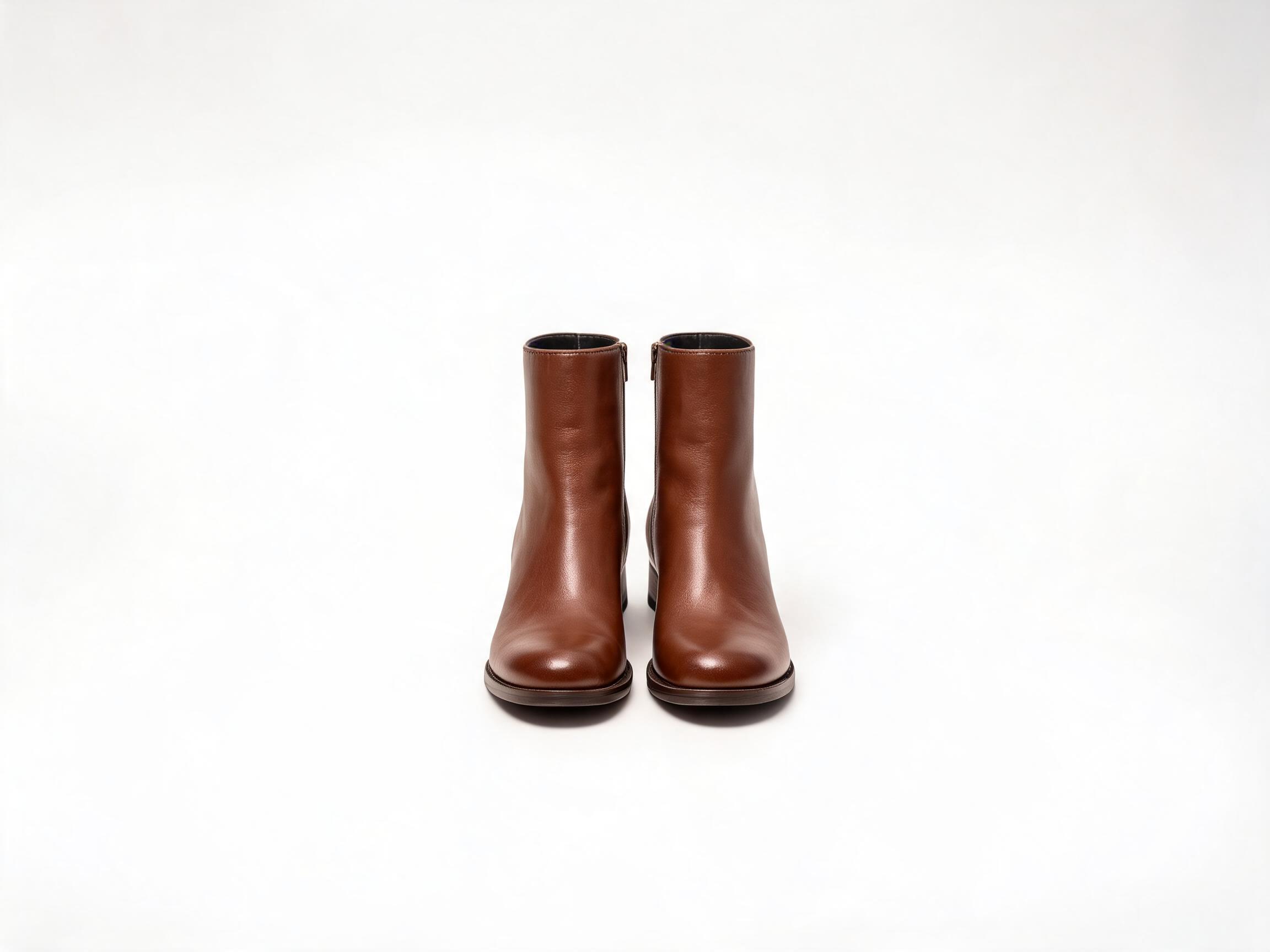
Start from the upper. The reference build for a chestnut-tone suede-effect mini boot draws on full-grain leather as the upper material, with matched hides selected so the panels on one pair come from comparable parts of the hide. Matched hides matter more on a mini boot than on a tall boot, because the toe, vamp, and shaft sit next to each other and any tonal jump is immediately visible.
Inside, the boot is built with a warm lining and a cushioned insole. For a winter style, the lining is the part buyers most often want to discuss — thickness, feel, and how it behaves at the collar. Treat lining specification as something to confirm on the sample rather than assume from a phrase.
Hardware and structure:
- Side zipper — gives the mini boot an easy entry point, and it is also the component most likely to fail a wearer's test first.
- Anti-slip rubber outsole — the base of a winter boot; on the sample, check the bond line at the toe and heel.
- Hand-burnished edges — a finishing step that affects how the chestnut tone reads at the collar and seams.
- Sizing EU 35–41 — the available range to plan your size curve around.
For the base product these facts are drawn from, see the brown leather ankle boots reference page, which lists the same upper, lining, zipper, and outsole construction in a colourway close to what chestnut buyers typically request.
Colour and dye consistency: matched hides and Pantone control
Chestnut is not one colour — it is a range, and the job of an OEM sample is to fix exactly where in that range your line sits. The practical mechanism is Pantone colour matching: you supply a Pantone reference, the factory matches to it, and the approved sample becomes the physical standard for the run.
Three things decide whether that standard holds:
- Hide selection at the cutting stage. Matched hides reduce the chance that two panels on the same boot pull in different directions tonally.
- Dye and finish consistency. The upper, the collar, and the edge finish all have to land on the same reference; hand-burnished edges in particular can read darker, so the sample should be checked edge-to-panel.
- A retained reference sample. Keep the approved sample sealed and labelled, and ask the factory to do the same. It is the only fair way to settle a colour question later.
Because chestnut sits close to the brown, black, and tan colour options available on the base build, it is worth confirming whether your chestnut reference is a genuine custom match or a near variant of an existing colourway. That single question affects both sampling time and how repeatable the colour is across seasons.
The OEM sampling workflow, step by step
A workable sequence for chestnut-tone suede mini boots looks like this:
| Stage | What you provide / approve | What the factory does |
|---|---|---|
| Brief | Pantone reference, size curve (EU 35–41), zipper and lining expectations | Confirms material availability and feasibility for the mini silhouette |
| Sampling | Approval of colour, shaft proportions, and trim | Produces the sample; typical sample lead time 7–12 days |
| Sample review | Fit, colour under your own lighting, zipper function, sole bond | Adjusts the pattern, colour, or finish as needed |
| Bulk confirmation | Signed colour and construction standard, branded logo/packaging (OEM/ODM) | Produces the order; typical lead time 30–40 days after order confirmation |
OEM and ODM support here covers logo and packaging, which is usually where private-label buyers add the most value — the boot itself is stable, but the box, tissue, and label decide how the SKU presents on shelf or on a marketplace listing.
Small-order lead times and how to read them
Two numbers matter, and they should never be blended into one:
- Sample lead time: 7–12 days. This is the clock on your colour and fit decision.
- Bulk lead time: 30–40 days after order confirmation. The clock starts once the order and the approved standard are confirmed — not when you first inquire.
Between those two, the variable is colour. A chestnut match built from matched hides and an existing dye palette moves faster than a fully custom dye lot. If your calendar is tight, ask the factory early which chestnut references it can hit without a new dye run — that answer usually determines whether a small-order window is realistic.
MOQ is set per style rather than as one blanket figure, so ask the factory to confirm MOQ per style before you finalise quantities. Trade terms are typically quoted EXW, FOB, or CIF, so state your preferred basis up front — it changes the landed comparison between two otherwise similar quotes.
Inspection points that decide approval
The base construction is checked by a three-stage inspection that includes zipper function and sole adhesion — the two failure points most likely to generate returns on a winter boot. When you review the sample, run the same two checks yourself:
- Zip the boot fully open and closed several times; feel for snagging at the collar and any shift in the tape alignment.
- Flex the boot at the ball and press along the toe and heel bond line; a clean bond should not lift or show a visible gap.
- Compare the sample against your Pantone reference at the toe, vamp, shaft, and burnished edge — all four, not just the vamp.
If any of these need rework, that is a sampling conversation, not a production conversation. Approving a sample you have doubts about simply moves the risk downstream into the bulk run.
FAQ for wholesale and private-label buyers
Can chestnut-tone suede mini boots be produced as OEM with our logo and packaging?
Yes — OEM/ODM support covers logo and packaging on the base construction. Confirm the specific logo method and packaging format with the factory when you brief them.
How long does a chestnut sample take?
Typical sample lead time is 7–12 days. Custom dye matching may extend this; ask the factory to confirm against your specific Pantone reference.
What is the bulk lead time after we place the order?
Typical bulk lead time is 30–40 days after order confirmation. Confirm the start point in writing, since it depends on order confirmation and the approved sample standard.
What sizes are available?
The available range is EU 35–41. Build your size curve before sampling so the factory can cut to it.
What are the trade terms?
Quotes are typically offered as EXW, FOB, or CIF. State your preference when you request a quotation so the comparison is like-for-like.
Is there a MOQ?
MOQ is set per style. Confirm MOQ with the factory per style before finalising your order quantities.
Next step
If you are planning a chestnut-tone mini winter boot for Europe, North America, or the Middle East, the fastest path is to send three things at once: your Pantone reference, your size curve (EU 35–41), and your required trade term. That package lets the factory quote sampling time accurately and flag any colour constraint before you invest in a full brief. Start with the brown leather ankle boots specification as your reference build, then ask for the chestnut variant as a custom OEM sample.