
A practical guide for importers, wholesalers and retail-chain buyers on reading leather grade terminology in supplier quotations, weighing sole construction tradeoffs for bulk programs, and structuring a repeatable leather sandal range with core styles, seasonal additions and a disciplined colour strategy.
Three questions decide whether a leather sandal programme holds together: what the quotation actually means when it says a certain leather grade, how the sole is put together and what that costs you in weight, flexibility and money, and whether the range you are buying is a repeatable base with seasonal additions or just a pile of one-off styles. This guide works through all three from a buyer's side of the table, with the checkpoints that matter before you commit to bulk.
Why leather grade wording is the first thing to pin down
Leather terminology is one of the most loosely used parts of a sandal quotation. Two suppliers can both write "leather upper" and mean very different materials, and neither is necessarily being misleading — the words simply are not standardised across the industry. Before comparing prices, you need to know which grade the quotation is describing and what that grade implies for the straps, the lining and the footbed.
The four terms below are general trade vocabulary, not a ranking, and not a certification. They describe how much of the original hide surface is retained and how the material is processed. Ask your supplier explicitly which one applies to each component; do not assume that "genuine leather" means the same thing in every factory.
| Quotation term | What it generally describes | What to confirm with the supplier |
|---|---|---|
| Full-grain | The outer surface of the hide is left intact; no sanding of the grain. Usually the most expensive option and shows natural markings. | Whether the straps and footbed are both full-grain, or only the straps. Hide yield matters: full-grain panels waste more hide. |
| Top-grain | The outer surface is lightly sanded and often finished or embossed to remove natural variation. More uniform appearance than full-grain. | Whether finishing is pigment, aniline or a corrected spray; this affects how the colour behaves at the buckle fold lines. |
| Genuine leather | A broad term covering many split and reconstituted leathers. It says the material contains real leather, but says nothing about which layer of the hide. | Which layer is used, and whether the straps and lining use the same material or differ. Ask for a material description per component. |
| Split / bonded | Split leather is the lower layer of the hide; bonded leather is reconstituted from leather fibres with a binder, then rolled into sheets. | How it wears at the edges and flex points, and whether it is acceptable for the strap or only for hidden reinforcement. |
A quotation that lists only "leather" for the whole sandal is incomplete for purchasing purposes. The strap, the lining and the footbed are subjected to different stresses: the strap takes all the flex and the buckle abrasion, the lining sits against skin for hours, and the footbed carries full body weight plus foot arch pressure. These are separate specification lines and should be quoted as separate lines.
How grade affects the components of a sandal
- Straps and buckle tabs: the leather has to survive repeated flexing at the buckle. Ask whether the strap is one continuous panel or joined pieces, because a join near the buckle is a fatigue point.
- Lining: a soft leather lining is comfortable, but the lining grade is sometimes downgraded to save cost in a quotation. If the buyer specifies a lining quality, write it into the purchase order, not just the email thread.
- Footbed: a cushioned leather footbed with arch-support contour is a structural component, not trim. If the footbed is quoted as a lower grade, the sandal may look the same on a shelf but feel different after a month of wear.
- Matched hides: for a finished pair, the left and right sandals should share grain direction and shade. Ask the supplier how they sort hides across a pair — this is a real operational step, not a marketing phrase.
When you request a quotation, put the grade question in writing and ask for a per-component breakdown. This gives you a document you can actually compare across suppliers, and it becomes the reference point if a production batch differs from the approved sample.
Sole construction: what buyers are choosing between
The sole is usually where the largest material and labour cost differences sit, and it is also where the end-customer's perception of the sandal is formed. Weight, flexibility, grip and how the outsole is attached to the upper all matter in bulk, and none of them can be judged from a product photo.
Attachment method
Sandals are typically assembled with stitched construction, cemented construction, or a combination of both. A stitched-and-cemented construction — where the upper is stitched and then cemented to the sole unit — is a common way to increase the bond's reliability while keeping the sandal flexible. In a wholesale programme, ask the supplier to describe the exact method used for your model, and ask how sole adhesion is checked in production. A sole that separates at the toe is one of the most expensive failure modes for a retailer, because it is visible and it returns.
Sole material and weight
Rubber outsoles are widely used for grip, but rubber density and tread pattern change both weight and flexibility. A lightweight rubber anti-slip outsole keeps the sandal comfortable for casual wear, but the tradeoff is that very lightweight formulas can be less abrasion-resistant over a long season. There is no universal right answer — the question is what your customer does in the sandal. A resort sandal worn indoors and at the pool has a different requirement from a sandal expected to handle city walking.
Where the cost actually moves
- Hide yield and grading: higher grades with visible grain require more hide per sandal and more skilled cutting. This is often a bigger cost driver than the sole itself.
- Sole attachment: adding a stitching operation increases labour content, particularly on a strap sandal where access is limited.
- Footbed build: a contoured cushioned footbed with arch support involves a shaped component and more assembly steps than a flat insole.
- Colour runs: custom colours add a colour-matching and small-run cost, which is why colour strategy is a range question, not a single-style question.
- Hardware: buckle corrosion resistance checking is part of a responsible specification for metal hardware, and it needs to be asked for, not assumed.
Heel height and wearability
Heel height in a casual sandal is usually kept low for stability. A flat heel of approximately 2 cm is a common choice because it keeps the foot close to the ground and works with both the arch-support contour and the natural flex of the forefoot. If your market demands a higher platform, that becomes a different construction problem — the sole unit, footbed shaping and balance all change — so treat it as a separate development request rather than a modification to an existing model.
Building a bulk range instead of buying one style
Most first-time buyers start with a single style and then wonder why reorders are unpredictable. A leather sandal range works better when it is designed as a small system: one or two core repeat styles that customers can rely on, a limited set of seasonal additions, and a colour strategy that gives you breadth without fragmenting your stock.
Core repeat styles
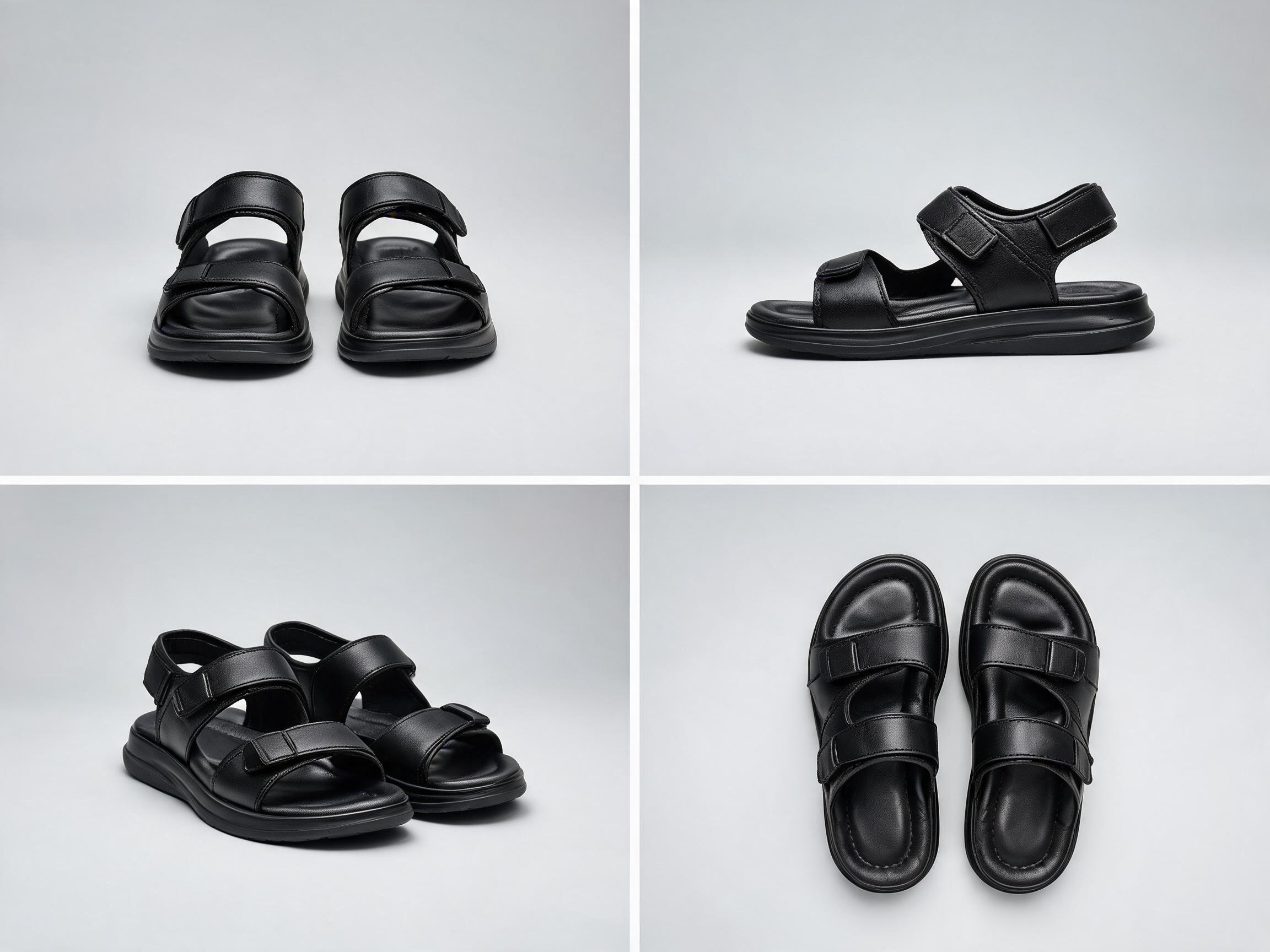
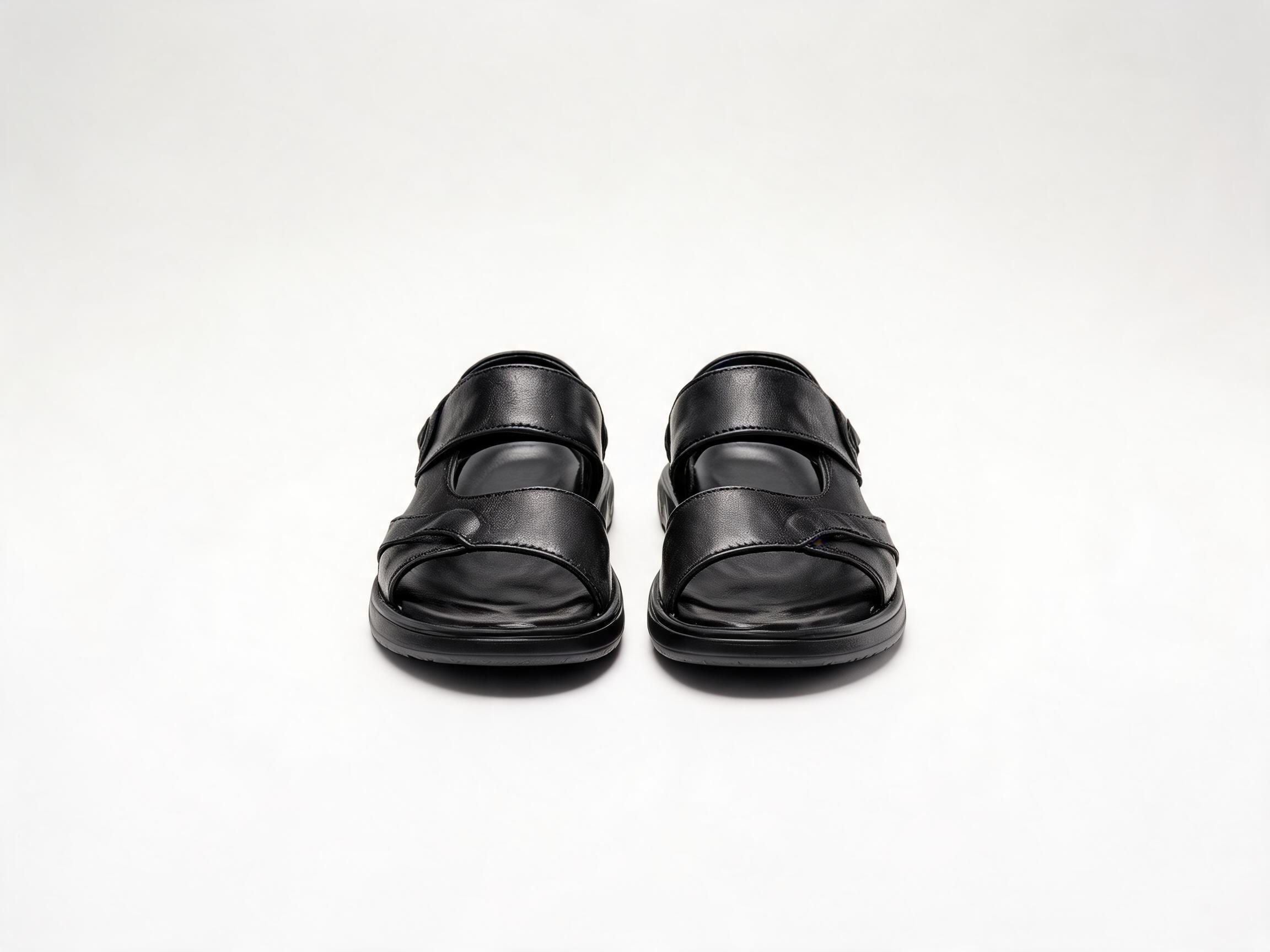
The core is the part of the range that carries the programme. It should be a style that is simple enough to produce consistently, comfortable enough to earn repeat purchase, and specifiable in writing without ambiguity. A men's open-toe sandal in smooth black leather with genuine leather straps, adjustable buckle closures across the instep and ankle, soft leather lining, and a cushioned leather footbed with arch-support contour is a representative example of a core casual style: the construction is straightforward, the buckles give fit adjustability across a range of foot widths, and the design does not depend on a trend to sell. See the Black Leather Casual Sandals product page for the full specification of this style, including EU sizes 39–45 and US 6.5–12 with US/UK conversions on request.
The value of a core style is not that it is exciting. It is that it can be reordered, inspected against the same reference sample, and sold into a known customer base. When a core style works, adding a second colour is a far cheaper way to grow sales than developing a new model.
What to check in a core style
Before a style becomes a repeat order, it needs to be documented. The four-angle collage earlier in this guide shows the views that should be captured for the reference file — front, side, buckle detail and footbed — because different production risks show up from different angles. The strap alignment and buckle setting read from the front; the sole profile and heel height read from the side; the buckle and hardware read in close-up; the lining, footbed contour and stitching read from above.
Alongside the visuals, the reference file should record the inspection points you expect in production. For a sandal programme, useful checks include incoming material inspection, in-line inspection and finished-shoe inspection, with specific tests such as forefoot flex testing, colour fastness, buckle strength and sole adhesion. For the black leather casual sandal, these three inspection stages — incoming material, in-line and finished-shoe — are part of the documented process, and third-party inspection is welcome. If your own compliance team requires a third party, raise it during development rather than after the order is placed, because it affects scheduling.
Seasonal additions
Seasonal additions are where you respond to the market without disturbing the core. Keep them few. A practical pattern is one open-toe variation for warm weather and one closed or strappier variation for transitional seasons, each built on the same last and the same footbed as the core so that sizing and fit feedback remain comparable. If a seasonal style requires a new last, a new sole unit and a new footbed, it is effectively a new programme, and it should be budgeted as one.
Colour strategy
Colour is the cheapest way to multiply a range, and the easiest way to create unsellable stock. A workable approach is a permanent base of black, brown and tan — the three colours that sell across men's casual footwear without trend risk — plus a small number of custom colours for specific accounts or seasons. Where a retail partner needs a brand colour, Pantone colour matching is offered, and it is worth using Pantone references rather than verbal colour names in the purchase order. "Tan" means one thing to a buyer in Germany and another to a factory cutting hides; a Pantone number does not.
Two practical rules keep custom colours from becoming dead stock. First, only run a custom colour on a core style, so the tooling and patterns are already validated. Second, define which components carry the colour — strap, lining and footbed can each be specified separately, and a coloured strap with a natural footbed often reads as a more considered product than a fully monochrome one.
Putting the brief together
When you send a development brief, separate it into three parts: the leather specification per component, the sole construction and attachment method, and the range structure with colour references. Ask for quotations on that basis, not on a single line that says "leather sandal".
Some items will always be programme-specific. Confirm MOQ and lead time with the supplier for your program, since these depend on your colour mix, the component specification and the supplier's current schedule. If you are consolidating a range across multiple accounts, it is worth asking how the supplier handles colour runs and whether it can support the US/UK size conversions your retail partners need.
A leather sandal programme does not succeed because the product is impressive in a catalogue. It succeeds because the grade, the sole and the range structure are all documented clearly enough that the second order matches the first. That documentation is what you are really buying when you place a bulk order — the product is just the output.