
A buyer's guide to building a Mary Jane range for wholesale: how strap and buckle hardware affect price and fit, how to mix heel heights across a collection, where Mary Janes sit in a women's line, and how to structure an opening order without overcommitting.
Wholesale Range Planning
Building a Mary Jane offer is less about picking one good shoe and more about covering a set of decisions customers keep making: how the strap fastens, how high the heel sits, and how many variants are worth stocking. Below is how those three decisions interact, and how to lay out an opening order that can be expanded once sell-through tells you which direction is working.
In this guide
- What Mary Janes actually decide at the buying stage
- Strap and buckle hardware: the choice that sets the price block
- Mixing heel heights across a collection
- Fitting Mary Janes into a women's line
- Structuring the order
- Size runs and fit notes
- Supplier questions worth asking early
What Mary Janes actually decide at the buying stage
The strap is the defining element, and it is also the most sensitive part of the shoe for returns. A customer who finds the instep too tight or the buckle awkward will bring the pair back to the boutique, not to you, but the margin loss still reaches your account. So the buying decision is narrower than "which Mary Jane looks best": it is which closure system you can commit to across sizes, and which heel heights let the same customer buy two pairs instead of one.
For a boutique buyer, the practical framing is a small matrix: closure type on one axis, heel height on the other, with a single entry per cell in the first season. That keeps the range readable on shelf and gives you a clean read on demand before you widen it.
Strap and buckle hardware: the choice that sets the price block
Mary Jane straps run from a plain fixed bar to an adjustable buckle with a metal keeper. The hardware is visible, it is what customers touch first, and it is where most of the per-pair cost difference sits.
| Strap type | What it does for the customer | Buying consideration |
|---|---|---|
| Fixed single strap (stitched or elastic) | Slip-on entry, no fiddling | Cheapest tier; fit depends entirely on the last, so size grading matters more |
| Adjustable buckle strap | Customer sets the instep tension | The broadest fit tolerance; buckle and keeper quality become visible touchpoints |
| Double or cross strap | Stronger visual signature | Reads as a fashion statement; harder to carry across a full size run |
On hardware, three details decide whether a Mary Jane feels worth its shelf price: buckle thickness and edge finish, the keeper width relative to the strap, and the punched hole spacing. Closely spaced holes give a finer fit adjustment; too few holes and a customer either punches her own or returns the pair. Ask for a physical sample of the buckle rather than judging from a photo, and check it against the strap width it is meant to hold.
Strap material and its interaction with the upper
A strap cut from the same leather as the upper reads as coherent and keeps the colour consistent. A contrast strap is a merchandising decision, not a durability one, but note that a firmer strap material will resist stretch over time while a softer one moulds to the instep faster. Whichever you choose, the strap should be specified alongside the upper in the tech pack, because switching one later changes the cutting plan and the sampling timeline.
Key takeaways
- Start with one adjustable-buckle style as the fit anchor of the range, then add a fixed-strap version at a lower price point.
- Judge hardware from a physical sample: buckle thickness, keeper width, hole spacing.
- Keep the strap and upper specified together so late changes do not reset sampling.
- Spread heel heights rather than duplicating one height in several uppers.
Mixing heel heights across a collection
A Mary Jane collection usually works best when it moves from a true flat upward in steps customers recognise. Two or three heel heights are enough to cover everyday wear, workwear and occasion, and each step should be visible to the customer from a metre away.
| Band | Typical role in the range | Merchandising note |
|---|---|---|
| Flat (around 1–1.5 cm) | Volume driver, everyday and commuting | Carry the widest size run here; this is usually the reorder style |
| Low block or stacked heel | Bridge style, works with tailoring | Where you can justify a slightly higher price without a new customer |
| Mid to high heel | Event and evening, tighter size run | Smaller buy, stronger colour direction, less depth per size |
There is a fit reason to spread heights rather than stacking them: the last geometry that supports a flat is not the same as the one that holds a higher heel, so each height band needs its own confirmation on a fit model. Ordering across bands is also what lets a customer who already owns your flat come back for the heel version.
A flat that anchors the range
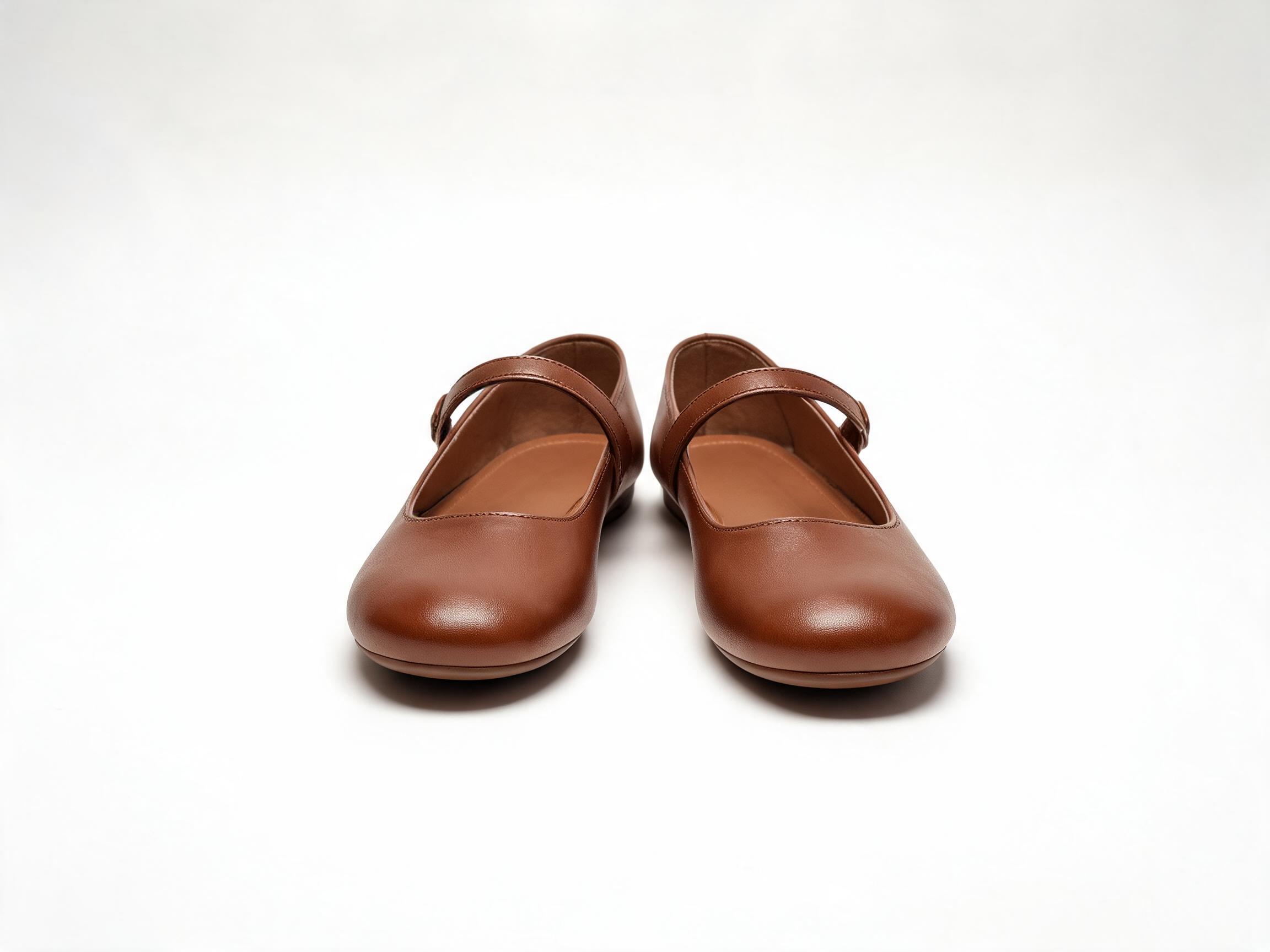
One workable starting point is a true flat with an adjustable buckle strap and a heel of about 1.5 cm, which keeps the shoe in the everyday band while still giving the customer fit adjustment at the instep. The Brown Mary Jane Flats are built this way and run in EU sizes 35–41, which covers the core women's size run most boutiques sell through first. Using a single flat like this as the anchor, then adding a low block and one heeled version, gives a coherent three-tier story rather than three unrelated shoes.
Fitting Mary Janes into a women's line
Mary Janes rarely carry a boutique on their own; they work as the quiet volume piece next to boots, sneakers and sandals. Two placement rules help.
- Colour continuity. If your existing line leans on black, tan and one seasonal accent, place the Mary Jane in the same palette. A Mary Jane in a colour your customer already buys is an easier add-on than a new colour introduced on an unproven silhouette.
- Price ladder. Slot the fixed-strap flat at or just below your entry price, the buckle flat at your core price, and the heeled version above it. That way the Mary Jane range widens your ladder instead of competing with an existing style at the same price.
Crossover with school and uniform business is worth noting if you sell in those markets: a plain, low, buckle-fastened Mary Jane serves both the uniform customer and the adult fashion customer, which raises the value of depth per size in the flat band. If that is not your market, keep the styling clearly adult and skip the uniform positioning entirely.
Structuring the order
Minimum order quantities vary by style, material and hardware, so confirm the current minimums with the supplier's sales team before you build the buy — do not plan around a number you have not been given in writing. What you can control is the shape of the order.
- Anchor styles first. Commit depth to one or two styles you expect to reorder, and place the more directional styles as shallow buys.
- Colour before silhouette. In a first order, more colours on a proven silhouette usually outperforms more silhouettes in one colour.
- Keep size curves realistic. A flat in EU 35–41 needs a fuller curve than a heeled style, where the extremes can be thinner.
- Sample before you scale. Approve buckle, strap tension and heel height on a physical sample in at least two sizes before the production order is fixed.
- Plan the reorder window. Ask how long a repeat order takes once the style is approved, so the first buy is sized to bridge that gap.
Size runs and fit notes
Mary Janes expose grading problems faster than slip-on styles, because the strap crosses the instep at a fixed point on the last. If the strap is not regraded with the upper, one end of the size run will feel tight and the other loose. When you review samples, check the strap on the smallest and largest sizes in the run, not just the middle. Hole count and spacing on the buckle strap should also be consistent across sizes, otherwise customers at the extremes lose adjustment range.
Supplier context. Aurevia Footwear Co., Ltd., founded in 2011 and based in Quanzhou, China, employs around 260 staff and exports to Europe, North America and the Middle East. The company runs in-house design and sampling, offers OEM/ODM and private label production, and applies three-stage quality control across production.
These capabilities matter at the sampling stage described above: in-house sampling means strap, buckle and heel changes can be worked through before a production order is placed.
Supplier questions worth asking early
- Which buckle and keeper are specified, and can I see them as physical samples?
- Is the strap regraded with the upper, or cut from one pattern across sizes?
- What is the actual measured heel height, and is it consistent across colourways?
- Can the same last be used across the flat and low-heel styles to simplify sizing?
- What are the current minimums and lead times for repeat orders on an approved style?
FAQ
How many Mary Jane styles should a first wholesale order include?
Two or three styles is usually enough to test a range: one adjustable-buckle flat as the fit anchor, one lower-price fixed-strap option, and one heeled style. More than that in a first order spreads depth too thinly to read sell-through.
Is an adjustable buckle worth the extra cost over a fixed strap?
It widens the range of insteps the shoe fits, which reduces returns and lets a single style serve more customers. If your customer base has an uncertain fit profile, it is usually the safer choice for the core style.
What heel heights should a Mary Jane range cover?
A flat around 1–1.5 cm, a low block, and one mid or high heel covers everyday, bridge and occasion wear. Each height band should be confirmed on a fit model separately.
Can I private label a Mary Jane style?
Aurevia Footwear offers OEM/ODM and private label production, with in-house design and sampling. Confirm labelling, packaging and minimums directly with the sales team for the specific style.
Next step. Take the strap and heel decisions to samples before fixing the buy. Ask Aurevia Footwear's sales team for current minimums, lead times and sampling timelines on the styles you are considering, and specify buckle, strap material and heel height in writing so the sample you approve is the sample that goes into production.