
A practical sourcing guide for B2B buyers building a wholesale booties assortment: how shaft height changes the wearer it serves, how to mix heel types without duplicating SKUs, and how to sequence autumn order windows and restock decisions using style-level specifications.
Autumn booties are rarely a single-style buy. Buyers who plan a wholesale booties assortment for a full season are deciding three things at once: how tall the shaft should be, which heel constructions earn shelf space, and when each decision has to be locked so production and shipping land inside the selling window. This article breaks down those decisions by style specification.
Key takeaways
- Shaft height defines the wearer and the outfit more than any other bootie attribute; ankle-height and mid-shaft styles serve different customers.
- A heel mix built on block, stacked and low-profile constructions covers more price and use cases than a single heel direction.
- Autumn order windows are set by when the retail floor needs goods, not by when the buyer starts talking to suppliers.
- Restock planning should be triggered by sell-through on size runs, not by calendar alone.
Shaft Height: The First Assortment Decision
Shaft height is measured from the top of the heel to the top of the boot shaft, so the same heel changes the effective look. For wholesale booties, the practical split is between ankle-height styles that sit just above the ankle bone and taller mid-shaft styles that reach partway up the calf. Each serves a different capsule.
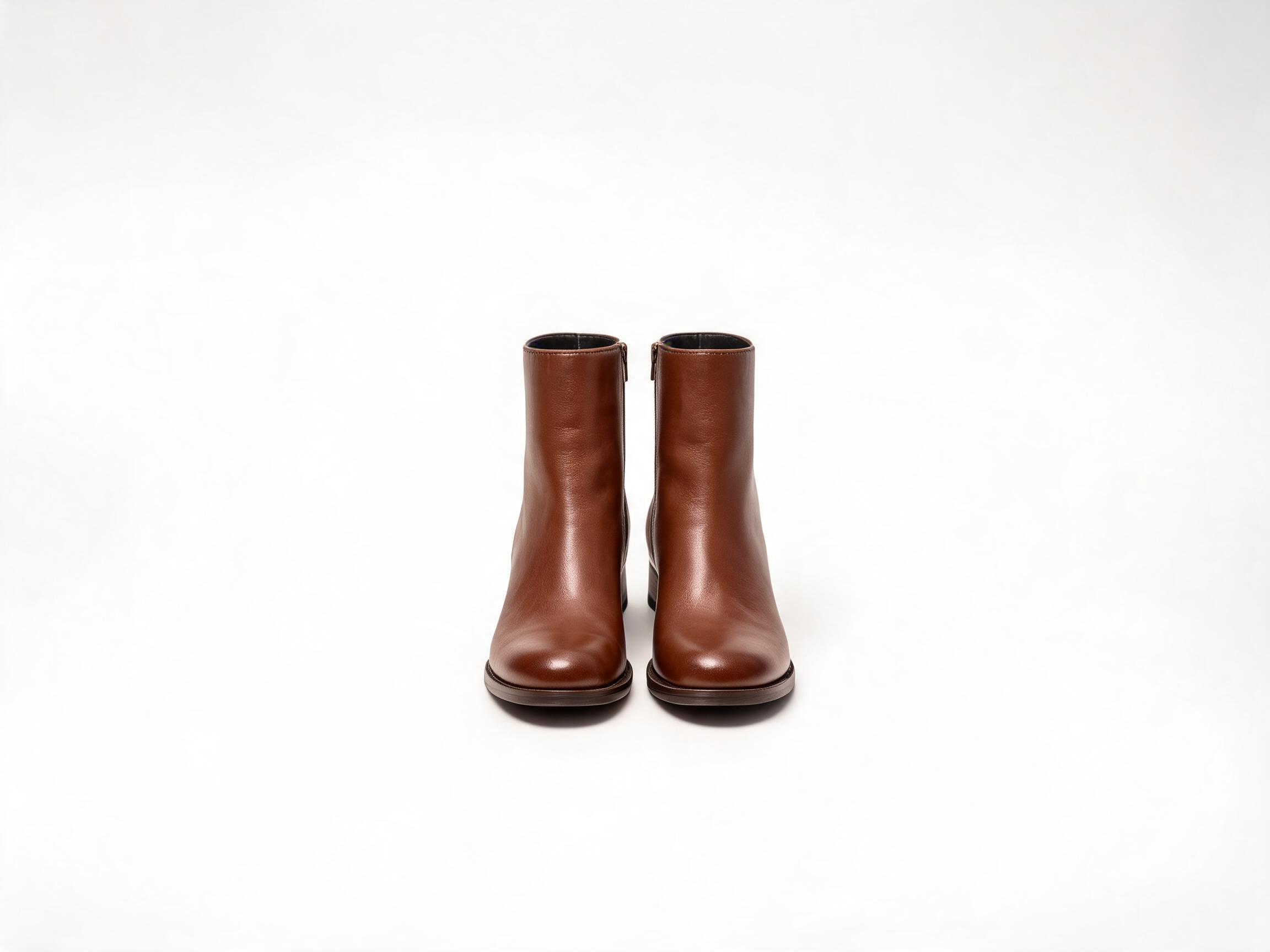
Ankle-height booties suit the widest range of bottoms: straight-leg and cropped trousers, midi skirts, and dresses. They are the safer volume driver for a first autumn program because sizing risk is lower and the silhouette pairs with almost everything in a transitional wardrobe. A representative spec from our line is the Brown Leather Ankle Boots, with a shaft height of about 12cm, a side zipper, and a block heel of about 6cm, offered in EU sizes 35–41.
Taller shafts change the customer. A style that reaches the calf reads as a statement piece and pairs best with skirts, dresses, and slim trousers. For contrast, our Black Leather Knee-High Boots use a shaft height of about 38cm with an inner zipper, also in EU sizes 35–41. That height is a different product category from an ankle bootie, but it shows how much the shaft measurement moves the wearer and the price architecture.
In an assortment plan, treat shaft height as a tier rather than a detail. A common structure is:
- Ankle-height (roughly 10–14cm shaft): the volume core; multiple colors, one or two heel directions.
- Mid-shaft (roughly 15–25cm): the fashion layer; fewer SKUs, stronger color and hardware stories.
- Tall and knee-high (roughly 35cm and above): often a separate program or a hero style, with its own fit and sizing considerations.
Who Each Shaft Height Suits
Matching shaft height to customer profile is more useful than matching it to trend alone.
| Shaft tier | Typical wearer | Best paired with | Assortment role |
|---|---|---|---|
| Ankle-height (~10–14cm) | Commuter and everyday customer; broad age range | Trousers, jeans, midi skirts | Volume driver, repeat color buys |
| Mid-shaft (~15–25cm) | Fashion-forward customer buying a seasonal look | Dresses, skirts, slim trousers | Trend and margin layer |
| Tall / knee-high (~35cm+) | Customer buying a statement or cold-weather piece | Skirts, dresses, over skinny trousers | Hero style, limited size depth |
The table is a planning aid, not a rule. What matters is that each tier in the buy has a named customer and a stated reason to exist, so the range does not end up with three ankle boots that compete for the same sale.
Heel Options: Build a Mix, Not a Collection
Heel type drives perceived occasion and price. For wholesale booties, most assortments can be covered with three constructions:
- Block heel: the workhorse. Stable underfoot, easy to walk in, and the most forgiving for a broad size run. Our Brown Leather Ankle Boots use a block heel of about 6cm, a height that reads dressy enough for workwear without becoming an evening shoe.
- Stacked or low-profile heel: the everyday and casual option. Lower heel heights widen the age range and suit denim-led capsules.
- Statement heel (sculpted, flared, or higher block): the fashion accent. Keep depth shallow and use it to anchor the mid-shaft or hero styles.
Two rules keep a heel mix from bloating the buy. First, do not run every shaft tier in every heel; assign a dominant heel to each tier and let one accent style break the pattern. Second, check that heel height and shaft height work together — a tall shaft on a very high heel changes the fit and the walk, and that combination should be sampled and wear-tested before it goes into a volume program.
Autumn Order Windows: Work Back from the Floor
The order window is set by the date goods must be on the retail floor, minus shipping, minus production, minus sampling and approval. Buyers who start with the supplier's production calendar usually end up compressing the wrong stage.
A practical sequence for an autumn program:
- Assortment lock: confirm shaft tiers, heel mix, color card, and size run before sampling begins. Changes after this point multiply across every SKU.
- Sampling and approval: fit, last, and material confirmation. This is where shaft height and heel height are validated together.
- Bulk production slot: booked against the approved sample, not against the inquiry date.
- Shipping and customs: sea freight for volume, air for late or test quantities.
- Floor date: the fixed point everything else counts back from.
Because the floor date is fixed, the real lever is how early the assortment is locked. A buyer who confirms specifications early can hold a later production slot; a buyer who keeps changing colors and heel heights will lose that flexibility regardless of the supplier.
Restock Planning for Booties
Booties are a seasonal category, so restock logic differs from year-round basics. Three triggers are worth building into the plan:
- Size-run sell-through: watch which sizes clear first. A broken size run early in the season is the signal to reorder the core ankle-height styles, not the fashion layer.
- Color velocity: dark neutrals typically carry the repeat buy; fashion colors should be planned as one-shot depth.
- Remaining selling weeks: a restock that lands after the cold-weather peak has limited value. Set the last useful arrival date before the season starts and treat it as a hard cutoff.
Keep restock candidates to styles that were sampled and approved in the original program. Reordering an approved style is faster and lower-risk than introducing a new shaft or heel combination mid-season.
Supplier Capability Behind the Assortment
Aurevia Footwear Co., Ltd. was founded in 2011 in Quanzhou, China, and employs around 260 staff. The company exports to Europe, North America, and the Middle East, and runs in-house design and sampling with OEM/ODM support. Quality control is handled in three stages across production. For buyers building a booties program, that in-house sampling matters most at the shaft-and-heel validation step, where fit and proportion are decided before bulk.
FAQ
What shaft height counts as a bootie?
There is no single industry cutoff, but in wholesale planning, styles with a shaft of roughly 10–14cm are treated as ankle booties, while taller shafts move into mid-calf or knee-high categories.
How many heel types should an autumn booties buy include?
Most ranges can be covered with a block heel as the core, a lower stacked heel for casual volume, and one statement heel as an accent. Assigning one dominant heel per shaft tier prevents overlap.
When should autumn booties be ordered?
Count back from the required floor date through shipping, production, and sampling. The earlier the assortment and specifications are locked, the more flexibility remains for production and freight.
Can ankle booties and knee-high boots share a size run?
They can share a size range, as both example styles here run EU 35–41, but fit must be validated separately because shaft height and closure change how the boot sits on the leg.
For buyers comparing shaft heights and heel options for an autumn program, the next step is to confirm the target floor date and the shaft tiers you need, then request samples against those specifications.