
A practical launch guide for buyers who have already chosen private label heels and now need to get branded product to shelf: where your logo can actually appear, how private-label boxes and hangtags are specified, how to build a retail presentation that survives real store conditions, and how to plan a seasonal launch cadence with replenishment that keeps core styles in stock.
You have already decided the business case works: a private label heel line under your own brand, produced by a wholesale heels shoes partner, priced and positioned for your market. What is left is execution. Getting a heel program onto shelf means deciding where your logo physically appears, how the product reads on a shelf next to competing labels, and how you will keep the line in stock across a selling season without over-committing on the first order.
This guide covers those three areas: branding and packaging, retail presentation, and seasonal launch and replenishment planning. It assumes your sourcing is settled and focuses on the steps that turn a confirmed heel specification into a launch.
Key takeaways
- Branding on heels is limited to insole, box and hangtag — decide early which of the three carries your identity.
- Private-label boxes and hangtags are standard requests at specialist heel factories; Pantone color matching and insole branding are the customization points most buyers use first.
- Shelf presentation depends on heel height mix, color story and consistent sizing (EU 34-41), not on decoration.
- Build the launch around a core block of styles with a defined reorder cadence, not a single large opening order.
On this page
Where your brand can actually appear on the shoe
On a women's heel, the visible branding surface is small. The upper is the product itself; the insole, the box and the hangtag are the three places that carry a private label without interfering with the design. Aurevia Footwear Co., Ltd., a B2B manufacturer and exporter based in Quanzhou and founded in 2011, runs OEM and ODM programs with the logo placed on insole, box and hangtag — the same three surfaces buyers usually request first.
What this means in practice is a short decision list rather than a long design project:
- Insole branding — the only mark the end customer sees while wearing the shoe. Best for a woven or printed label, debossed logo, or a printed sock liner.
- Box branding — the surface that carries brand story, size, color name and barcode at retail and in e-commerce photography.
- Hangtag branding — the cheapest element to change between colorways or seasons, and the easiest to version for a limited run.
Only these three are standard private-label placements. If your brand system requires a logo on the outsole, heel counter or buckle hardware, treat it as a separate technical request and confirm feasibility against the specific style before you commit to it in your packaging artwork.
Customization points that shape your line
Beyond branding, the variables that define a private label heel program are heel height, color, insole branding, sole material and trims. Color is matched to Pantone, which matters more than it sounds: a nude family that reads warm in one market and cool in another is a color-matching decision, not a design one. The manufacturer maintains dedicated women's heel lines for stable repeat production, so a colorway you approve for the first run can be held as a reference for later replenishment.
Packaging: from private-label box to hangtag
Private-label boxes and hangtags are produced to your artwork. The practical work is specifying them precisely enough that the factory, the printer and your warehouse all understand the same thing. Confirm the following per program, since format and material choices are set case by case:
| Element | What to specify | Why it affects the launch |
|---|---|---|
| Private-label box | Box style, board and print finish, size marking position, color name field, barcode placement | Drives retail shelf fit, stackability and e-commerce photography |
| Hangtag | Shape, material, attachment method, print on both sides | Fastest element to version between colorways and seasonal drops |
| Insole label | Label type, print or deboss, position within the sock area | The only in-wear brand mark; position affects comfort perception |
| Size and color marking | Size range labeling, color code system | Prevents mis-picks when you reorder core colors |
Two rules keep this stage from delaying the launch. First, approve packaging artwork and shoe specification in parallel, not in sequence — the heel build and the box print do not depend on each other. Second, lock your color names and codes before the first bulk run, because those names will appear on the box, the hangtag and your own listing page, and changing them later means reprinting.
Any quantity terms, box minimums or print setup conditions should be confirmed per program with the supplier rather than assumed from a previous order.
Building the retail presentation
A heel wall sells on silhouette and height, then color. Buyers assembling a private label line usually build the range around a small number of heel heights that cover most of the demand, and use color to create breadth. Three reference styles show how the heights divide:
| Style | Heel | Build details | Size range | Colors |
|---|---|---|---|---|
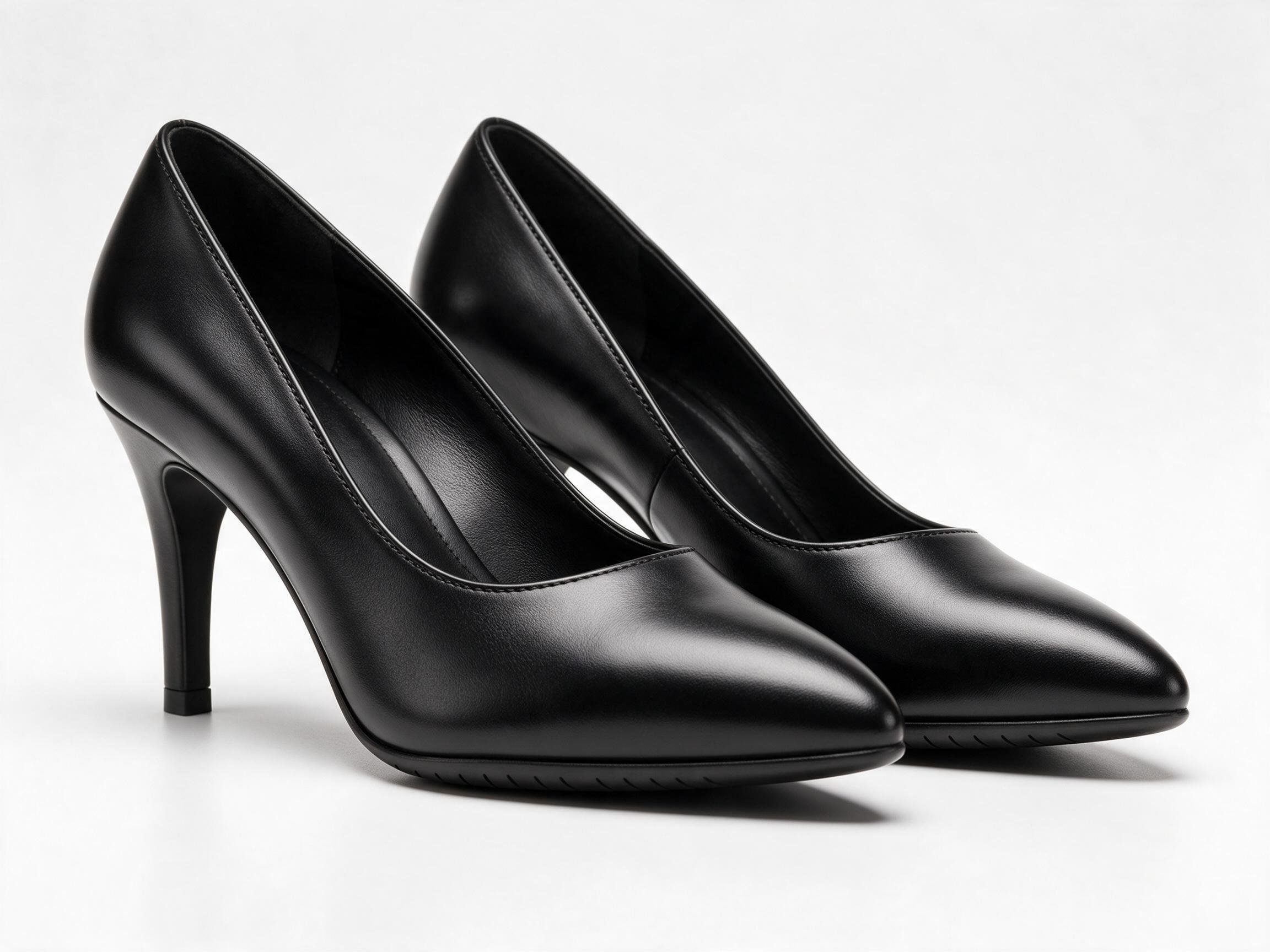
| Black Leather Classic Pumps | approx. 7 cm stiletto with reinforced core | Pointed toe | EU 34-41 / US 4-10 | Black, nude, red, custom |
| Black Leather Stiletto Heels | approx. 10 cm stiletto | Padded insole | EU 34-41 | — |
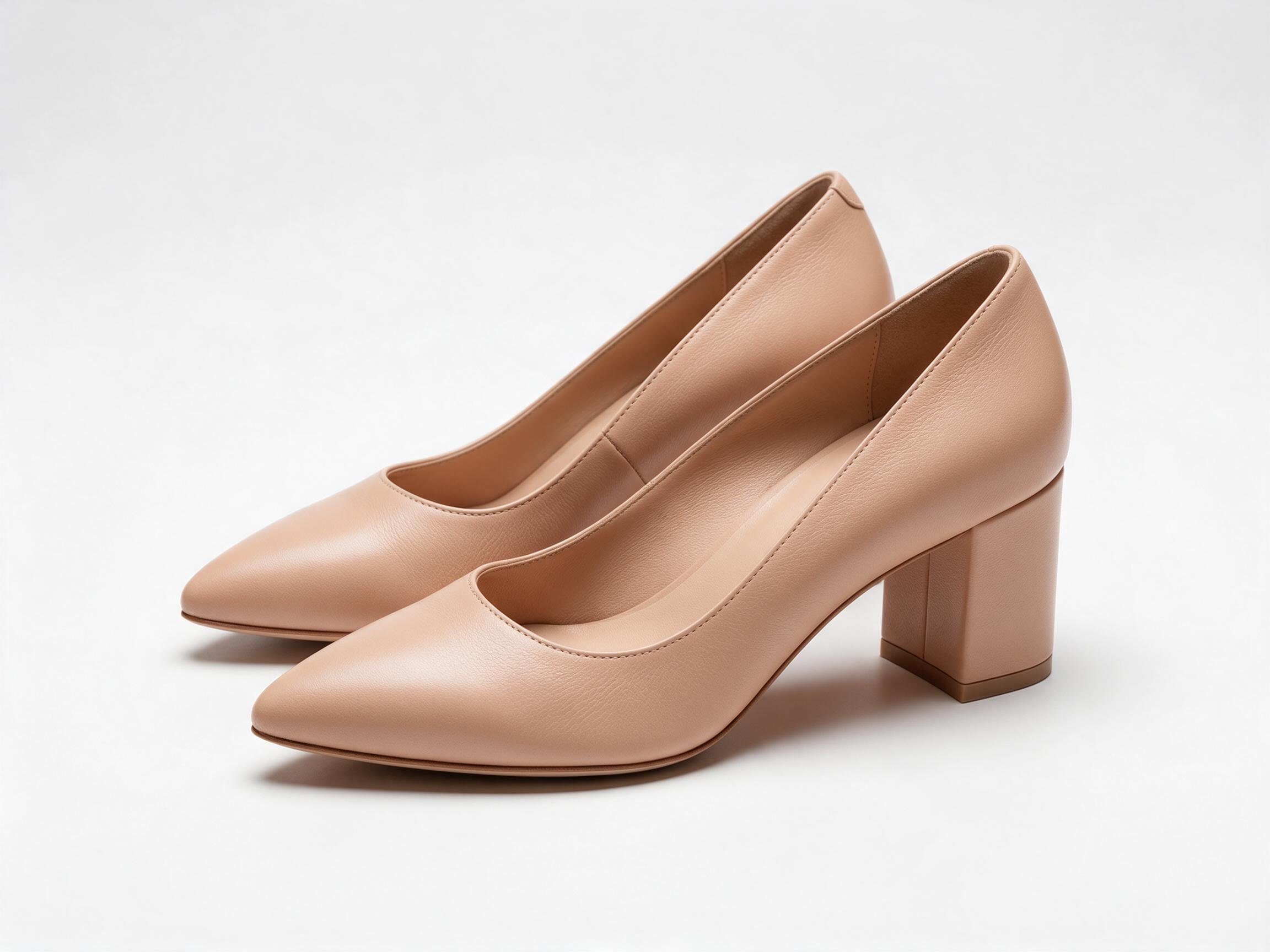
| Nude Block-Heel Shoes | approx. 5 cm block heel | Rounded pointed toe, padded insole | EU 34-41 | Nude, black, taupe, custom |
The 5 cm block heel and the 7 cm stiletto sit on the same size run (EU 34-41), which lets you merchandise a single size ladder across the line. The 10 cm stiletto is the statement piece; it does not need a wide color offering to do its job on shelf, but it does need consistent sizing so that a customer who buys the 7 cm in her size can order the 10 cm with confidence.
Three presentation decisions matter more than decoration:
- Height mix. Anchor the line with a comfort height and a classic height, then add one head-turning height. This gives staff a reason to move a customer between styles.
- Color story. Build around neutrals and add one seasonal accent. Pantone matching makes it possible to repeat the neutral later without a visible shift.
- Size integrity. One size range across the line keeps your size curve, reorder planning and returns handling consistent.
Photography follows the same logic. Shoot the insole branding, the hangtag and the box in the same frame as the shoe, because those are the elements that prove the product is your label and not an unbranded pair in a plain carton.
Seasonal launch cadence and replenishment
A private label heel program fails more often from stock gaps than from a weak opening order. The cadence principle is simple: place a smaller opening order across more styles, measure sell-through, then replenish the styles that move. Do not design the season around one large buy.
Phase the launch
- Opening drop — the core heights and core neutrals that define the line.
- First activation — the accent colorway or the highest heel, released once the core is selling.
- Replenishment — repeat production on the styles with proven sell-through, held against the approved color reference.
Because the manufacturer runs dedicated women's heel lines for stable repeat production, a style approved in the opening drop can be repeated later in the season without redeveloping the specification. That is the operational reason to keep the opening range tight and the reorder list precise.
Set the reorder triggers before launch
Decide in advance what signals a reorder — a sell-through threshold, a size-curve break, or a stock-cover rule — and which styles are eligible. Replenishment quantity is a commercial decision for each program; what matters here is that you have a defined trigger rather than a feeling. Sizes that sell out first are usually the same sizes every season, so track them by style and color rather than in aggregate.
Production scheduling, lead times and minimum order quantities vary by style, material and season, and should be confirmed per program when you place the opening order and again before each replenishment.
Branded samples and internal approval
Before bulk, you need a branded sample in hand: shoe, insole, hangtag and box together, in the colorway you intend to sell. Customized samples run about 7–12 days, which is long enough that you should not treat sampling as an afterthought once the artwork is ready.
Use the sample to run an internal approval against three separate checklists, because they fail independently:
- Brand accuracy — logo placement, color, spelling, size and color naming on box and tag.
- Product accuracy — heel height, toe shape, color against the approved Pantone reference, size run.
- Packaging integrity — box fit, print quality, tag attachment, how the pair presents when the lid comes off.
Aurevia runs three-stage bulk QC that includes heel attachment checks, so the heel itself is verified at production. The branded sample is your check on everything around the shoe: the identity, the packaging and the retail read.
FAQ
Can we put our logo on the shoe itself?
Standard private-label branding covers the insole, the box and the hangtag. Anything on the upper, outsole or hardware is a separate technical request and needs to be confirmed against the specific style.
Can we choose our own colors?
Yes. Color is matched to Pantone, and the available options include black, nude, red, taupe and custom colors depending on the style. Confirm the target Pantone references at the sampling stage.
Which heel heights should we open with?
Most programs open with a comfort height and a classic height — for example a 5 cm block heel and a 7 cm stiletto — and add a 10 cm stiletto as the statement piece. The right mix depends on your market and price position.
Do you supply private-label boxes and hangtags?
Yes — private-label boxes and hangtags are part of the OEM and ODM program. Artwork, box format and print specification need to be agreed before the bulk run.
How do we plan replenishment?
Start with a smaller opening order across the core range, set a reorder trigger in advance, and repeat the styles with proven sell-through. Replenishment quantity and scheduling are confirmed per program.
Next step
If you are ready to move from specification to shelf, the useful next move is a branded sample. Send the style, heel height, Pantone references, size range and logo placement for the insole, box and hangtag, and confirm the commercial terms per program; sample production for customized heels runs about 7-12 days.