
A program-level guide for European buyers sourcing wide fit shoes wholesale: how width-graded lasts are developed, where EU sizing and width fittings intersect, how to fit-test across a full size run, and what to confirm with a supplier before committing to a wide-fit program.
"Wide fit" is not a size you add to an existing line. It is a second build standard: another last, another set of graded sizes, and a separate fit sign-off. For European buyers, the complication is that EU sizes describe length, while width is your own specification. A pair can carry the right EU number and still be unwearable. This guide covers what a wide-fit program actually involves and which questions separate suppliers who can develop it from those who can only relabel it.
- Width is defined by the last, not by the size number on the box.
- EU sizing is length-led; width must be agreed and documented separately.
- A fit test is only meaningful when it runs across the full size run, not one middle size.
- Ask for width grading in millimetres and for who owns the last.
- Samples that fit do not guarantee production that fits; confirm grading and QC hold points.
- What a wide fit actually is, in build terms
- How width-graded last development works
- EU sizing and width fittings: where they intersect
- Fit-testing across a full size run
- What to confirm with a supplier before committing
- FAQ
What a wide fit actually is, in build terms
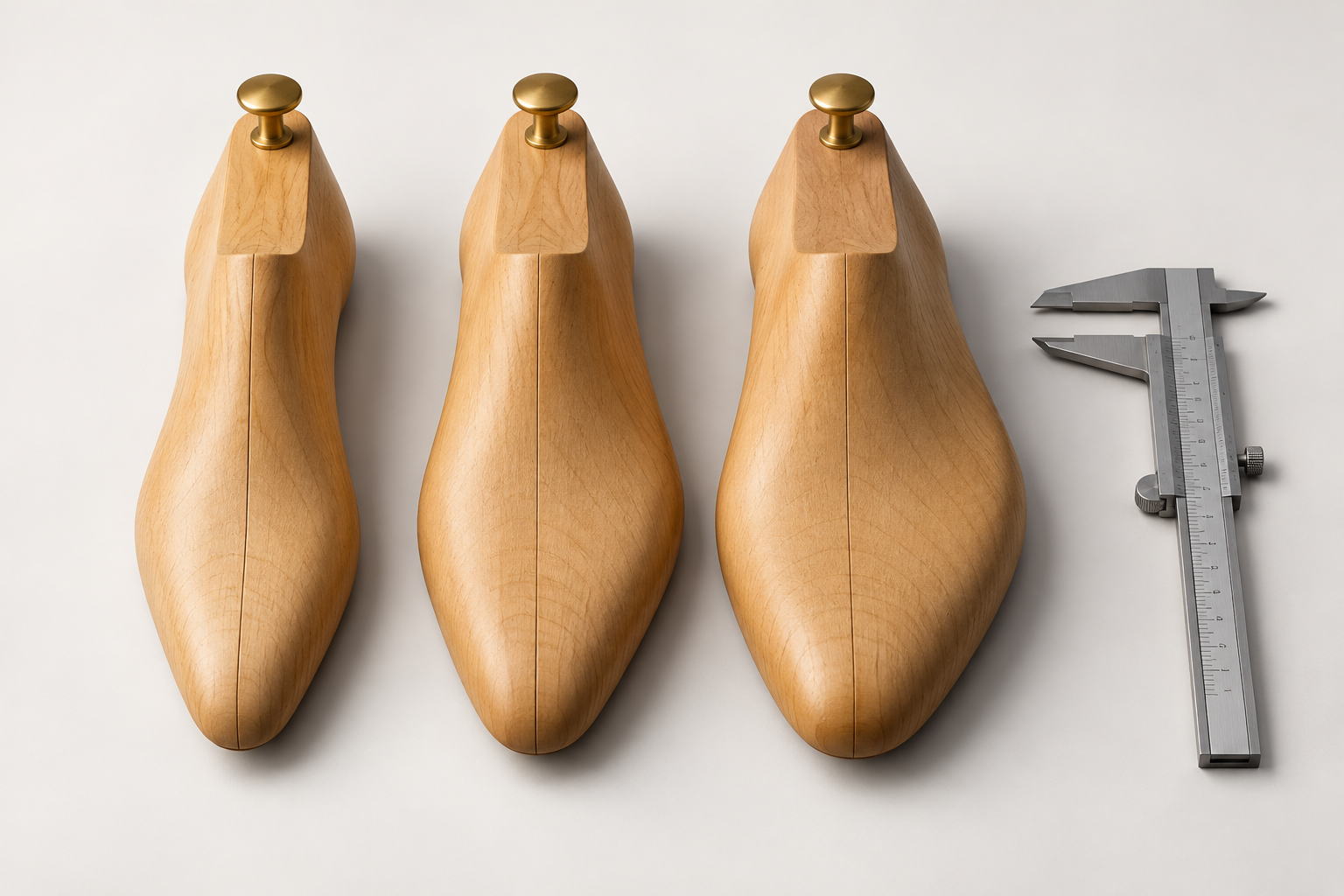
A last is the foot form the shoe is built around. Every upper pattern, sole mould, insole and stiffener is cut to fit that form. Changing the width of a shoe means changing the last, then re-deriving everything that touches it. Widening a pattern on paper without re-cutting the last produces a shoe that looks roomier but does not sit correctly around the heel or through the waist.
So the first question in any wide fit shoes wholesale conversation is not "do you have wide sizes?" but "do you develop your own lasts, and can you build a width-graded range from one?" A supplier who buys finished lasts from a third party can only offer the widths those lasts already exist in, and cannot adjust them for your market.
Three elements define a wide-fit build:
- The last itself — its forepart width, ball girth, instep height and heel curve, in the base size.
- The width grading — how much each of those dimensions increases from one size to the next, and whether that increment is the same across the run.
- The upper and bottom tooling — patterns, insoles, soles and stiffeners that match the widened last rather than being stretched over it.
Wholesale programs fail most often at the second point. A last may be correct in the sample size and drift in the larger sizes, where buyers actually notice fit problems. That is a grading issue, not a last-size issue, and it is invisible in a single-sample approval.
How width-graded last development works
Width grading is a numeric exercise before it is a manufacturing one. For each size step, the last volume is increased in defined places: across the ball, around the instep, through the heel, sometimes in toe depth. The increments are settings, and they are the supplier's design decisions — there is no universal standard that every factory follows. That is precisely why they need to be stated, not assumed.
A workable development sequence looks like this:
- Foot data and target market. The buyer states the population and fit complaint being addressed — for example, customers returning standard-width shoes because of forefoot pressure.
- Base last modification. The supplier adjusts the base last in the agreed zones and documents what was changed.
- Grading rules. Width increments are set per size step and recorded, ideally as a table of measured dimensions at each size.
- Pattern and bottom revision. Uppers, linings, insoles and soles are re-derived so they follow the new last.
- Fit samples. Shoes are built in a spread of sizes and checked on real feet before tooling is committed.
Aurevia Footwear Co., Ltd., based in Quanzhou, China and founded in 2011, runs in-house design and sampling that supports custom last development, alongside OEM/ODM production. For a buyer, "in-house sampling" matters practically: last adjustments and trial pairs can be iterated inside one facility rather than passed between an external last maker, a pattern room and a factory, which is where specification drift usually enters.
The outputs you should be able to hold at the end of this stage are a written width-grading table and a set of fit samples. If a supplier can show neither, the program is being sold on the word "wide" alone.
EU sizing and width fittings: where they intersect
EU sizes are length designations, derived from a Mondopoint-style scale based on foot length in centimetres. A buyer looking at an EU 42 is reading a length figure. Nothing in that number tells you how wide the shoe is. Two pairs both marked EU 42 can differ substantially across the forepart.
This is the core trap in European sourcing: a supplier can offer "EU 36–46" in a wide fit and still be shipping a single width across the whole range. The size chart looks complete; the width specification is unchanged. Before placing an order, confirm whether the width designation is a genuine second last or a marketing label on the standard one.
Where the two systems meet, three things need to be pinned down:
- Size conversion basis. Confirm whether the supplier converts from UK, US or Mondopoint measurements, and whether the conversion is by formula or by physical last measurement. Conversions are not exact translations; they are decisions.
- Width expressed independently. Ask for forepart width or ball girth in millimetres at each size, not as a letter code. Letter systems differ between markets and between makers, so a code alone is not a specification.
- Full-run coverage. Confirm that the wide fit exists at the extremes of your range, not only in the middle sizes. The smallest and largest sizes are where grading errors surface.
There is no single correct increment. A European market with a particular fit complaint may need one answer; a different market may need another. The point is that the answer must be documented and consistent, because retailers and their customers will compare pairs across sizes and across repeat orders.
Note on labelling: requirements for how size and fit information appears on footwear sold in the EU are governed by the applicable consumer information rules. Ask the supplier what labelling and size marking they support, and verify current requirements with your own compliance advisor for the markets you sell into.
Fit-testing across a full size run
Approving a wide fit on one sample size is the single most common cause of a program that ships and then returns. Fit changes with size: the girth gradation that feels generous at EU 39 may be tight at EU 44, and the heel curve that holds well at EU 44 may slip at EU 36.
A fit test that actually supports a wholesale commitment should cover:
- At least the smallest, a middle and the largest size in the range, tested by wearers who match your target market's foot profile.
- Multiple wearers per size, because one person's fit is an anecdote and three people's fit is a pattern.
- Wearing conditions that match the end use — socks, duration, activity — since a shoe that fits barefoot may not fit over a winter sock.
- Documented feedback against specific zones: forepart pressure, instep, heel hold, toe clearance, and where the foot sits relative to the insole edge.
- Measurement checks on the finished shoe, not only on the last, since lasting, sole attachment and material thickness all shift the internal volume.
Aurevia runs a three-stage quality control process in production, which is the relevant control structure for a wide-fit program: the fit specification has to be checked at more than one point, because a pair can pass at lasting and still be wrong after sole attachment. Ask any supplier where in their production sequence the width and girth of the finished shoe are measured, and what happens to a pair that falls outside the tolerance.
If a supplier cannot describe a fit-test protocol beyond "we will send you one sample", treat the wide-fit claim as unverified.
What to confirm with a supplier before committing
These are the questions worth putting in writing before a program is agreed. The answers also give you a fair basis for comparing suppliers, because they expose capability rather than vocabulary.
| Area | Question to confirm | Why it matters |
|---|---|---|
| Last development | Do you develop and modify lasts in-house, or source finished lasts? | Determines whether widths can be adjusted to your market at all. |
| Width definition | What is the forepart width and ball girth in mm, per size, in the wide fit? | Turns "wide" into a measurable specification you can inspect against. |
| Grading | What is the width increment per size step, and is it constant across the run? | Prevents fit drift at the extreme sizes. |
| Last ownership | Who owns the last and the grading data, and can it be held exclusively for us? | A last shared with other buyers is not a differentiator. |
| Fit testing | What is your fit-test protocol across sizes, and what feedback format do you return? | Shows whether approval is evidence-based or sample-based. |
| Production QC | At which stages is finished-shoe width or girth measured, and what is the tolerance? | Fit must survive lasting and sole attachment. |
| Size conversion | Which system do you convert from, and by formula or measured last dimensions? | EU numbers can be assigned inconsistently otherwise. |
| Range coverage | Which sizes in our target range exist in the wide fit, and which do not? | Half a wide range is a returns problem. |
| Commercials | What are the sampling timeline, tooling implications and order terms for a new width? | New lasts and tooling change the cost and lead-time structure. |
Two further practical points. First, a new width is not a colourway — it needs its own sample rounds and its own approval, so build the development time into your launch plan rather than treating it as a line extension. Second, put the width specification, the grading table and the fit-test results into the purchase documentation. A specification that lives only in an email thread will not survive a change of production planner.
FAQ
Is wide fit the same as a larger EU size?
No. EU size describes length. A larger size gives more length, not necessarily more width across the forepart or more girth at the ball. A buyer who "sizes up" to solve a width problem usually gets a shoe that is too long and still too tight.
Can a supplier add a wide fit to an existing style without a new last?
Not properly. Widening the upper pattern alone changes the shape without changing the volume the foot sits in. A genuine wide fit requires a modified or separate last plus re-derived patterns, insoles and sole tooling. Ask what was re-cut, not just what was adjusted on paper.
What width increments should I specify?
There is no universal figure, and any supplier who quotes one without asking about your market and fit target is guessing. State the fit complaint you are solving, ask for the supplier's proposed grading table in millimetres, and review it against your fit-test results before committing to tooling.
How many sizes should be fit-tested?
At minimum, the smallest, a middle and the largest size in your range, with several wearers per size. If the range is long or the grading increment is large, add intermediate sizes. Test the finished shoe, not the last.
What should I receive before approving a wide-fit sample?
The width-grading table, the last specifications for the base size, fit-test feedback across the tested sizes, and a clear statement of which sizes in the range are covered by the wide fit. Approving a single pair without these documents leaves the production run unspecified.
If you are building a wide-fit program for a European market, the first useful conversation is about lasts and grading, not price lists. Ask for the width grading table in millimetres, the fit-test protocol and the sizes covered. A supplier who can answer those points in writing is a supplier you can develop a program with.