
A procurement guide for wholesale buyers, importers, and private-label brands developing bespoke oxford shoes with a factory. Covers last selection, leather grading, sample-to-bulk workflow, QC checkpoints, and how to brief a supplier so the first sample matches the brief.
Private-Label Development Guide
Most importers start with a catalog page. Bespoke work starts with a decision: which last, which hide, and which seams you are willing to pay to control. This guide walks through how a private-label oxford program is actually built with a factory, from first brief to bulk shipment, using standard practice at Aurevia Footwear Co., Ltd. in Quanzhou.
- Bespoke buying shifts the decision-making to the buyer: last, leather grade, color, and branding are all specified, not selected from stock.
- Last and fit grading drive the pattern; change them before sampling, not after.
- Full-grain versus corrected-grain is a cost and appearance trade-off you should define in writing, hide by hide.
- Customized samples run about 7–12 days once details are confirmed; bulk runs 30–40 days after order confirmation.
- Three-stage QC and a forefoot flex test belong in the purchase agreement, not just in conversation.
Why bespoke differs from catalog buying
Catalog buying asks a supplier to ship an existing style in an existing spec. Bespoke asks the supplier to build a pattern around your requirements: your last, your leather, your color target, your logo placement. The commercial difference is that you own the specification, and the specification is what the factory builds against, in sampling and in bulk.
That has three practical consequences for a buyer.
- The brief replaces the catalog number. A sketch, a reference photo, or a tech pack becomes the manufacturing document. Aurevia's in-house design team converts any of those three inputs into a production-ready sample, which is the point at which the discussion becomes concrete.
- Specification choices are yours to make, and yours to live with. If you specify a corrected-grain upper to hit a price point, that decision follows the order into the QC plan.
- Lead time starts when details are confirmed. Sample timing and production timing are both anchored to confirmation of the specification, not to the first email.
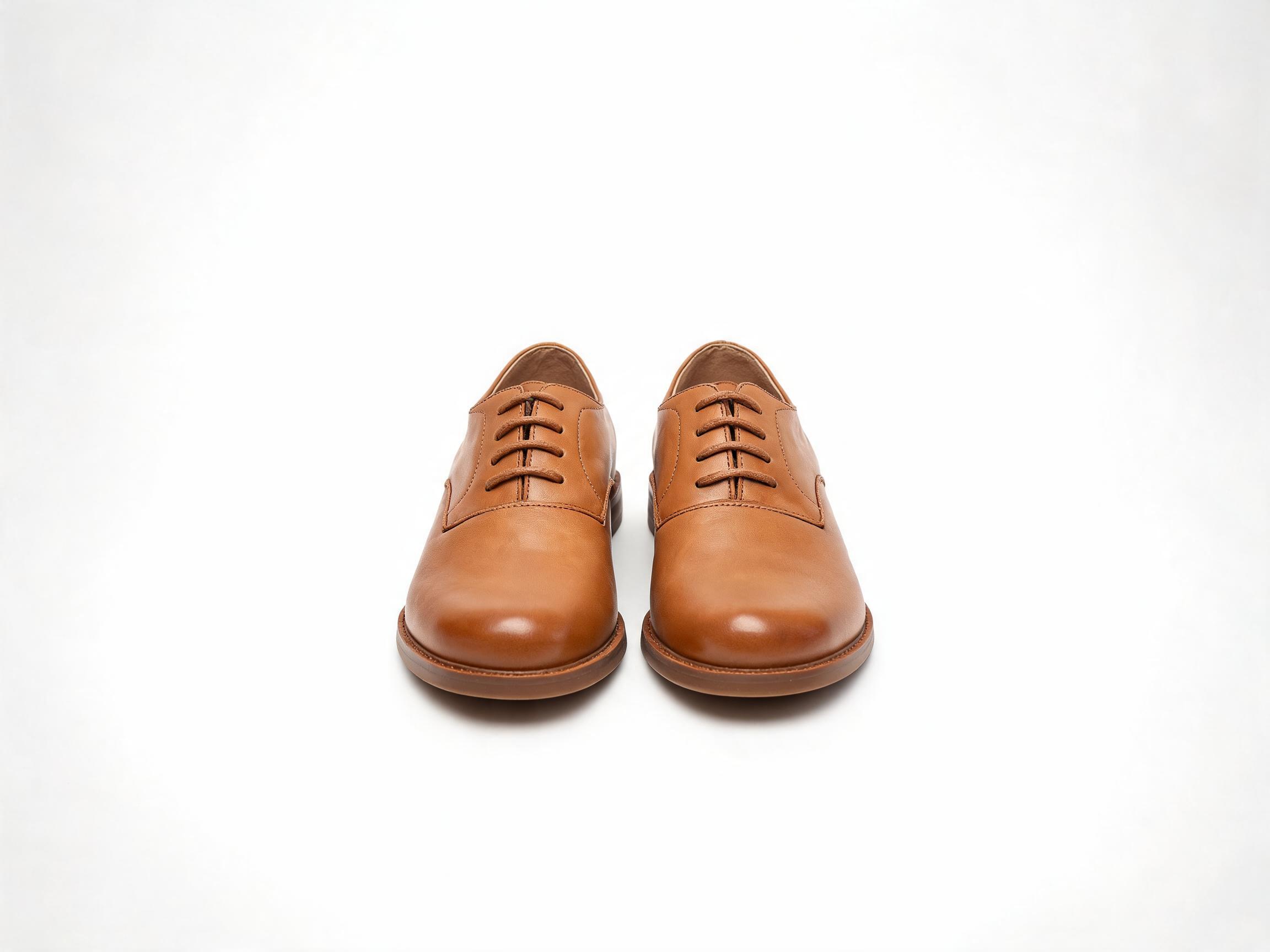
If you are building a women's program, a first development reference is the Tan Leather Oxford Shoes: polished full-grain upper, closed oxford lacing, leather lining, cushioned insole, stitched rubber sole, EU 35–41, with custom colors and Pantone leather color matching. It shows the level of detail a bespoke brief is expected to control.
Choosing the last and grading the fit
The last is the form the shoe is built on. In bespoke development it is the single most consequential decision, because it determines the toe shape, the instep height, the heel seat, and how the shoe sits when worn. It also determines whether an existing pattern can be adapted or a new one has to be cut.
Buyers who develop multiple sizes should think in terms of a last library: a set of forms the factory already holds, from which you select the closest match to your target market's foot profile and then adjust. Working from a last library is faster than commissioning a brand-new form, and it gives you a stable reference for repeat orders. The specific forms a factory holds are project-dependent, so ask for the current list before you commit to a shape.
Fit grading: what to agree before sampling
Grading is the system that scales one size into a range. For a women's oxford program, Aurevia produces EU 35–41. The grading decisions that matter are:
- Toe and forefoot width progression. How much the shoe widens from one size to the next, and whether the width increments suit your market.
- Heel seat and instep. A last that fits at the sample size may not fit at the extremes of the range once graded.
- Left/right symmetry. Pattern pieces should produce a matched pair, not two shoes that happen to be the same size.
Grading is cheapest to change on paper and most expensive to change after tooling and cutting are underway. Agree the range and the increments first, then approve the sample.
Leather grading as a selection criterion
Leather is where price, appearance, and consistency compete. Buyers choose along two axes: the grain grade and the finish treatment.
| Grade | What the buyer gets | What to plan for |
|---|---|---|
| Full-grain | The natural grain surface is retained. Aurevia's tan women's oxford uses a polished full-grain upper, which gives a clean finished surface over the grain. | Natural variation between hides is expected. For a matched pair, hides must be selected for grain direction and shade, which is standard practice in the men's program below. |
| Corrected-grain | The surface is sanded and re-embossed for a more uniform look. | Discuss the finishing system and how it will be presented, and confirm the exact grade offered for your program with the supplier. |
Finish treatment is the second axis. A polished finish, a matte finish, or a burnished edge each change how the shoe reads and how the surface behaves. For brand-driven color, Aurevia matches leather color to Pantone, which gives you a defined target instead of an approximate swatch description. Ask what color-matching tolerance applies and how the approved standard is retained between orders.
Where left and right shoes must match, matched hides are the control. The Black Cap-Toe Oxford Shoes are built so that the left and right shoe share grain direction and shade, with a cap-toe seam and closed lacing. If your program depends on a consistent look across a run, matched-hide selection is the specification to insist on.
A separate point that comes up in development meetings: construction. Stitched-and-cemented build is used in the men's cap-toe oxford above. Goodyear welt is a construction option buyers may discuss with a factory if their market expects it, but it should be confirmed as a project-specific choice, not assumed as a default.
From sketch to sample to bulk
The sampling stage is where a bespoke program either converges or drifts. Aurevia's design team accepts a sketch, a reference photo, or a tech pack. The output is a production-ready sample, which is the document the bulk order is measured against.
What the buyer supplies
- A sketch, reference photo, or tech pack describing the upper pattern and seam placement.
- The target last, or acceptance to work from the factory's last library.
- Leather grade, finish, and a color target (Pantone reference where color matching is required).
- Branding: private-label logo on insole, box, and hangtag as required.
- Size range and grading expectations.
Timing and sequence
- Brief review and clarification. The factory confirms what is buildable from the materials supplied and what needs a decision.
- Sample production. Customized samples take about 7–12 days after details are confirmed.
- Sample approval. The approved sample, with any written amendments, becomes the reference standard.
- Bulk production. Bulk lead time is 30–40 days after order confirmation.
Two working notes on this sequence. First, the 7–12 day sample window and the 30–40 day bulk window both run from confirmation, so the fastest route to a ship date is a complete brief, not a faster chase. Second, a sample that passes your inspection is not the same as a bulk run that passes; keep the approved sample available for comparison during production.
QC checkpoints worth writing into the order
QC for leather oxfords is not a single inspection at the end. Aurevia runs three stages: incoming material inspection, in-line inspection, and finished-shoe inspection. For a bespoke program, the incoming and in-line stages matter most, because that is where a leather or assembly problem is still cheap to correct.
| Stage | What it controls | Buyer-side check to request |
|---|---|---|
| Incoming material | Hides and components before cutting. | Confirm grade, shade, and grain direction against the approved standard. |
| In-line | Upper assembly and lasting. | Confirm seam placement, closed lacing, and cap-toe line where applicable. |
| Finished shoe | The completed pair. | Forefoot flex test, color fastness, sole adhesion. |
Three finished-shoe tests are specified in this program: a forefoot flex test, color fastness, and sole adhesion. These are objective checks you can reference in a purchase agreement. If your market requires additional testing or documentation, raise it during development so it can be built into the sampling plan and confirmed on the order.
How to brief the factory
A brief that produces a correct first sample usually contains five things:
- Style and pattern. A sketch, reference photo, or tech pack, with seam and lacing type stated explicitly (for example, closed oxford lacing, cap-toe seam).
- Last and fit. The target last, the size range, and grading expectations.
- Leather. Grade, finish, and color target, with a Pantone reference if color matching is required.
- Construction and sole. The build method and sole type you expect, named openly so any option can be discussed rather than assumed.
- Branding. Where the private-label logo goes (insole, box, hangtag) and how it is presented.
Leave out the marketing adjectives and include the decisions. "Polished full-grain upper, closed lacing, leather lining, cushioned insole, stitched rubber sole, EU 35–41, color matched to Pantone" tells the factory more in one line than a paragraph of description.
Product details, timing, and QC stages described here are drawn from the current Aurevia Footwear Co., Ltd. oxford program. Minimum order quantities, pricing, and country-specific compliance documentation are set per project; confirm these with the factory when you send your brief.
Next step: send the brief, not the question
Aurevia Footwear Co., Ltd. has manufactured and exported B2B footwear from Quanzhou since 2011, supplying buyers in Europe, North America, and the Middle East. For a bespoke oxford program, the fastest start is a brief containing your sketch, reference photo, or tech pack, plus your target last, leather grade, color reference, size range, and branding requirements. Send those details together and the factory can confirm buildability, sample timing, and next steps in one pass.