A manufacturing-process view for EU, North America and Middle East buyers: how casual leather sandals are built in a Chinese factory — sole forming and bonding, upper leather selection and matching, and the three-stage inspection routine that catches defects before they reach your cartons.
Manufacturing process view
How a casual leather sandal is actually built in a China factory — from sole forming and bonding to upper leather matching and the three-stage inspection that decides whether your cartons ship clean.
Key takeaways
- Sole construction: the Black Leather Casual Sandals use a stitched-and-cemented build with an anti-slip rubber outsole and hand-burnished sole edges — two separate operations that buyers should track on the production schedule.
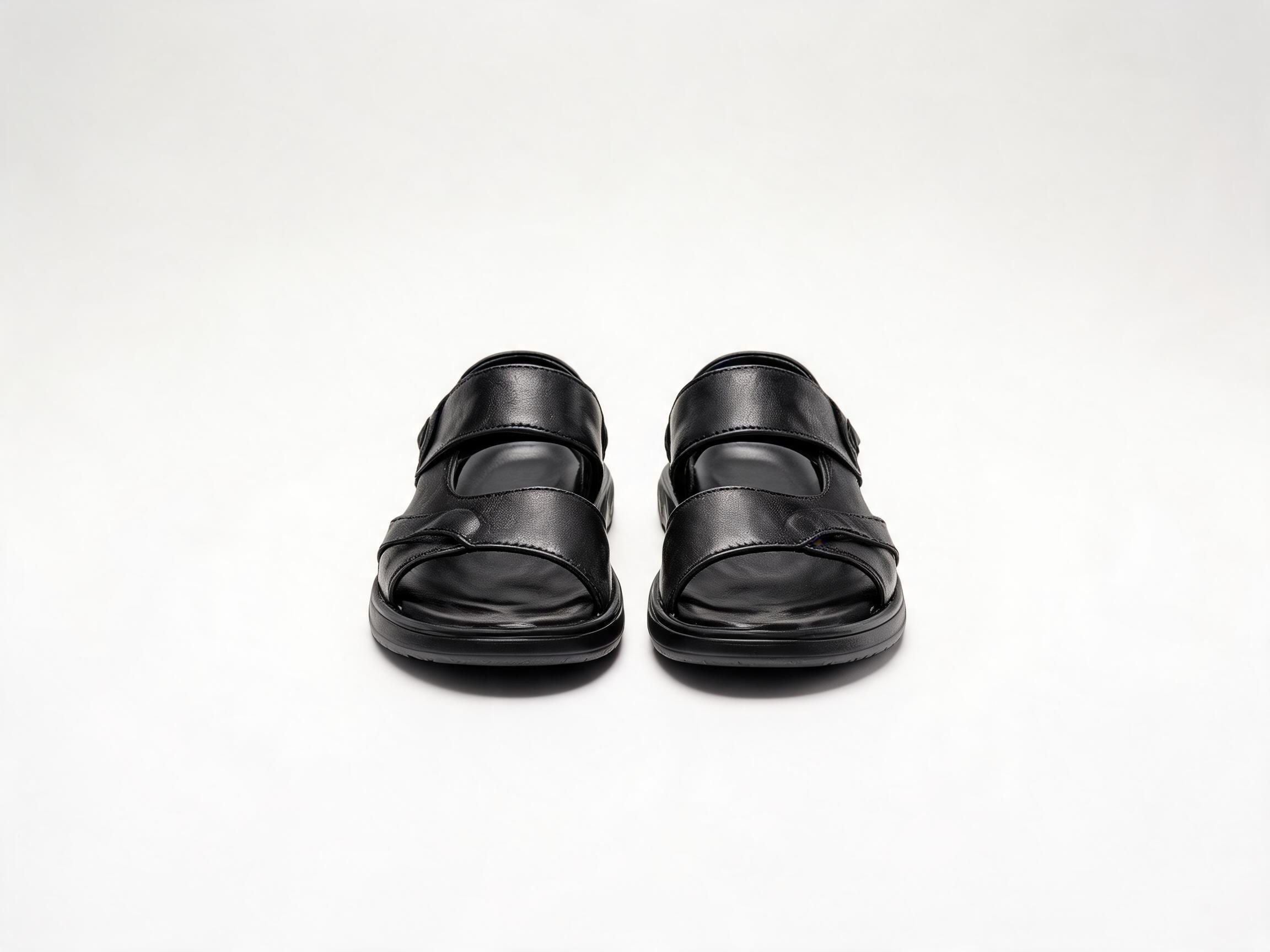
- Upper facts that drive cost: smooth black calf leather, adjustable buckle straps, matched hides left/right, and a leather lining. Hide matching is a manual step, not a machine setting.
- Bulk QC has three stages and includes buckle strength and sole adhesion checks, plus buckle corrosion testing.
- Timeline: samples 7–12 days; lead time 25–35 days after order confirmation. Trade terms EXW / FOB / CIF.
Sole forming and bonding: what happens before the upper goes on
For a casual leather sandal, the sole is not one part. It is a stack: a cushioned arch-contour footbed, a rubber outsole with an anti-slip tread, and a finished edge. Each of those is handled at a different station, and the order matters — an outsole bonded before the edge is finished will need rework, not just a touch-up.
On this style, the outsole is attached with a stitched-and-cemented construction. Two things are happening at once: cement adhesive holds the sole to the lasted upper, and stitching provides a mechanical join. That combination is why sole adhesion shows up as a named check in bulk inspection rather than being taken for granted.
Why the edge finish is a separate step
The sole edges are hand-burnished. Hand burnishing is done by friction and heat along the edge of the sole, and it is a per-pair operation. In a bulk run, this is one of the slower stations and a common source of schedule drift if the factory under-staffs it. When you review a production plan, ask where burnishing sits in the sequence and how many pairs per station per shift — that number tells you more about your delivery date than the total order quantity.
Buckle corrosion testing
Buckles are not only a cosmetic item on a sandal. They carry load every time the wearer tightens the strap, and in humid coastal markets or in transit through humid climates they are the first metal part to show corrosion. The factory runs buckle corrosion testing as part of the quality routine. If your market has a specific salt-spray or humidity exposure expectation, raise it at the sampling stage so the test conditions can be discussed before bulk production — not after.
Upper materials: leather selection and left/right hide matching
The upper on this style is smooth black calf leather, with a leather lining against the foot. Calf leather is chosen for a fine, even grain and a surface that takes a clean black finish; the smoothness you see in the finished sandal is a function of the hide grade and the finishing, not of the pattern.
Matched hides, left and right
The spec includes matched hides left/right. This is a manual matching step: two hides are selected so that grain, texture and colour read as a pair when the sandals are worn side by side. It is one of the differences between a casual sandal built for a retail display table and one built to a price floor.
For buyers, matching has a practical implication for your order. Because it is a manual sort, hide availability affects how quickly a given quantity can move. If your range includes several colourways or finishes beyond the confirmed black calf leather upper, sequence the styles rather than loading them all into one production window.
Adjustable buckle straps
The straps are adjustable with buckles. Adjustability means the strap ends, punch holes and buckle hardware all have to align consistently pair to pair — otherwise a customer who wears the sandal loose or tight will find the buckle sitting off-centre. This is one reason buckle strength appears in inspection: the strap is only as usable as the hardware holding it.
Bulk-order QC: the three-stage inspection routine
This style runs through a three-stage inspection. The stages are not a marketing number; each one catches a different class of defect, and they map onto the production sequence.
- Incoming and in-process checks. Leather, lining and hardware are reviewed before assembly. This is where a mismatched hide pair or a faulty buckle batch can still be pulled without scrapping finished pairs.
- Assembly checks. Sole adhesion and buckle strength are verified at the point where the sandal is structurally complete. A sole that has bonded unevenly is detectable here; once the pair is packed, it is not.
- Pre-shipment inspection. Finished pairs are checked before cartoning, when corrections are still possible without unpacking a container.
Two checks are worth naming explicitly to the factory when you place your order: buckle strength and sole adhesion. Both are already part of the routine here, and both are the failure modes that generate returns rather than complaints — a strap that pulls out, or a sole that separates at the toe. If you have a defined acceptance level for either, put it in the order confirmation so the inspection station has a written threshold.
Confirmed specification reference
| Item | Confirmed detail |
|---|---|
| Style | Men's casual sandals |
| Upper | Smooth black calf leather |
| Lining | Leather lining |
| Straps | Adjustable buckle straps |
| Hide selection | Matched hides left/right |
| Footbed | Cushioned arch-contour footbed |
| Outsole | Anti-slip rubber outsole |
| Construction | Stitched and cemented |
| Sole edge | Hand-burnished |
| Hardware testing | Buckle corrosion testing |
| Inspection | Three-stage, including buckle strength and sole adhesion |
| Sizes | EU 39–45 |
| Sample lead time | 7–12 days |
| Production lead time | 25–35 days after order confirmation |
| Trade terms | EXW / FOB / CIF |
| Export markets | Europe, North America, Middle East |
What to confirm with the factory before you place a bulk order
Most of this article describes a process that already exists for this style. The gaps that remain are commercial, and they are the ones to close in writing before production is scheduled.
- MOQ. Confirm MOQ with the factory per style — it varies by upper material and colourway, and it is not a fixed figure across the range.
- Size curve. EU 39–45 is the confirmed size run. Tell the factory your market's actual size distribution so the packing ratio matches what sells, not a flat split.
- Trade term. EXW, FOB and CIF are all offered. Pick the term that matches who controls freight and insurance on your side, because it changes the effective landed cost more than a small unit-price difference does.
- Private label. If you need your own branding, raise it at sampling. Buckle hardware and footbed are the usual branding surfaces, and both need to be settled before the order is confirmed.
- Inspection acceptance level. Ask what AQL the pre-shipment stage applies, and whether your own third-party inspection is welcome before cartoning.
FAQ for wholesale and private-label buyers
Is the sole leather or rubber?
The outsole is anti-slip rubber. The footbed is cushioned with an arch contour, and the sole edges are hand-burnished. All three are separate components of the same sole assembly.
What construction holds the sole on?
Stitched and cemented — adhesive plus stitching. Sole adhesion is checked during the assembly stage of the three-stage inspection.
Can the upper be produced in a colour other than black?
The confirmed upper for this style is smooth black calf leather. Other upholstery options are a per-project question; confirm material availability and MOQ with the factory for the specific colourway you want.
How long from sample approval to shipment?
Samples run 7–12 days. Bulk lead time is 25–35 days after order confirmation. Hand-burnished edges and matched hides are the two steps most likely to affect that window, so ask for the station plan alongside the delivery date.
Are the buckles tested for corrosion?
Yes, buckle corrosion testing is part of the routine for this style. If your market requires specific exposure conditions, raise them at sampling so the test scope can be agreed before bulk production.
Which sizes and markets does this style cover?
EU 39–45, with exports to Europe, North America and the Middle East. Trade terms are EXW, FOB or CIF.
If you are building a casual leather sandal programme and want to work through the upper spec, sole finish and bulk QC routine against your own market requirements, the Black Leather Casual Sandals page carries the confirmed specification, or you can send your size curve and target trade term directly to the factory for a quotation.