
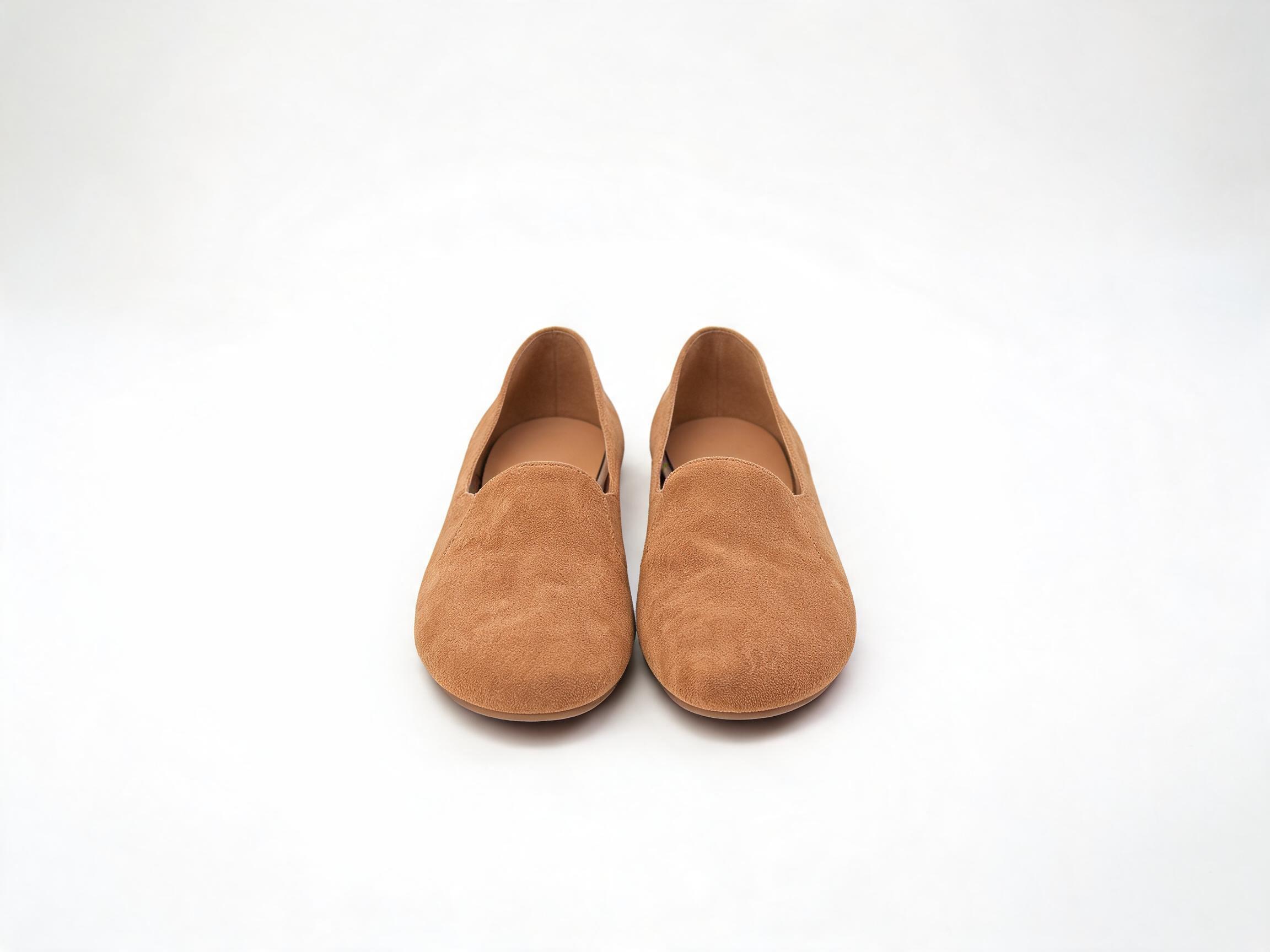
A procurement-focused guide to foldable flats wholesale covering sub-segments and buyer profiles, upper material selection (suede, soft leather, canvas) and how each behaves when folded, folding-structure durability factors to test before bulk, bulk-order QC checkpoints drawn from three-stage inspection practice, compact packaging, and how to brief a factory for production-ready samples.
Wholesale Sourcing Guide
Foldable flats are a packability product, not just a shoe with a soft sole. When you source them in bulk, three things decide whether the order ships clean and sells through: the upper material and how it behaves along the fold, the folding structure itself, and whether your QC plan catches structure failures before the container leaves. This guide covers all three across the whole category — foldable travel flats, slip-on styles, and ballet flats — and explains how to brief a factory so the sample you approve is the product you receive.
- Material choice sets the fold behavior: suede, soft leather, and canvas each crease, recover, and print differently.
- Fold-line placement, sole flexibility, and upper thickness are engineering decisions to settle with the factory before sampling — not assumptions to carry into a PO.
- Bulk QC should track the same structure points the sample was approved on: fold-line creasing, forefoot flex, sole adhesion, and color fastness.
- Compact flats need packaging that holds shape under compression, because the shoes are designed to be squeezed.
Where foldable flats sell and who buys them
Foldable flats are bought as a solution to a specific problem: carrying footwear that disappears into a bag. That shapes the buyer list and the way wholesale programs are built.
- Travel and airport retail. Buyers look for a flat that folds small, holds its shape when unpacked, and pairs with the rest of a travel accessory range. Fold lines and recovery matter more than fashion detailing.
- Comfort and commuter retail. Shoppers who change out of heels on the way to work buy slip-on and ballet shapes. Cushioned insoles and flexible outsoles carry the value story here.
- Gift, hotel, and hospitality channels. Often bought in volume as a compact, presentable item where consistent sizing and clean finishing matter more than intricate design.
- Private-label and DTC brands. These buyers typically drive the material and folding specification, and expect the factory to turn a sketch, reference photo, or tech pack into a production-ready sample.
Across these channels, the sub-segments are not interchangeable. A foldable travel flat is engineered around folding. A slip-on flat is engineered around ease of entry. A ballet flat is engineered around a clean, close upper. A wholesale program that carries all three needs one factory that can hold the same QC standard across different constructions.
Material options and how they affect folding
Upper material determines how a flat creases at the fold line, how it recovers after being packed, and how it ages in the customer's hands. There is no universally best choice — the right pick depends on where the fold sits and how the shoe will be stored.
| Upper material | Folding behavior | Best suited to | Points to confirm |
|---|---|---|---|
| Suede | Soft hand, creases readily, surface texture can mark along a repeated fold | Slip-on and casual travel shapes such as the Tan Suede Slip-On Flats | Nap direction across the fold line; crease recovery after packing |
| Soft leather | Recovers well from folding, holds shape, takes a clean finish | Structured ballet, pointed-toe, and dress-casual flats such as the Nude Leather Ballet Flats | Thickness at the fold; whether the topline or elastic detail interferes with the fold |
| Canvas and textile | Light and packable, but can wrinkle and lose structure at a hard crease | Entry-level travel and promotional programs | Backing and lining that keep the fold from sagging; print alignment across the crease |
Two material interactions are worth raising with the factory before sampling. First, the fold line does not have to run through the upper alone — where the fold meets the lining, the insole edge, or a decorative seam, the layers move together, and a poorly placed line concentrates stress at one spot. Second, cushioned insoles and flexible outsoles support folding only when the insole is built to bend; a cushioned insole that is stiff at the forefoot fights the fold. These are construction decisions, and they are the reason a foldable flat cannot be specified from a photo alone.
Folding-structure durability: what to test before bulk
The folding structure is the part of a foldable flat that fails first in the field, and it is the part most often left to assumption. Treat the following as engineering considerations to be evaluated and confirmed with the factory on your own sample — not as fixed specifications.
Fold-line placement
Where the fold sits determines how the shoe creases and whether it lies flat when packed. Ask the factory to show you the fold line marked on the pattern, and check it against the shoe's construction seams. A fold line that crosses a stitched seam, a hard counter, or a stiffened topline creates a hinge point where the material will fatigue first. On a ballet flat with an elastic topline, the elastic should not sit on the fold; on a slip-on, the opening should not be forced to compress.
Sole flexibility and the forefoot bend
A foldable flat needs a sole that bends at the forefoot without delaminating. This is measurable: forefoot flex testing is part of the in-line construction checks used on this factory's production, applied to confirm that the sole bends as intended rather than cracking or separating from the upper. For your own program, flex the sample by hand at the fold and at the forefoot, then ask what test the factory runs on the bulk run and whether the results are recorded. Sole adhesion checks should accompany flex testing, because a sole that grips well when flat can still peel after repeated folding.
Upper thickness and lining at the crease
Thicker uppers hold shape but resist a tight fold; thinner uppers fold easily but can collapse at the crease. The practical question is whether the upper, lining, and any reinforcement at the fold are balanced. A reinforced fold line can reduce creasing on a soft leather ballerina, but too much reinforcement turns the fold into a hard ridge that presses on the foot. Confirm the intended thickness and reinforcement with the factory, and check that the lining is not glued in a way that pulls away when the shoe is folded and unfolded.
Crease recovery after packing
How a flat looks after being folded in a bag is a merchandising issue as much as a durability one. Suede, soft leather, and canvas recover differently, and the surface finish matters: a repeated fold on suede can mark the nap, and a crease on coated or printed material can crack the coating. Before bulk, pack a sample the way the end customer will — folded, in its retail packaging, for a realistic period — and inspect the fold line on unpacking.
Bulk-order QC checkpoints
A bulk QC plan for foldable flats should track the same structure points that were approved on the sample, at stages where problems can still be corrected. The three-stage inspection model used in this factory's production gives a workable frame.
| Stage | What is checked | Why it matters for foldable flats |
|---|---|---|
| Incoming material | Upper, lining, insole, and outsole against approved samples | A softer or thinner lot of the approved material folds differently and changes crease recovery |
| In-line construction | Stitching and lasting; fold-line placement; forefoot flex testing; sole adhesion | These are the checks that catch a structure failure while the run is still open |
| Final finished-shoe inspection | Finished-shoe appearance, sizing, stitch integrity, color fastness, fold-line condition | Confirms the shipped shoe matches the approved sample, not just the components |
Two practices make this plan enforceable. Ask for inspection reports to be shared on request, so the record travels with the order rather than staying verbal. And keep third-party inspection open as an option — a factory that welcomes an independent check on a foldable program is one that expects its structure to hold. When you set the AQL and the specific defect list, define fold-line creasing, sole separation, and color transfer as defects in their own right; they are the failure modes unique to this category and will not be captured by a generic footwear checklist.
Packaging considerations for compact flat designs
Because the product is sold for its small packed size, packaging and product have to work together. A few practical points:
- Hold the folded shape. The retail box or pouch should keep the shoe at the fold the sample was approved at; compression in transit should not add a new crease.
- Protect the fold line. Where the upper meets itself, a light tissue or shaped insert prevents surface marking, especially on suede and coated finishes.
- Plan the pack ratio. Compact flats allow a higher pack density than standard footwear, which affects master carton dimensions and shipping economics. Confirm carton dimensions with the factory once the folded sample is final, not before.
- Keep branding legible when folded. If the branding is printed or embossed on the upper, check its position against the fold so it is not split by the crease.
How to brief the factory
A foldable flat program is easier to place when the brief is specific about the structure, not just the look. An in-house design team can turn a sketch, reference photo, or tech pack into a production-ready sample, which means the brief should arrive with the following decisions made or flagged as open:
- Sub-segment and silhouette. Foldable travel flat, slip-on, or ballet — and whether the fold runs forefoot-to-heel, side-to-side, or as a packable twist.
- Upper material and finish. Suede, soft leather, or canvas, with the color reference and any print or coating.
- Fold requirement. How small the flat must pack and how it will be stored by the end customer.
- Comfort features. Cushioned insole and flexible outsole, and any topline or elastic detail such as the topline on the Nude Leather Ballet Flats.
- QC expectations. The defect list, inspection reports on request, and whether third-party inspection will be used.
- Packaging format. Box, pouch, or polybag, and the pack ratio for the master carton.
Where the brief does not yet answer a structural point — fold-line placement, sole flexibility at the forefoot, or upper thickness at the crease — say so and ask the factory to propose it on the sample. That is the point at which those decisions are cheapest to change.
Next step
If you are building a foldable flats program across travel, slip-on, and ballet sub-segments, send the factory your target silhouette, upper material, and fold requirement, and ask for a sample with the fold line marked and the flex and adhesion checks documented. Aurevia Footwear Co., Ltd. is a B2B footwear OEM/ODM manufacturer and exporter based in Quanzhou, founded in 2011 and exporting to Europe, North America, and the Middle East, with an in-house design team that can turn a sketch, reference photo, or tech pack into a production-ready sample. Share your brief and ask which structure points need to be confirmed before the sample is approved.