A practical framework for comparing high heel wholesale suppliers across heel construction, heel-height range, sampling, color consistency, and communication—grounded in specific product specs and confirmable terms.
B2B Procurement Guide
How to Compare High Heel Wholesale Suppliers Before You Order
High heel wholesale is a crowded, ad-heavy category. When several suppliers bid on the same query, the deciding factor is rarely the headline price—it’s whether their construction, sampling process, and quality controls match your assortment and your tolerance for returns. This guide gives you a like-for-like comparison method, using three representative styles as concrete examples of what to ask. Before placing any order, confirm current MOQ and lead time with the sales team; the figures below are the specs listed on our product pages and can change by color, size run, and season.
Key takeaways
- Compare heel structure (block vs. stiletto) separately from heel height; they carry different stability and QC implications.
- Ask for the supplier’s full heel-height range and category coverage before shortlisting—one style does not prove a full line.
- Treat sampling and confirmation samples as a process, not a single photo.
- Color consistency and per-pair inspection are where bulk orders succeed or fail.
- Listed specs (MOQ, lead time, heel height) are starting points; confirm them in writing for your specific order.
1. Heel structure: block vs. stiletto
Start with the heel’s structure, because it drives how the shoe behaves underfoot and how you should inspect it. A block heel spreads load across a wider base; a stiletto concentrates it on a narrow point. That difference affects stability and wear patterns, and it should shape your QC questions.
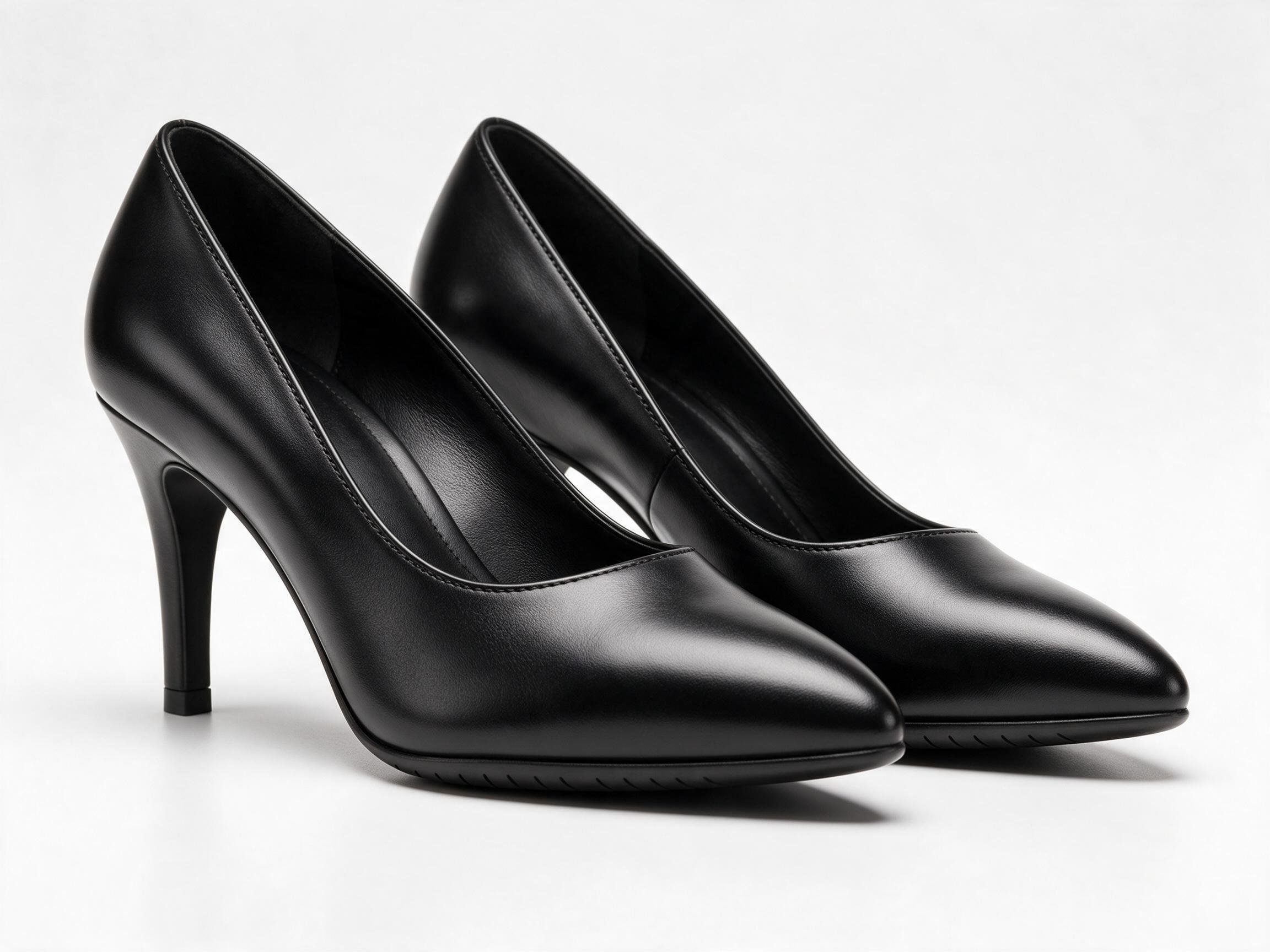
Take two styles from our catalog. The Nude Block-Heel Shoes list a 5 cm block heel—a lower, broader profile that suits buyers targeting comfort-led or everyday assortments. The Black Leather Stiletto Heels list a 10 cm stiletto—a taller, narrower profile aimed at dress and occasion lines. Same MOQ and lead-time band, very different construction and inspection focus.
When comparing suppliers, ask each one how they finish and reinforce the heel-to-sole junction for each structure, and request the same angle and lighting in heel photos so you can compare shape and symmetry. Do not accept a single glamour shot as evidence of construction quality; ask for close-ups of the heel attachment on the actual sample you will receive.
2. Heel-height range and category coverage
A supplier that lists one heel height has not shown you a range. Before shortlisting, request the full heel-height ladder they can produce and the categories they cover—pumps, block heels, stilettos, and any adjacent styles. This tells you whether one supplier can carry your assortment or whether you’ll need to split orders.
Our listed examples span three positions: the Black Leather Classic Pumps at 7 cm, the Nude Block-Heel Shoes at 5 cm, and the Black Leather Stiletto Heels at 10 cm. That spread is a useful comparison anchor: if your line needs a mid-height pump, a low block heel, and a high stiletto, you can see whether a supplier covers all three or only one.
| Style | Heel type | Listed heel height | Listed MOQ | Listed lead time |
|---|---|---|---|---|
| Black Leather Classic Pumps | Pump | 7 cm | 100 pairs per color | 25–35 days |
| Nude Block-Heel Shoes | Block | 5 cm | 100 pairs per color | 25–35 days |
| Black Leather Stiletto Heels | Stiletto | 10 cm | 100 pairs per color | 25–35 days |
Specs as listed on product pages. Confirm current MOQ and lead time with the sales team before ordering.
Use the table as a template: ask every candidate supplier to fill the same columns for each style you need. Where a cell is blank or “varies,” treat it as an open question, not a gap you can assume away.
3. Sampling and confirmation samples
A photo is not a sample, and a sample is not a confirmation sample. Compare suppliers on the full sampling sequence: who pays for the sample, how many rounds are allowed, what the sample approval covers, and whether a signed confirmation sample is kept before bulk production.
Ask specifically:
- Will the sample be made on the same last and heel as bulk?
- What is the revision process if the sample’s heel height, shape, or color is off?
- Is a confirmation sample held (by both sides) and referenced during production?
These questions matter more than the sample’s price. A supplier who treats sampling as a box-ticking step will show it in bulk; one who documents revisions gives you something to hold them to.
4. Bulk color consistency and per-pair inspection
Color drift is one of the most common reasons a bulk order fails inspection—especially across dye lots. Ask each supplier how they handle color across a bulk run: whether they keep a retained standard, how they check panels against it, and what lighting they use.
For inspection, ask whether they check every pair or sample by AQL. “We check quality” is not an answer; “we inspect each pair against the confirmation sample for heel alignment, color, and finish” is. Request their inspection record format and a recent example (redacted) so you can see what is actually recorded.
Practical test: ask for photos of the same style from three different production days. If the color shifts visibly under the same lighting, ask how they control dye lots. This is a comparison question, not a rejection—suppliers handle it differently.
5. Communication and responsiveness
Response time is a proxy, not a guarantee. Track how quickly each supplier answers specific technical questions (heel construction, sample revision policy, color control) versus generic sales replies. A fast reply to “what’s your price” tells you little; a fast, specific reply to “how do you check heel alignment on a 10 cm stiletto” tells you more.
Also note who answers: a sales rep who can route technical questions to production is more useful than one who promises to “check and get back” on every point. Keep a simple log—question sent, answer received, answer quality—and compare after three exchanges.
6. A comparison checklist
Use this to score suppliers side by side. Mark each item as answered, partially answered, or unanswered—and treat unanswered items as risks, not as points in the supplier’s favor.
- Heel structure: block vs. stiletto construction explained; heel-to-sole junction described; close-up photos provided.
- Range: full heel-height list and categories covered; MOQ and lead time per style.
- Sampling: sample cost, revision rounds, confirmation sample policy, last/heel consistency.
- Color: retained standard, dye-lot control, lighting for color checks.
- Inspection: per-pair vs. AQL, record format, recent example.
- Communication: response time to technical questions, routing to production.
No supplier will score perfectly on every line. The point is to see where the gaps are and whether they are acceptable for your order. A supplier who is transparent about a limitation is easier to work with than one who claims everything is perfect.
Before you commit, confirm current MOQ and lead time with the sales team for every style and color you plan to order. The specs in this article are a starting reference; your order terms should be in writing.