
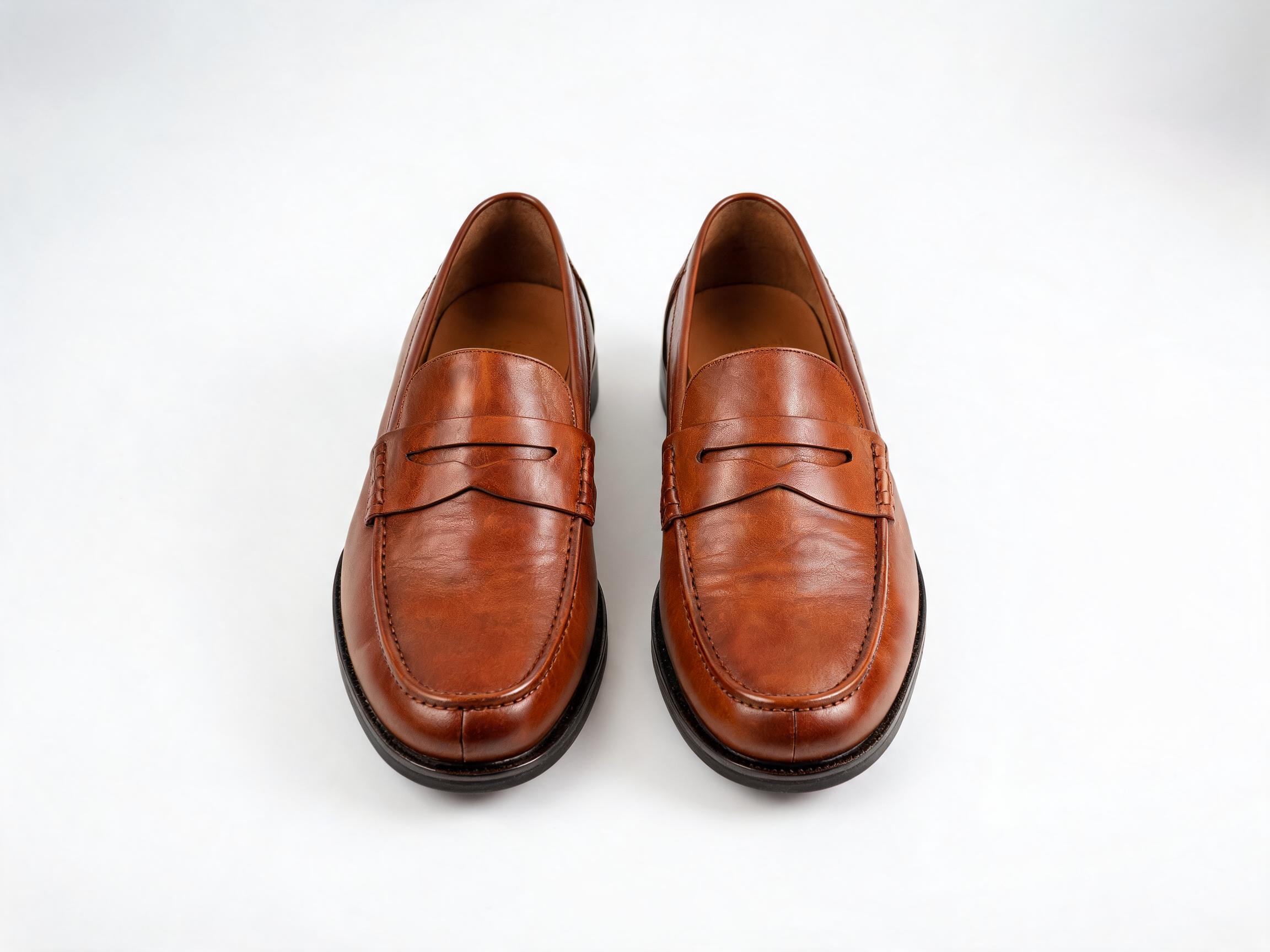
A buying checklist for menswear retailers and distributors sourcing men's loafers wholesale. Covers the leather grading questions worth asking, how last shape drives fit and returns, how to structure a size run, and how mixed-size ordering and restock cadence affect sell-through.
Most mens loafers wholesale orders that disappoint a retailer do so for reasons that were visible at the sampling stage: a leather grade that was described in adjectives rather than terms, a last that fits the sample foot but not the target customer, or a size run built from the supplier's packing list instead of the store's sell-through. This checklist walks through those four decisions in the order a buyer actually faces them.
- Leather grading: which questions produce a usable answer and which do not
- Last shape and fit: how to compare lasts across suppliers before committing
- Size run structure: how to weight a run toward the sizes that actually sell
- Mixed-size ordering and restock cadence: planning reorders before the first shipment lands
Start with the leather grade conversation
"Full grain," "top grain," and "genuine leather" are not regulated terms in most export markets, which means two suppliers can use the same phrase for very different material. For a wholesale buyer, the goal is not to win a vocabulary argument but to establish what will arrive in the cartons and how consistently it will arrive across reorders.
Questions that tend to produce a checkable answer:
- What is the exact material name and tannery source? A named tannery or at minimum a named tannage type gives you something to compare across quotes. "Quality cow leather" does not.
- Is the finish corrected, and if so how heavily? Corrected-grain leathers are more uniform and hide scars; uncorrected leathers show natural variation. Both are legitimate; the problem is ordering one and receiving the other. Ask to see the surface at close range on the actual sample, not a catalog photo.
- What is specified on lining and insole? These are the parts buyers most often skip, and they drive comfort perception and returns. On a penny loafer, the lining and insole construction frequently matter more to the customer than the upper grade.
- How is color matched between dye lots? If you plan to reorder the same cognac in six months, ask how the supplier handles lot-to-lot variation and what tolerance they work to.
- What will the supplier guarantee in writing? Thickness ranges, finish descriptions, and any material statements should appear on the sample confirmation or tech pack, not only in an email.
Ask for the answers on the sample confirmation sheet and keep that sheet with the order. When a reorder arrives and something feels different, the sheet is the document that settles the conversation.
Last shape and fit: compare before you commit volume
The last is the foot-shaped form the shoe is built on, and two loafers that look identical in a photo can fit very differently. For a retailer, last choice shows up as return rate and as whether the shoe sells to the customer who tries it on in store.
At the wholesale stage, compare lasts on four points:
- Toe shape and volume. An almond or slightly tapered toe reads dressier; a rounder, fuller toe reads more casual and accommodates a wider forefoot. Match the shape to the category the loafer will sit in on your floor.
- Instep and opening. A loafer has no lacing to adjust, so the opening and instep height do all the holding work. A last with a high instep can feel loose on a low-volume foot and tight on a high one. This is the single most common fit complaint on slip-on styles.
- Heel fit. Ask how the heel counter is built and whether the sample slips at the heel when walked in. A small amount of initial slip is normal in leather; persistent lift is a last problem, not a break-in problem.
- How the last is graded across sizes. A last that fits well at EU 42 does not automatically scale cleanly to 39 or 45. Ask the supplier to confirm that the same last is used across the full run rather than being substituted at the size extremes.
A practical exercise: request samples in the smallest and largest sizes you plan to stock, not only the middle. Fit problems concentrate at the ends of the run, and that is where your returns will come from.
Size run structure: build the run from sell-through, not from the packing list
Suppliers quote in standard runs because standard runs are efficient to cut and pack. Your store's demand curve is unlikely to match that run exactly. Before ordering, pull your own sales data, or your best estimate if you are opening the category, and weight the run toward it.
| Decision point | What to ask | Why it matters at wholesale |
|---|---|---|
| Run shape | Can the standard run be reweighted toward specific sizes? | A run heavy in the middle sizes leaves you with stock in sizes your customers do not buy. |
| Size range | Is every size in the range made on the same last and pattern? | Substituted patterns at the extremes create fit inconsistency across the run. |
| Size marking | How is sizing marked on the shoe and the box, and is EU sizing used throughout? | Mixed or inconsistent marking causes mis-picks at the warehouse and confusion at retail. |
| Packing | How are pairs packed per carton, and can cartons be size-assorted? | Assorted cartons reduce your receiving and repacking work if you distribute to multiple stores. |
Order minimums vary by style and color, so the size mix you want may need to be confirmed with the sales team before it can be built into a quotation. Ask early: a size run that looks reasonable on paper can become an order-minimum problem if it is spread thinly across too many colors.
Mixed-size ordering and restock cadence
Loafers are a repeat-purchase category for many retailers, and the cost of a poor first order is usually not the first order itself but the reorder that has to be placed in a hurry. Two planning questions are worth settling before the first shipment leaves.
Plan the reorder before the first delivery
Ask the supplier how they handle repeat orders on the same style: whether the leather and last are held consistent between runs, and what lead time applies to a reorder versus a first order. If the answer differs by color, note which colors are treated as core and which are seasonal. A core color that can be reordered reliably is worth more to a menswear retailer than a broader palette that cannot be repeated.
Set a cadence you can actually hold
A restock cadence works when it is tied to your sell-through rather than to a calendar. Two useful inputs: how many weeks of cover you want to hold on the top two sizes, and how long the supplier needs from confirmation to dispatch on a repeat order. Where those two numbers meet is your reorder trigger. For distributors shipping to several retailers, the same logic applies per account, with the smallest viable shipment per account determined by the order minimum.
This is also the point to agree on what happens when a size sells out faster than expected. Suppliers who can split a reorder across sizes, rather than requiring a full run, make mid-season replenishment far easier.
How the sample and QC conversation should run
Most of the risk in a loafers order is settled at sampling, so treat the sample as a specification document rather than a preview. Confirm in writing: the leather and lining materials, the last reference, the size range and grading, the size marking, the packing configuration, and any color reference for each colorway ordered.
A supplier operating a staged quality control process will typically check at more than one point, for example during production and again before packing. Ask what is checked at each stage and who signs off, and ask for that in the quotation response so it sits alongside the commercial terms rather than being assumed.
Matching the style to the run
A buying checklist is easier to apply to a concrete style. Consider the Cognac Penny Loafer Shoes: a classic penny strap with a hand-stitched apron toe, a heel of about 2.5 cm, and EU sizes 39–45. That is a mainstream men's run, which makes it a realistic test case for the size weighting discussion above — the 39 and 45 ends are where you should request fit samples, and the middle sizes are where the run will likely need the most depth.
For retailers carrying a paired men's and women's offer, the women's companion style, Black Leather Loafers, uses a 3 cm block heel and an almond toe across EU sizes 35–41. Sourcing both from one supplier can simplify color and material matching across a floor display, but the size runs are separate decisions and should be planned from separate sell-through data.
Supplier questions worth putting in writing
A short list to send with your first enquiry. Answers to these will tell you more about a supplier's fit for your business than a catalog will.
- What leather, lining, and insole materials are used, and what is documented on the sample confirmation?
- Which last is used, and is it consistent across the full size range?
- Can the size run be reweighted, and what are the order minimums by style and color?
- How is sizing marked on the shoe and carton, and can cartons be size-assorted?
- What is the lead time for a reorder versus a first order, and can reorders be split by size?
- What quality checks are performed, at which stages, and who signs off?
About Aurevia Footwear Co., Ltd.
Aurevia Footwear Co., Ltd. was founded in 2011 and is based in Quanzhou, China, with around 260 staff. The company exports to Europe, North America, and the Middle East, and handles genuine leather sourcing, in-house design and sampling, and OEM/ODM and private label service, with a three-stage quality control process. Buyers sourcing men's loafers wholesale can request sampling and confirm size runs, materials, and order minimums with the sales team before committing volume.