
A planning guide for buyers building a slip-on shoe program: what to ask about elastic gore construction and durability, how to keep fit consistent across a size run, how to structure men's and women's size coverage, and how to plan quarterly restocks without overcommitting inventory.
Slip-on programs fail on details that never show up in a lookbook: a gore that is the wrong width for the last, a size run that leaves a gap in the middle, or a restock calendar that arrives after the season has already turned. This guide covers what to lock down before you commit a slip-on series to production.
Key takeaways
- Elastic gore is a construction decision, not a trim detail — specify width, tension, anchoring and stitch pattern with the factory.
- Durability should be handled as a question list for the supplier, not a claim on your product page.
- Fit consistency across sizes depends on the last and grading rules, so agree on a measurement point before sampling.
- Men's and women's ranges rarely align numerically; map both to a single size ladder and note where the overlap sits.
- Quarterly restocks work better when the reorder trigger is tied to sell-through velocity, not to a fixed date.
On this page
Elastic gore construction: what to specify up front
A slip-on lives or dies on the gore. The upper has no lacing to take up slack, so the elastic panel has to hold the foot with enough tension to stay on, and release enough to get in without a shoehorn.
Before sampling, agree on the following with your supplier and write it into the tech pack:
- Gore width and placement. A single wider panel and two narrower side panels behave differently in wear and in cutting. The width has to match the last and the intended opening.
- Elastic type and stretch direction. Woven and knitted elastics recover differently, and the stretch axis matters — the panel should stretch across the instep, not along the length of the shoe.
- Anchoring and stitching. Ask how the gore is secured at top and bottom, how many stitch rows are used, and whether the seam allowance is reinforced. This is where a cheap gore fails first.
- Lining behind the gore. An unlined gore panel can chafe and can also distort; confirm what sits between the elastic and the foot.
- Colour matching. Elastic is dyed separately from leather or suede. Confirm the gore is matched to the upper under the lighting your market expects.
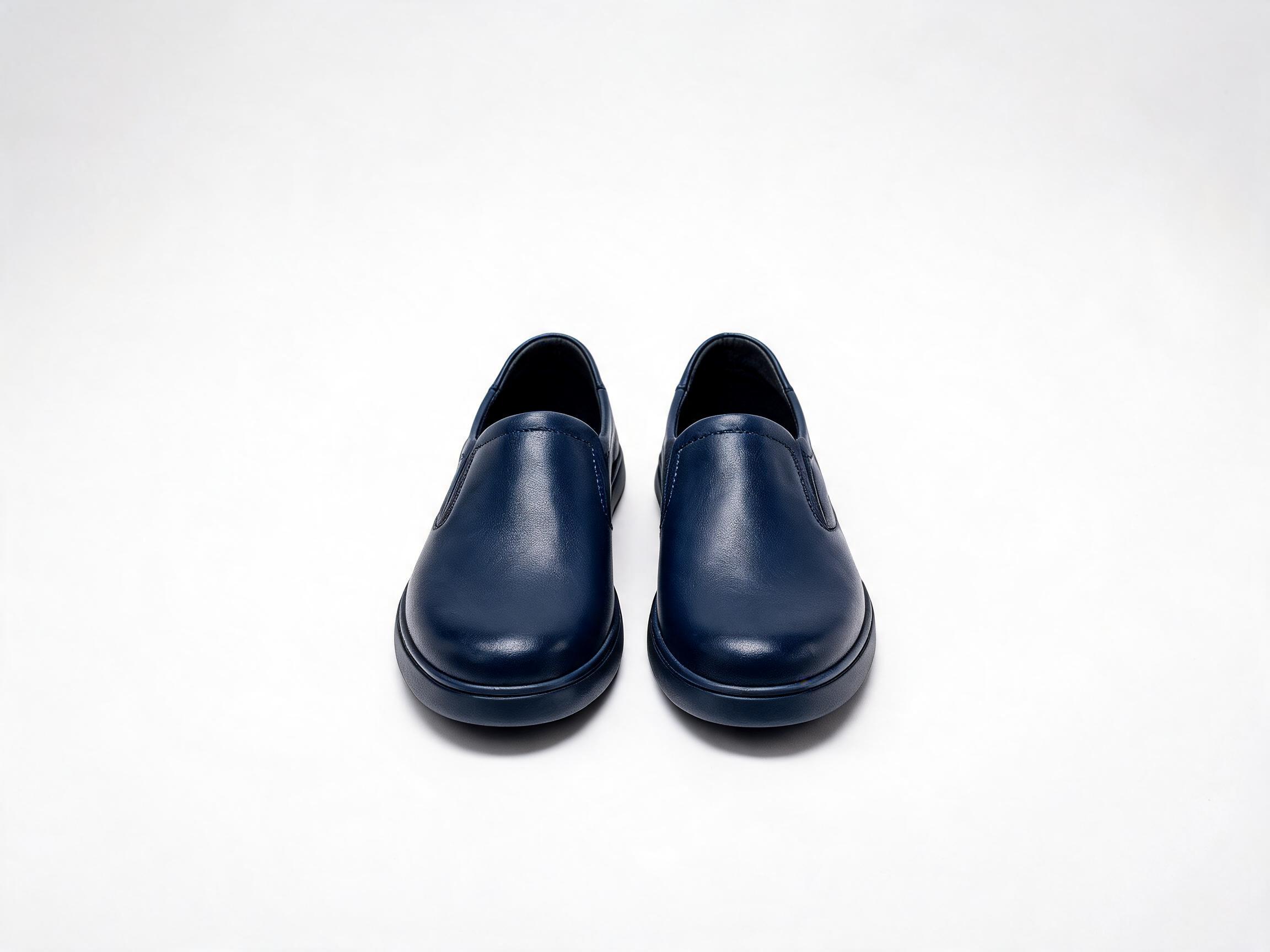
If you are building a men's casual block, a good reference point is a plain navy leather slip-on with an apron toe and a roughly 2.5 cm heel — a shape that carries a visible side gore well. For women's ranges, the equivalent is a lower, flatter profile, where gore placement has less vertical room and needs a tighter specification.
Durability: the questions, not the promises
Elastic recovery is the most common failure point in the category, and it is also the hardest thing to verify from a photo. Rather than accepting a durability claim, ask the factory to describe how they test and what they have observed.
| Question | Why it matters | What a useful answer looks like |
|---|---|---|
| How is the gore's recovery tested before bulk? | Shows whether the factory has a repeatable method or relies on visual checks | A described procedure with sample size and pass criteria |
| What tension range do you specify for this last? | Tension too high causes entry problems; too low causes heel slip | A stated range that the sampling team works to |
| Which elastic suppliers do you use, and can I see the specification? | Elastic quality varies widely and is rarely visible | A named specification with thickness and stretch direction |
| How is the gore seam reinforced? | The seam is the first place a panel separates | Stitch pattern, row count and any backing tape |
| What wear feedback have you had on this construction? | Reveals whether the pattern has been run before | A specific answer, or an honest acknowledgement that it is new |
Treat the answers as a screening tool. A supplier who can describe the method is easier to work with than one who simply says the gore is "high quality", regardless of what the marketing copy says.
Fit consistency across a size run
Slip-ons have a narrower tolerance band than lace-ups. A half size of extra volume can be taken up by laces; on a slip-on it becomes heel slip or a tight instep. Fit consistency therefore comes down to two things: the last and the grading rules.
Ask the supplier for the last measurement at the ball girth and instep for the smallest, middle and largest sizes in your run. If those three points sit on a smooth curve, the grading is likely sound. If the instep grows faster than the opening, the largest sizes will feel loose even though the length is correct.
Agree on a measurement point before you approve samples. Common disagreements come from measuring the opening flat versus on a last, and from measuring leather before and after lasting. Fix the method in the approval document so the pre-production sample and the bulk order are judged the same way.
Two practical notes for buyers:
- Leather and suede relax differently. A leather upper holds its shape through the opening; suede gives more quickly and can feel a half size larger after a few wears. Do not assume one fit standard covers both materials in the same program.
- Insole thickness changes internal volume. A memory foam insole, common in women's flats, takes up space that the gore would otherwise compensate for — confirm the fit was developed with the insole in place.
Size coverage for men's and women's ranges
Slip-on assortments are usually bought as a compact run rather than a full size ladder, because the category sells in fewer widths and the size curve is sharper at the ends. The two ranges in a typical program do not line up numerically, which is where assortment planning gets messy.
Navy Leather Slip-On Shoes (men)
A casual leather slip-on with an apron toe — a plain, wearable shape suited to everyday casual programmes rather than formal use.
Heel: approx. 2.5 cm · EU sizes 39–45
Tan Suede Slip-On Flats (women)
A suede-upper flat with a memory foam insole and a low profile, aimed at casual and comfort-led assortments.
Heel: approx. 1 cm · EU sizes 35–41
Put both ranges on one sheet and mark the overlap. EU 39 is the largest women's size and the smallest men's size in the examples above, so a single size can serve two blocks — but only if the lasts are different. Do not assume a EU 39 women's last and a EU 39 men's last are interchangeable. They are separate developments, and if a customer returns a pair because it "runs big", the cause is usually that the two were conflated somewhere in the order sheet.
For a compact wholesale run, consider these coverage principles:
- Weight the middle. The central three sizes normally carry the volume; the extremes are there for service level, not for turns.
- Decide the top and bottom cut-offs explicitly. A men's run to EU 45 and a women's run to EU 41 is a service decision; state it so the range does not creep during reorders.
- Keep colourways proportional to size depth. A new colour is easiest to test in the core sizes only, then extended if it earns its place.
- Ask about size-set packing. Whether the factory packs by ratio or by solid size affects your receiving and your ability to reorder a single size later.
Quarterly restock planning
Slip-ons sit on a seasonal curve that is flatter than boots but sharper than plain lace-up casuals — they tend to move at the shoulder seasons, when buyers want an easy shoe but not yet a sandal or a boot. That makes a quarterly cycle a reasonable frame, provided the trigger is sell-through rather than the calendar alone.
A workable quarterly plan has four parts:
- A base forecast per size, not per style. Style-level forecasts hide the fact that you run out of EU 41 before you run out of the style.
- A reorder trigger. Set a sell-through percentage for core sizes that opens a reorder, and review it at a fixed point each quarter.
- A carry-over decision. Decide in advance which colourways continue and which are closed out, so the next quarter's sample budget is not spent re-developing a style you already own.
- A production window agreed with the supplier. Ask when their capacity is committed for each quarter and book the reorder slot before the trigger fires, not after.
Two construction notes affect restock planning more than buyers expect. First, leather and suede are dyed in lots, so a reorder placed months after the first run may not match the original colour exactly; ask the supplier how they handle lot matching on repeat orders. Second, if the gore elastic is a special order, a small reorder can be slower than the first bulk order. Both points are worth raising when you set the reorder schedule.
For buyers sourcing from a factory with in-house design and sampling, as Aurevia Footwear Co., Ltd. does from its Quanzhou base, it also helps to ask whether the original last is retained between seasons. A retained last is what makes a second-quarter reorder a restock rather than a redevelopment.
FAQ
How do I check elastic gore quality before placing a bulk order?
Ask for the elastic specification, the tension range the sampling team works to, and a description of how the gore seam is secured. Then handle the pre-production sample yourself — put it on and take it off repeatedly and note whether the opening recovers. A factory that can describe its method is easier to hold to a standard than one that only offers reassurance.
Should men's and women's slip-ons share a last?
No. They are separate developments, even where the EU size numbers overlap. Confirm the last used for each range and keep the two size charts separate on your order sheet so the overlap is not treated as interchangeable.
What is the best time to place a slip-on reorder?
Tie it to sell-through on core sizes and to the supplier's production calendar. Because leather and suede repeat orders can vary by dye lot, place the reorder early enough that a colour deviation can still be resolved before the goods are packed.
Can a slip-on program run leather and suede on the same fit standard?
Not directly. Suede generally gives more through the opening than leather. If both materials are in the range, develop and approve each against its own fit reference.
If you are building a slip-on series for the coming quarters, the useful next step is a size-and-material brief: which ranges you need, which sizes carry your volume, and which colourways return. With that in hand, the sampling conversation moves straight to construction instead of starting from a catalogue page.