A pre-commit evaluation guide for brand, wholesale and retail-chain buyers shortlisting sneaker manufacturers for OEM and private-label programs. It covers last development and fit grading, upper material decisions across leather low-tops, high-top collar construction and engineered knit uppers, outsole and construction choices, and the QC evidence to request before bulk production is released.
Buyer Evaluation Guide
Shortlisting sneaker manufacturers for an OEM or private-label program usually comes down to three things a spec sheet will not settle on its own: how the last is developed, what the upper is built from, and what QC evidence exists before you commit to bulk. This guide gives brand, wholesale and retail-chain buyers a consistent basis for comparing factories on those points.
Key takeaways
- A factory's last library and grading method decide whether the whole size run fits, not just the sample size.
- Leather low-tops, high-top collar constructions and engineered knit uppers fail in different places — compare them on the right criteria.
- Cupsole, vulcanized-style and EVA midsole constructions carry different tooling and QC consequences.
- Ask for QC records tied to the specific model and stage, not generic certificates.
- Sample speed matters early; order quantities and schedules are confirmed per model with the supplier.
What buyers actually differ on between sneaker manufacturers
Most factories can show a finished sneaker. Fewer can show how the last was developed, how sizes are graded, and what was measured before the bulk order was released. When you compare sneaker manufacturers for a custom label, the useful differences sit in those process stages rather than in the catalogue photo.
A practical comparison basis is to score every candidate on the same four dimensions: last and fit development, upper material and construction, outsole and assembly method, and inspectable QC evidence. Keep the basis identical across candidates so the shortlist reflects capability, not presentation.
Last development and fit grading
The last is the shape the whole shoe is built around. Fit problems that surface at retail — tight forefoot, slipping heel, inconsistent sizing across the run — are usually settled at the last stage, long before materials are cut.
Questions that separate capable factories
- Does the factory develop lasts in-house, or buy stock lasts and adapt them? Judge this on evidence rather than on a general design capability: ask each candidate to show its last library, its grading method and a written measurement sheet for the size run.
- How is grading handled across the size run? Ask whether the factory grades from a physical last per size or scales from a base size, and request confirmation that key girth measurements are checked at the extremes of the run.
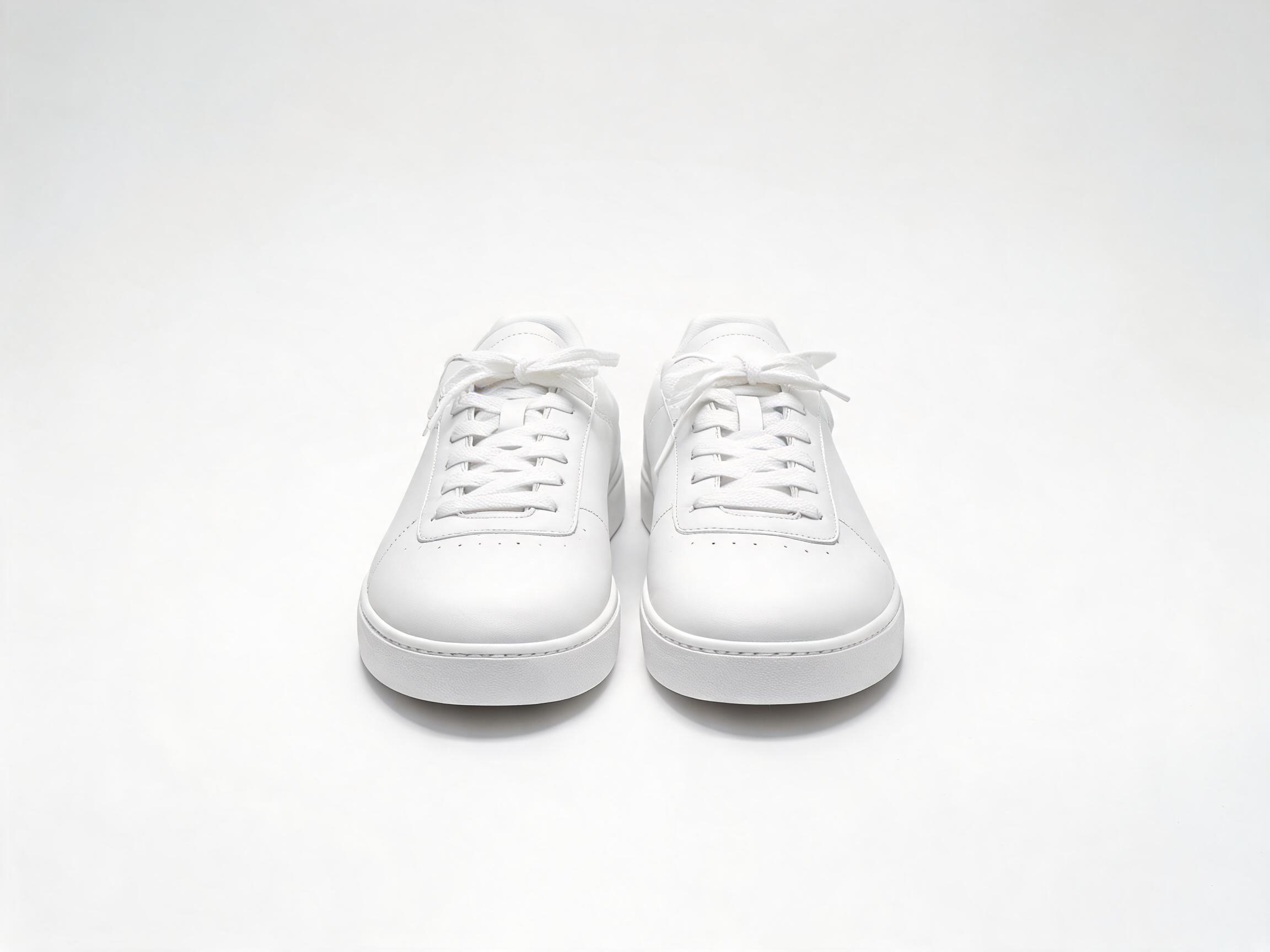
- Does the size offer match your market? The white leather low-top sneakers and black leather high-top sneakers are both offered in EU 39–45 (the low-top also in US 6.5–12); the grey knit running sneakers run EU 39–45.
- Who signs off the fit sample, and against what measurement sheet? A factory that supplies a written measurement table before the fit trial is easier to hold to the agreed fit.
Fit is not something a buyer can judge from one sample. Request a fit set across at least the smallest and largest sizes in the range and check forefoot width and heel hold at both ends.
Upper material decisions: leather low-top, high-top collar, knit running
The upper choice changes what you should inspect. Compare candidates on the construction that matches your program, and do not assume a factory strong in one upper type is equally strong in another.
Full-grain leather low-tops
Cemented construction with a rubber cupsole is the common approach for a leather low-top; the white leather low-top uses a full-grain leather upper, breathable textile lining, cushioned removable insole and rubber cupsole, with a heel of approximately 2.5 cm. For this type, ask about leather selection consistency, colour matching across panels, and how the factory checks colour fastness between the upper and the lining.
High-top collar construction
A padded high-top collar adds stitching and padding steps that affect comfort and shape retention. The black leather high-top uses full-grain leather, a padded high-top collar and a vulcanized-style rubber outsole, with a lace-up closure and a side zipper option. If you specify the zipper option, confirm how the factory inspects the zip action and collar shape after lasting — these are the parts most likely to be flagged at final inspection.
Engineered knit uppers
Knit uppers are built from a mesh with zoned density rather than cut from panels, so the questions shift. The grey knit running sneakers use an engineered knit mesh upper with zoned density and a reinforced heel counter, breathable mesh lining, lightweight EVA midsole and a wear-resistant rubber outsole. Ask which zones are reinforced, how the factory checks the heel counter bond, and whether the knit is inspected for distortion after lasting.
| Upper type | What to compare | Where problems typically show |
|---|---|---|
| Full-grain leather low-top (cemented, cupsole) | Leather consistency, panel colour match, colour fastness between upper and lining | Shade variation across panels; sole-to-upper bond |
| Full-grain leather high-top (padded collar, vulcanized-style outsole) | Collar padding and stitching, zip action if the zipper option is specified | Collar shape after lasting; zipper function |
| Engineered knit running upper (zoned density, EVA midsole) | Zone reinforcement, heel counter bond, knit distortion after lasting | Upper distortion; midsole and outsole attachment |
Outsole and construction choices
Outsole and assembly method drive both the tooling you may need to pay for and the QC checks that matter most.
- Cupsole with cementing: familiar for leather low-tops and gives a clean sidewall. Bond strength between upper and sole is the critical check.
- Vulcanized-style rubber outsole: used on the high-top; ask how the factory inspects the join between upper and outsole, since this construction has more seams to check.
- EVA midsole with rubber outsole: typical for knit running uppers; ask about midsole-to-outsole adhesion and whether wear resistance of the outsole is checked at the sample stage.
On the same comparison basis, note whether each candidate has existing tooling for your chosen outsole or would need new tooling developed. Tooling readiness affects the sample timeline and should be confirmed per model with the supplier.
QC evidence to request before bulk
Do not accept a general statement that the factory inspects quality. Ask for evidence tied to the specific model and the specific stage. Aurevia's stated process is a three-stage inspection — incoming material, in-line and final finished-shoe — with forefoot flex testing, colour fastness and sole adhesion checks, inspection reports available on request and third-party inspection welcome. Treat that as a supplier statement, not as evidence in itself: ask to see the actual model-specific records before you accept it. Use the same standard for any candidate:
- Incoming material: records showing the leather, knit or lining was checked against spec before cutting.
- In-line: inspection points during lasting and sole attachment, not only after completion.
- Final finished-shoe: the specific tests run — for example forefoot flex, colour fastness and sole adhesion — and the pass/fail criteria.
- Reports: ask to see actual inspection reports for the model; confirm whether third-party inspection is permitted before you commit.
Confirm which reports the factory can share and in what form. Records that name the model, the stage and the date are far more useful than a generic quality statement.
A practical pre-commit checklist
- Confirm the last and grading method, and that the full size run covers your market (EU 39–45 or equivalent).
- Request a fit set at both ends of the size range.
- Match the upper type to your program and agree the inspection points for that type.
- Agree the outsole and construction, and check whether tooling is ready or must be developed.
- Ask for inspection records at all three stages and confirm third-party inspection is welcome.
- Check sample timelines: existing samples 3–5 days and customized samples about 7–12 days where the last and outsole are already tooled; confirm separately if new tooling is needed.
- Confirm trade terms (EXW, FOB or CIF) and that order quantities and schedules are agreed per model.
FAQ
How long does a customized sneaker sample take?
For Aurevia, existing samples take 3–5 days and customized samples about 7–12 days. Timelines for a specific model should be confirmed with the supplier once the upper, outsole and last are agreed.
Can the factory share inspection reports?
Inspection reports are shared on request, and third-party inspection is welcome. Ask for records that name the model and inspection stage.
What sizes are available?
The leather low-top and high-top models from Aurevia run EU 39–45 (the low-top also in US 6.5–12), and the grey knit running sneakers run EU 39–45.
What trade terms are offered?
EXW, FOB and CIF are available. Order quantities and schedules are confirmed per model with the supplier.