
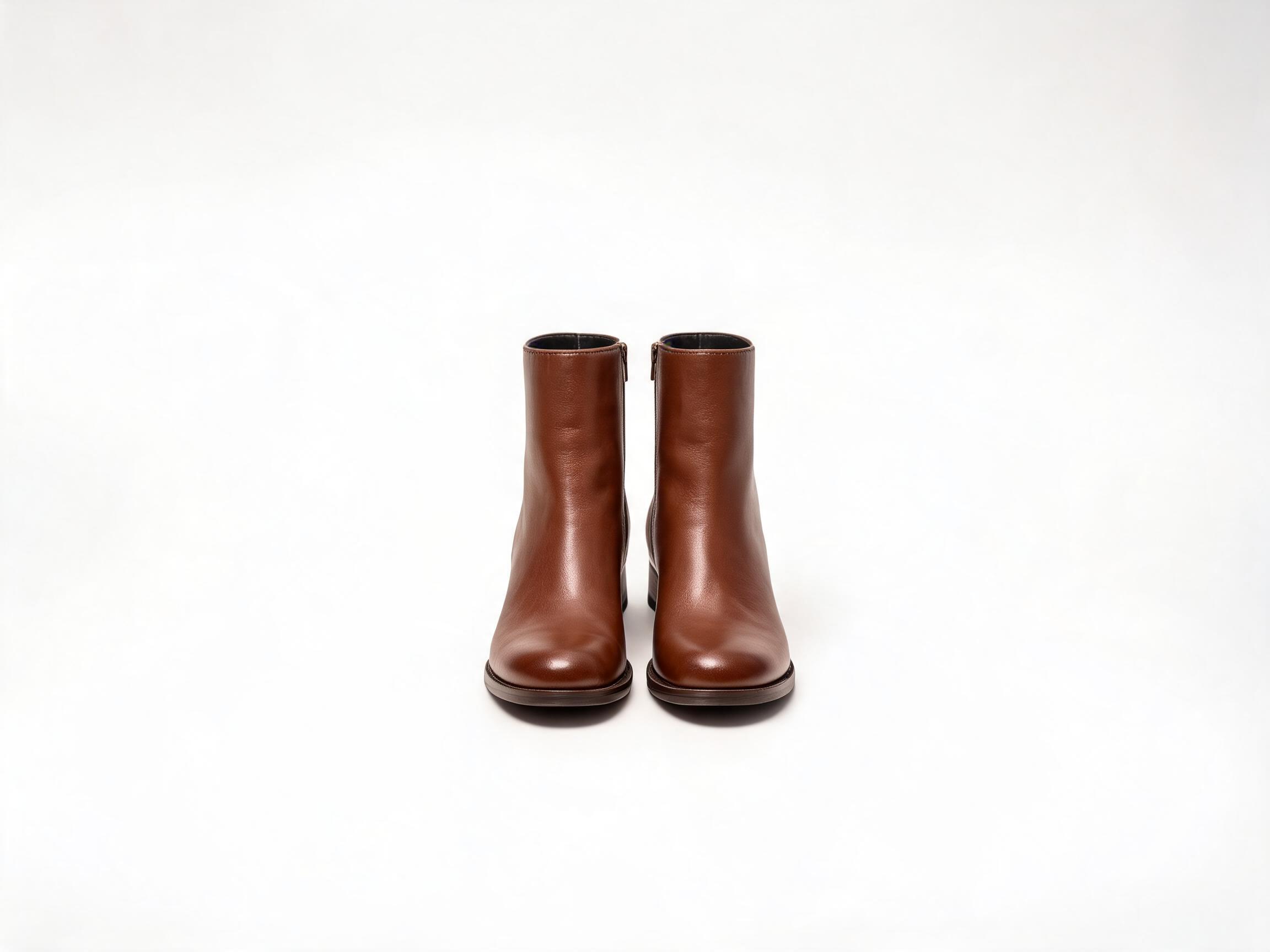
A procurement guide for importers and retail chains planning autumn/winter ankle boot orders. Covers last and shaft development, leather upper selection, closure and lining choices, three-stage bulk QC, and private-label customization — with reference to Aurevia Footwear's Brown Leather Ankle Boots (12 cm shaft, EU 35–41 / US 5–10).
B2B Procurement Guide · Autumn/Winter Season
Every autumn/winter program starts with the same problem: the ankle boot is the highest-visibility item in the collection, and it is also the one most likely to generate size complaints, zipper failures and colour mismatches after the container lands. For importers, wholesalers and retail chains, the difference between a clean season and an expensive one is usually decided long before the PO is signed — at the last, the leather selection and the QC plan.
Aurevia Footwear Co., Ltd. has been based in Quanzhou since 2011, with 260 employees and in-house design and pattern teams, exporting to Europe, North America and the Middle East. This guide covers the four technical decisions that determine whether a bulk ankle boot order ships clean: last and shaft development, leather upper selection, closure and lining choices, and bulk QC checkpoints. It also outlines what private-label buyers can realistically customise, using the Brown Leather Ankle Boots from our range as a working reference.
Key takeaways for bulk buyers
- Last and shaft are the first approval gate; a 12 cm shaft changes opening, lining consumption and fit grading compared with a low-cut boot.
- Leather upper selection is a three-way trade-off between grain appearance, temper and price — full-grain, corrected-grain and split suede behave differently in lasting and in colour fastness.
- Closure and lining choices — side zipper, elastic gusset, warm lining — determine both the retail price point and the most common after-sales complaints.
- Bulk QC works when it is staged: incoming material, in-line and finished-shoe inspection, with forefoot flex, zipper function, sole adhesion and colour fastness checked at defined points.
- Private-label buyers should separate what can be changed (colour, logo, packaging, lining) from what requires a new mould or last investment.
Why ankle boots are the hardest category to order blind
An ankle boot sits between a shoe and a tall boot. That middle position creates procurement risk in three places. First, the shaft height defines how much leather and lining each pair consumes, so a specification change of a few centimetres moves the material cost and the pattern grading. Second, the closure — usually a zipper or gusset — is a mechanical component with a defined service life, and it is the part most exposed to repeated flexing. Third, because the boot covers the ankle, a fit error that a low shoe would hide becomes a visible comfort problem for the end consumer.
That is why experienced buyers treat ankle boots as an engineering item, not a fashion item. The questions to settle before the first sample are technical: what last, what shaft, what upper, what closure, what lining and what QC evidence.
Last development: the first decision that locks in fit
What “last” controls
The last determines toe shape, instep height, heel seat width and the internal volume of the whole boot. Two suppliers can quote the same photographed design and deliver a completely different fit because their lasts are different. For a bulk program, the last must be approved on a physical fit sample before any leather is cut.
Ask for the last specification in writing: the last number or reference, the size grading table, and the physical measurements at key points (ball girth, instep girth, heel width). If the supplier cannot provide a grading table, the size run will drift across EUR 35–41, and the largest and smallest sizes will attract the complaints.
Shaft height and opening
The anchor model in our range — the Brown Leather Ankle Boots — uses a shaft height of approximately 12 cm. That is a genuine ankle height: it covers the ankle bone without restricting movement, and it sits in the volume band that most European and North American autumn/winter assortments buy. For buyers, the practical consequence is that 12 cm defines the leather and lining consumption per pair, the pattern piece count, and how the boot presents on a shelf next to a tall boot or a low shoe.
When you review a shaft sample, check three things: that the left and right shaft heights match within your tolerance, that the opening circumference allows the foot to enter without forcing, and that the top line is level around the whole leg opening. A skewed top line is a lasting or pattern problem, not a cosmetic one, and it will repeat across the bulk order.
Heel and sole attachment
The heel height and heel shape are design variables that must be confirmed on the approved sample. Because heel height records can differ between development rounds, the safe procurement practice is to approve the physical sample and record the measured heel height on the specification sheet, rather than working from a written figure. The same applies to the sole: confirm the outsole type and the attachment method on the sample, and make sole adhesion one of the bulk QC checks described below.
Leather upper selection: grain, temper and cost
Ankle boot uppers are usually cut from one of three leather families. Each behaves differently on the lasting line and in the field.
| Upper type | Appearance | Working behaviour | Typical buyer concern |
|---|---|---|---|
| Full-grain leather | Visible natural grain, minimal surface correction | Firm temper, holds shape well on a structured boot | Natural marks and shade variation between hides |
| Corrected-grain leather | Uniform surface, consistent colour | Softer and more forgiving in lasting | Grain pattern can look flatter at close range |
| Split suede | Napped surface, matte finish | Thin and flexible, needs care in cutting direction | Colour fastness and water sensitivity |
The Brown Leather Ankle Boots use a full-grain leather upper. Full-grain is chosen when the buyer wants the leather to remain visible as leather — the grain is the selling point. The trade-off is that full-grain hides show natural variation, so the colour approval must be done on a full pair in the final colour, not on a swatch card alone.
What to specify in the leather brief
- Leather type and thickness range — for example, full-grain with a stated thickness band. Thickness drives both lasting behaviour and the cost per pair.
- Colour reference and finish — provide a physical reference or a matched swatch, and state whether the finish is aniline, semi-aniline or pigmented.
- Colour fastness requirement — confirm the test method and the pass level the supplier will work to, and make colour fastness a bulk QC checkpoint.
- Hide yield expectation — ask how many pairs per hide the pattern assumes. This is the single biggest driver of leather cost in the quotation.
Closure and lining: small components, large complaint volume
Closure choice
The common ankle boot closures are a side zipper, a rear zipper, an elastic gusset, or a combination. The Brown Leather Ankle Boots use a side zipper closure, which is the most common choice for a 12 cm shaft: it lets the foot enter without lacing, and it keeps the front line clean for the upper leather.
Zipper quality is a specification, not a detail. Ask for the zipper brand or reference, the tape width, the slider type and the puller. Then test it: a bulk QC zipper check should cycle the zipper open and closed, confirm the slider does not catch on the tape, and confirm the zipper does not open behind the slider under light pull. Zipper function is one of the most frequent after-sales complaint points on any zipped boot.
Lining choice
Lining is where the seasonal positioning is decided. The Brown Leather Ankle Boots use a soft warm lining, which targets the cold-weather segment of the autumn/winter range. The options buyers typically weigh are:
- Soft warm lining — for cold-weather retail positioning; adds warmth and a premium hand-feel.
- Textile lining — lighter, breathable, lower cost; suits transitional-season ranges.
- Leather lining — highest hand-feel and moisture management; highest cost.
Lining also affects fit. A warm lining adds internal volume, so a boot that fits tightly in a textile lining can become uncomfortable in a warm lining on the same last. If you change the lining between seasons, re-approve the fit sample.
Insole and outsole
The Brown Leather Ankle Boots combine a cushioned insole with an anti-slip rubber outsole — a combination aimed at comfort-led retail programs. For bulk orders, confirm the insole material and thickness, and confirm the outsole rubber compound and tread pattern on the physical sample. Anti-slip performance should be discussed with the supplier against the specific floor conditions and test method your market expects; the supplier can confirm which method applies to a given order.
Bulk order QC: build the checkpoints into the PO
Quality control on a bulk ankle boot order works when it is staged and tied to release points. Aurevia runs a three-stage inspection — incoming material, in-line, and finished-shoe — supported by in-house design and pattern teams and multi-stage leather inspection.
| Stage | What is checked | Why it matters for ankle boots |
|---|---|---|
| Incoming material | Leather grain and shade against the approved standard; lining, zipper and outsole conformity; material quantity | Leather shade variation is the main cause of mismatched pairs in a finished shipment |
| In-line | Lasting symmetry, shaft height and top-line level, stitching alignment, zipper seating | Catches pattern and lasting faults while the batch is still on the line |
| Finished shoe | Forefoot flex testing, zipper function, sole adhesion, colour fastness, size and shaft measurement, packing and carton mark | Confirms the pair that will actually reach the customer, not the sample |
Four finished-shoe checks to write into the inspection plan
- Forefoot flex testing — flex the boot at the ball line repeatedly and check that the upper and sole do not separate and that the flex point matches the foot's natural break.
- Zipper function — cycle the zipper, check slider travel, tape alignment and that the closed zipper holds under light pull.
- Sole adhesion — inspect the bond line between upper and outsole, and check for gaps or lifting at the toe and heel.
- Colour fastness — check the finished boot against the approved colour standard under consistent lighting, on both boots of the pair.
Inspection logistics
Decide before production whether inspection is done by the factory's own QC team, by your nominated third-party inspector, or both. Whichever route you choose, tie the final inspection to a release point in the PO — payment or shipment release should follow a passed inspection, not a promised one. Sample lead times for existing samples run 3–5 days, and custom samples 7–12 days, so build the approval cycle into your calendar before the production window opens.
Private-label customization: what can change and what cannot
Ankle boot OEM/ODM programs are most efficient when the buyer separates cosmetic and commercial customization from structural change.
| Customization | Typical scope | Buyer impact |
|---|---|---|
| Colour | Brown, black, tan, or custom colour matching | New colour approval; leather availability to confirm per order |
| Logo | Logo on insole, outsole, zipper puller or packaging | Usually the lowest-risk brand element to add |
| Packaging | Individual box and export carton, printed to your artwork | Requires artwork files and a packaging approval step |
| Lining | Warm lining, textile or leather alternatives | Requires fit re-approval if the lining volume changes |
| Last or shaft height | New last or a different shaft height | New pattern and tooling work; treat as a development project, not a colour change |
The Brown Leather Ankle Boots are offered in brown, black, tan and custom colours, in sizes EU 35–41 / US 5–10, with individual box and export carton packing. OEM and ODM support covers logo and packaging. For orders covered by our standard terms, a six-month quality warranty applies, with a 48-hour after-sales response window.
Terms to confirm per project: minimum order quantity, unit price, production lead time and payment terms vary by specification, colour and packaging. These are not fixed figures — confirm them for your specific brief before you build your cost sheet.
FAQ for wholesale ankle boot buyers
How do I choose the right ankle boot last for my market?
Start from your existing best-selling last if you have one. Otherwise, ask for the supplier's standard last and its grading table, then approve a fit sample in the actual retail size range — not just a single mid-size sample. Request physical measurements at ball girth and instep girth so you can compare with your current range.
Where can I buy leather ankle boots in bulk?
Leather ankle boots are typically sourced through OEM/ODM manufacturers with in-house pattern and sampling capability. When you evaluate a supplier, ask for the leather specification in writing (type, thickness, finish), the colour approval process, and the QC stages applied to a bulk order. Aurevia's Brown Leather Ankle Boots product page shows the specification format we work from.
What is the most common quality complaint on bulk ankle boots?
Zipper function, colour mismatch between the two boots of a pair, and sole adhesion at the toe or heel. All three are addressable with staged QC: material inspection for colour, in-line inspection for zipper seating, and finished-shoe inspection for flex and adhesion.
Can I change the shaft height on a standard ankle boot?
Yes, but treat it as a development item. Changing shaft height alters the pattern, the lining consumption and the fit grading, so it requires a new sample round. Existing samples take 3–5 days; custom samples take 7–12 days.
How long does sample development take for a custom ankle boot?
Custom samples are quoted at 7–12 days, against 3–5 days for existing samples. Factor the approval round into your autumn/winter calendar so that sample sign-off closes before the production window.
Next step for your autumn/winter ankle boot program
Bring your brief to the sampling stage early: last and grading table, shaft height, leather type and colour reference, closure type, lining, and the QC checkpoints you want written into the PO. If you are starting from an existing specification, the Brown Leather Ankle Boots — full-grain leather upper, side zipper, warm lining, cushioned insole and anti-slip rubber outsole, 12 cm shaft, EU 35–41 / US 5–10 — is a practical reference point for a first sample request. Share your target market, size range, colour direction and packaging artwork, and our design and pattern team can confirm which parts of the brief are standard and which require development work.