
A B2B guide to building seasonal heel assortments around metallic finishes, suede, ankle straps, and statement colors—and how mixed orders with OEM Pantone color-matching reduce trend-SKU risk.
Most seasonal heel programs fail for the same reason: the buyer picks one trend SKU, commits volume to it, and then watches the season move while the stockroom does not. A metallic pump that looked right in a showroom photo can read flat under store lighting; a statement color that sold in one city can sit untouched in another. The fix is rarely a better single style. It is a better assortment—finishes, straps, colors, and heel heights combined across one mixed order, with color specified by Pantone reference rather than by whatever appears on a trend board.
This guide translates the four seasonal details buyers ask about most—metallic finishes, suede, ankle straps, and statement colors—into wholesale selections, then explains how mixed ordering across finishes, colors, and heel heights works with OEM color-matching. Two styles serve as anchors throughout: a metallic-finish leather evening heel at 9 cm and a kid suede ankle-strap heel at 8.5 cm.
What this guide covers
Translating seasonal details into wholesale selections
Each seasonal detail carries a different buyer risk. Metallic finishes are lighting-dependent; suede is texture- and care-dependent; ankle straps are fit- and silhouette-dependent; statement colors are market-dependent. Treating them as one interchangeable trend is where programs go wrong.
Metallic finishes
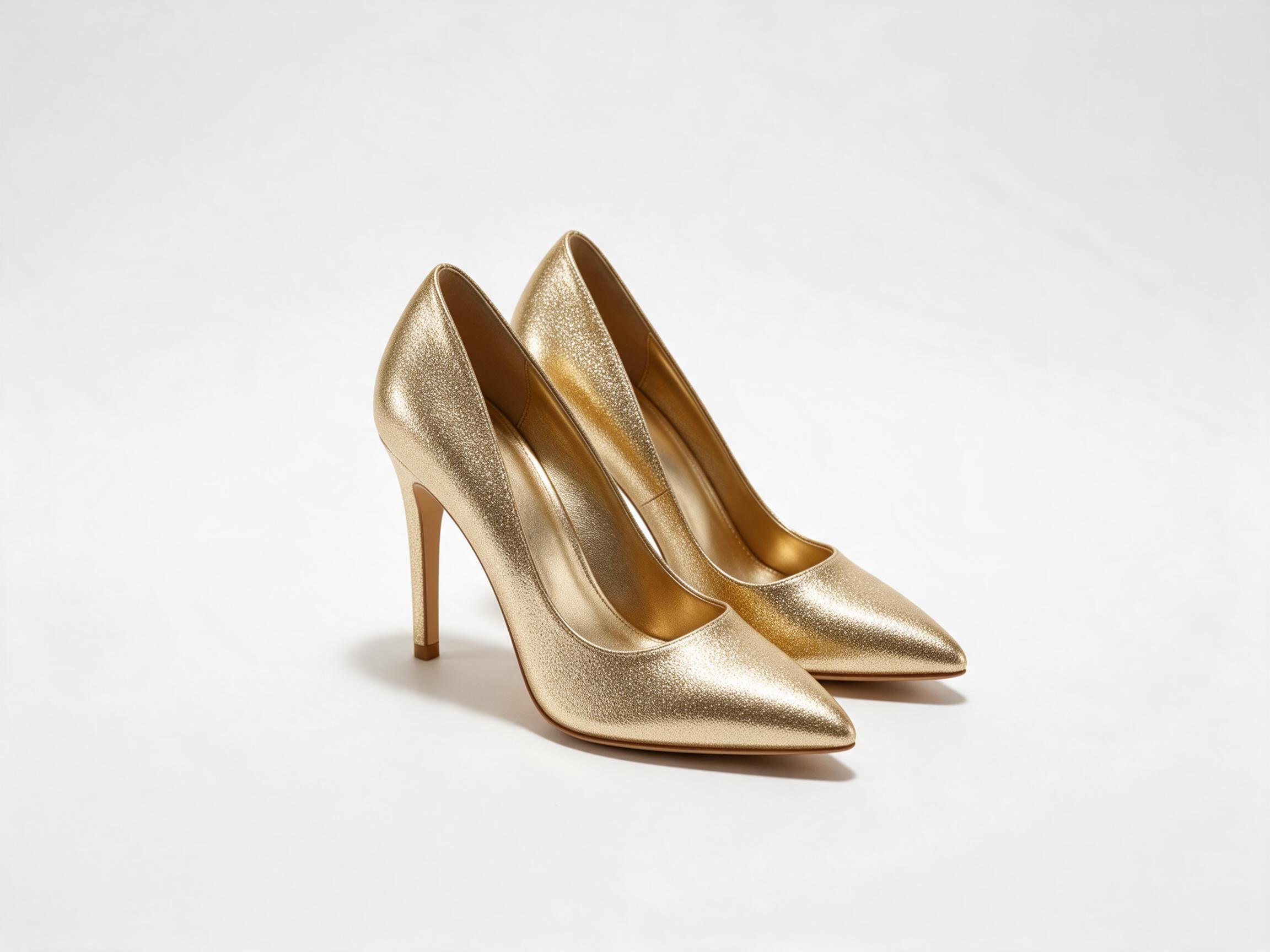
Metallic footwear sells on surface response—how the finish catches light at different angles. In wholesale terms, that means the finish family should be selected before the color, and the color should be pinned to a Pantone reference so that gold, silver, and rose gold read identically from the sample room to the bulk order. The gold metallic evening heel illustrates the category: metallic-finish leather, a 9 cm heel, and a choice of gold, silver, rose gold, or custom finishes. A 9 cm height suits evening and occasion programs; buyers planning day-to-night wear often mix in a lower heel from the same finish family rather than lowering the heel on every SKU.
For buying purposes, the metallic decision is threefold: which finish family (gold, silver, rose gold), which Pantone reference defines the tone within that family, and which heel height anchors the program. Finishes that look close on a screen can diverge in production, so the Pantone reference is what makes three finish variants behave as one coherent family.
Suede
Suede adds texture that smooth leather does not, and that texture behaves differently under retail lighting and across colorways. The black suede ankle-strap heel is a useful anchor: kid suede, an adjustable ankle buckle, and an 8.5 cm heel. The adjustable buckle matters for wholesale because ankle straps are a fit variable—one strap length does not serve every ankle, and a buckle that adjusts reduces the risk of returns tied to fit.
For buying purposes, suede raises two questions that smooth leather does not. First, the color reference matters more, because suede absorbs and reflects dye differently from smooth leather; a Pantone chip approved on a leather swatch should be re-approved on the suede swatch. Second, the finish (matte versus brushed) affects how the color reads across the collection, so it belongs in the specification alongside the color reference.
Ankle straps
Ankle straps are a silhouette decision as much as a detail. They visually shorten the leg line, so they pair differently with hemlines and with heel heights. In a wholesale assortment, ankle straps work best as a variant within a family—same toe shape, same heel, strap on or off—rather than as a standalone trend SKU. That structure lets a buyer test strap acceptance without committing the entire order to one silhouette.
Statement colors
Statement colors are the most market-specific variable in the mix. A color that performs in one region can underperform in another, and the same color can behave differently across finishes. Buyers who treat statement color as a Pantone reference rather than a name—"cobalt" means little; a Pantone number means something specific—can place smaller quantities across more colors and let sell-through decide where to reorder. This is the core argument for mixed orders: color breadth inside one order replaces the all-or-nothing bet on a single trend color.
Why mixed orders beat single-trend-SKU buying
A single-trend-SKU order concentrates risk. If the trend lands, the buyer reorders; if it misses, the inventory is stranded. A mixed order spreads that risk across finishes, colors, and heel heights within one program, so a miss in one color is offset by a hit in another. The constraint is usually not willingness but coordination: can the supplier produce a mixed assortment without treating each variant as a separate order with its own setup cost?
That is where OEM color-matching changes the economics. When the buyer specifies each colorway by Pantone reference, the supplier can group production by finish and heel construction and vary color within the group. Mixed ordering across finishes, colors, and heel heights then becomes a planning exercise rather than a series of independent orders. The two anchor styles show the structure: one metallic-finish leather family (9 cm, gold/silver/rose gold/custom) and one kid suede ankle-strap family (8.5 cm, adjustable buckle). A buyer can build a program that spans both families, with colorways pinned to Pantone references and heel heights selected to match the occasion mix.
Practical rule: specify color by Pantone reference before discussing quantity split. A mixed order is only manageable when every colorway has a fixed reference; without it, each variant becomes a negotiation.
OEM color-matching with Pantone references
OEM color-matching means the supplier matches production to a color reference the buyer controls, rather than to a supplier's stock color card. For wholesale fashion heels, the reference is typically a Pantone number, and the process has four steps that buyers should plan for:
- Reference selection: the buyer provides a Pantone reference for each colorway, including the statement colors and any custom metallic finish.
- Swatch approval: the supplier produces a swatch in the target material—metallic-finish leather, kid suede, or another specified material—and the buyer approves it against the Pantone chip. Approving on the wrong material is the most common source of color drift.
- Production matching: bulk production matches to the approved swatch, with the Pantone reference recorded on the specification.
- Variance acknowledgment: some variance between materials and production batches is normal in footwear; the buyer and supplier should agree on acceptable tolerance before production, not after.
Two points are worth stating plainly. First, Pantone references are the buyer's tool for control—without them, "rose gold" or "burgundy" is a description, not a specification. Second, color-matching does not eliminate material differences: a Pantone reference approved on smooth leather will not automatically match on suede, which is why the anchor suede style should be swatched separately even when it shares a reference with a leather style.
A sample mixed-order structure
The table below shows how the two anchor styles can be combined into one seasonal program. Quantities are illustrative only—the actual split depends on the buyer's market, and MOQ, lead time, and pricing should be confirmed with the sales team before ordering.
| Style family | Heel height | Finish / material | Colorways (Pantone-specified) | Role in assortment |
|---|---|---|---|---|
| Metallic evening heel | 9 cm | Metallic-finish leather | Gold, silver, rose gold, custom | Occasion anchor; finish breadth |
| Suede ankle-strap heel | 8.5 cm | Kid suede, adjustable ankle buckle | Black plus statement colors by Pantone | Texture and strap variant; day-to-evening |
| Mixed program | 8.5–9 cm | Leather + suede | Shared Pantone system across both families | Risk-spread across finishes, colors, heights |
The value of this structure is not the specific quantities but the logic: two heel heights close enough to share an occasion profile, two finishes that serve different parts of the season, and a color system that spans both families through Pantone references. A buyer can shift volume between rows as sell-through data arrives, without renegotiating the color specification.
Questions to ask a fashion heels supplier
When evaluating a fashion heels supplier for a mixed seasonal order, the useful questions are specific and verifiable:
- Can you produce the metallic-finish leather family in gold, silver, rose gold, and a custom finish, with each colorway matched to a Pantone reference?
- For the suede ankle-strap style, is the ankle buckle adjustable, and can the suede color be swatched against a Pantone reference separately from the leather styles?
- How are mixed orders structured across finishes, colors, and heel heights—grouped by construction, by finish, or by color?
- What is the swatch approval process, and on which material is the Pantone reference approved?
- What MOQ, lead time, and pricing apply to a mixed order versus a single-SKU order? (Confirm these with the sales team before ordering; they are program-specific.)
These questions do not require a supplier to promise anything beyond what it can verify. A supplier that can answer them concretely is easier to plan a seasonal program with than one that answers only in trend language.
FAQ
Can I mix metallic and suede styles in one order?
Yes—mixed orders are the point of this approach. The two anchor styles use different materials and heel heights, so the buyer should specify each colorway by Pantone reference and approve swatches on the correct material for each family.
Do I need a Pantone reference for every color?
For a controlled program, yes. Pantone references turn descriptions like "rose gold" or "statement red" into specifications, which is what makes mixed-order colorways manageable across finishes and heel heights.
Is the 9 cm metallic heel suitable for daywear programs?
The 9 cm height is positioned for evening and occasion use. Buyers planning day-to-evening assortments often pair it with a lower heel from the same finish family rather than using one height across the whole program.
What about MOQ and lead time for mixed orders?
These depend on the specific mix—finishes, colors, heel heights, and quantity split. Confirm with the sales team before ordering so the terms reflect the actual program.
Next step: if you are building a seasonal heel program around metallic finishes, suede, ankle straps, or statement colors, start with the two anchor styles and a Pantone list. Review the metallic evening heel and the suede ankle-strap heel, then confirm MOQ, lead time, and color-matching details with the sales team before placing a mixed order.