A buying guide for wholesale flat shoes comparing ballet flats and loafer-style flats on upper materials, lining, insole, construction and fit, plus a practical method for planning a color range that holds across sizes and reorders.
Wholesale Buying Guide
Two flat styles dominate most women's footwear assortments: the ballet flat and the loafer-style flat. They photograph similarly and sit in the same price band in many programs, yet they behave differently on the shelf, on the foot and in production. This guide sets out the differences that matter when you are placing a wholesale flat shoes order — upper materials, lining, insole construction and fit — and then gives a working method for planning colors across the range.
Key takeaways
- Ballet flats and loafer-style flats differ most in upper construction and fit across the topline, not in heel height.
- Nappa leather and suede change the silhouette, care story and seasonality of the same last.
- Lining and insole specifications are what buyers actually feel and complain about; agree them in writing.
- Color planning works best as a fixed core plus a controlled seasonal layer, with MOQ checked per color for each style.
In this guide
- Ballet flats vs loafer-style flats
- Materials: what each upper does to the product
- Fit and sizing differences buyers should test
- Color planning for a flat shoes range
- MOQ, lead time and sampling
Ballet flats vs loafer-style flats
Both are flat shoes with a heel of about 1 cm, both are slip-on, and both work in the same seasonal window. The practical difference is in the topline and how the upper is held on the foot.
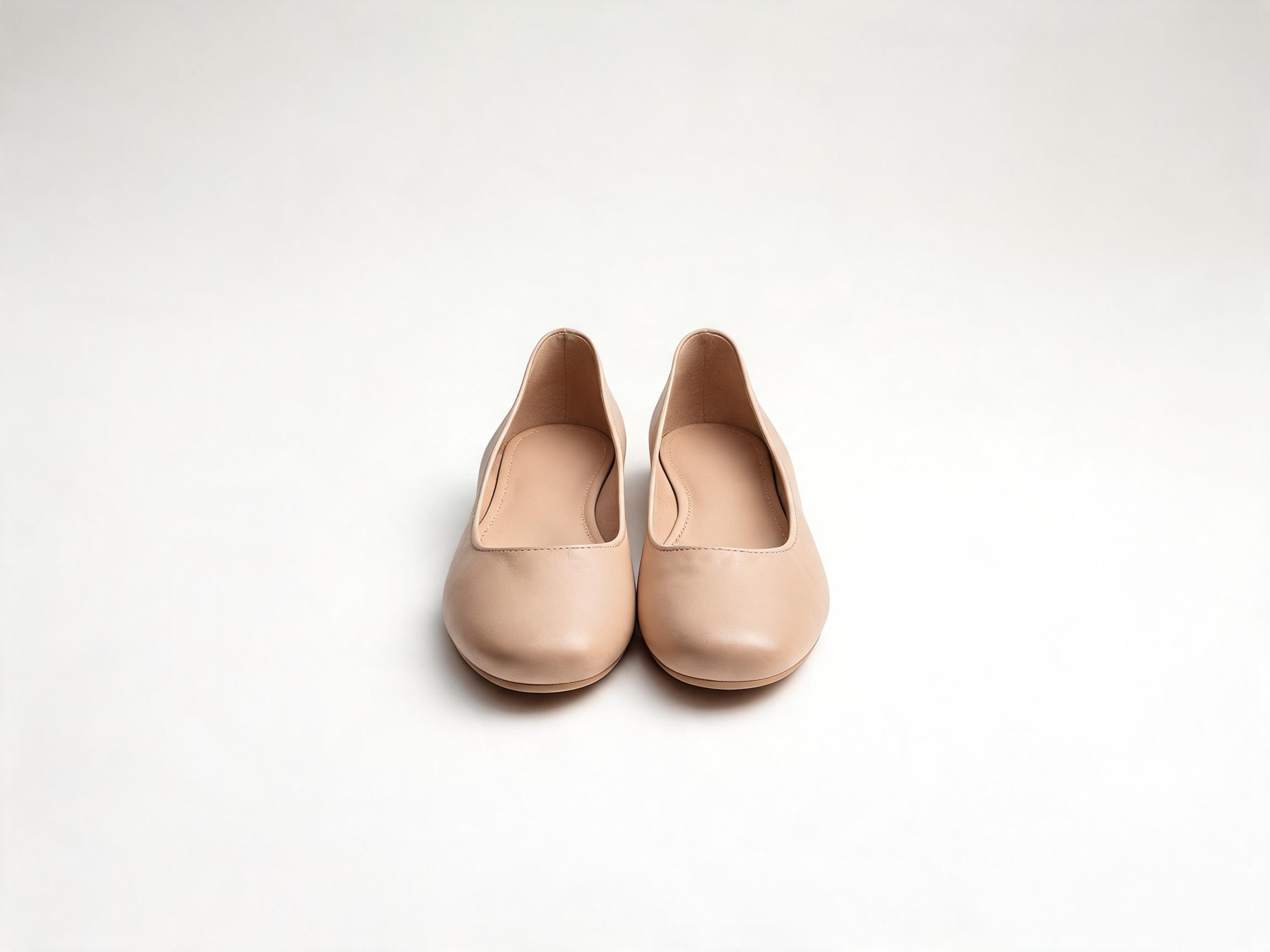
A ballet flat has a low, rounded or gently almond topline that opens the foot. In a specification such as the nude leather ballet flats, the upper is soft nappa leather with an elasticated topline, leather lining, a cushioned insole and a flexible rubber outsole. The elasticated topline is the structural detail that matters: it gives the shoe its grip without a fastening, and it determines how much the upper stretches across a range of foot widths.
A loafer-style flat closes higher up the instep and reads as a more structured shoe. In the tan suede slip-on flats, the upper is premium suede with pigskin lining and a memory-foam insole, again on a flat heel of about 1 cm. The slip-on construction still has no closure, so the fit depends on the cut of the throat and the give in the suede rather than an elastic edge.
For a buyer, that translates into two different shelf roles. The ballet flat suits a lighter, more fluid assortment; the loafer-style flat carries more visual weight and sits comfortably in a trans-seasonal or more tailored story. Many assortments carry both, with the color plan doing the work of separating them.
Materials: what each upper does to the product
Nappa leather upper
Soft nappa leather is chosen for a smooth, close-fitting upper that follows the foot. On a ballet flat it produces a clean, uncluttered silhouette — useful when the color itself is the selling point, as with a nude tone that needs to sit close to skin tone. Nappa also takes a wide range of finishes, which makes it a practical base for a multi-color program.
Suede upper
Premium suede gives a matte, textured surface. It holds deep saturated colors well, which is why tan and other warm earth tones are a natural fit. Suede also brings a care dimension: buyers should expect to communicate surface care to end customers, and any color they choose should be assessed with that in mind. Suede is not the right choice for every program, but where the assortment is built around texture, it does the job that smooth leather cannot.
Lining and insole
These are the specifications end customers actually feel. The ballet flat above uses leather lining and a cushioned insole; the suede slip-on uses pigskin lining and a memory-foam insole. Neither is automatically better. Leather and pigskin linings are chosen for breathability and durability expectations; memory foam is chosen for initial underfoot softness. When you compare quotations from different suppliers, compare the lining and insole line by line, because this is where a lower price is most often achieved.
Outsole and heel
Both styles here use a flat heel of about 1 cm. The ballet flat specifies a flexible rubber outsole, which suits the softer upper. The suede slip-on's outsole is not detailed in its specification summary, so ask for the outsole specification in writing on any loafer-style flat you source, since the harder, more structured upper is often paired with a firmer bottom unit, and that changes the walk feel.
| Specification | Nude Leather Ballet Flats | Tan Suede Slip-On Flats |
|---|---|---|
| Upper | Soft nappa leather | Premium suede |
| Topline / construction detail | Elasticated topline | Slip-on, no closure |
| Lining | Leather | Pigskin |
| Insole | Cushioned | Memory foam |
| Outsole | Flexible rubber | Not stated in the summary specification; confirm with the sales team |
| Heel | Flat, approx. 1 cm | Flat, approx. 1 cm |
| Sizes | EU 35–41 / US 5–10 | Not listed in the specification summary; confirm with the sales team |
| MOQ | 100 pairs per color | 100 pairs |
| Lead time | 25–35 days | 25–35 days |
Specification-sheet figures. Confirm current MOQ and lead time with the sales team before ordering.
Fit and sizing differences buyers should test
The elasticated topline on a ballet flat is a fit mechanism. It holds a slightly wider range of feet than a plain edge, but it also means the opening has a defined stretch limit — a buyer fitting a sample should check where that limit sits across the size run, not just on one size.
A loafer-style flat without elastic depends on the last and the throat cut. Suede has more give than smooth leather over the first days of wear, so a sample that feels snug in the box may relax. If your market has a history of returns tied to heel slip or tightness across the instep, the loafer-style flat is the style to fit most carefully.
Practical steps before you commit to a size run:
- Request samples in at least the smallest, middle and largest sizes, and try each on the same fitting foot.
- Check heel grip with a thin and a medium sock, since the same shoe is worn both ways in most markets.
- For the elasticated style, confirm the topline returns to shape after stretching.
- Confirm the size conversion you will publish (EU to US) against the supplier's own chart, not against a generic converter.
On size range, the ballet flat is listed at EU 35–41 / US 5–10, while the suede slip-on's size range is not shown in its specification summary. If you need the same range across both styles, raise it as a requirement in the enquiry rather than assuming it carries over — the size chart is a specification point, and it should appear on the quotation.
Color planning for a flat shoes range
Color is where a flat shoes order is won or lost, because with a simple silhouette the color is most of the product. The method below is a planning structure, not a forecast; the right colors depend on your own sell-through history and your market.
Step 1: fix a core that never changes
Define two to four colors that you will carry in every size and every reorder. A neutral and a dark are the usual anchors, and on the ballet flat a nude tone is a natural core because it is a wardrobe basic rather than a seasonal statement. The core is what makes reordering simple and what keeps the size curve intact.
Step 2: separate the styles by color family
Give each style a distinct color territory so they do not compete on the shelf. Smooth nappa leather carries clean, close-to-skin neutrals well; suede carries deeper, matte earth tones. Working within those strengths keeps each style's purpose visible to the buyer in your customer's store.
Step 3: add a controlled seasonal layer
Seasonal colors should be a small, defined addition — not a replacement for the core. Because minimums can apply per color, each added color can be a separate commitment, so decide the size of that layer before you open the color meeting. On the two styles above, the ballet flat lists a MOQ of 100 pairs per color while the suede slip-on lists 100 pairs; whether colors can be combined toward one minimum is a commercial question for the sales team. With a 25–35 day lead time on both, a wide seasonal spread multiplies both units and scheduling load. Confirm current MOQ and lead time with the sales team before ordering, as these figures are specification-sheet values.
Step 4: plan color and size together
A color plan is really a matrix. Before confirming, lay colors against the size curve and check that no color is left with an incomplete size run. This is also the point to settle color fastness expectations — the supplier's process includes color fastness testing, so ask how that applies to the specific colors and materials in your order.
Step 5: agree the approval step
Request color swatches or lab dips for approval before bulk production on any new color. For a suede upper, approve the swatch in the lighting conditions your customer will see it in, and note that suede shades can read differently from smooth leather samples of a similar name.
MOQ, lead time and sampling
For the two styles referenced here, the ballet flat lists a MOQ of 100 pairs per color and the suede slip-on lists 100 pairs; both carry a listed lead time of 25–35 days. Confirm current MOQ and lead time with the sales team before ordering, since both can change with material availability and order mix.
Sampling is the fastest way to settle the material and fit questions above. Standard samples are typically available in 3–5 days, and custom samples in 7–12 days. Order samples in the exact upper and lining you intend to buy — a nappa sample will not tell you how a suede loafer-style flat fits.
The supplier, Auravia, has been based in Quanzhou since 2011 with around 260 staff, and works on OEM/ODM and private label programs with three-stage inspection and a 6-month warranty. Trade terms offered are EXW, FOB and CIF, with exports to Europe, North America and the Middle East. Enquiries receive a response within 48 hours.
To review the full range before building your color plan, start at the women's flats category page, then compare the nude leather ballet flats and the tan suede slip-on flats side by side. Bring your size curve and target color count to the enquiry; that is the information the quotation needs in order to be useful.
Frequently asked questions
Which style is easier to fit across a broad size range?
That depends on the last and the topline, not on the category. The elasticated ballet flat has a built-in stretch allowance; the slip-on loafer-style flat relies on the upper cut and the material's give. Fit both in the smallest and largest sizes before deciding.
Can I order mixed colors within one style?
MOQ is stated per color on the ballet flat and as 100 pairs on the suede slip-on. Whether colors can be combined toward a single minimum is a commercial question for the sales team — ask before you finalize the color count.
What should I put in a color brief?
Color name, material it will be applied to, reference swatch or Pantone number, target size curve per color, and whether it is a core or seasonal line. That is enough for a supplier to quote accurately and to prepare lab dips.