
A range-planning guide for buyers building a women's summer sandal assortment: how to balance flats and low block heels, plan size runs across EU 35–41, and specify packaging that protects leather in export transit, drawn from how a leather footwear manufacturer structures its women's summer program.
A summer sandal program fails for reasons that have little to do with the sandals themselves. The flat style that looks safe in the catalogue runs out of two sizes by mid-season. The heeled option sits because the heel was chosen for looks rather than for what the customer will actually walk on. Cartons arrive with scuffed uppers because the inner packing was an afterthought. Buyers who plan the heel mix, the size run and the packaging together tend to avoid all three.
This article sets out how a mixed flat and low-heel ladies sandal range can be planned for European retail chains, Middle East seasonal buyers and North American distributors, and how the manufacturer's women's summer program is structured to support it. It focuses on decisions you make before the order is placed.
What this guide covers
- Flat and low-block-heel styles solve different purchase occasions; the ratio between them is a buying decision, not a cosmetic one.
- Size-run depth in the middle sizes of EU 35–41 matters more than spreading units evenly across the run.
- Open-back and slip-on constructions reduce the number of fit variables in a warm-season assortment.
- Individual boxes with your logo plus sturdy export cartons protect finished leather between the factory and your warehouse.
- Heel-height changes, Pantone colour matching and footbed branding are available within the women's leather production line.
Why the flat-to-heel mix drives sell-through
A ladies sandal range that is all one heel type tends to generate one kind of sale. All-flat assortments convert easily at the entry price but leave nothing for shoppers who want a lifted silhouette for evening or occasion wear. All-heeled assortments look aspirational on the shelf but lose the shopper who needs something to walk in every day.
Mixing the two gives the range more than one reason to be bought, and it does so with fewer SKUs than a buyer might expect, because the same upper patterns and leathers can be reused across heel heights. That reuse matters when you are matching shades across a collection: a cognac leather carried in both a flat and a low-heeled style reads as one coherent story on the shelf, not two unrelated buys.
The practical question for seasonal buyers is the ratio. It cannot be set from a template, because it depends on the climate of the market, the price architecture of the chain, and whether sandals sit in a dedicated summer window or run alongside transitional footwear. What the manufacturer can do is help you build the mix so that the flat and heeled styles share leathers, lasts and finishing, which keeps the range visually unified and reduces the number of separate confirmation steps.
Flat, low block heel and mule: how each earns its slot
Three constructions do most of the work in a warm-season women's program. Each answers a different shopper need, and each carries different risks in production and in transit.
The flat
The flat is the volume driver. It is the style bought for daily wear, for travel, for wide-fitting comfort needs and for gifting. In a wholesale ladies sandals program it is also the style that most often runs short of the middle sizes, because buyers tend to spread units evenly across the run instead of weighting them toward the sizes that actually sell.
For flat styles, the specification conversation should centre on the footbed and the sole rather than on decoration. A leather flat with a soft lining and a well-finished insole is what the customer keeps wearing, and that drives repeat orders. Colour choice also matters more for flats than for heels, because flats are bought in multiples. See the nude leather ballet flats as an example of a neutral that sits under a wide range of seasonal palettes.
The low block heel
The low block heel is the range's lift. It covers occasion wear and dressier summer dressing without asking the customer to change her walking behaviour. A block heel is also structurally more forgiving than a slender heel in transport, because the weight sits over a wider base.
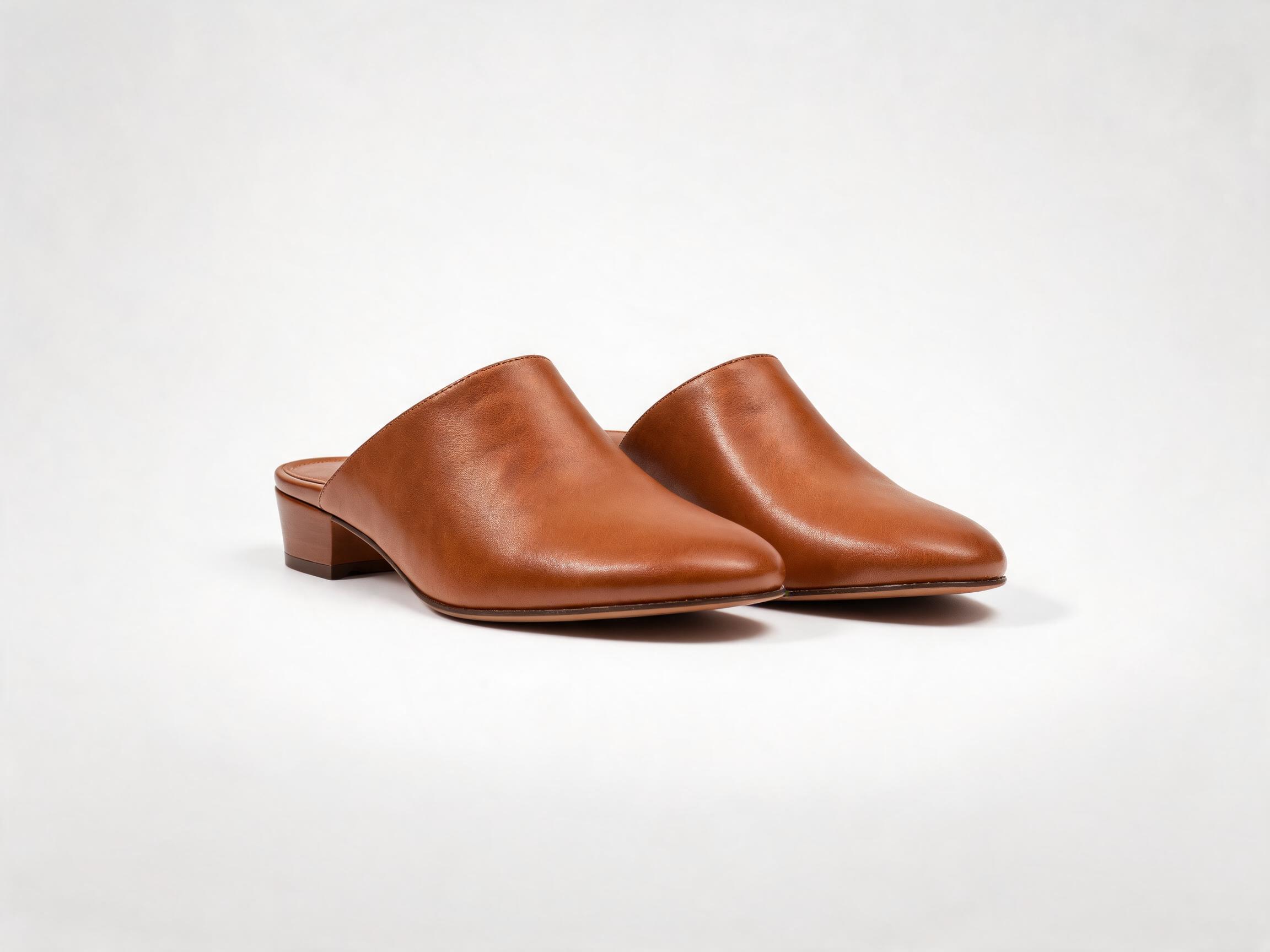
The cognac leather mule shoes show how a low block heel can be combined with an open back and a pointed toe: polished calf leather upper, soft leather lining, and a rubber anti-slip outsole. The vegetable-tanned leather develops a natural patina over time, which is a selling point worth putting on the shelf card rather than leaving buried in the spec sheet.
The open-back mule
Open-back slip-on construction is worth considering as a deliberate range decision rather than a style preference. With no heel counter to fit around, the number of fit variables at the point of sale drops, and the customer can try the shoe on quickly. For chains with high footfall and limited fitting assistance, that is a practical advantage. It also simplifies the size run, because the open back accommodates small variations in heel width across the range.
The trade-off should be stated as clearly as the advantage. An open back gives less heel support than a closed-heel style, so shoppers who need a secure fit for long walking days may prefer a sandal with a strap or a heel counter. Treat the open-back slot as the quick-try-on, easy-wear option in the range rather than as a universal fit, and validate the size recommendation with fitting feedback from your own market before the size curve is locked.
| Construction | Shopper need it answers | Planning risk to watch |
|---|---|---|
| Flat / ballet | Daily wear, travel, comfort-led purchase, gifting | Middle sizes sell out first if the run is spread evenly |
| Low block heel | Occasion and dressier summer dressing | Size depth in the upper end of the run is often over-bought |
| Open-back mule | Easy try-on, quick purchase, transitional wear | Less heel support than closed-heel styles; needs clear packaging so the pair does not shift in the box |
Planning the size run across EU 35–41
The women's leather program covers EU 35–41, equivalent to US 5–10. That range is the planning frame; how you distribute units inside it is where most of the sell-through is won or lost.
The three heuristics below are drawn from buying experience in warm-season assortments, not from published sales statistics. Use them as a starting point and calibrate them against your own sell-through data for the market and channel you serve — a discount-heavy channel and a premium boutique will not share the same curve.
- Weight the centre. In many warm-season ranges, sizes at the middle of the run move fastest. If your total order is fixed, taking units out of the extremes to deepen the centre often improves sell-through and reduces end-of-season markdown depth — but verify this against your historical size-level sales before locking the curve.
- Treat heel height as a size variable. Experience suggests demand for the upper end of the run can be stronger in heeled styles than in flats in some markets. Building separate size curves per construction, rather than one curve for the whole range, is more work at the planning stage but avoids the wrong sizes ending up in the wrong style.
- Check width early. Half sizes and width options are available on request for bulk orders in the women's range. If your market has a meaningful comfort segment, raise this at the sampling stage rather than after the size curve is locked, because width options change both the size run and the packing layout.
It is worth asking your supplier for a size curve per style rather than a size curve per order. The two look similar on paper but behave very differently at the till.
Materials and finishing that survive a warm season
Warm-weather footwear is exposed to more than a temperate-climate shoe: higher humidity, more direct sun in transit and on display, and more frequent wear in some markets. Two material decisions carry most of the risk.
First, the lining. Soft leather lining is standard in the women's leather program, and it is the component that most affects how the shoe feels after a full day. Second, the outsole. A rubber anti-slip outsole, as used on the cognac mule, gives the range a sole that behaves predictably on polished floors, paving and tile, which matters in markets where sandals are worn on hard surfaces year-round.
Finishing is the third factor. The women's leather program uses hand-finished uppers, and where vegetable-tanned leather is specified, the colour is intended to develop a natural patina rather than stay uniform. That is a legitimate characteristic to communicate to the end customer, and it also means your quality inspection criteria should allow for variation between pairs rather than treating it as a defect.
Packaging that protects leather in export transit
Finished leather is vulnerable in ways that textiles are not. Uppers scuff against each other, heels press into neighbouring uppers, and a box that collapses under carton stacking leaves creases that cannot be corrected at the destination. The packaging specification is therefore part of the product specification, not a logistics detail to be settled at the end.
The women's leather product records describe a standard sequence:
- Each pair wrapped in protective tissue.
- Each pair in an individual box carrying the buyer's logo (OEM).
- Boxes packed into sturdy export cartons.
Each element does a specific job. The tissue prevents the upper and the sole of the opposite shoe from rubbing during handling. The individual box provides a rigid shell that holds its shape under stacking and carries your branding into the store. The export carton takes the loads of container stacking and port handling.
Two things are worth confirming in writing on the purchase order. First, that the box is specified to hold the pair without movement — particularly for open-back styles, where a loose fit lets the shoe slide. Second, that the carton grade is matched to the shipment mode and stacking height for your destination. Trade terms are available as EXW, FOB or CIF; because the point at which transit risk transfers from seller to buyer differs under each term, agree the packaging spec and the damage-responsibility clause together with the term you choose, and put both in the contract rather than in an email thread.
Customization worth writing into the spec
A range sells as a range, which means the customization you ask for should serve the collection rather than individual SKUs. The women's leather program covers sandals, mules, flats, heels and boots on dedicated women's leather production lines, and the customization options include:
- Heel-height changes — useful when you want one upper pattern to serve two price points.
- Leather colour matching to a Pantone reference — the single most useful option for chains that need the sandal range to sit with an existing palette.
- Footbed and insole branding — carries your mark into the part of the shoe the customer sees every time she wears it.
- Private-label boxes and hangtags — ties the shelf presentation to the box you receive.
Pantone matching is worth prioritising if your chain has a colour story. It is also the option that most benefits from being raised early, because matching a reference takes a round of confirmation before bulk production.
Buyer questions
What size range do the women's styles cover?
EU 35–41, equivalent to US 5–10. Half sizes and width options in the women's range are available on request for bulk orders.
Can flat and heeled styles share the same leather?
Yes, and it is usually the better approach for a mixed-heel range: shared leathers keep the collection visually coherent and reduce the number of colour confirmations. Leather colour can be matched to a Pantone reference if you need a specific shade.
What packaging comes as standard?
Pairs are wrapped in protective tissue, packed in individual boxes with the buyer's logo (OEM), and packed into sturdy export cartons. Trade terms are EXW, FOB or CIF.
Which product should a buyer start with when planning a first summer range?
A flat for volume and an open-back or low-block-heel style for the dressier slot gives two purchase occasions with a small number of SKUs. Both can be specified within the same colour palette.
Next step
If you are building a mixed-heel ladies sandal range for the coming season, the most useful starting point is a size curve per construction together with your Pantone references and packaging requirements. Send those three items to the supplier and the range can be discussed at the level of leathers, heel heights and box specifications rather than at the level of generalities. The cognac leather mule shoes and nude leather ballet flats are published examples from the women's leather range.