
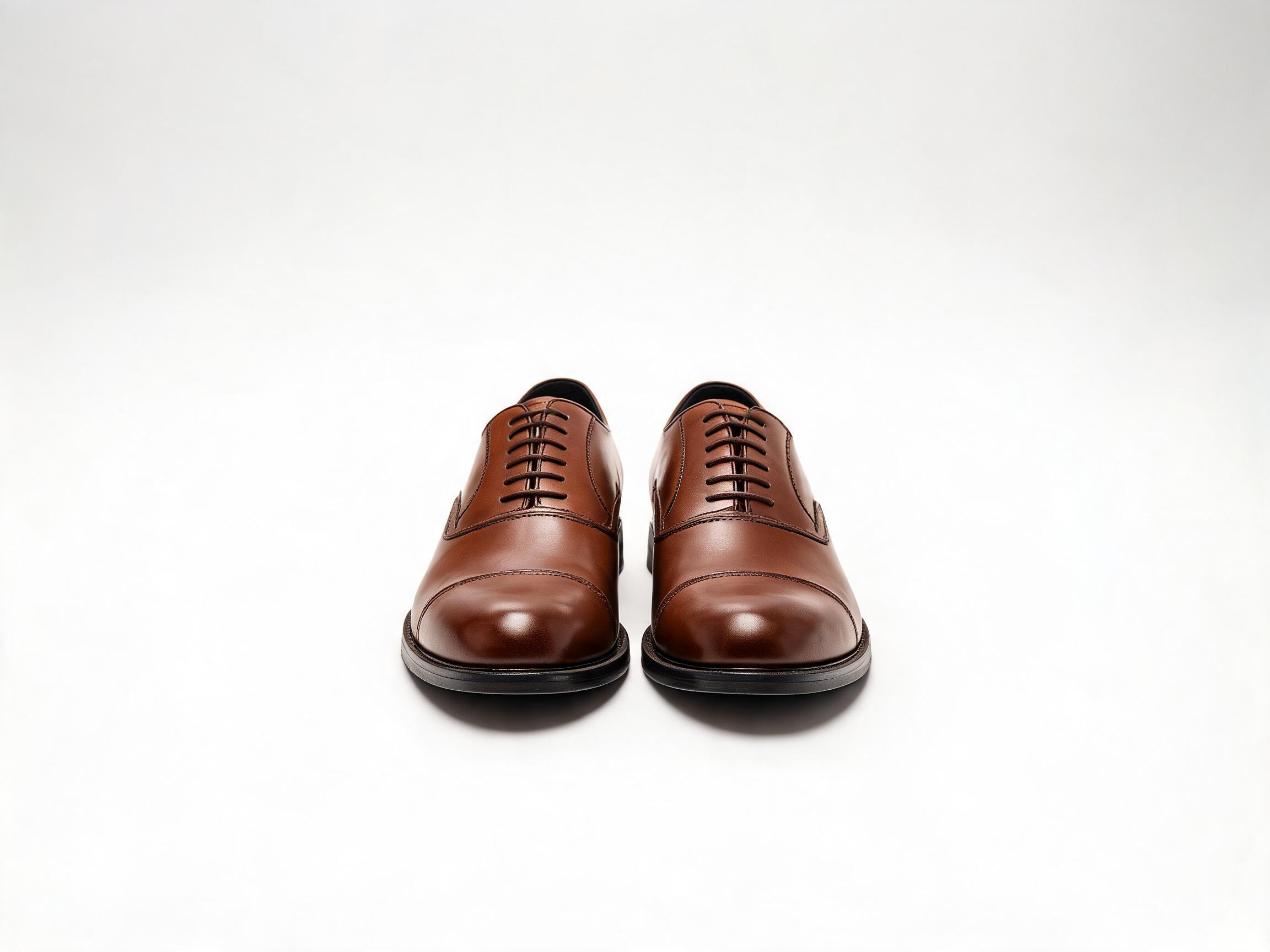
A practical guide for B2B buyers and brand owners on how a factory-accepted bespoke leather shoe workflow operates at OEM scale—covering foot measurement and last selection, full-grain leather selection with Pantone matching, the sample confirmation loop, and what to prepare before contacting a custom leather shoes manufacturer.
Bespoke & Made-to-Measure Programs
Brand owners often ask us how a bespoke leather shoe program actually runs at factory scale. The short answer: it is a structured, sample-driven process—not a tailor's bench. You supply measurements, materials direction, and a reference; we return a production-ready sample and a size grid you can order against. Below is how the workflow works, what we need from you, and where true bespoke differs from factory OEM customization.
- Measurement and last selection are the foundation; a size grid lets you produce consistently across a range.
- Full-grain leather selection and Pantone color matching happen before sampling—not after.
- The sample confirmation loop is where fit, construction, and color are locked.
- Bring a sketch, reference photo, or tech pack; our in-house design team turns it into a production-ready sample.
- Factory OEM customization supports your size grid; it is not one-off bespoke for a single pair.
In this article
The factory-accepted bespoke workflow
At OEM scale, “bespoke” means a reproducible program built around your brand's specifications. The workflow has four stages:
- Input review. You provide a sketch, reference photo, or tech pack, plus target size range, leather direction, and color references.
- Last and pattern development. We select or adapt a last to your measured size grid and develop patterns for the requested construction.
- Material confirmation. Full-grain leathers are selected and color-matched to your Pantone references; left/right hides are matched for visual consistency.
- Sample loop. A production-ready sample is made, reviewed against your spec, and revised until approved. Production then runs against the approved sample and your size grid.
Each stage produces a document you can sign off on: a measurement sheet, a material approval, a sample approval. That documentation is what makes the program repeatable across production runs.
Foot measurement and last selection
Fit begins with the last—the foot form a shoe is built around. For a B2B program, you are not measuring one customer's foot; you are defining a size grid. That means deciding the range (for example, EU 39–45 on our brown derby dress shoes) and the fit profile: how much room at the toe, how the instep sits, how the heel holds.
What to provide
- Size range and increments. The grid you intend to sell or stock, including half sizes if relevant.
- Fit target. Whether the shoe should run narrow, standard, or relaxed, and any known fit issues from your market.
- Reference shoes (optional but useful). A pair your team considers a good fit helps calibrate the last more precisely than numbers alone.
We map your measurements to a last and confirm the mapping with a fit sample. If you are launching multiple styles, we can typically share a last across styles to keep fit consistent—but construction changes (open derby lacing vs. closed lacing) may require pattern adjustments even on the same last.
Full-grain leather selection and Pantone matching
Leather choice and color are locked before sampling. Full-grain leathers are selected for grain character, temper, and finish suitability for the style. For color, we work from your Pantone references or physical swatches.
How color matching works in practice
- Reference first. Send Pantone codes or a physical swatch. Digital screens vary; a physical reference reduces mismatch.
- Hide selection. Because leather is a natural material, we match hides left and right for visual consistency—critical on pairs where the two shoes are seen together.
- Approval swatch. Before cutting, you approve a swatch or sample panel under agreed lighting.
Our polished full-grain derby and black cap-toe Oxford both use matched hides left/right—a detail that matters more on dress shoes than on casual styles.
Be aware: Pantone matching on leather is a tolerance process, not an exact science. We will tell you when a reference is achievable on a given leather and when a slight shift is unavoidable.
The sample confirmation loop
Sampling is where the program becomes real. It is also where most delays occur—not in production, but in unclosed feedback loops. Here is how we run it:
| Step | What happens | What you approve |
|---|---|---|
| 1. Spec review | We review your sketch, reference, or tech pack and flag open points. | Spec sheet |
| 2. First sample | Pattern, last, leather, and color come together in a physical sample. | Fit and construction |
| 3. Revision round | Adjustments to fit, seam placement, or color are made. | Revised sample |
| 4. Final sign-off | Approved sample becomes the production reference. | Golden sample |
To keep the loop short, give consolidated feedback: one round of comments per sample, with clear priorities. If fit and color are both off, tell us which matters more—we can usually address both, but knowing the priority helps us sequence revisions.
What to prepare before you contact a factory
The quality of your input determines the speed of the output. Bring as many of these as you have:
- Sketch or reference photo. Even a rough sketch plus a photo of a shoe you like gives us direction on silhouette, lacing, and toe shape.
- Tech pack (if available). Construction details, seam placement, lining, sole type, and any hardware.
- Size grid. The range and increments you intend to produce.
- Leather and color direction. Full-grain preference, finish (polished, matte, etc.), and Pantone references.
- Target market context. Climate, wear expectations, and price positioning—these affect leather and sole choices.
If you do not have a tech pack yet, that is workable. Our in-house design team can turn a sketch or reference photo into a production-ready sample and document the spec as we go.
True bespoke vs. factory OEM customization
Honesty matters here. True bespoke means a last is made for an individual foot, and the shoe is built to that person's measurements. Factory OEM customization is different: we build a program around your size grid, your materials, and your design—reproducible across many pairs.
| Aspect | True bespoke | Factory OEM customization |
|---|---|---|
| Last | Individual last per foot | Last adapted to your size grid |
| Output | One pair per customer | Production runs against approved sample |
| Leather | Buyer-selected per order | Buyer-approved lot, matched left/right |
| Color | Matched to individual request | Pantone-matched with agreed tolerance |
| Sampling | Fitting process per customer | Sample confirmation loop before production |
We support OEM/ODM with an in-house design team and can produce against your own size grid. What we do not claim is one-off bespoke for individual end customers. If your business model is made-to-measure at retail, the factory workflow still applies—you collect measurements, we produce to your grid.
Product starting points
Two styles our buyers commonly use as a base for customization:
- Brown derby dress shoes — polished full-grain leather, open derby lacing, EU 39–45, matched hides left/right. A flexible base for color and sole changes.
- Black cap-toe Oxford shoes — closed lacing, cap-toe seam, matched hides. A more formal base where seam placement and toe shape are the main customization levers.
Both can be adapted to your leather and color direction, but construction changes affect pattern work—tell us early what you want to change.
FAQ
We support OEM/ODM programs where you provide a size grid. We do not produce one-off bespoke pairs for individual end customers.
Leather is a natural material; matching is a tolerance process. We confirm achievable matches during sampling and tell you when a shift is unavoidable.
That is workable. Our in-house design team turns a sketch or reference photo into a production-ready sample and documents the spec.
It depends on the complexity of your changes and how consolidated your feedback is. We confirm the sampling plan with you before starting.
Yes. We produce against your size grid, including half sizes where relevant.
For MOQ, lead time, and pricing, confirm with the sales team before ordering—these depend on your spec and size range.
Send your sketch, reference photo, or tech pack, along with your target size grid and Pantone references. Our team will review and come back with a sampling plan.