
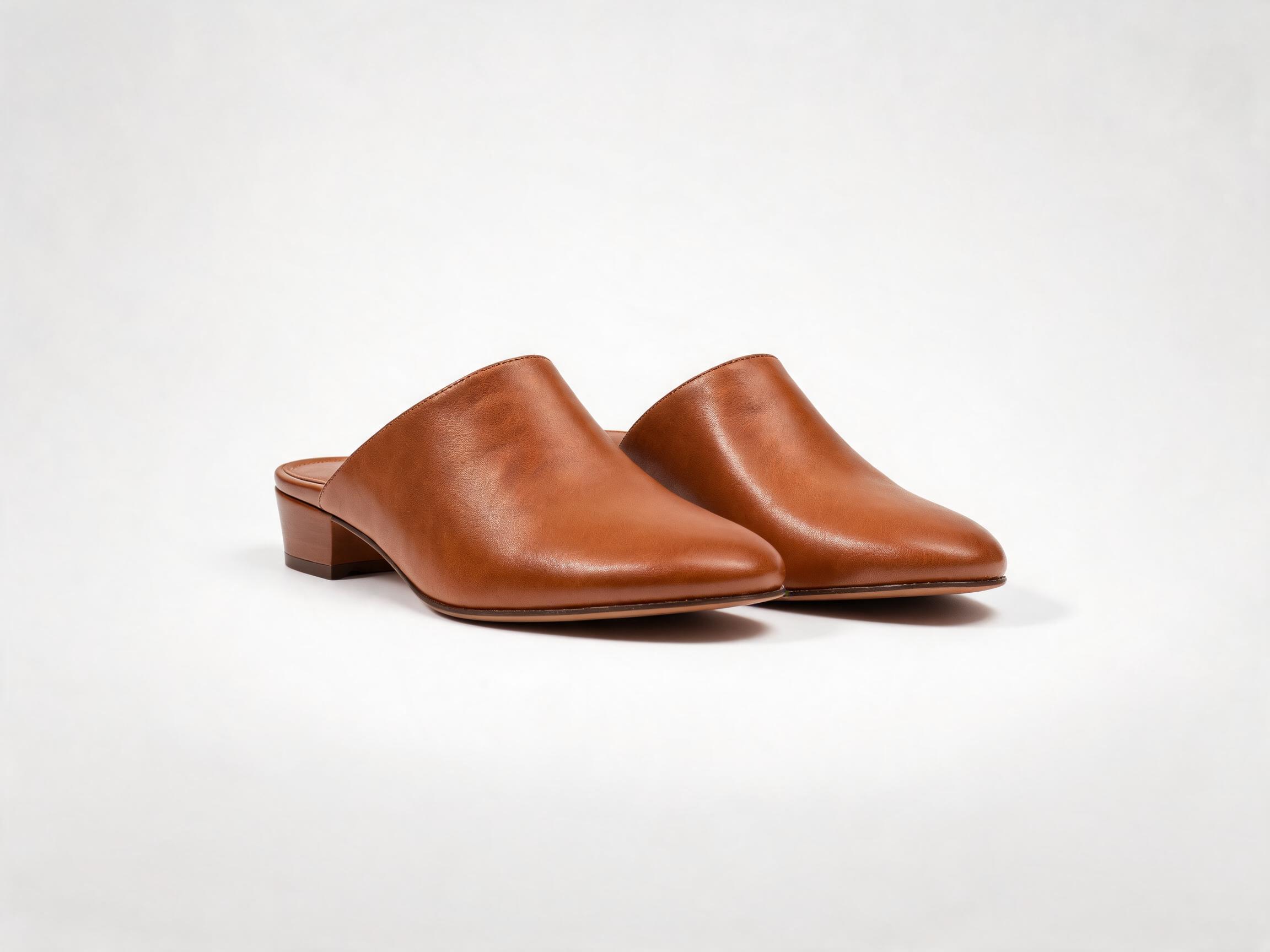
A verification checklist for importers and private-label buyers sourcing women's leather mule sandals in bulk — covering backless fit and heel grip, top-line lasting, leather grade consistency across a production run, colorway planning, and how an OEM/ODM factory handles mule sampling and customization.
Open-back mules are not just pumps without a counter. The missing back changes how the shoe sits on the foot, how the top line holds its shape, and where a bulk run can drift. This checklist covers what to verify before you commit a purchase order.
Key takeaways
- Fit checks for mules are about grip and stability, not just length — verify the forefoot and insole hold the foot during walk-throughs.
- Leather grade must be assessed across a production run, since hide variation shows up most on large, single-piece uppers.
- Colorway planning should happen before sampling, because nude, cognac and custom Pantone shades behave differently across dye lots.
- Confirm heel height, MOQ per color, lead time and sole material with the supplier for your target colorway — published figures can vary by specification.
In this article
Why leather mule sandals earn shelf space in a range
Leather mule sandals sit in a useful commercial position: they read as a category step up from a flat sandal, they suit spring and early autumn selling, and they give a range a slip-on silhouette that buyers can merchandise alongside closed-toe loafers and block-heel pumps.
For importers and private-label buyers, the shape also has practical advantages. A mule uses less material than a closed-back shoe, so the upper is often a single leather panel — a visible surface where the quality of the leather is immediately apparent to the end customer. The open back means less fitting complexity around the heel counter, but more attention to how the foot is retained. That trade-off is exactly where a bulk order succeeds or fails.
A representative example in a women's line is the Cognac Leather Mule Shoes — an open-back slip-on in cognac top-grain leather with a pointed toe and a low block heel, soft leather lining, a cushioned insole, and EU sizing across 35–41, with color options in cognac, black and nude or custom shades, and half sizes and width options available for bulk orders.
Fit and construction checks unique to backless shoes
With no heel counter, a mule relies on the forefoot and insole to keep the foot in place. A shoe that fits like a pump on a measuring stick can still slip, clack or rotate during walking. When you evaluate samples, test them the way the end customer will use them.
Backless fit and heel grip
- Walk-through test: have someone wear each sample size and walk on a hard floor for several minutes. Watch for heel lift, lateral slide at the ball of the foot, and toe gripping.
- Insole hold: check whether the footbed surface and the shape of the insole cup keep the foot from sliding forward. A cushioned insole that is too smooth can let the foot slide toward the toe box.
- Heel-to-ball placement: confirm that the wearer's ball of foot lands on the widest part of the sole. Mules are less forgiving here than slingbacks, because there is no strap to compensate.
- Sizing spread: ask for the full size run in your target market's sizing, including half sizes and width options if you intend to offer them. A single sample size proves nothing about the sizes at the edges of your run.
Top-line lasting
The top line — the visible opening edge of a mule upper — is where lasting quality shows first. Ask the factory to show you the top-line finish on samples and, if possible, at in-line inspection: the edge should be consistently shaped from left to right shoe, with even finishing and no waviness where the upper meets the lining. A top line that looks different on two pairs of the same size is a warning about lasting consistency, not a cosmetic detail.
Sole and heel construction
Because an open-back mule has no heel counter to anchor the shoe, the sole and heel attachment carry more of the stability load. Ask the supplier to confirm the sole material and heel construction as specified for your order, and to show you the bond line on a cut or worn sample. Published specifications can differ between versions, so get the sole material, heel height and construction written into the tech pack and the signed sample.
Leather grade and bulk consistency checks
A single leather mule upper is a large visible surface. That makes it an honest test of whether the factory's leather is consistent across a run — and an unforgiving one if it is not.
- Grade and type: confirm whether the upper is top-grain, corrected-grain or split leather, and whether the lining is leather or a synthetic. Ask for the confirmation in writing, not from a photo.
- Hand-feel and temper: squeeze the samples. Leather that is too stiff will crease hard at the toe; leather that is too soft may collapse at the top line.
- Color and dye-lot consistency: ask how the factory controls dye lots and whether upper and lining are matched. Request samples from more than one lot if you are placing a program order.
- Grain and defect inspection: check for scars, growth marks and uneven grain across the vamp. On a pointed-toe mule, the vamp is where customers look first.
- Third-party inspection: if you plan to use a third-party inspector, ask at quotation stage whether that is welcome and what access they will have to the line.
At Aurevia Footwear Co., Ltd., a B2B footwear manufacturer and exporter founded in 2011 and based in Quanzhou, China, production runs through three-stage QC — incoming material inspection, in-line inspection and final finished-shoe inspection — and third-party inspection is welcome. The company operates OEM/ODM and private-label programs for buyers mainly in Europe, North America and the Middle East, with trade terms EXW, FOB or CIF.
Colorway and sizing planning
Colorway decisions are easy to defer until sampling and expensive to defer until production. Nude is the classic example: a nude that reads correctly against a light complexion will look different against a deeper one, and a nude that photographs well under studio light can shift in daylight. Treat nude as a color that needs its own approval, not as a neutral default.
A practical approach for a bulk program:
- Core and fashion split: anchor the assortment with a dark, easy color such as black or cognac, then add a nude or seasonal shade as the fashion layer.
- Pantone matching: if you are matching a brand color, confirm that the factory supports Pantone color matching on leather, and approve a physical swatch rather than a screen rendering.
- Size curve: build the size run from your sell-through history, not a default curve. If you need half sizes or width options, confirm they are available for bulk orders and which sizes they cover.
- Per-color MOQ: MOQ is usually set per color, and it can vary by specification. Confirm the MOQ for each colorway you plan to order rather than assuming one number covers the line.
Sampling and customization with an OEM/ODM factory
Mules are a good candidate for customization because the upper is a simple, highly visible panel. The workflow that keeps a program on schedule is straightforward:
- Send the brief: tech pack or reference sample, target market sizing, leather type, colorway direction, logo and packaging requirements.
- Review existing samples: if a factory already produces a similar mule, existing samples can be shipped in about 3–5 days so you can assess the last and the top-line shape before committing to a custom development.
- Develop the custom sample: once details are confirmed, custom samples typically take around 7–12 days.
- Approve against the signed sample: keep a signed, sealed sample as the reference for production. Bulks are compared against it, not against memory or a photo.
Customization items to lock down in the tech pack include leather type and lining, top-line finish, insole construction, sole material, heel height, logo placement (footbed, outsole, packaging) and packaging format. The Cognac Leather Mule Shoes program supports OEM/ODM including Pantone color matching and logo and packaging customization.
Heel height, MOQ per color and lead time can vary with the specification and colorway. Confirm all three against your target order before you sign — and get the confirmed values written into the purchase order.
Verification checklist before you commit
| Area | What to verify |
|---|---|
| Backless fit | Walk-through test on each size; heel grip and forefoot hold; ball-of-foot placement |
| Top line | Consistent shaping left-to-right and pair-to-pair; even edge finishing |
| Sole and heel | Sole material and heel construction confirmed in writing; bond line inspected |
| Leather | Grade and type in writing; dye-lot control; grain and defect check on the vamp |
| Lining and insole | Lining material confirmed; insole cushioning and slip resistance assessed on walk-through |
| Colorways | Physical swatch approval, including nude and any Pantone match |
| Sizing | Full size run; half sizes and width options confirmed for bulk |
| Commercials | MOQ per color, heel height, lead time and trade terms confirmed for your order |
| Quality process | Inspection stages explained; third-party inspection access confirmed |
| After-sales | Warranty terms on manufacturing defects confirmed in writing |
Aurevia Footwear Co., Ltd. offers a 6-month quality warranty on manufacturing defects and a team of roughly 260 people supporting OEM/ODM and private-label production.
FAQ
How do I check fit on a mule when there is no heel counter?
Focus on retention rather than length. Have wearers walk for several minutes on a hard floor and watch for heel lift, lateral slide and toe gripping. Confirm the ball of the foot sits on the widest part of the sole, and test every size in your run, not just the middle.
What should I confirm about leather before a bulk order?
Get the leather grade and type and the lining material confirmed in writing. Ask how dye lots are controlled, and review samples from more than one lot for color and grain. On a single-panel mule upper, the vamp is the area customers inspect first, so check it for scars and uneven grain.
Can the factory match my brand color on a leather mule?
OEM/ODM programs can include Pantone color matching, along with logo and packaging customization. Approve a physical swatch rather than a screen rendering, and treat nude shades as their own approval item because they shift with lighting and skin tone.
How long does sampling take?
Existing samples are typically shipped in 3–5 days. Custom samples take around 7–12 days after details are confirmed. Confirm the sampling timeline and the production lead time for your specific colorway and quantity before you sign.
Next step
If you are evaluating a leather mule for an upcoming season, start with a sample review rather than a quote comparison. Request existing samples, walk them, and check the top line and leather against the checklist above. Then confirm MOQ per color, heel height and lead time for your target colorway so the commercial terms match the shoe you approved.