
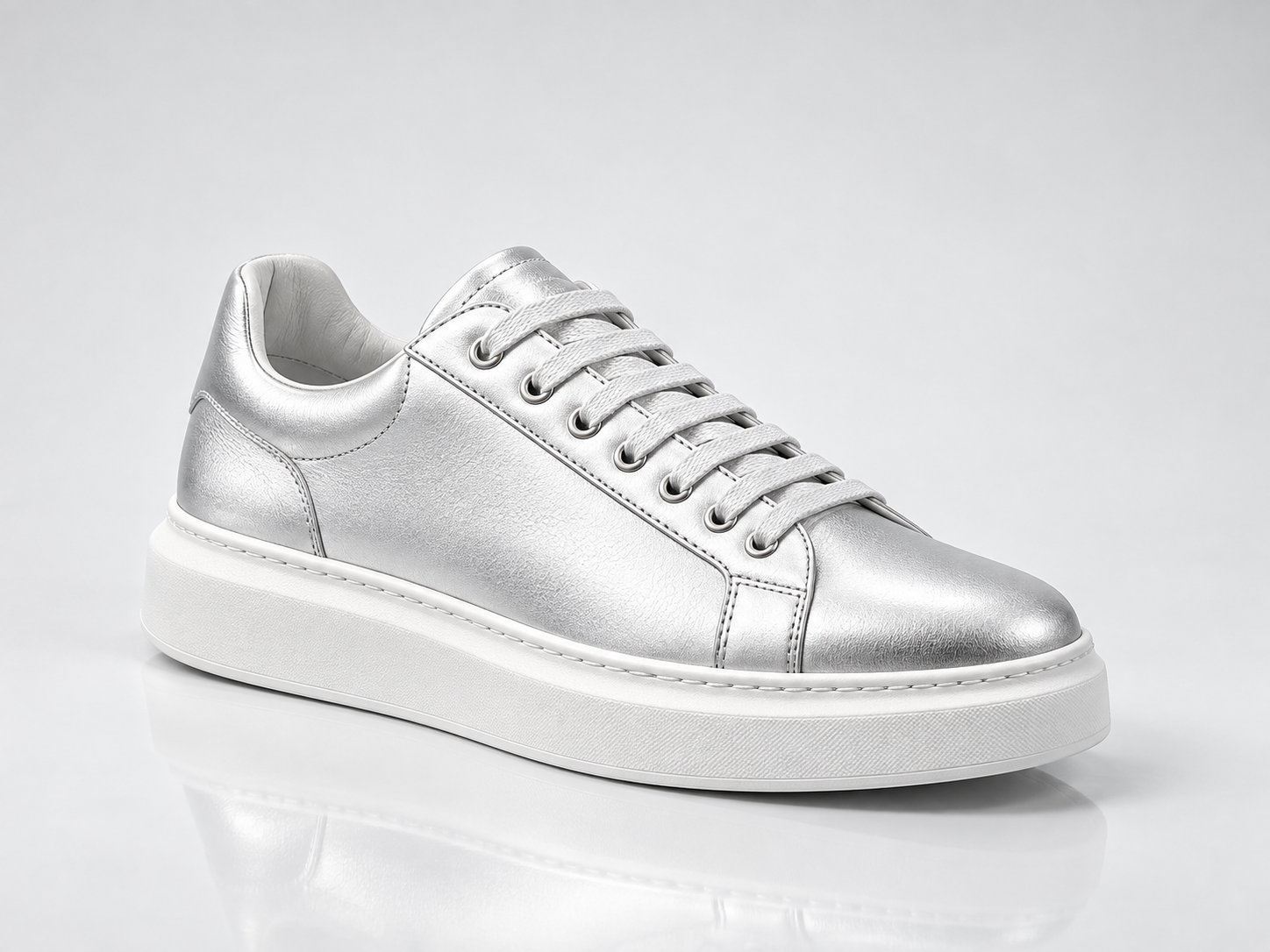
A practical guide for B2B sourcing managers on specifying custom metallic and silver trainers from China: finish options, colour consistency controls, material selection, and MOQ considerations—without invented numbers.
B2B Sourcing Guide
Metallic and silver trainers look simple on a mood board. In production, the finish is the hard part. This guide covers how custom metallic-finish trainers work from China—coatings, foils, and metallic yarn uppers—and what buyers should control on colour consistency, materials, and MOQ before placing a bulk order.
Key takeaways
- Metallic look comes from different processes—coating, foil, or metallic yarn. Each has a different cost and durability profile.
- Colour consistency across batches depends on base material, lighting, and supplier QC routines.
- MOQ is driven by material sourcing, not by stitching. Metallic finishes often raise minimums.
- Always confirm sample colours under agreed lighting and request production batch panels.
Why Metallic Finishes Are Not One Product
Buyers searching for “China silver trainers customized” usually assume there is one silver material. In practice, factories use at least three different routes to achieve a metallic look, and each changes how the shoe is made:
- Surface coatings — a metallic pigment or film applied to a synthetic or textile upper. Cheapest to tool, but the finish sits on the surface and can wear, crack, or change appearance with flexing.
- Metallic foils and laminates — a thin metallic layer bonded to a substrate, then cut and stitched. Gives a sharper, more uniform mirror-like effect, but limits how much the upper can stretch and complicates edge finishing.
- Metallic yarns and textiles — metallic fibres woven or knitted into the upper itself. The metallic effect is part of the material, not a coating, so it behaves more like a normal knit or woven upper. Colour consistency depends on the yarn lot and the knit structure.
Each route also affects the shoe’s construction. A foil laminate may need different interlining or stitch density to avoid puckering. A coated upper may need a gentler lasting process. When you ask for “silver,” you are really choosing a process family—so the first specification question is which finish route your factory can offer for the upper you have in mind.
Colour Consistency Controls for Metallic Finishes
Metallic colours are harder to control than flat colours because the visual effect comes from reflected light, not just pigment. Two panels that measure the same in a lab can still look different in a warehouse or a store because the flake orientation or coating thickness varies. Buyers should build controls into three stages.
Agree on the reference standard before sampling
Provide a physical reference—a Pantone chip, a competitor sample, or a previous production swatch. If using a metallic Pantone, note that the factory will need to match surface effect as well as hue. Ask your factory to confirm which reference is realistic for the finish route they propose.
Define lighting conditions for approval
Metallic surfaces shift under cool, warm, and daylight. State the lighting conditions you will use to approve the sample—for example, a specified light box setting or daylight at a stated time—and ask the factory to photograph the sample under the same conditions. Both sides should approve the same image and physical swatch.
Control production lots and issue batch panels
Metallic coatings and foils are typically produced in lots. Request that each production lot’s material be kept together and that the factory retain a swatch from each lot. For larger orders, ask whether the factory can provide a production panel showing the metallic finish as actually applied, not just the raw material roll. This is the fastest way to spot batch drift before cutting.
Finally, ask what the factory’s internal tolerance is for colour variation, and how they document it. A clear answer—measured, recorded, and checked against the approved standard—is more useful than a verbal promise.
Material Selection: What to Decide Before MOQ
Metallic-finish trainers can be built on genuine leather, synthetic, or knit uppers. Each choice changes look, feel, and order requirements.
| Upper material | Metallic look achieved by | What buyers should verify |
|---|---|---|
| Genuine leather | Metallic foil lamination or coated finish on leather | Flex behaviour, edge finishing, and how the metallic layer ages. Confirm with your factory whether the finish suits the leather’s grain. |
| Synthetic / PU | Coating or foil | Adhesion and surface durability after flexing. Ask for a flex-tested sample if the shoe will be worn heavily. |
| Knit textile | Metallic yarn in the knit | Yarn lot consistency, knit density, and how the metallic effect reads across the toe and heel. |
Each material also has different tooling and lead-time implications. Metallic yarns and foils are often specialty materials with their own supply lead times, which feeds directly into MOQ. Aurevia Footwear Co., Ltd. works with genuine leather craftsmanship and also produces knit and synthetic uppers for OEM/ODM and private-label programs; the right finish route depends on your target price, wear case, and colour standard.
MOQ: What Actually Drives the Minimum
MOQ for custom metallic trainers is rarely set by the stitching line. It is set by material sourcing. Buyers should expect the following factors to move the minimum up or down:
- Specialty metallic materials — foils and metallic yarns are often sold in minimum roll or batch quantities. Ask whether your finish requires a material your factory does not already stock.
- Custom tooling — new lasts, molds, or print/emboss tooling add setup cost that must be amortised over the run.
- Colour matching work — a tight metallic match may require lab dips and multiple sample rounds, each of which has a cost.
- Packaging and labelling — private-label boxes, hangtags, and inserts have their own minimums from their suppliers.
- Size curve — a full size run increases the number of SKUs even if total pairs are modest.
Because these factors vary by material and finish, MOQ should be confirmed project by project. When you request a quote, send the finish route, reference colour, upper material, target size curve, and packaging plan. That lets the factory give you a realistic minimum rather than a generic number.
What to Put in a Custom Metallic Trainer Brief
A clear brief reduces sample rounds. Include:
- Silhouette and last reference—you can point to an existing white low-top or grey knit trainer style as a starting shape, then specify the metallic finish.
- Finish route preference or openness—coating, foil, or metallic yarn.
- Colour reference and the lighting condition you will use to approve it.
- Upper, lining, and sole materials, with any performance or wear expectations.
- Target size curve and total pair volume per colourway.
- Packaging, labelling, and any private-label artwork requirements.
The more of these are fixed before sampling, the fewer revisions and the faster the path to a bulk order.
Frequently Asked Questions
Can metallic finishes be applied to leather trainers?
Yes. Metallic foil lamination and coated finishes can be applied to leather uppers. The key is to confirm with your factory how the finish behaves when the shoe flexes and how edges are finished, since leather grain varies.
How do I check colour consistency between samples and bulk?
Approve a physical swatch and a photo under agreed lighting, then ask for a production panel from the actual bulk material. Keep a swatch from each production lot and compare against your approved standard.
Does a metallic finish raise the MOQ?
It can, because metallic foils and yarns are specialty materials with their own supply minimums. Custom tooling and colour-matching work also affect the minimum. Confirm MOQ per project with your factory.
Can I combine a metallic upper with a standard sole and lining?
Often yes. Keeping the sole and lining standard can reduce tooling and material minimums, while the metallic upper carries the custom look. Ask your factory which components can stay standard.
Aurevia Footwear Co., Ltd. is a high-end footwear and fashion accessories manufacturer-exporter specialising in genuine leather craftsmanship, offering OEM/ODM and private-label customization to global B2B buyers in Europe, North America, and the Middle East. For custom metallic-finish trainer projects, share your finish route, colour reference, materials, and target volume, and the team can confirm feasible options and project minimums.