
A step-by-step guide to working with a custom shoe factory: how OEM/ODM sampling rounds run, how to control revision cycles, how production scheduling is set, and how designs, lasts, molds and branding should be documented and protected in writing before you commit to a production order.
Supplier Workflow Guide
Working with a custom shoe factory is not one conversation and one order. It is a sequence of four decisions: what the sample must prove, how many revision rounds you are willing to pay for, when the line can actually run your size run, and who owns the drawings, lasts, molds and brand marks once the order is delivered. Each decision has a document behind it. Get the documents right and the factory relationship is predictable. Leave them vague and the risk moves onto your balance sheet.
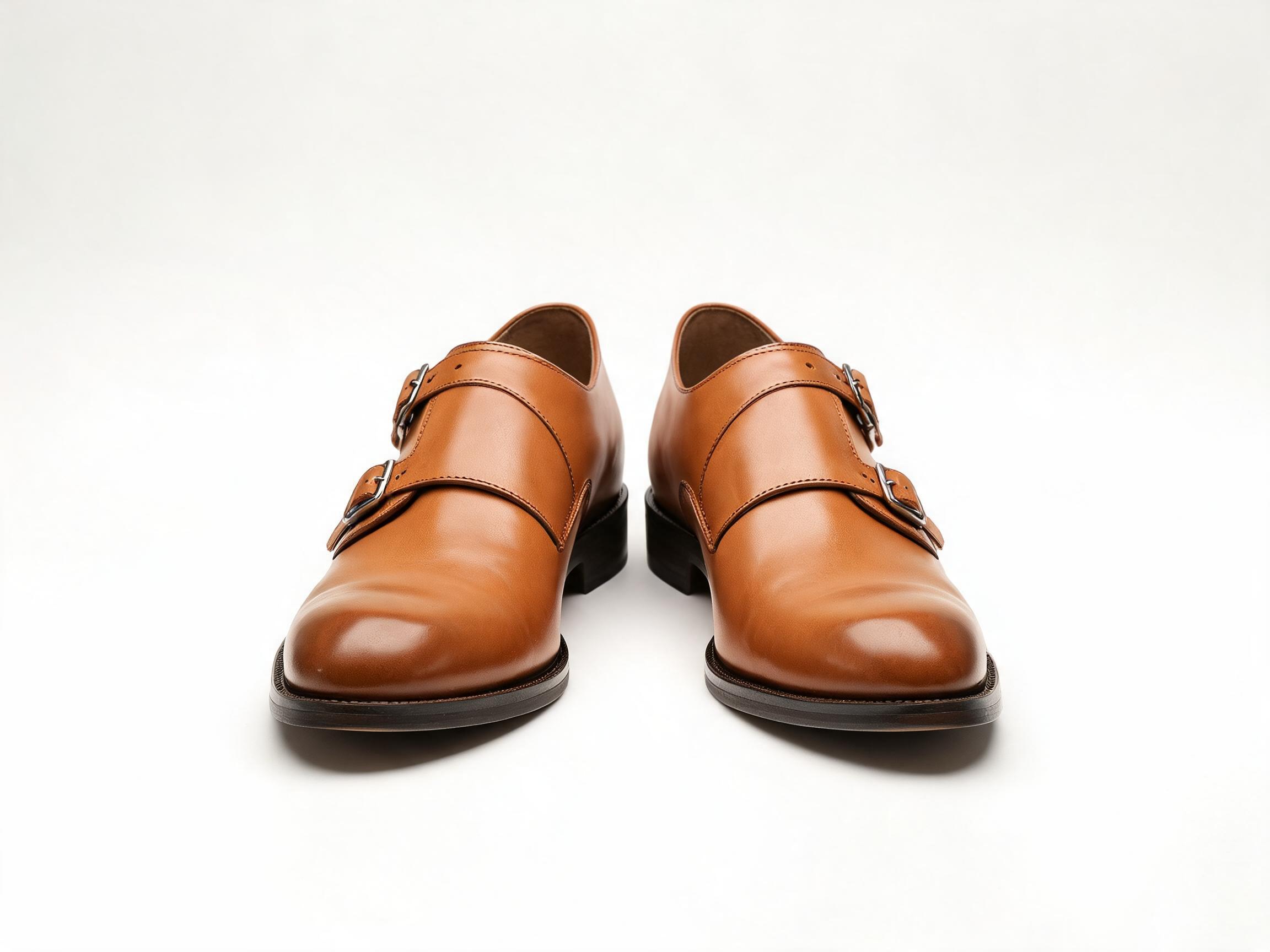
This guide walks through that sequence using a real OEM/ODM footwear workflow, with the Tan Double Monk Strap Shoes as a working example of how a catalog model becomes a private-label order.
Key takeaways
- Two sample types run on different clocks: catalog sample pairs in 3–5 days, custom samples in 7–12 days.
- Every revision round should be written as a numbered change so the next sample has an unambiguous brief.
- Production scheduling depends on approved samples, confirmed MOQ and confirmed specifications — in that order.
- Lasts, molds, buckle tooling and brand marks are separate assets. Agree in writing who owns each one, before tooling starts.
- Confirm current MOQ and lead time with the sales team before ordering; catalog figures are a starting reference, not a quotation.
On this page
- Step 1 — Sampling: what each sample is for
- Step 2 — Revisions: running controlled rounds
- Step 3 — Scheduling: from sample approval to production
- Step 4 — IP: designs, lasts, molds and branding
- How the four steps connect to a real model
Step 1 — Sampling: what each sample is for
The first sample is not a preview of the final shoe. It is a test of whether the factory understood your specification. That is why the sample type matters more than the sample speed.
A catalog sample pair lets you inspect an existing model as the factory already builds it. At Auravia, a catalog sample pair ships in 3–5 days. This is the right first step when you are still deciding whether a model’s construction, last shape and finish suit your market — for example, checking whether a burnished full-grain leather upper and a double monk strap with buckles fit the price band and dress code you sell into.
A custom sample is built to your changes and takes 7–12 days. Use this stage for the variables you actually intend to change: buckle hardware, upper color, lining, packaging, or a branded insole. Keep the rest of the specification fixed in the first custom round. If you change the last, the leather and the buckle at the same time and the fit is wrong, you will not know which change caused it.
What to put in the sample request
- The base model and its reference number or page link.
- Each change, stated as a separate numbered item with a target value: color reference, buckle finish, logo placement, packaging format.
- Size to be sampled, and whether you want a single size or a size run.
- Which points you will inspect on receipt — fit, finish, stitching, hardware function, labeling.
Sending a written request in this format does two things. It gives the factory a checklist instead of an impression, and it gives you a baseline to compare the next round against. When you compare samples, compare them to the written spec, not to memory.
Step 2 — Revisions: running controlled rounds
Revision rounds go wrong in two directions. Either the buyer keeps refining small details until the calendar eats the season, or the factory interprets an open comment (“make it look more premium”) in a way nobody wrote down. Both are avoided by treating each round as a closed loop.
A workable revision discipline
- One consolidated comment sheet per round. Collect all feedback from your team — design, sales, any technical reviewer — before sending anything back. Split comments sent across a week produce split revisions.
- Classify every comment. Mark each item as a must-change, a nice-to-have, or an accepted-as-is. A factory can only prioritize correctly if you have prioritized first.
- Freeze approved items. Once a detail is approved, it should not reappear in a later round unless a real problem is found. Re-opening approved points is the most common cause of extra rounds.
- Record the outcome. After each sample arrives, write one line per item: approved, rework, or dropped. This becomes the specification sheet for production.
Decide your revision budget before the first custom sample. Two rounds is a common working assumption for buckle, color and packaging changes on an existing model; a new last or a new sole mold is a different project with a different timeline. Whatever number you settle on, write it into the sampling plan so that both sides know when the design is considered final.
Practical note: Sample timelines are measured from a complete brief and available materials, not from the email that starts the conversation. If your leather color reference arrives in week two, the 7–12 day custom sample clock has not started yet.
Step 3 — Scheduling: from sample approval to production
Production scheduling starts when three things are true: the sample is approved in writing, the order quantity is confirmed against the factory’s current MOQ, and the specification sheet is closed. Anything scheduled before that is a placeholder.
For the Tan Double Monk Strap Shoes, the specification sheet lists an MOQ of 100 pairs and a lead time of 30–40 days, with sizes EU 39–45. Treat those as reference figures and confirm current MOQ and lead time with the sales team before ordering — capacity and material availability move, and a quoted date is only meaningful for a defined order.
What to lock before you ask for a production date
| Item | What it fixes | Why the factory needs it |
|---|---|---|
| Approved sample | Construction, fit, finish | Becomes the reference standard for inspection |
| Size breakdown | Cutting and last allocation | Determines material pull and line sequencing |
| Order quantity | MOQ check | Confirms the run is viable before a slot is held |
| Materials and colors | Leather, lining, buckles | Long-lead components drive the start date |
| Packaging and labels | Branding, cartons, inserts | Often the last item to arrive and the first to delay shipping |
| Incoterm | EXW, FOB or CIF | Changes who books freight and when goods must be ready |
The inspection stage deserves its own place in the schedule. A three-stage inspection process — typically incoming materials, in-process and final — only protects you if the final check happens before packing, not after. Ask when your order will be inspected and who signs off. Auravia runs three-stage inspection plus flex, color fastness and heel-attachment testing; ask which tests apply to your model and get the answer for your order in writing.
Build two dates into your plan: the factory’s ex-works readiness date and your in-store or warehouse date. The gap between them is freight and customs, and it belongs in your calendar, not the factory’s.
Step 4 — IP: designs, lasts, molds and branding
Intellectual property in an OEM/ODM relationship is not one item. It is a set of separate assets that each need their own written treatment. Lumping them into a single clause is where disputes start, because the assets have different owners, different lifetimes and different values.
The four asset classes to separate
- Your designs and artwork. Sketches, technical drawings, colorways, packaging graphics and photography you supply. Agree that these remain yours and define the permitted use — production for your orders only.
- Lasts. A last is the physical form of your fit. If you develop a proprietary last, agree who holds it, where it is stored, whether it can be used for other customers, and what happens to it if you stop ordering.
- Molds and tooling. Sole molds, buckle tooling and any custom component dies. Agree who pays for tooling, who owns it after payment, whether it is held exclusively for you, and the conditions under which it can be reused or scrapped.
- Brand marks. Logos, labels, woven tags and any embossing. Agree the exact files, placement and approval step, and state that overruns or rejects carrying your mark cannot be sold on.
Two more points belong in the same conversation: confidentiality of your designs and order details, and exclusivity, if you want the factory to refrain from producing a near-identical model for others in your market. Whether a factory will agree to either, and on what terms, is a commercial negotiation — it is not something a buyer should assume. Put each one in writing with the factory, signed before tooling or sampling of a proprietary design begins. A verbal assurance during a factory visit is not a record.
A short checklist for the IP conversation
- List every asset you are supplying or paying to create.
- State the owner of each asset, and the permitted use.
- State the storage and return terms for lasts and molds.
- State what happens to your brand-marked rejects and overruns.
- State the confidentiality terms for designs and order volumes.
- State whether exclusivity is requested, for which market, and for how long.
- Get the document signed before sampling of a proprietary design starts.
Ask the same questions about any design the factory proposes to you under an ODM arrangement. If the factory owns the model and you are private-labeling it, you need to know whether other buyers can order the same shoe. That answer affects how you position the product, and it should be known before you print a catalog.
How the four steps connect to a real model
Take the Tan Double Monk Strap Shoes as a concrete case. The listed specification is a burnished full-grain leather upper, double monk strap with buckles, leather lining, cushioned insole, stitched leather/rubber sole, heel approximately 3 cm, sizes EU 39–45, MOQ 100 pairs and lead time 30–40 days. OEM customization is supported for buckle hardware, colors and packaging.
Read through the workflow above, the order of operations becomes clear. You start with a catalog sample pair (3–5 days) to confirm the shape and finish suit your market. You then specify your changes — a different buckle finish, your colorway, your box and labels — and order a custom sample (7–12 days). One or two written revision rounds settle the details. You confirm current MOQ and lead time with the sales team, lock the size breakdown and Incoterm, and only then does the order take a production slot. Before the first custom sample, you have already signed the document covering your design files, your brand marks, and any tooling you commissioned.
Auravia has operated from Quanzhou since 2011 with roughly 260 staff, working on OEM, ODM and private label orders and exporting to Europe, North America and the Middle East. The company offers EXW, FOB and CIF terms, a 6-month warranty and a 48-hour response time on inquiries. Those terms are the frame for the workflow; the details of your order are set in the specification sheet and the purchase agreement.
Questions buyers ask before the first order
Can I get a sample before committing to MOQ?
Yes — sample pairs are a separate step from a production order. Catalog sample pairs ship in 3–5 days and custom samples in 7–12 days. Confirm current MOQ and lead time with the sales team before ordering production.
How many revision rounds should I plan for?
That depends on how much you are changing. Color, buckle and packaging changes on an existing model usually need fewer rounds than a new last or sole mold. Decide the number with the factory at the sampling stage and record it in the sampling plan.
Do I own the mold if I pay for it?
Ownership, storage, exclusivity and reuse of molds and lasts are terms to agree in writing with the factory. They are not determined by who pays the invoice alone. Settle them before tooling begins.
What if I want the factory to stop making a similar shoe for others?
That is an exclusivity request, and it is a commercial term. Raise it directly, specify the market and duration you need, and get the answer in writing.
If you are evaluating a monk strap model for a private-label line, start with the sample. You can review the full specification for the Tan Double Monk Strap Shoes and request a catalog sample pair to assess the construction before you define your changes.