A factory-process guide for brand buyers sourcing heeled sandals: how leather uppers are selected, cut and matched; how block, stiletto and wedge-adjacent heel constructions differ in assembly; and how sampling, inspection and private-label customization run from sketch to bulk at Aurevia Footwear Co., Ltd. (Quanzhou, China, founded 2011).
Heeled sandals carry more construction variables per pair than almost any other footwear category: an open upper that has to hold shape without a full vamp, a heel that has to stay vertical under load, and a buckle line that sits directly against the skin. This guide walks through how those variables are actually handled on the factory floor — leather upper selection and cutting, heel construction options, the sampling-to-bulk flow, and the private-label points brand buyers can specify.
- Leather uppers for open sandals are cut from matched hides, so left and right share grain direction and shade — the main defense against a visible mismatch on the shelf.
- Heel type (block, stiletto, wedge-adjacent) changes the lasting and sole-attachment sequence, not just the look. Choose it at sampling, not after.
- Sampling runs about 3–5 days for existing samples and roughly 7–12 days for customized development.
- Inspection is staged: incoming material, in-line, and finished-shoe, with forefoot flex, color fastness, buckle strength and sole adhesion checks.
- Every heeled sandal program should confirm its own private-label and hardware specifications against a signed sample, since tooling is built per project.
Leather Uppers: Hide Selection, Cutting and Matching
An open sandal upper exposes much more of the leather's surface than a closed shoe, and the straps flex every time the wearer walks. That makes two things matter from the start: hide quality and how the hide is cut.
Aurevia Footwear Co., Ltd. sources genuine leather through stable channels with multi-stage inspection, so incoming hides are checked before they enter cutting. Once accepted, the hide is read for grain direction, stretch zones and shade variation across the piece.
Why hides are matched
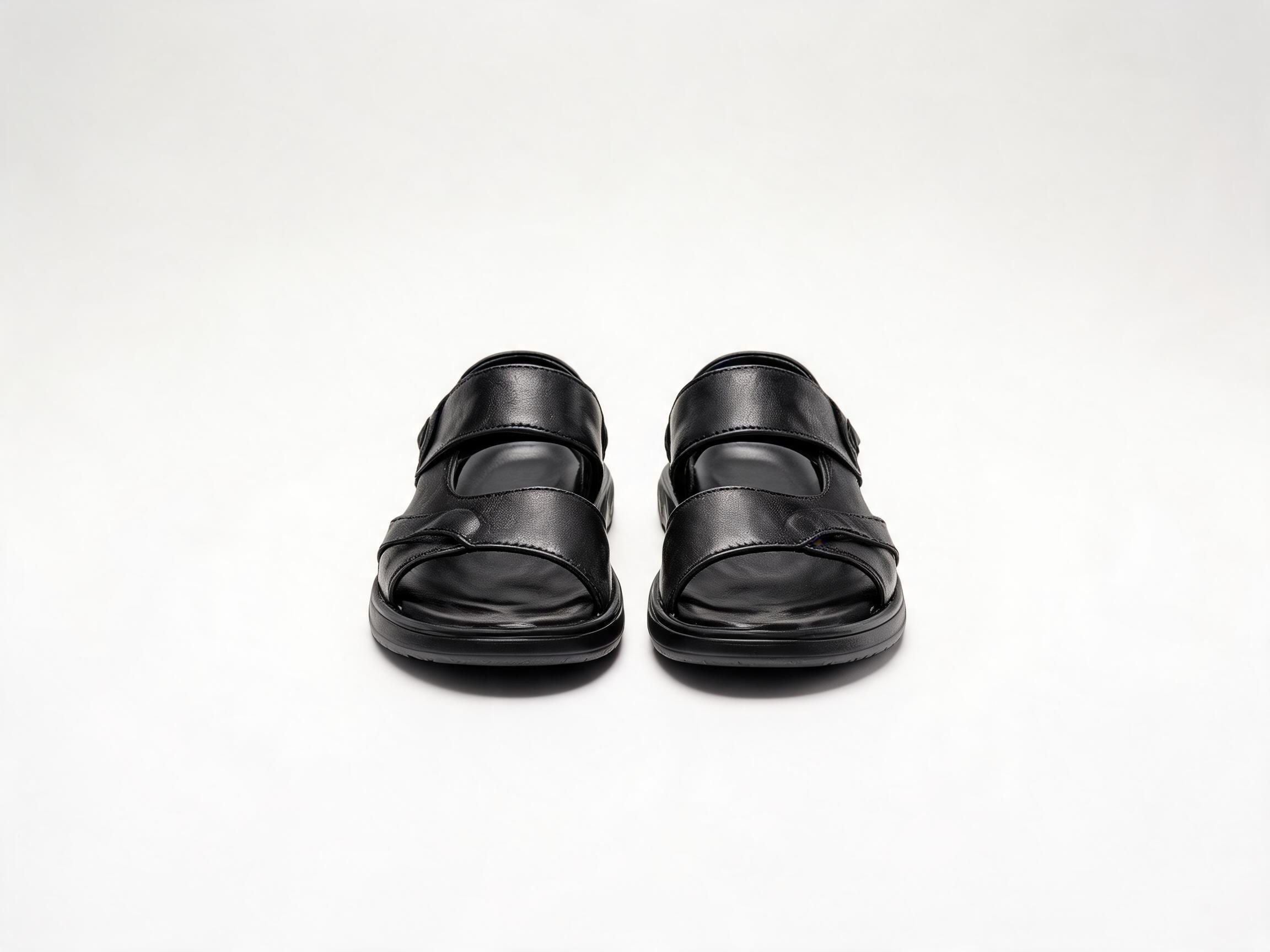
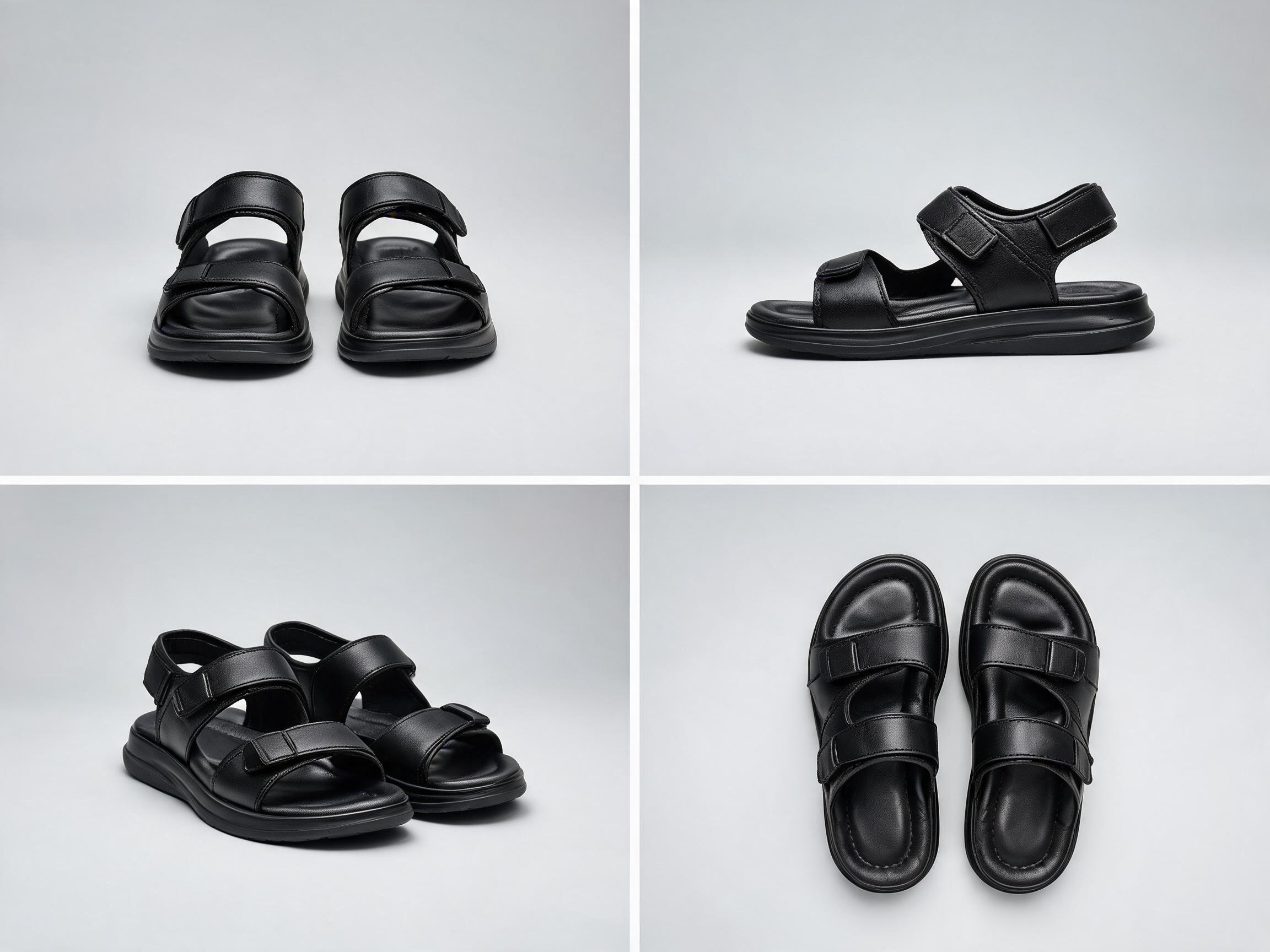
On the verified Black Leather Casual Sandals, the smooth black calf leather uppers are built from matched leather hides so that the left and right sandals share grain direction and shade. This is not cosmetic theater. On an open sandal, the two sandals are often displayed side by side, and the straps sit close to each other on the customer's foot. A hide with a visible grain break or a shade shift that runs one direction on the left sandal and the opposite direction on the right will read as a defect even when both halves meet the same thickness tolerance.
Cutting and strap preparation
Cutting is directed by the graded pattern, so strap lengths, widths and the position of buckle slots already account for the confirmed size run. After cutting, straps are prepared for stitching and the buckle hardware is fitted. On the referenced sandal, the upper carries adjustable buckle straps over a soft leather lining — a combination that lets the buyer keep one upper pattern while adjusting fit range through the strap length and buckle position.
Two practical points for buyers reviewing leather upper samples:
- Check grain direction and shade under the same light, on both sandals, side by side.
- Check the lining where the strap meets the foot. Soft leather lining is the surface the customer feels immediately, so any roughness shows up in returns faster than upper-surface issues.
Heel Construction Options: Block, Stiletto and Wedge-Adjacent
Heel choice is usually made from a look book, but it drives the manufacturing plan. Below is how the three common families differ as a construction decision. These are process descriptions, not fixed specifications — the heel height, material and profile for any given sandal come from the buyer's design and the approved sample.
| Heel family | How it typically assembles | What to settle at sampling |
|---|---|---|
| Block heel | Wide footprint gives a larger cementing and sole-pressing contact area. The heel is set onto the sole unit and pressed as part of the same sequence that attaches the outsole. | Heel height and top-piece material; how the heel blends into the sole edge; whether heel and sole are supplied as one unit or joined on the line. |
| Stiletto | Narrow footprint concentrates load into a small base. The heel is attached with the same cemented sequence but needs a tighter fit between heel, seat and sole, and the lasting has to hold the last shape accurately for the narrow contact area to sit flush. | Shank and heel-seat reinforcement; the exact heel-to-sole interface; how the narrow base will be checked in finished-shoe inspection. |
| Wedge-adjacent | The heel and forepart form one continuous sole profile, so the cementing and sole-pressing step covers a single larger surface rather than a separate heel block. | Whether the wedge is a single molded unit or built up; edge treatment; how the arch-support contour of the footbed sits against the wedge top. |
What holds across all three: the heel has to keep the sandal stable when the forefoot flexes. That is why forefoot flex testing is part of finished-shoe inspection rather than a separate structural test run only on request.
The Assembly Sequence on the Line
The referenced sandal uses stitched-and-cemented construction, and that choice is visible in the order of operations. A representative production flow runs:
- Pattern grading
- Leather cutting
- Strap stitching
- Buckle fitting
- Lasting
- Cementing
- Sole pressing
- Cooling
- De-lasting
- Inspection
- Packing
Stitching the upper and strap assembly before lasting lets the buckle areas be sewn and reinforced off the last, where the operator has better access. Cementing, sole pressing and cooling come after, and de-lasting follows cooling so the upper has set before it is pulled off the last. On the Black Leather Casual Sandals, the outsole is lightweight rubber with an anti-slip pattern, the footbed is cushioned with an arch-support contour, and the buckle hardware is corrosion-tested — three points that are easiest to confirm at finished-shoe inspection rather than mid-line.
Sampling to Bulk: What the Buyer Owes the Factory, and Vice Versa
Aurevia's in-house design team turns buyer sketches or reference shoes into production-ready samples. The clearer the input, the fewer sample rounds — so the useful handover package is:
- Technical sketch or reference sandal, with the heel family identified
- Target size run and any width requirements
- Leather color or Pantone reference, plus hardware color
- Branding requirements (footbed, box, hangtag)
- Any packaging or labeling rules the destination market requires
On timing: existing samples are quoted at 3–5 days, and customized samples at about 7–12 days. A customized sample usually means new pattern work, new heel or hardware selection, or branded components, which is why it takes longer than pulling an existing sample.
Bulk sizing is built on the approved sample. On the referenced sandal, the size range is EU 39–45 / US 6.5–12, with half sizes and width options available for bulk after sample confirmation. That last phrase matters: half sizes and widths are locked against the confirmed sample, not chosen independently at the bulk order stage, because they change the graded pattern.
Three-Stage Inspection and What It Catches
Inspection is split into three stages rather than one final gate:
| Stage | Focus | Typical checks |
|---|---|---|
| Incoming material | Leather, lining, hardware, outsole and footbed before production | Hide condition and matching; hardware corrosion testing; sole material |
| In-line | Strap stitching, buckle fitting, lasting, cementing | Stitch consistency, buckle placement and function, last shape |
| Finished-shoe | Completed pair, before packing | Forefoot flex testing, color fastness, buckle strength, sole adhesion |
Third-party inspection is welcome. Buyers who appoint their own inspection body should share the inspection protocol with the factory before the run so the finished-shoe stage can be prepared accordingly.
Hand-finished details also sit inside inspection scope. On the referenced sandal, outsole edges are hand-inked and burnished — a step that is judged visually on the finished pair, so the standard should be agreed on the approved sample.
OEM and Private-Label Customization
For brand buyers running an OEM heeled sandal program, the customization menu on this construction covers:
- Color matching to a Pantone reference on leather and hardware
- Hardware changes — buckle style, finish and hardware color
- Footbed branding — logo or label on the footbed
- Private-label packaging — branded boxes and hangtags
Each of these attaches to a specific part of the line: color matching affects leather selection and cutting, hardware changes affect the buckle-fitting station and corrosion testing, and footbed branding and packaging affect the finishing and packing stages. That is why all four should be settled on the sample, so the bulk order is a repeat of an approved build rather than a new one.
Aurevia Footwear Co., Ltd. is a B2B footwear and fashion accessories manufacturer and exporter based in Quanzhou, China, founded in 2011, with a 260-person team serving Europe, North America and the Middle East.
Buyer FAQ
- How long does sampling take for a new heeled sandal design?
- Existing samples are quoted at 3–5 days. Customized samples take about 7–12 days because they involve new pattern work, heel or hardware selection, or branded components.
- Can we change the heel type after the sample is approved?
- A heel change is a construction change: it alters lasting and the cementing and sole-pressing sequence, and usually the pattern. It is best treated as a new sampling cycle rather than a line adjustment.
- Are half sizes and width options available in bulk?
- On the referenced sandal, half sizes and width options are available for bulk after sample confirmation. Exact availability should be confirmed against your target size run when requesting a quote.
- Can we appoint our own third-party inspection?
- Yes. Third-party inspection is welcome; share the protocol before production so the finished-shoe inspection stage can be aligned with it.
- What should we send to start an OEM program?
- A sketch or reference sandal, target size run and widths, leather and hardware color references, branding requirements, and any destination-market packaging or labeling rules.
Start a Heeled Sandals OEM Program
Send your sketch or reference sandal, target size run, heel family and branding requirements. The in-house design team will confirm what can be produced and return a sampling plan.
Request product details