
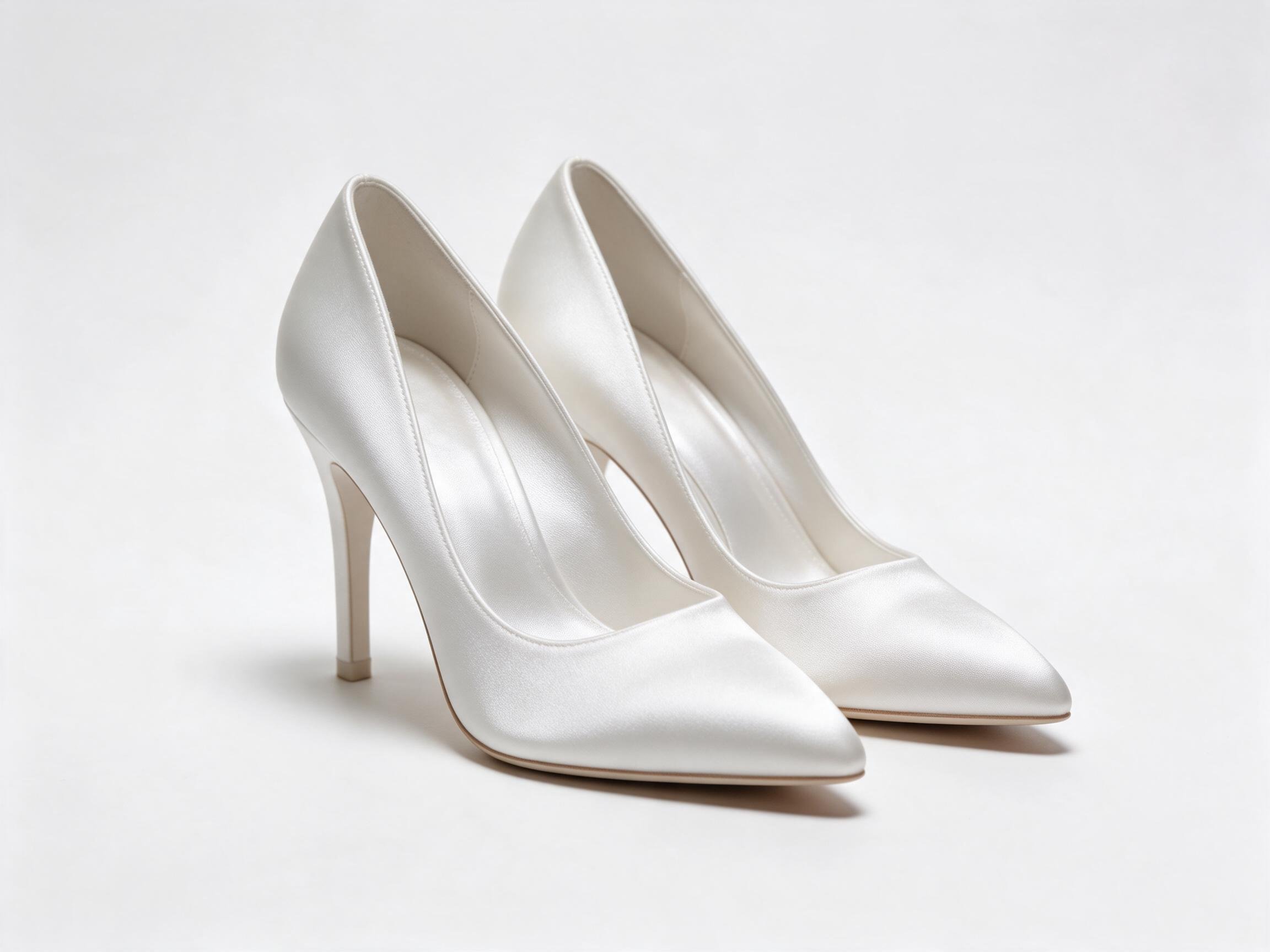
A buyer's verification guide to two decisions that determine whether a bulk satin bridal heel program holds up: shade consistency across the run and fit/comfort QC for long ceremonies. Covers matched panel cutting, Pantone dyeing, satin incoming inspection, heel stability and attachment checks, plus a sampling workflow and a practical QC checklist.
Buyer verification guide
Two decisions separate a profitable satin bridal heel program from a return-heavy one: whether the satin shade holds across the whole run, and whether the shoes stay comfortable through a full ceremony. This guide walks through the checks that catch both problems before the carton ships.
Key takeaways
- Shade consistency starts at cutting: panels for left and right shoes should come from matched satin so the sheen lines up.
- Pantone-referenced dyeing gives you a written target; approve it on a production-run sample and signed swatch, not on a photo.
- White, ivory and blush each carry different shade-management risk; ask how each is controlled per batch.
- Fit QC for long wear focuses on heel stability, footbed cushioning, forefoot flex and a secure heel attachment.
- Confirm order minimums and production windows directly with the supplier, since they vary by color and customization.
In this guide
Why satin bridal heels are a repeat bulk category
Bridal and occasion-wear buyers reorder satin heels because the product sits at the center of several selling seasons — spring and summer weddings, autumn bridal events and year-end party ranges. A closed-toe pointed pump in white or ivory is the item that anchors a bridal collection, and blush extends the same last into bridesmaid and occasion assortments.
That repeat demand is also where bulk programs fail. A buyer who approves one beautiful sample may receive a run where the white drifts between dye lots, or where the slim heel feels unstable after an hour on a stone floor. Both problems are detectable during production; both are expensive after the retailer takes delivery.
The reference product for this discussion is a white satin wedding heel: a women's closed-toe pointed-toe heel in soft white duchess satin, built on a slim heel with a reinforced core, soft lining, a cushioned footbed with arch-support contour and a rubber-tipped anti-slip outsole. It uses cemented construction, comes in EU sizes 34–41, and offers white, ivory, blush or custom shades, with upper panels cut from matched satin.
Shade management across a bulk run
Satin is a light-catching material. Two panels of nominally identical white can read differently under a showroom light if they were cut from different areas of a roll, if the nap direction differs, or if they came from separate dye lots. In a bulk bridal program, shade control is therefore a cutting and dyeing discipline, not a color name on a purchase order.
Matched panel cutting
The most direct control is to cut the upper panels for left and right shoes from matched satin, so the pair shares the same sheen and shade. Ask your supplier how panels are laid out and whether pair-matching is standard on the bridal line. When pairs are matched at cutting, a bride comparing her two shoes in daylight sees one color, not two.
Pantone dyeing and approval
If you need a shade beyond standard white, ivory or blush, satin can be dyed to a buyer's Pantone reference. Treat that reference as a starting target, not a guarantee. The practical workflow is: give the Pantone number, receive a dyed swatch or sample, compare it under daylight and under the store's actual lighting, then approve the physical swatch in writing. That signed swatch becomes the standard against which production is checked.
White, ivory and blush: different risks
- White shows dye-lot drift as a shift toward blue, yellow or pink. It also shows soiling and handling marks, so cutting and packing areas need to be clean.
- Ivory is harder to match consistently because small shifts read as "cream vs. champagne." Approve ivory against a physical swatch, not a screen image.
- Blush sits in a narrow band where a small dye variation becomes a visibly different pink. Confirm blush per batch and keep a retained swatch from each approved lot.
Across all three, ask how many dye lots a bulk order may draw from and whether the supplier retains swatches from each lot for comparison. A supplier that can show you its retained swatches is easier to hold to a standard.
Satin quality checks at incoming inspection
Satin quality affects both appearance and durability. At incoming material inspection, a manufacturer checks the roll before it reaches cutting. As a buyer, you can ask what is checked and request that the same points be verified on your order.
| Check | What to look for | Why it matters in a bridal heel |
|---|---|---|
| Surface defects | Snags, pulls, crease marks, shading bands across the roll | Defects on a pointed toe are highly visible and cannot be cut around invisibly |
| Hand and weight | Consistent thickness and drape across rolls | Inconsistent weight changes how the satin wraps the last and how the toe holds shape |
| Color consistency | Roll-to-roll comparison against the approved swatch | Catches dye-lot drift before it becomes mixed-shade cartons |
| Backing and stability | Whether the satin is backed or handled to hold shape on the upper | Affects how the toe box and heel counter hold their form |
At Aurevia Footwear Co., Ltd., a B2B footwear manufacturer and exporter founded in 2011 and based in Quanzhou, China, quality control runs in three stages: incoming material inspection, in-line inspection and final finished-shoe inspection. Third-party inspection is welcome, so a buyer can arrange an independent check at the material or finished-goods stage.
Fit and comfort QC for long ceremonies
A bridal heel is worn for hours — through a ceremony, photographs and a reception — often on uneven surfaces. Fit QC for this product is about stability and endurance, not only the size number on the box.
Slim-heel stability and reinforced heel core
A slim heel looks elegant but concentrates load on a small footprint. The reference product addresses this with a slim heel built on a reinforced core. During QC, check that the heel stands vertical under hand pressure, that it does not wobble where it meets the sole, and that the heel tip is securely fixed. A heel that rocks on a flat surface will feel unstable on a stone floor.
Heel attachment
Heel attachment is a common failure point after repeated wear. Ask how the heel is secured and check finished pairs by applying firm lateral and backward pressure at the heel. The joint should stay tight, with no gap opening between heel and upper. Because the reference shoe uses cemented construction, the bond between upper, sole and heel is part of what you are verifying.
Cushioned footbed and arch-support contour
Comfort over a long event depends heavily on the footbed. The reference product uses a soft lining and a cushioned footbed with an arch-support contour. In QC, press the footbed to confirm cushioning is present and even, and check that the arch contour sits where the foot expects it, with no hard ridge or lump under the arch.
Forefoot flex
A pointed-toe heel should flex at the ball of the foot without collapsing the toe shape. Flex each shoe by hand at the forefoot: it should bend where the foot bends, not across the toe box, and it should return without a permanent crease. A shoe that is too stiff will cause pressure; one that is too soft will lose its shape.
Outsole and anti-slip
The reference shoe has a rubber-tipped anti-slip outsole. Check that the tip is present on every pair, that it is firmly attached, and that the outsole sits flat. On smooth indoor floors, an uneven outsole or a missing tip undermines confidence in the product.
Colorway and size planning for bridal lines
Bridal assortments usually run white and ivory as core shades, with blush as an occasion and bridesmaid option. Plan shades against the retailers you supply: a department-store own brand may want ivory as its main offer, while a boutique may lead with white and use blush for secondary lines. Custom shades are possible when dyeing to a Pantone reference, but they add a sampling and approval step, so schedule them early.
Sizing deserves the same attention. The reference product covers EU sizes 34–41. Confirm the size curve with your supplier against your market's demand, and check that the last is consistent across sizes — a pair that fits at one end of the range should follow the same fit logic at the other. Order minimums and production windows vary by color and customization, so confirm them directly with the supplier before you finalize a purchase plan.
Sampling and customization workflow
Most bulk problems are cheaper to fix at sample stage. The reference product supports OEM/ODM, including a logo on the insole, box or hangtag, and a gift box plus export carton packaging. A practical sampling sequence:
- Share your shade reference (Pantone or a physical swatch) and target size range.
- Receive existing samples, which Aurevia ships in 3–5 days, to assess last, heel height and finish.
- Request custom samples, typically about 7–12 days after details are confirmed, with your chosen shade and logo placement.
- Approve the physical sample and signed swatch in writing; keep a retained pair as the production standard.
- Confirm order minimums, production windows and trade terms (EXW, FOB or CIF) with the supplier.
- Arrange third-party inspection if your compliance process requires it.
Aurevia is a roughly 260-person team exporting mainly to Europe, North America and the Middle East, and offers a 6-month quality warranty on manufacturing defects. Warranty terms should be reviewed alongside your own retail return policy.
A short QC checklist
| Area | Check |
|---|---|
| Shade | Pairs cut from matched satin; shade compared to approved swatch under daylight |
| Satin | No snags, pulls or shading bands on visible panels; toe shape holds |
| Heel | Vertical under pressure; no wobble; tip secure |
| Heel attachment | Tight joint under lateral and backward pressure; no gap |
| Footbed | Even cushioning; arch contour positioned correctly; soft lining intact |
| Flex | Bends at the forefoot, returns without permanent crease |
| Outsole | Rubber tip present and attached; sole sits flat |
| Pairing | Left and right match in shade, sheen and size |
Use this checklist at sample approval and again at final inspection. If you use a third-party inspector, give them the same list so their report matches your standard.
FAQ
How do I make sure the white satin shade is consistent across a bulk order?
Approve a physical swatch, ask for matched panel cutting so left and right shoes share the same sheen and shade, and ask how many dye lots the order may draw from. Compare retained lot swatches during final inspection.
Can the satin be dyed to my Pantone reference?
Yes — the satin can be dyed to a buyer's Pantone reference. Approve the dyed swatch under daylight and under your store lighting before production, and keep a signed swatch as the standard.
What should I check for comfort during a long ceremony?
Focus on heel stability and the reinforced heel core, a secure heel attachment, even cushioning and arch support in the footbed, and forefoot flex at the ball of the foot. These are the points that affect how the shoe feels after several hours.
What are the order minimums and production windows?
These vary by color and customization and should be confirmed directly with the supplier. Ask for both figures in writing before you finalize a purchase plan, and confirm trade terms at the same time.
Next step
If you are building or refreshing a satin bridal heel line, start with a shade reference and a target size curve, then request existing samples to assess the last and finish. For a custom shade or logo program, plan the custom sample stage early enough to approve the swatch before production. You can review the reference product and send your requirements through the white satin wedding heels page.