
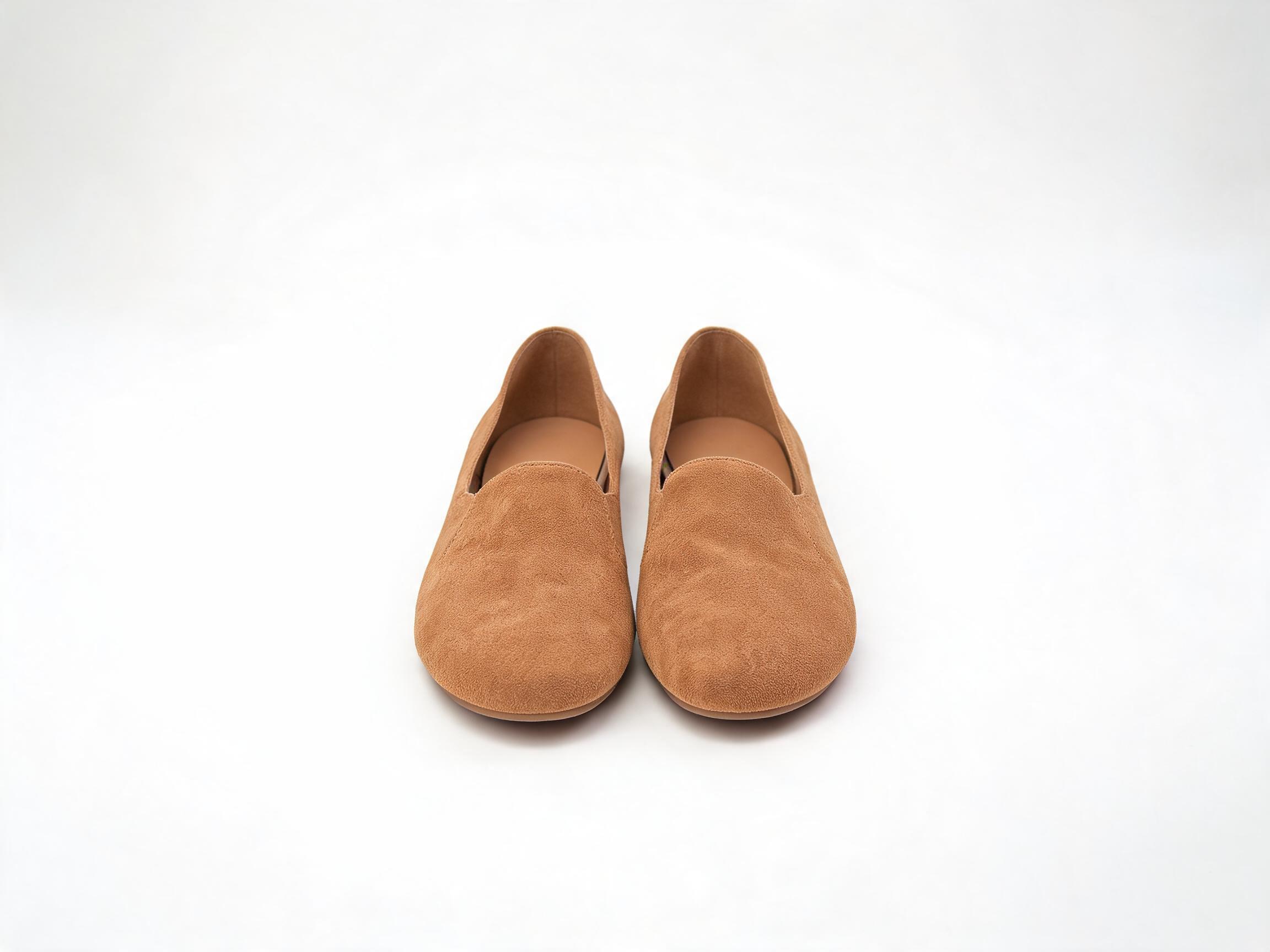
A practical QC framework for buyers sourcing suede boots wholesale: how to judge nap direction and evenness, what to ask suppliers about colorfastness and dye lots, how to set batch-to-batch acceptance limits, and why care labeling belongs in the pre-production conversation. Anchor points are drawn from a real suede construction currently in production — the Tan Suede Slip-On Flats for women.
Suede is the part of a boot order most likely to come back as a claim. Nap, shade and surface handle are set by the hide, the finishing and the dye lot long before the boot is assembled — which means the checks that decide a shipment happen at inspection, not after arrival. This guide covers the checks buyers can specify and run: nap direction and evenness, the questions worth asking about colorfastness and dye-lot control, how to write a batch-to-batch acceptance standard, and where care labeling sits in the pre-production conversation.
- Nap and shade are hide-and-finish properties; judge them on the approved sample under one fixed viewing condition, never on two photos taken in different rooms.
- Colorfastness and dye-lot control should be checked as supplier test reports and lot records covering the specific material — ask for the report, its scope and its condition, and do not accept a claim in place of a document.
- Batch consistency needs a written acceptance limit agreed before production: which defect, how much, and measured how.
- Confirms minimums, lead times and any test scope directly with sales before you build them into a spec sheet.
Why suede behaves differently from smooth leather in inspection
Smooth leather is judged mostly on surface defects and color. Suede adds a third variable: the nap, the raised fiber surface created during finishing. Nap can lie in one direction or vary across a hide, and it looks different depending on which way you tilt the sample and where the light sits. Two panels cut from the same hide can read as different shades if the nap of one runs against the other.
That is a finishing property, not a defect by itself. The buyer’s job is to decide whether the variation falls inside the look they approved. To see how the material behaves when handled, the Tan Suede Slip-On Flats for women are a useful reference point: a suede upper, a memory foam insole, roughly a 1 cm flat heel and EU sizes 35–41. It is a flat, not a boot, but the upper is a real example of the material being cut, assembled and finished on a production line — and it shows where inspection attention belongs on any suede upper, boot or flat.
Nap: direction, evenness and how to judge it
Ask for the following to be nailed down on the approved sample, then write them into the inspection standard.
Nap direction
The nap on each panel has a direction. On a boot, mismatched direction between the vamp, quarter and shaft is one of the most common visual complaints, because the panels catch light differently and read as two tones. Agree with the supplier which direction is the “correct” one for the style — usually laid in a consistent direction on adjacent panels — and have the inspector check it by tilting the boot under a fixed light and running a hand against and with the nap.
Nap evenness
Evenness is about whether the raised surface looks uniform across a panel and between panels of the same pair. Look for patchy areas where the nap is flattened or sparse, and for a stiff or boardy feel in one area against a soft area elsewhere. Note that handling itself disturbs the nap: an inspector who rubs a panel repeatedly will change what the next check sees, so sequence the nap check before other handling.
Viewing conditions
Set the light source, the angle and the distance for every inspection, and hold it the same in the factory and on the sample you approved. If your approval was based on a photo taken in daylight and the inspection happens under factory strip lighting, you are comparing two different objects. A short written viewing condition — light type, angle, viewing distance — prevents most arguments later.
Colorfastness: the questions to put to the supplier
Colorfastness is a test property, not something an inspector can confirm by eye. For suede boots wholesale, the practical risk is dye or finish transferring onto socks, linings or other garments through rubbing, or shifting after exposure to light or water. The right move is to ask the supplier for the evidence that applies to your material and the market you sell into, and to understand what the report actually covers.
- Which test method and which test condition does your report use — and does it name the specific material and color you are quoting me?
- Who carried out the test, and on what date? Does the report correspond to the current dye lot or to an earlier sample?
- What rubbing conditions were tested (dry and wet, if applicable), and what was the result against the acceptance level for my market?
- Do you have separate evidence for light exposure and for water spotting, if my market expects either?
- For linings, sock linings and binding that touch the foot: are those materials tested too, or only the upper?
- Do you hold lot records that let me trace a finished boot back to the dye batch used for its upper?
These are check questions, not a set of thresholds this article can supply. The acceptable level depends on your destination market, your end use and your own buyer requirements. Ask for the current documents covering the material you are ordering, and check that the scope matches. If a supplier answers with a verbal assurance instead of a report, treat that as an open item.
Dye-lot control and batch-to-batch consistency
Color variation between batches is expected in dyed suede. What can be controlled is how much variation the buyer accepts, how the supplier records it, and how the two sides agree a pass or a fail.
Set the acceptance standard before production
A workable standard names the property, the method and the limit. Vague language (“shade to be close to approved sample”) gives both sides room to disagree. A stronger pattern is a short table that the factory and the buyer both sign:
| Property | How it is checked | What to agree up front |
|---|---|---|
| Shade vs approved sample | Visual comparison of a cut piece or finished boot against the approved standard, under the fixed viewing condition | Which reference set is used, who holds it, how often it is replaced, and what counts as out of tolerance |
| Nap direction and evenness | Tilt and hand test under fixed light; check adjacent panels on the same boot and between left and right of a pair | Required nap direction; which panel-to-panel differences are rejectable |
| Surface defects | Visual scan at a set distance and light for scars, thin spots, stains and finish marks | Defect types, size and number allowed per boot or per pair |
| Lot traceability | Supplier’s own records linking finished goods to material lots | Whether records are kept and whether they are available with the shipment |
The limits in the third column are yours to set with the supplier — they are not published thresholds, and they should reflect the market and price position you are buying for.
Compare like with like
A batch comparison fails if the two sides are looking at different things: unfinished panels versus finished boots, one light versus another, a fresh sample versus one that has sat in a warehouse. Keep a retained standard sample sealed and dated, inspect incoming batches against it, and record whether the comparison was made on material or on finished product. When a new lot is approved, the old standard is retired and the new one retained, so there is always exactly one live reference.
What good looks like on a production line
Aurevia Footwear Co., Ltd., founded in 2011 and based in Quanzhou, China, works with a three-stage quality control process covering production stages from material to finished goods. For a suede order, that structure matters most at two points: material confirmation before cutting, and finished-goods inspection against the retained standard. Exactly how a given buyer’s suede is checked — which stage, which defect list, which sampling — should be confirmed with sales rather than assumed from the process description.
Care labeling belongs in the spec, not on the box
Suede care instructions are part of the product, not an afterthought added at packing. The label wording, the language set and the placement need to be agreed before production, because a change after the uppers are assembled is expensive.
- Which care symbols and wording are required for the destination market, and in which languages?
- Where does the label sit — insole, side seam, hangtag — and what is the approved artwork?
- Does the care text match the actual construction and finish, so the buyer is not told to treat the boot in a way the material does not support?
- Do you supply a care card or insert, and is that a separate item with its own approval?
Label accuracy is the supplier’s and the buyer’s shared responsibility. Ask for the proposed label artwork at sampling, not at shipment. If care-label requirements come from the destination market, confirm the current rule for that market rather than relying on a template from a previous order.
A short inspection checklist for the warehouse
- Unpack under the fixed viewing condition and compare each boot to the retained standard before any handling.
- Check nap direction on the vamp, quarter and shaft on both boots of a pair.
- Compare left and right for shade and nap evenness — pairs are what the customer sees.
- Scan for finish marks, stains and thin spots; handle the boot as little as possible before this step.
- Confirm the care label matches the approved artwork and language set.
- Record the lot number so a later complaint can be traced back.
Frequently asked questions
Can I judge suede colorfastness from a sample I rub by hand?
Not reliably. A hand rub tells you that something transferred once, which is useful as a prompt to ask for the test report, but it is not a substitute for a test carried out to an agreed method. Ask the supplier for the report covering your material, color and market.
How much shade variation should I accept between batches?
That is a commercial decision, and it should be written down before the first bulk order. Define the reference standard, the viewing condition and what counts as out of tolerance, and agree who holds the retained sample. The limit itself depends on your market and price position, not on a universal figure.
Does the Tan Suede Slip-On Flat tell me anything about boots?
It shows how suede is handled and finished in a real production line — cut, assembled and inspected as a suede upper — which is where the same nap, shade and label checks apply. It is a flat, not a boot, and it does not stand in for boot construction or boot testing.
What about minimum order quantities and lead times?
These vary by material, color and order composition, and they should be confirmed with sales for your specific requirement before you plan a launch around them.
Where to start
Write the nap, shade and care-label standard first, because those are the three that cannot be fixed after assembly. Then ask for the colorfastness and lot-traceability documents that apply to your material and market, and check their scope before you accept them. If you are sourcing suede uppers for wholesale, send the style, target market and expected color range to the Aurevia Footwear sales team, near Quanzhou, China — the company handles OEM/ODM work with in-house design and sampling, and minimums will be quoted against your actual requirement.