
A buyer-focused guide to how men's leather dress shoes are made in bulk, covering upper craft, last and size grading for EU, US and Middle East fits, the points to confirm before an OEM run, and a practical quality-control checklist for wholesale mens dress shoes.
Buyers comparing wholesale mens dress shoes are rarely short of options. The harder question is which factory can hold a given leather finish, last shape and size grid across a full production run. This guide explains what actually varies between factories, and where to focus your checks before placing an OEM order.
Key takeaways
- Upper cutting, lasting and sole stitching separate a controlled factory from an assembly shop.
- Last dimensions and size grading decide whether a style sells in the EU, US or Middle East.
- Confirm size grid, leather finish and construction before bulk, not after the first shipment.
- Three-stage inspection with forefoot flex, colour fastness and sole adhesion checks protects the run.
What defines quality in men's dress shoes
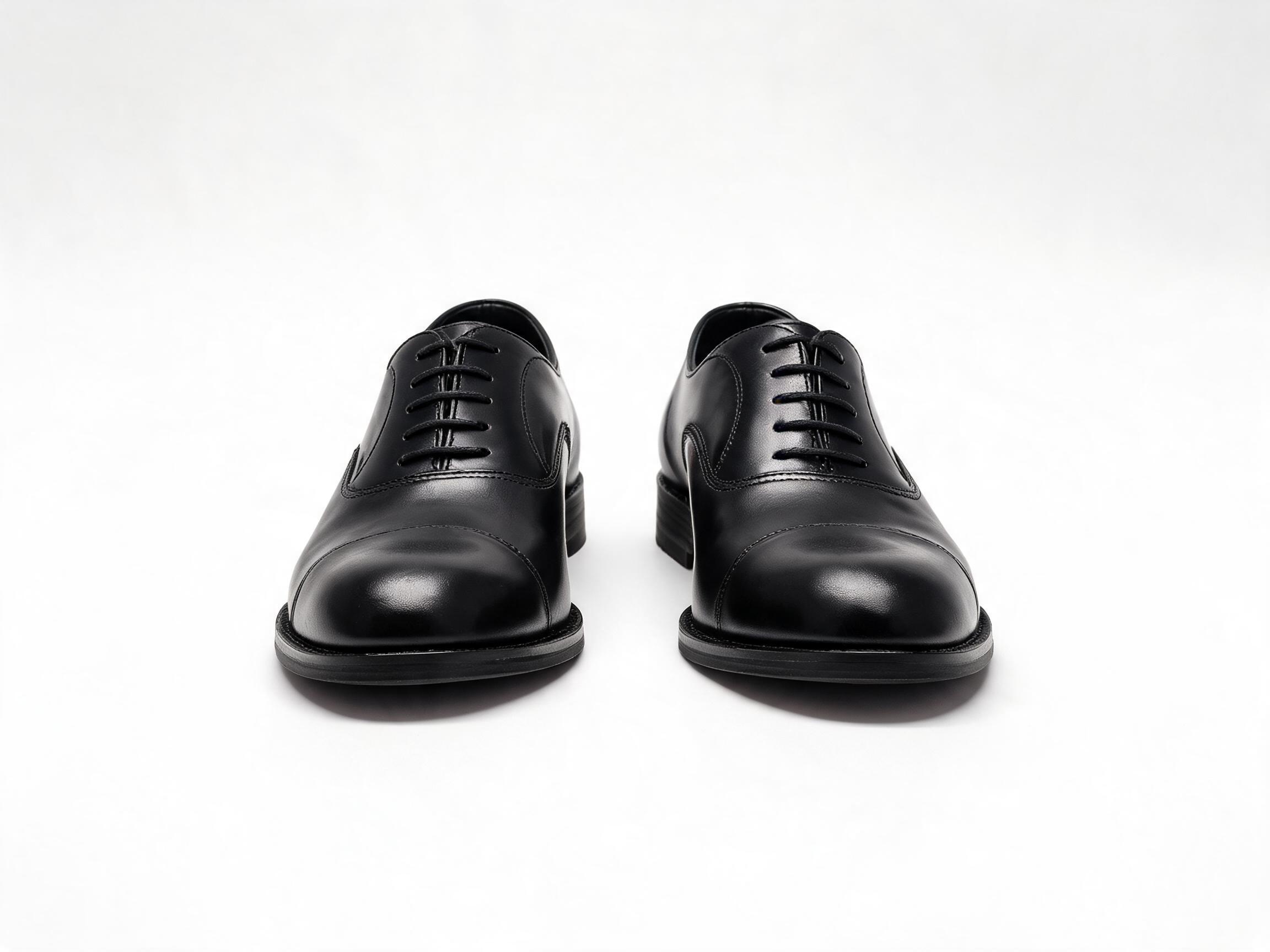
A men's leather dress shoe is built in a sequence, and each step leaves evidence you can inspect. For a model such as a black cap-toe oxford, the visible upper is only part of the story. Look at how leather is selected, how it is pulled over the last, and how the sole is attached.
Upper cutting and material selection
Full-grain leather carries the tightest surface fibres, so it takes a polish well and shows fewer stretch marks than split or corrected leathers. When a factory sources genuine leather with multi-stage inspection, the incoming check happens before cutting — hides are reviewed for scars, growth marks and colour variation, and the cutter lays patterns to avoid weak or mismatched areas.
Cutting also determines how the shoe ages. On a cap-toe oxford, the cap seam runs across the vamp and should sit level, with even spacing and no puckering. Panels that are cut from different regions of the hide can look fine individually but mismatch under polish. Ask how panels are matched within and across sizes.
Lasting and the shape of the shoe
The last is the foot form the leather is stretched over. Lasting sets the toe spring, the heel seat and the line of the instep. If the lasting is loose, the upper creases early and the shoe loses its shape; if it is over-tight, the leather is stressed at the seams.
For a closed-lacing oxford, the quarters must close cleanly over the tongue without gaping. This is largely a pattern and last decision, not a finishing fix. Buyers evaluating a sample should flex the forefoot and check that the crease falls behind the cap line rather than across it.
Lining, footbed and sole construction
Leather lining manages moisture and holds the shape of the upper. A cushioned footbed adds a layer under the sole, which changes how the shoe feels on hard retail floors but should not be confused with structural support.
Sole attachment is the most common place for cost to be hidden. The black cap-toe oxford from Aurevia uses a stitched leather/rubber sole with a rubber insert, described as a stitched-and-cemented build, with a heel of approximately 3 cm. Stitching holds the sole mechanically; the cement bond secures the layers that are not stitched. Buyers should ask which parts of the sole unit are stitched and which are bonded, because that answers repairability questions from retailers.
You can review the construction details on the Black Cap-Toe Oxford Shoes page, including the cap-toe seam, closed lacing and leather lining.
Last and size grading for EU, US and Middle East fits
A single style sold into three regions usually needs more than one grading decision, because the reference foot differs. EU sizing runs in continental increments; US sizing is commonly expressed in half sizes; Middle East buyers often order wider fittings for the same nominal length. Grading is the process of scaling the last pattern up and down while keeping proportions that still fit a real foot.
Two failures show up repeatedly in bulk orders. The first is length-only grading, where width does not increase with size, so the largest sizes feel narrow. The second is inconsistent grading between colourways or leathers, where a softer leather relaxes differently and the same size feels larger.
| Attribute | Detail |
|---|---|
| Upper | Polished full-grain leather with cap-toe seam |
| Construction | Closed-lacing oxford, stitched-and-cemented build |
| Lining and footbed | Leather lining, cushioned footbed |
| Sole | Stitched leather/rubber sole with rubber insert |
| Heel height | Approximately 3 cm |
| Size range | EU 39 to 45 / US 6.5 to 12 |
| Colours | Black, dark brown, custom |
Data reflects the current published specification for this style.
Before confirming a size grid, ask for the width grading that goes with each length, and for the measured last dimensions rather than the nominal size label. If a retailer in one market needs a wider fitting, that is a last question, not a packaging question.
Points to confirm before bulk production
Most disagreements between buyer and factory trace back to assumptions made at quotation rather than defects in production. Settle these three areas in writing before the run starts.
Size grid
- The exact size range per colourway, not just per style.
- Width grading by size, and whether a wider fitting is available as a separate last.
- How sizes will be marked and packed, so retail and warehouse staff read the same labels.
- Whether the sample size you approved sits inside the range or at its edge — fit at the edge is the risk point.
Leather finish
- The finish name and appearance: polished, matte, corrected or full-grain.
- Colour references for black, dark brown and any custom shade, agreed against a physical standard rather than a screen.
- How panel matching is handled across the pair and across the run.
- What acceptable natural variation looks like, so an inspection does not reject normal hide character.
Construction and components
- Which parts of the sole are stitched and which are cemented.
- Lining material and footbed specification.
- Heel height tolerance for the 3 cm reference, since small differences change the silhouette.
- Logo or private-label placement, and which elements are in-house design work.
A factory with in-house design and pattern teams can usually resolve last and pattern questions without an external tooling loop, which shortens sample rounds. Customized samples from Aurevia typically take 7 to 12 days, so buyers can plan approval steps around that window.
QC checklist for a dress-shoe production run
A three-stage inspection covers incoming materials, in-line work and the finished shoe. The finished-shoe stage matters most to buyers because it catches problems that only appear once the shoe is assembled.
| Stage | What is checked | Why it matters to the buyer |
|---|---|---|
| Incoming materials | Leather grade, visible defects, colour consistency, lining and sole components | Stops weak or mismatched panels before they are cut |
| In-line | Cap seam alignment, lasting tension, stitch density and symmetry | Catches shape and stitch faults while correction is still possible |
| Finished shoe | Forefoot flex testing, colour fastness, sole adhesion, heel height, size labelling | Confirms the pair a retailer receives behaves as approved |
Three checks deserve specific attention. Forefoot flex testing shows whether the crease forms in the right place and whether the sole bond holds through movement. Colour fastness confirms the finish does not transfer to socks or linings under normal wear and moisture. Sole adhesion checks the bond between the sole unit and the upper, especially on cemented sections where a stitched-and-cemented build relies on both methods.
Pair-level inspection also matters. A run can pass on individual shoes and still ship mismatched pairs, so check that left and right match on colour, grain and seam position.
Working with a leather dress shoes manufacturer
Aurevia Footwear Co., Ltd. was founded in 2011 in Quanzhou, China, and operates with 260 staff. The company works on OEM/ODM and private-label programs, with in-house design and pattern teams and genuine leather sourcing under multi-stage inspection. Its exports go to Europe, North America and the Middle East, which is why its size grading has to serve different fit expectations rather than a single home market.
For buyers building a dress-shoe program, the practical sequence is: agree the last and size grid, approve a sample in the final leather finish, confirm which sole components are stitched, then set the inspection points you want to see. Each of those decisions is cheaper to change before bulk than after.
If you are evaluating a new oxford or derby style, share your target size range, colour reference and construction preference with the factory so the sample reflects the market you actually sell into.