
A buyer-side framework for grading wholesale mens dress shoes suppliers and building a tiered range. Covers leather and workmanship checks, three-stage bulk QC evidence, sampling before commitment, and how to split core, mid and statement tiers without over-ordering any single SKU.
A bulk order of dress shoes fails for predictable reasons: hides that are not matched across pairs, a cap-toe seam that drifts between sizes, or a sole that lets go after the first wear test. None of these problems show up in a catalogue photo. They show up when you inspect the second and third production runs, and by then the container is already on the water. That is why experienced importers grade suppliers on process evidence rather than product photos, and why they build a range in tiers instead of betting the season on one SKU.
The short version
- Grade suppliers on leather sourcing control, in-line QC and their willingness to open inspection records — not on appearance alone.
- Ask for samples before bulk, and pay attention to what the sample cycle proves about their internal handoffs.
- Split your range into three price tiers with clearly different construction stories, so each tier has a reason to exist.
- Confirm MOQ, pricing and delivery per program with the factory; these vary by leather, size curve and packaging.
- Invite third-party inspection. A supplier who welcomes it is usually the one with nothing to hide.
Start with what you can actually verify
You cannot audit a factory from a trade show booth. What you can do is ask for evidence that costs the supplier something to produce, and see how quickly and how completely they respond.
Four things are worth verifying before you discuss price:
- Leather sourcing and hide control. Genuine leather varies from batch to batch. Ask how hides are selected, how they are matched into pairs, and whether left and right uppers are cut from comparable grain. A supplier with a multi-stage inspection process will be able to describe those stages without prompting.
- In-line QC, not just final QC. Catching a misaligned cap-toe seam at the end of the line means the whole run is suspect. Ask where in the process checks happen and what happens to a pair that fails.
- Finished-shoe checks. Forefoot flex testing, colour fastness and sole adhesion are the three that matter most on a dress shoe, because they map directly to the complaints you will receive from retail customers.
- Records you can see. Inspection reports on request, and a stated willingness to accept third-party inspection, tell you more about a supplier's confidence than any certificate of good intentions.
Aurevia Footwear Co., Ltd., a B2B footwear manufacturer and exporter founded in 2011 and based in Quanzhou, runs a three-stage bulk QC process covering incoming material, in-line and finished-shoe inspection, including forefoot flex testing, colour fastness and sole adhesion checks. Inspection reports are available on request and third-party inspection is welcome. That is the kind of structure you should be asking every candidate supplier to describe in their own words.
How to grade a supplier in one sampling round
The sample stage is where most sourcing decisions are actually made, whether buyers realise it or not. Use it as a test of the supplier's internal coordination, not just of the shoe.
What the sample should demonstrate
Ask for a sample in a mid-range size, not the easiest one to make. A pair in EU 42 tells you less about grading accuracy than a pair at the edge of the range, such as EU 39 or EU 45. If the supplier's up/down grading is loose, the extremes reveal it.
Check the following on receipt:
- Are the two shoes in the pair matched for grain, shade and finish, or is one visibly darker?
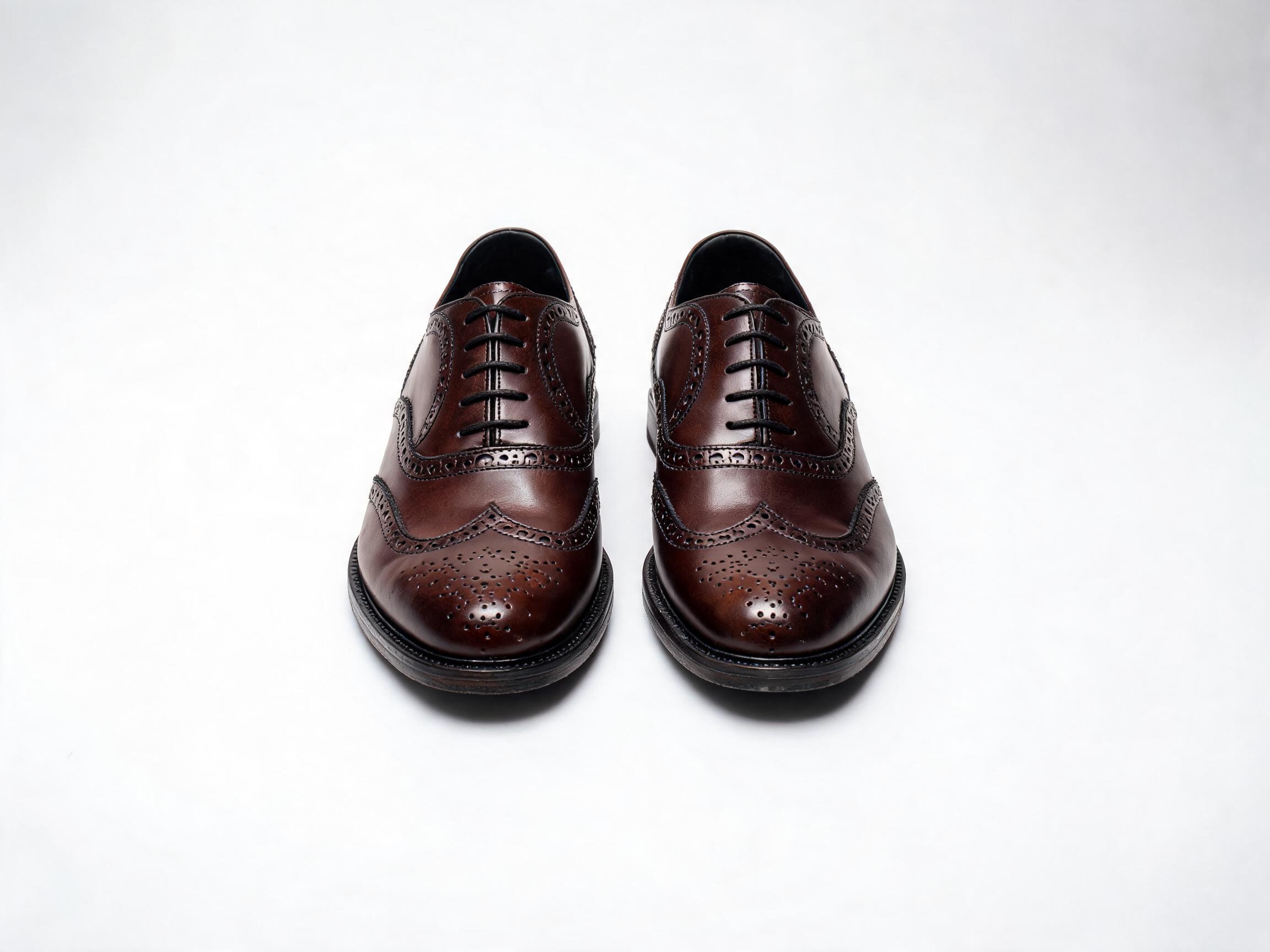
- Does the cap-toe or brogue pattern sit symmetrically on both shoes when viewed from directly above?
- Is the heel height consistent between left and right? A dress-shoe heel sits at approximately 3 cm; anything noticeably off is a grading problem.
- Does the sole bond cleanly at the edges, with no lifting or excess adhesive?
- Does the leather lining sit flat without creasing that will rub?
Customised samples typically take about 7 to 12 days. That window is useful in itself: a supplier who hits it consistently is one whose sampling team and production floor talk to each other.
Questions that separate real factories from traders
- Who cuts the uppers — your own floor or a subcontractor?
- Which stages are inspected, and by whom?
- What are the most common defect reasons you reject a pair, and how has that changed?
- Can you supply inspection records for the run you are quoting?
A trading intermediary will often answer these vaguely. A factory with a design and sampling team in-house will answer with specifics, because they are describing work they do every day.
Build a tiered range instead of a single hero SKU
Most wholesale mens dress shoes programmes underperform because the buyer commits too deeply to one construction level. Retail demand is not uniform: some customers want a durable everyday office shoe, others want something with visible finishing detail, and a smaller group will pay for a statement piece.
A three-tier structure lets you cover that spread without carrying three near-identical SKUs that cannibalise each other.
| Tier | Construction story | Example from a real range | Where it earns its shelf space |
|---|---|---|---|
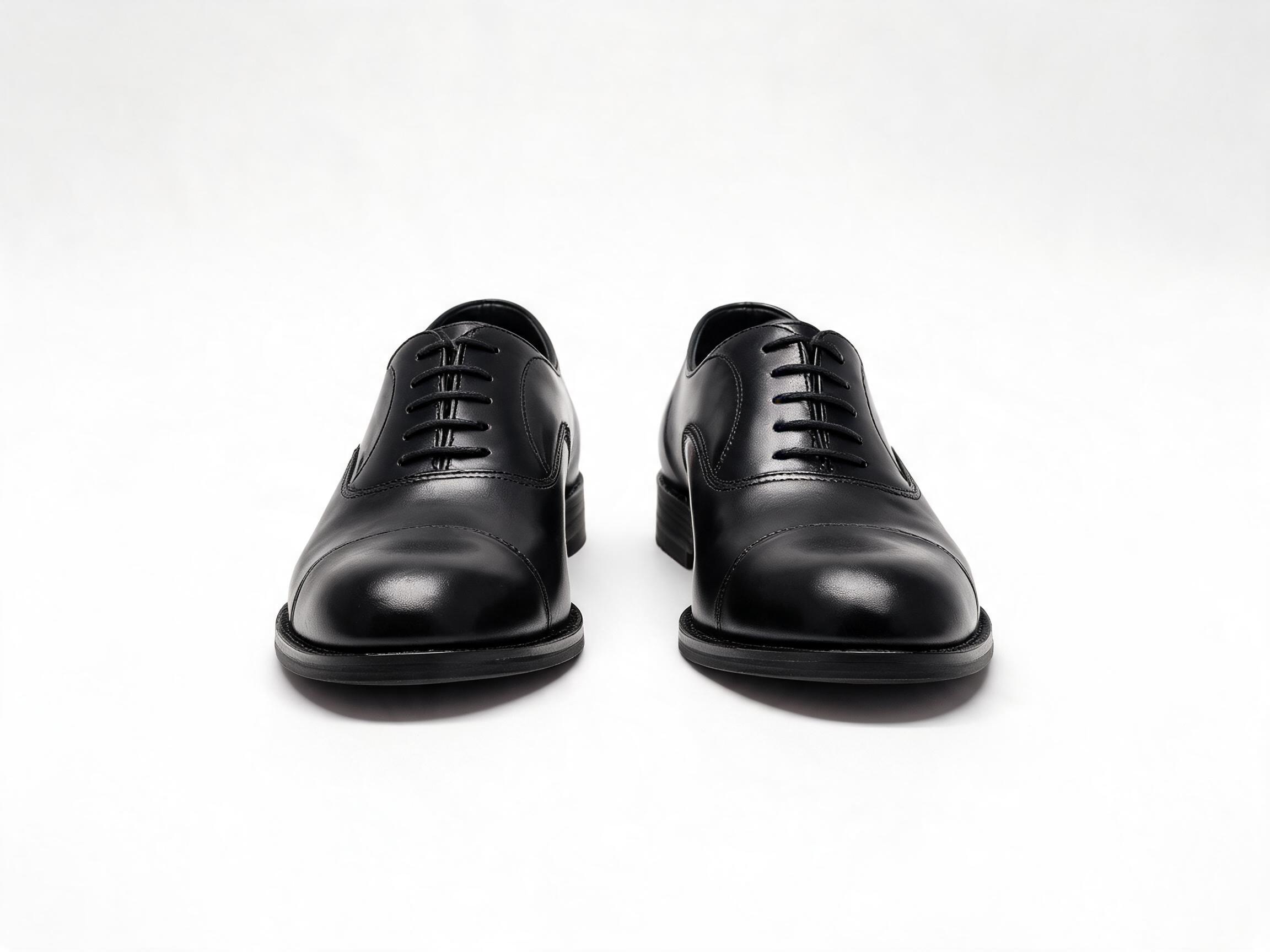
| Core / volume | Clean cap-toe formal, polished full-grain upper, leather lining, stitched leather/rubber sole, cushioned footbed | Black Cap-Toe Oxford Shoes — EU 39–45 / US 6.5–12 | Office, uniform and corporate-supply accounts where repeatability matters more than novelty |
| Mid / detail | Burnished full-grain leather with hand-punched wingtip perforations | Dark Brown Full Brogue Shoes — EU 39–45 | Customers who want a visible step up in finish without moving to a premium price band |
| Statement | Burnished full-grain leather with double buckle straps | Tan Double Monk Strap Shoes — EU 39–45 | Independent retail and markets where monk-strap styling is a recognised fashion item |
The point of the table is not the three specific models — it is the structure. Each tier should differ in a way a shopper can see and a retail buyer can explain to their team. If two tiers look identical on the shelf, you have a pricing problem, not a range.
Why the core tier should carry the volume
The black cap-toe Oxford is the least risky SKU in most programmes. It has the broadest size demand, the least seasonal styling risk, and the widest range of retail contexts. Build your depth here, and use the brogue and monk strap tiers to generate interest and margin rather than to carry the season.
That said, depth still needs a limit. Test each tier at a modest depth first, then reorder against sell-through. Suppliers who support OEM/ODM and private label can often absorb a phased intake better than a single large commitment, but the terms are set per program, so confirm the intake structure with the factory before you plan your buy.
Getting to bulk: the acceptance points that matter
Once a sample is approved, the risk moves from design to consistency. This is where a tiered range creates a second advantage: if one tier has a QC problem, it does not automatically compromise the others.
Set your acceptance points before production starts, in writing:
- Pre-production. Confirm the exact leather, lining, sole and footbed specification against the approved sample. Ask for the incoming material inspection to be recorded.
- In-line. Confirm when you will be notified of in-line checks, and agree the remedy if a check fails. Forefoot flex, colour fastness and sole adhesion are the three checks that most directly predict field complaints.
- Finished shoe. Agree the inspection basis and whether you or a third party will attend. A supplier who welcomes third-party inspection has effectively made your QC job easier.
- Documentation. Request the inspection reports for the production run. If reports are not part of the standard package, ask whether they can be provided for your program.
Note that not every detail you might want is necessarily published. MOQ, pricing, lead time and packaging specifications are not fixed across the industry — they change with leather availability, size curve and carton configuration. The reliable move is to confirm each of these per program with the factory rather than carrying a figure from one supplier to another.
A buyer's checklist you can send to any candidate
Forward this list to two or three suppliers and compare the quality, not just the completeness, of the replies.
- Describe your leather sourcing and how hides are matched into left/right pairs.
- List the inspection stages in your bulk process and what each one checks.
- Confirm whether forefoot flex, colour fastness and sole adhesion are part of finished-shoe checks.
- State your position on third-party inspection and whether inspection reports can be issued.
- Provide one dress-shoe sample in a mid range and one at the edge of the size run.
- Quote MOQ, unit price and delivery for the specific program, size curve and packaging you are discussing.
- State your sample cycle for a customised style.
- Confirm whether OEM/ODM and private label are supported, and who handles design and sampling.
Suppliers who answer all eight in detail are the ones worth a first order. Suppliers who answer six of them with marketing language and two with vagueness are the ones to keep on a shortlist for later.
Common mistakes that cost buyers a season
- Judging on the hero photo. A polished marketing shot tells you nothing about grain matching across a size run.
- Skipping the size extremes. Grading errors live at EU 39 and EU 45, not at the middle of the run.
- Treating MOQ as a fixed number. It is negotiated per program, and a supplier's published figure may not reflect your specification.
- Over-committing to one tier. Three tiers at moderate depth usually outsell one tier at heavy depth.
- Declining third-party inspection. If you are allowed it, use it. The cost is small relative to a rejected container.
What to do next
Pick the tier you most need to fill first — for most importers that is the core cap-toe tier — and send the checklist above to three candidate factories alongside a request for a sample in a mid size and an edge size. Compare the answers against the evidence, not against the price list alone.
Aurevia Footwear Co., Ltd. manufactures and exports wholesale mens dress shoes from Quanzhou, supporting OEM/ODM and private label with an in-house design and sampling team. Start by requesting the leather sourcing and QC structure for the specific style and size curve you are sourcing; the product pages for the Black Cap-Toe Oxford, Dark Brown Full Brogue and Tan Double Monk Strap list what is currently published, and the rest is best confirmed per program.