A merchandising framework for women's ankle boots, covering shaft height, heel type, and size-run planning. Grounded in the Aurevia Brown Leather Ankle Boots example, it helps buyers decide which ankle boots to stock.
If you are sourcing how to choose ankle boots for a retail line, the decision is rarely about picking one pretty style. It is about matching a shaft height, heel height and size run to the way your customers actually wear ankle boots — and then checking whether the factory can deliver that combination on your terms. This framework uses one real catalogue example, the Brown Leather Ankle Boots from Aurevia Footwear Co., Ltd.
Key takeaways
- Shaft height determines the boot's silhouette and how it pairs with trousers, skirts and tights; a mid-shaft height offers the widest styling range.
- Heel type — block, stiletto, wedge — affects perceived stability and the customer's use case more than heel height alone.
- Size planning is not a simple copy of your usual run; it should reflect the intended market and be confirmed against the factory's actual range.
- MOQ and lead time are commercial constraints that belong in the assortment decision from the start, not after the style is chosen.
In this article
- Shaft height: the first filter
- Heel type and heel height: matching the use case
- Size-run planning: beyond the size label
- The catalogue example: Brown Leather Ankle Boots
- MOQ and lead time in the assortment decision
- A practical selection checklist
- FAQ
Shaft height: the first filter
Shaft height is the distance from the top of the heel to the top of the boot shaft. For ankle boots, it is the specification that most visibly separates one style from another. A lower shaft reads as a shoe-like boot, sitting near the ankle bone and pairing easily with cropped trousers and midi skirts. A higher shaft rises toward the lower calf, covers more of the ankle and changes how the boot interacts with tights, socks and trouser hems.
For a retail buy, start with the shaft height because it narrows the field faster than colour or hardware. Ask what your customer's wardrobe looks like: if she wears ankle boots under straight-leg trousers, a shaft that sits cleanly at the ankle matters. If she wears them with dresses and tights, a slightly higher shaft can look more deliberate.
The catalogue example lists a shaft of approximately 12 cm. In practice, that is a mid-ankle height — high enough to read clearly as a boot, low enough to be styled with a range of hems. When you specify shaft height to a factory, give the target in centimetres and state the tolerance you need; accepted tolerance varies by construction and should be confirmed with the supplier.
Heel type and heel height: matching the use case
Buyers often look only at heel height, but heel type tells you more about how the boot will be worn. A block heel distributes weight over a wider base and tends to read as more stable underfoot, which suits all-day wear and commuter use. A stiletto concentrates weight on a narrow point and reads as dressier. A wedge or a flat sole moves the boot toward casual wear.
Heel height then positions the boot within that type. The example product uses a 6 cm block heel. That combination — moderate height plus a broad base — is a common middle ground for a retail line that needs to serve both workwear and evening styling without splitting into two separate buys.
| Heel type | Typical use case | What to confirm with the supplier |
|---|---|---|
| Block heel | All-day wear, commuting, smart-casual | Heel height in cm; heel material and top-lift; stability on the sole |
| Stiletto | Dress, occasion | Heel height; heel attachment method |
| Wedge | Casual, travel | Wedge material; sole construction |
| Flat | Everyday, casual | Sole thickness; tread |
Heel height is also a sizing variable in disguise: a higher heel changes the foot's angle inside the boot and can affect how the instep and toe box feel. If your customer base is split between heel wearers and flat wearers, treat those as separate styles in the assortment rather than asking one style to serve both.
Size-run planning: beyond the size label
Size planning for ankle boots is not simply copying the run you use for sneakers. The boot's shaft, lining and closure affect how the foot sits, and the size range the factory actually offers sets the outer boundary. The example product is available in EU 35–41.
Before you build a size curve, confirm two things with the supplier: the size range that is currently in production, and whether sizes are graded on a standard last or can be adjusted. Then plan your run around your market. If you sell into the Middle East or North America, check whether your customers expect EU sizing on the label or a local conversion, and make sure the factory's labelling matches what your channel requires.
A practical approach is to plan the size run in three tiers: core sizes that carry the bulk of the buy, extended sizes that complete the offer, and a small number of sizes held for reorder. The exact split depends on your sales history; the factory cannot choose it for you, but it can tell you which sizes are straightforward to produce and which may affect the minimum.
Size ranges and size curves are a negotiation point. Confirm the current size range, labelling and any grading limits with the sales team before you commit to a printed size chart.
The catalogue example: Brown Leather Ankle Boots
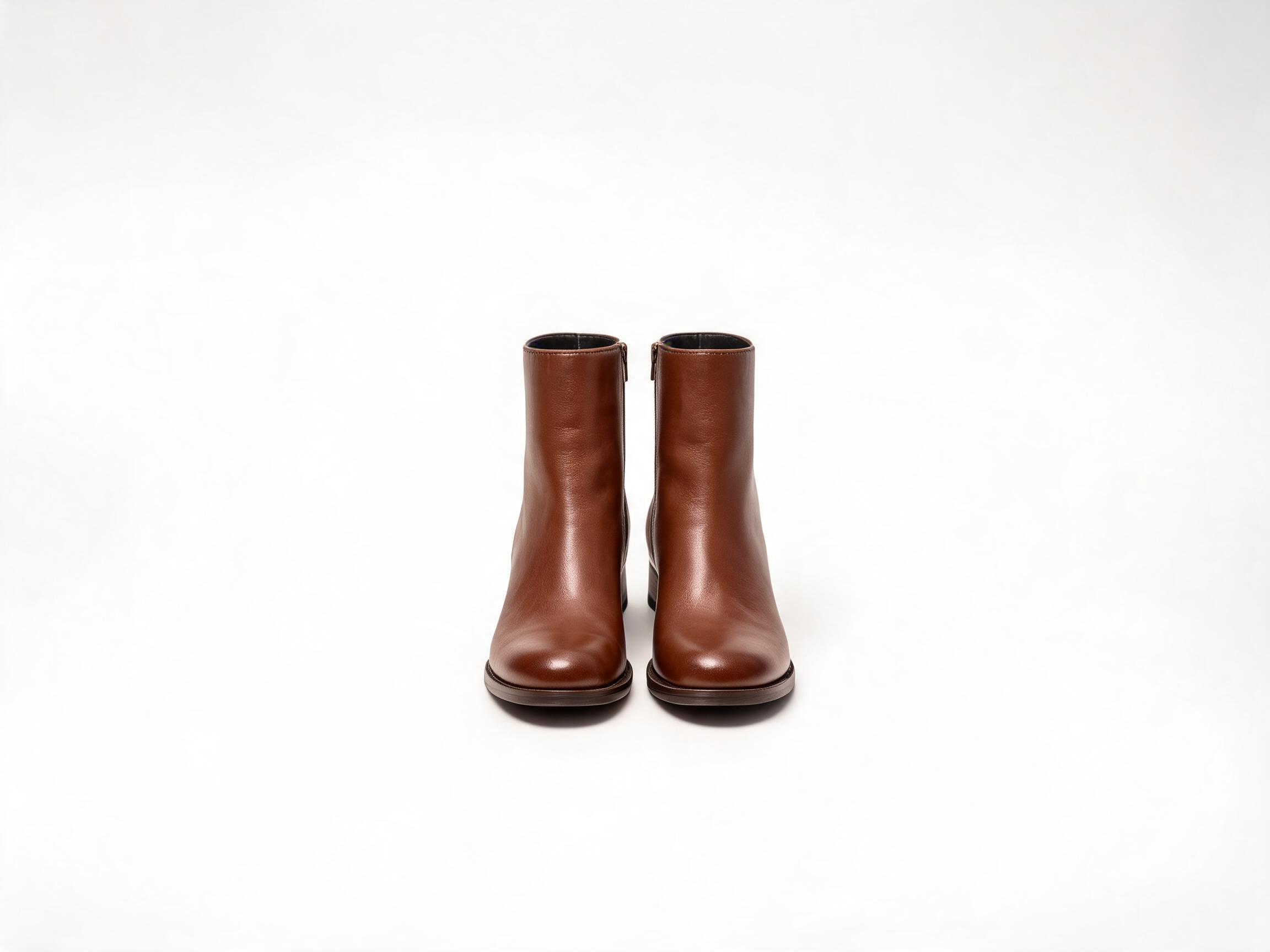
The Brown Leather Ankle Boots show how these three decisions come together in a real product. The style is a women's ankle boot in brown leather with a side zipper, a shaft of approximately 12 cm, a 6 cm block heel and a warm lining. The side zipper is worth noting for retail: it is a functional closure that affects how the boot is put on and taken off, and it belongs in your product copy and your fitting notes.
The warm lining positions the boot toward cooler seasons. For assortment planning, that means the style fits an autumn/winter buy or a market with a cooler climate, rather than a year-round warm-weather line. If you are building a broader women's leather range, the women's leather shoes category is the place to compare shaft heights, heel types and closures across styles.
| Specification | Listed value |
|---|---|
| Upper | Leather, brown |
| Closure | Side zipper |
| Shaft height | Approx. 12 cm |
| Heel | 6 cm block heel |
| Lining | Warm lining |
| Size range | EU 35–41 |
| MOQ | 100 pairs — confirm current terms with the sales team before ordering |
| Lead time | 30–40 days — confirm current terms with the sales team before ordering |
Aurevia Footwear Co., Ltd. is a genuine-leather footwear OEM/ODM exporter founded in 2011, with about 260 staff, serving markets in Europe, North America and the Middle East.
MOQ and lead time in the assortment decision
MOQ and lead time are not afterthoughts. They determine how many styles you can carry, how deep each size run can be, and whether a reorder is realistic within the selling season. The example product lists a MOQ of 100 pairs and a lead time of 30–40 days.
Those numbers shape the buy in a concrete way. If your total order is fixed, a 100-pair minimum per style limits the number of styles you can test. If you want to spread the buy across several colourways or shaft heights, calculate how many styles the minimum allows before you fall in love with a range. Lead time then tells you when to place the order relative to your selling window; build in time for sample approval and shipping on top of the production period.
MOQ and lead time vary by style, material and season. Confirm current MOQ and lead time with the sales team before ordering.
A practical selection checklist
Use this sequence when you evaluate ankle boots for a retail line. It keeps the styling decision and the commercial decision in the same conversation.
- Define the use case. Workwear, casual, occasion or a blend. This sets the heel type and the shaft height range you will consider.
- Fix the shaft height band. Decide the acceptable range in centimetres and state the tolerance you need.
- Choose the heel type, then the height. Block for stability, stiletto for dress, wedge or flat for casual.
- Map the size run. Confirm the factory's current size range and labelling against your market's expectations.
- Check the closure and lining. Side zipper, warm lining and similar features belong in your product copy and fitting notes.
- Model the MOQ. Calculate how many styles the minimum allows within your total buy.
- Confirm lead time and payment terms. Confirm current MOQ and lead time with the sales team before ordering, and align the order date with your selling window.
FAQ
What shaft height counts as an ankle boot?
Ankle boots generally sit at or just above the ankle. The example product uses a shaft of approximately 12 cm, which is a mid-ankle height. Exact boundaries vary by brand and last, so specify the height you want in centimetres rather than relying on the category name.
Is a 6 cm block heel comfortable for all-day wear?
A block heel spreads weight over a wider base than a stiletto, which is why it is often chosen for all-day or commuter use. Comfort also depends on the last, the lining and the individual wearer; the heel height alone does not guarantee it. Use fitting feedback from your market to judge.
Can I order a mixed size run within the MOQ?
That depends on the factory's current terms. The example product lists a MOQ of 100 pairs across EU 35–41, but the split across sizes and any minimum per size should be confirmed with the sales team before ordering.
How should I plan lead time around a selling season?
The example product lists a lead time of 30–40 days for production. Add sample approval and shipping time on top of that, and confirm current MOQ and lead time with the sales team before ordering, since both can change with material and season.
Explore the Brown Leather Ankle Boots or browse the full women's leather shoes range to compare shaft heights, heel types and size ranges.