
A material-first guide for importers and private-label brands: what cowhide actually is, which leather questions to settle before sampling, how strap and sole construction affect durability, and the QC checkpoints that keep repeat bulk orders consistent.
Leather Sourcing & Bulk Buying Guide
Cowhide is one of the most widely used hide sources for genuine-leather sandals, and it is also one of the most loosely specified. When buyers search for cowhide, the real question is almost never "what is cowhide" in the abstract — it is whether the material behind a quoted price is the same material that will arrive in the bulk cartons. This guide covers what cowhide means, the leather questions worth settling before you sample, how strap and sole construction decide durability, and the QC checkpoints that keep repeat orders consistent.
What this guide covers
Key takeaways
- Cowhide is a hide source, not a grade or a finish. Two sandals can both be "cowhide" and differ sharply in layer, thickness and surface treatment.
- Settle hide type, grade, thickness and finish per style in writing before sampling — not after.
- Strap construction (matched hides, edge finish, buckle hardware) and sole attachment determine how a sandal holds up, more than any single material label.
- Bulk consistency is a QC process, not a promise. Ask how color, texture and durability are checked across repeat runs.
What cowhide actually means for sandals
Cowhide is the hide taken from cattle. In the leather trade it is a source description, and it says nothing on its own about which layer of the hide was used, how thick the finished material is, or how the surface was finished. Those three variables — layer, thickness, finish — are what buyers actually compare when they evaluate cowhide leather sandals, and they are what determine feel, appearance, and how the material ages.
Industry context worth keeping in mind: grade and finish vary by hide layer and by the processing route a tannery uses. Full-grain, top-grain, and split or corrected-grain material can all originate from cowhide, and each presents differently in grain, softness and surface uniformity. There is no single universal cowhide standard that a supplier can simply "comply with." That is why the practical approach is to confirm hide type, grade and thickness with the supplier per style, rather than assuming one standard applies across everything quoted as genuine leather.
This matters for sourcing because the word on a spec sheet is not the same as the material in the carton. A buyer who receives a sample and approves it has approved one specific combination of hide, thickness and finish. Unless that combination is documented, a reorder can drift to a different one without anyone intending it. For a product where the strap is the most visible and most handled surface, that drift shows up immediately.
Leather selection questions to ask a supplier
These are the questions that separate a reliable leather sandals manufacturer from one who quotes a generic material and sorts the details later. Ask them per style, and ask for the answers in writing.
Hide and grade
- Which hide source is specified for this style, and is it cowhide specifically? A product can be specified as genuine leather without the hide source being pinned down. If you need cowhide, confirm it by name.
- What grade is being quoted? Ask the supplier to describe the grade in terms of surface condition and grain, not a marketing tier.
- Which part of the hide is used for visible straps? Straps are cut from specific areas; where they come from affects grain consistency and stretch.
Thickness and temper
- What finished thickness is used for straps versus lining? Straps, lining and footbed can use different specifications. Get each one.
- How does the leather behave when folded or bent? Tempered (flexible) material is generally preferred for straps that move with the foot; stiff material can crease sharply.
Finish and color
- What surface finish is applied? Dyed, aniline, pigmented or burnished finishes read differently and behave differently over time. Confirm which one is quoted.
- How is color matched across a bulk run? Ask how the supplier controls shade variation between hides within one order, and between one order and the next.
Lining and footbed
- Is the lining the same leather family as the upper, or a different material? A soft leather lining against the foot is a different spec from a synthetic lining, and should be named.
- What is the footbed construction? Cushioned leather footbeds and simple board footbeds feel and age very differently.
A supplier who can answer these per style is working from an actual material spec. One who answers only with "genuine leather, high quality" is not giving you anything you can hold a reorder to.
Strap and sole construction: what lasts
The leather decision and the construction decision are connected. Good hide on a weak build still fails at the strap or the sole seam; an overbuilt sandal on inconsistent hide still shows mismatched color from the first pair. Buyers should evaluate both together.
Strap construction
On a quality sandal, straps are cut from matched hides so that grain and shade are consistent across the pair and across the run. Cutting from mismatched hides is one of the most common causes of visible color variation in bulk. Beyond matching, look at how straps are aligned and assembled — hand-aligned straps keep buckles and eyelets sitting straight rather than twisted. Edge finishing also matters: hand-burnished edges seal and soften the cut edge, while an untreated edge frays and darkens with wear.
Buckle hardware is a durability point that is easy to overlook. Adjustable buckle straps take repeated load, and hardware that is not corrosion-tested can pit or discolor. Ask whether buckle hardware is corrosion-tested, and how buckle strength is checked.
Sole construction
Two sole questions decide most of the durability conversation: how the sole is attached, and what the outsole is made of.
- Attachment method. Stitched-and-cemented construction combines adhesive with stitching for a bond that resists separation better than cementing alone. Seam adhesion is testable — ask how sole adhesion is verified.
- Outsole material. Lightweight anti-slip rubber outsoles are common for casual sandals; a rubber outsole with a defined tread pattern is more practical than a flat, smooth one for daily wear.
- Forefoot flex. A sandal should flex at the forefoot where the foot bends. This is a simple, repeatable inspection point.
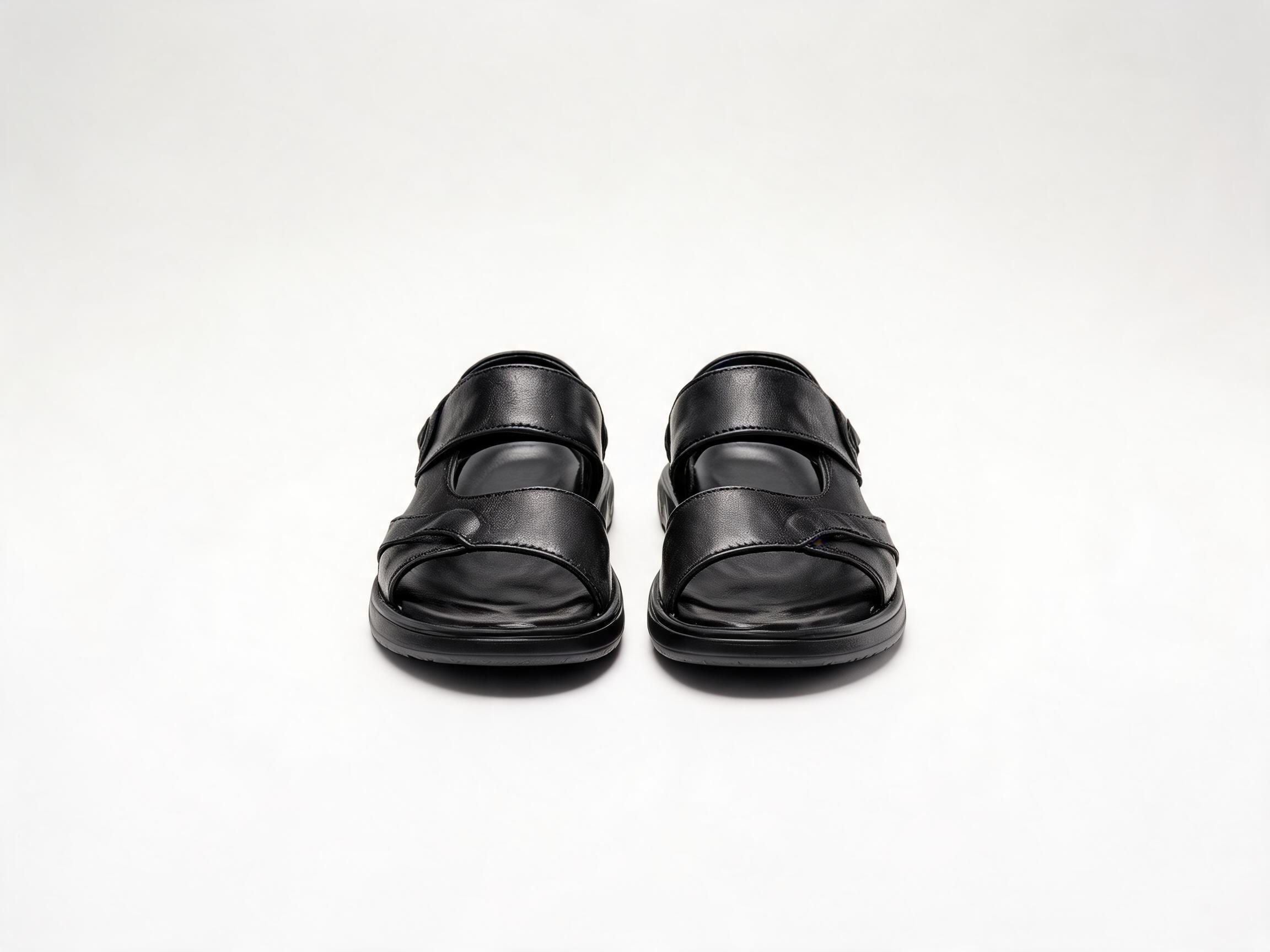
For reference, our own black leather casual sandals illustrate how these choices come together in a specific build: genuine leather straps with adjustable buckle straps, soft leather lining, a cushioned leather footbed, and a lightweight anti-slip rubber outsole, assembled with a stitched-and-cemented build. Straps are cut from matched hides sharing grain and shade, hand-aligned, and finished with hand-burnished edges. The style is specified as genuine leather rather than cowhide by name — which is exactly why the earlier advice matters: confirm the exact hide spec for whichever style you are ordering.
Available reference specifications for that style:
| Specification | Detail |
|---|---|
| Upper | Genuine leather straps, adjustable buckle straps |
| Lining | Soft leather lining |
| Footbed | Cushioned leather footbed |
| Outsole | Lightweight anti-slip rubber outsole |
| Construction | Stitched and cemented; hand-aligned straps; hand-burnished edges |
| Hardware | Buckle hardware corrosion-tested |
| Sizes | EU 39–45 / US 6.5–12 |
| Colors | Black, brown, tan; custom Pantone matching available |
| Sampling | Existing samples 3–5 days; custom samples typically 7–12 days |
Bulk QC checkpoints and sample-to-bulk consistency
The sample you approve is a promise about the bulk order. Bulk QC exists to test whether that promise holds. Good factories run inspection in stages — typically across incoming leather, work-in-progress, and finished goods — because catching a hide problem after the sandal is assembled means scrapping the pair.
Across incoming leather
- Hide-to-hide shade and grain comparison against the approved sample and the order's color standard.
- Thickness check at the point of use (strap, lining, footbed), because the same nominal material can vary by area.
- Surface inspection for scars, growth marks or finish faults that would land on a visible strap.
During and after assembly
- Forefoot flex test — confirmation that the sandal bends where the foot bends, without sole separation or strap distortion.
- Color fastness — checking that dyed surfaces do not transfer or fade in ways that would be visible after packing and shipping.
- Buckle strength — load-testing the buckle and strap connection, since this is a frequent field failure point.
- Sole adhesion — verifying the stitched-and-cemented bond on sampled pairs.
Consistency across repeat orders
The harder QC question is not the first order — it is the fifth. Ask a supplier how they keep color, texture and durability consistent across repeat orders, and what they retain from an approved run to compare against. Stable leather supply channels and multi-stage inspection for color, texture and durability are what make a reorder look like the original rather than a near-match.
If your order volume or brand risk warrants it, request third-party inspection. Most established exporters accept it; a supplier who resists is telling you something about their confidence in the bulk run.
How to write a cowhide sandal spec
A useful spec sheet does not need to be long. It needs to name the decisions that, if left open, would cause a dispute. At minimum, capture:
- Hide source and grade, per component (strap, lining, footbed).
- Finished thickness for each leather component.
- Finish type and color standard (including Pantone reference where a custom shade is required).
- Buckle hardware spec and confirmation that it is corrosion-tested.
- Sole construction method and outsole material.
- Size range and grading, and the size chart the factory will work to.
- The inspection points you expect to be reported — flex, color fastness, buckle strength, sole adhesion.
- The retained reference sample that both sides keep for reorder comparison.
Leave MOQ, lead time and commercial terms to be confirmed per project rather than assumed from a general catalogue. They change with material availability and factory scheduling, and a document that states them without confirmation invites disputes later.
FAQ
Is cowhide the same as genuine leather?
Not exactly. "Genuine leather" is a broad trade term that can cover many hide sources and layers. Cowhide names the hide source but not the grade, thickness or finish. If cowhide is a requirement for your product, say so explicitly and get the grade and thickness confirmed per style.
Why do two cowhide sandals look different if both use cowhide?
Because grade, layer and finish differ. Surface treatment and the part of the hide used for visible straps both affect grain and color appearance. Differences are normal across sources; the goal is consistency within your order and across reorders, which is a QC and supply-chain problem.
What sole construction should I specify for a casual sandal?
For daily-wear casual sandals, a stitched-and-cemented build with a rubber outsole and a defined tread is a practical, durable default. Confirm that sole adhesion and forefoot flex are part of the factory's inspection.
How do I keep repeat orders consistent?
Retain an approved golden sample, document the leather spec in writing, and ask the supplier to describe how color, texture and durability are checked across repeats. Multi-stage inspection and stable leather sourcing are the mechanisms; the specific process should be confirmed per factory.
Next step
If you are specifying a cowhide sandal program, the most useful first move is to settle the leather questions above before any sample is cut — hide and grade, thickness, finish, and the construction details that affect durability. Aurevia Footwear Co., Ltd. is a genuine-leather footwear manufacturer and exporter based in Quanzhou, China, working with OEM/ODM and private-label buyers in Europe, North America and the Middle East. To discuss a specific cowhide sandal spec, start with the material questions and request a sample against them. For an example of the construction detail described here, see the Black Leather Casual Sandals.