
A practical guide for overseas B2B buyers on choosing brogue detailing levels (full, semi-, quarter, and plain cap-toe) and understanding the OEM sampling workflow from reference to confirmed sample, based on our real product line.
When a buyer asks for custom brogues, the conversation quickly moves from "which style?" to "exactly which perforation pattern, and how do we get a sample that matches?" This article explains the four commonly referenced brogue detailing levels as ordering options — not as a style history lesson — and walks through the OEM sampling workflow we follow from reference or tech pack to a confirmed sample. It is written for overseas B2B buyers in Europe, North America, and the Middle East who need to place a production order with clear expectations.
Why Brogue Level Is a Sourcing Decision
Brogue detailing is not a single feature. It refers to the pattern of perforations (broguing) and the seams that carry them. The level you choose determines several practical points in an order:
- Pattern complexity: More perforated seams mean more pattern pieces, more stitching operations, and more points where the upper must be aligned during lasting.
- Reference clarity: A full brogue leaves little room for interpretation on the toe; a plain cap-toe does, which affects how precisely you must write the tech pack.
- Sample iteration needs: Complex detailing can require more than one sample round to confirm perforation placement, size, and spacing.
- Season and market fit: Some buyers use full brogues for casual or heritage lines, while quarter brogues and plain cap-toes often suit formal business collections.
None of these points make one level "better." The right choice depends on the collection, the target market, and how much detail you are prepared to specify and confirm.
The Four Brogue Levels We Work With
Our product line and custom development experience cover the range below. These are commonly used trade terms; the exact pattern within each level can vary by design, so always confirm the specific layout on the sample.
Full Brogue (Wingtip)
The full brogue has a wing-shaped toe cap with perforations along the wing edge, the vamp seams, and often the heel counter. The toe medallion is a frequent feature. Because the pattern touches most of the upper, the full brogue is the most detail-intensive option. For buyers, this means the tech pack should show the wing shape, perforation spacing, and medallion layout clearly. It is a strong choice for heritage-inspired or smart-casual ranges.
Semi-Brogue
A semi-brogue (also called a half brogue) uses a straight toe cap with perforations along the cap seam, plus perforations on the facing seams. It typically avoids the wing shape and the toe medallion. The result is a dressier look than a full brogue but still visibly decorated. In sampling, the main confirmation point is the alignment of the cap perforations and the facing broguing, which should be symmetric across both shoes.
Quarter Brogue
The quarter brogue keeps the straight cap but reduces perforations to a single row along the cap seam, without broguing on the facing. It sits close to a formal oxford in appearance. Buyers often choose this level when they want a subtle detail rather than a statement. The sampling check is simpler: confirm that the perforation row is even and that no perforations appear where they are not intended.
Plain Cap-Toe (No Perforation)
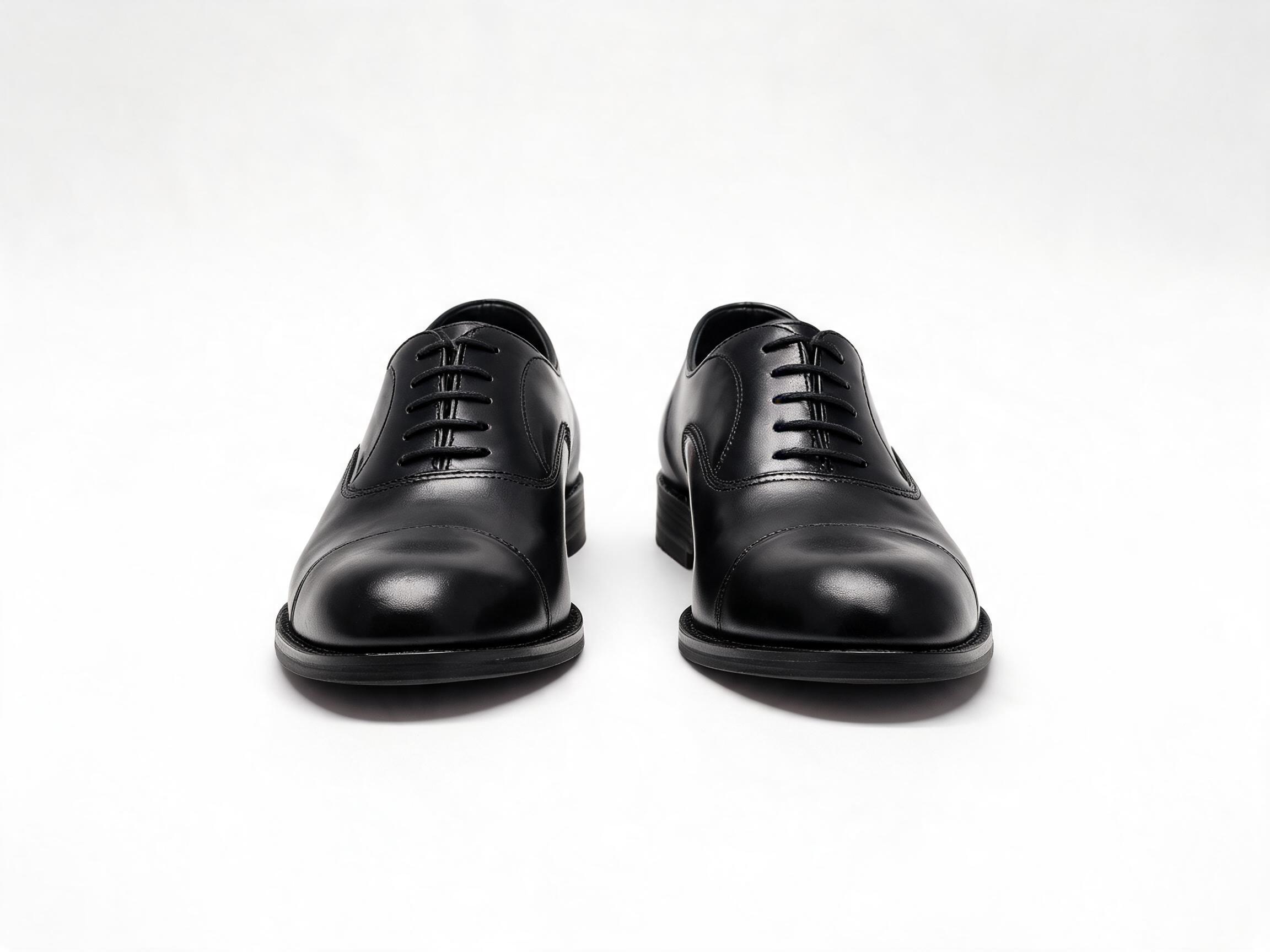
A plain cap-toe oxford has a stitched toe cap but no perforations anywhere on the upper. It represents the no-perforation end of the brogue spectrum and is often the baseline against which buyers evaluate the other levels. For example, our Black Cap-Toe Oxford Shoes use a polished full-grain leather upper, closed lacing, leather lining, and a cushioned footbed, available in EU 39–45 with OEM/ODM including logo and packaging. This type of shoe is a common starting point for buyers who want a formal core style before adding brogue detailing to a separate line.
| Brogue Level | Key Detailing | What to Confirm on Sample | Typical Ordering Consideration |
|---|---|---|---|
| Full brogue (wingtip) | Wing toe cap, perforations on wing, vamp, heel; often toe medallion | Wing shape, perforation spacing, medallion layout, symmetry | Highest pattern complexity; allow for detailed tech pack and possibly extra sample review |
| Semi-brogue | Straight cap with perforations; broguing on facing seams | Cap perforation alignment, facing broguing symmetry | Balanced dress/casual look; clear reference needed for facing detail |
| Quarter brogue | Straight cap with single perforation row; no facing broguing | Even perforation row, no unintended holes | Subtle detail; simpler sampling check |
| Plain cap-toe | Stitched toe cap, no perforations | Cap seam position, stitch density, overall finish | Baseline formal style; useful for buyers testing a new supplier |
For women's styles, the same detailing logic applies. Our Tan Leather Oxford Shoes are a women's closed-lacing oxford in EU 35–41 with cemented construction, available for OEM/ODM. A buyer could request a quarter-brogue or semi-brogue treatment on a similar base, but the exact pattern must be confirmed in the tech pack and sample.
From Reference to Confirmed Sample: Our OEM Workflow
Every custom brogue order starts with a reference. It might be a photo, a competitor sample, a sketch, or a full tech pack. Our in-house design team turns that input into a production sample. The workflow below reflects how we handle custom brogue development; it is a general description, and specific steps may vary by design.
Step 1: Reference Intake and Clarification
You share the reference and any requirements: brogue level, leather type and color, sole type, lining, size range, and branding (logo, packaging). If the reference is a photo or a physical sample, we clarify details that are not visible, such as perforation size, stitching color, and edge finish. At this stage, we also confirm current MOQ and lead time with the sales team before ordering.
Step 2: Tech Pack Review and Pattern Development
Our design team reviews the tech pack or builds one from the reference. For brogues, the pattern development focuses on the perforation layout: which seams are brogued, the spacing and diameter of holes, and the medallion design if applicable. We may produce a paper pattern or a digital rendering for your review before cutting leather.
Step 3: Sample Making
Once the pattern is approved, we make the sample using the specified materials. For a brogue, this includes cutting the upper pieces, perforating the leather, stitching the seams, and assembling the shoe. The sample is made to your specified size (within the available range) so you can check fit and proportions.
Step 4: Sample Review and Feedback
You receive the sample and review it against the reference and tech pack. Common feedback points for brogues include perforation alignment, spacing consistency, the shape of the wing cap, and the overall balance of the pattern. We document your comments and, if changes are needed, revise the pattern or sample accordingly.
Step 5: Confirmation and Production
When the sample is approved, it becomes the reference for bulk production. We keep the approved sample and tech pack on file to maintain consistency. Production then follows the confirmed specifications, including branding and packaging requirements.
- Choose the brogue level based on pattern complexity and market fit, not on a generic style ranking.
- For full brogues and semi-brogues, invest in a clear tech pack with perforation details to reduce sample iterations.
- Always confirm MOQ, lead time, and sampling charges with the sales team before committing.
- Use a plain cap-toe as a baseline sample if you are evaluating a new supplier's construction and finish.
Frequently Asked Questions
Can you produce a brogue pattern that is not in your current line?
Yes, our OEM/ODM service includes custom pattern development from a sketch, reference, or tech pack. The feasibility depends on the design details, so share your reference for review.
What size ranges are available for custom brogues?
Our existing product lines include EU 39–45 for the black cap-toe oxford and EU 35–41 for the women's tan oxford. Custom size ranges can be discussed with the sales team; confirm the available range for your specific design.
How many sample rounds are typical?
The number of sample rounds depends on the complexity of the design and the clarity of the reference. Simple patterns may need one round; full brogues with detailed medallions may need two or more. We will advise based on your tech pack.
Do you offer branding and packaging customization?
Yes, our OEM/ODM service includes logo and packaging customization. Details such as logo placement and packaging style are confirmed during sampling.
Ready to develop your custom brogue line?
Send us your reference or tech pack, and our team will review the brogue level, materials, and sampling steps with you.