A specification guide for B2B buyers sourcing custom Chelsea boots. Covers the three decisions that define the silhouette: elastic gore and pull tab for entry comfort, last shape and shaft height, and leather selection with Pantone matching and lining options. Grounded in real ankle-boot production experience with side-zip and pull-on construction.
Ankle Boot Development · Specification Guide
A Chelsea boot is a closed construction with no laces, so every fit and entry problem lands on three decisions: how the elastic gore and pull tab are sized and placed, what last shape and shaft height the boot is built on, and which leather goes over which lining. Get these three right and the rest of the specification — sole, heel, edge finish, labelling — is comparatively routine. Get them wrong and returns come back from the ankle, not the toe.
This guide is written for buyers specifying custom Chelsea boots, custom ankle boots, or OEM pull-on programs. Our production background is in ankle boots with both side-zip and pull-on construction. Chelsea-style builds are produced through our customization program after sample confirmation — we do not publish a fixed Chelsea SKU, and the points below describe the decisions that go into a confirmed build rather than a catalogue number.
Key takeaways
- Entry comfort is governed by gore height and placement, the counter shape behind the gore, and whether a pull tab is included — not by how tight the topline looks on a table.
- Last and shaft determine whether the boot reads as a rounded workwear shape or an almond dress shape; shaft height controls how the boot sits under trousers.
- Leather and lining should be specified together: full-grain upper, Pantone-matched finish, and a lining choice that supports the intended season and use.
- All three decisions are confirmed on a physical sample before bulk, not on a spec sheet alone.
1. Elastic gore, pull tab, and entry comfort
The gore is the functional heart of a Chelsea boot. It supplies the flex that lets the foot pass the ankle opening, then holds the boot on the foot. On a pull-on build, if the gore is too short the boot will not open enough for high insteps; if it is too long or placed too far forward, the boot loses grip at the ankle and slips at the heel.
We do not publish standard gore dimensions because the correct figure is derived from the last and upper pattern for each program. What a buyer should expect to confirm on the sample:
- Gore height relative to the topline. The elastic should start at or just below the topline and end above the ankle bone. A taller gore opens the boot more; a shorter one holds firmer.
- Horizontal placement. The gore sits on the lateral side of the boot, between the vamp and the heel counter. Its front edge should clear the flex point of the foot; its rear edge should not run so far back that it weakens the counter.
- Elastic quality. Woven elastic with good recovery matters more than a nominal width. Ask the sample team how the elastic behaves after repeated stretch — a stretched-out gore is the most common Chelsea failure in wear.
- Pull tab. A rear pull tab helps the wearer pull the boot on without crushing the counter. Its length, attachment point, and reinforcement inside the topline should be specified; on some builds a front tab is added as well.
Our side-zip ankle boot experience is relevant here. A side zip relieves entry pressure, but it changes the upper pattern and the way the topline is reinforced. For a pure pull-on Chelsea we would normally fit entry comfort through the gore and tab alone, and we can discuss whether a side zip should be retained as an additional entry aid if the buyer’s market expects it.
What to check on the entry sample
| Check | Why it matters | Confirm on sample |
|---|---|---|
| Gore opening | Determines whether a high instep can enter without forcing | Try the sample on a fit model with a typical instep, not only a narrow foot |
| Topline tension | Too loose slips at the heel; too tight marks the ankle | Walk test after entry; check heel lift and topline pressure |
| Pull tab | Reduces counter crush during entry | Confirm tab length, stitching, and internal reinforcement |
| Counter stiffness | A soft counter collapses; a hard one cuts | Flex the counter by hand and check recovery |
2. Last shape and shaft height
The last decides the silhouette before any leather is cut. For Chelsea boots, buyers usually choose between a rounded toe and an almond toe.
- Rounded toe. A fuller toe box with a more generous forefoot. It reads as workwear, country, or casual, and it is the easier fit across a broad size run.
- Almond toe. A tapered toe with a lower profile. It reads as dress or fashion and pairs well with tailored trousers. The almond shape needs a closer fit model check because toe room is reduced.
Shaft height is the second half of the silhouette. A lower shaft sits under trousers and reads as a classic ankle boot; a higher shaft covers more of the ankle and changes how the gore and topline behave. There is no universal correct height — the buyer should specify it against the target market and the trousers or hem widths the boot will be worn with.
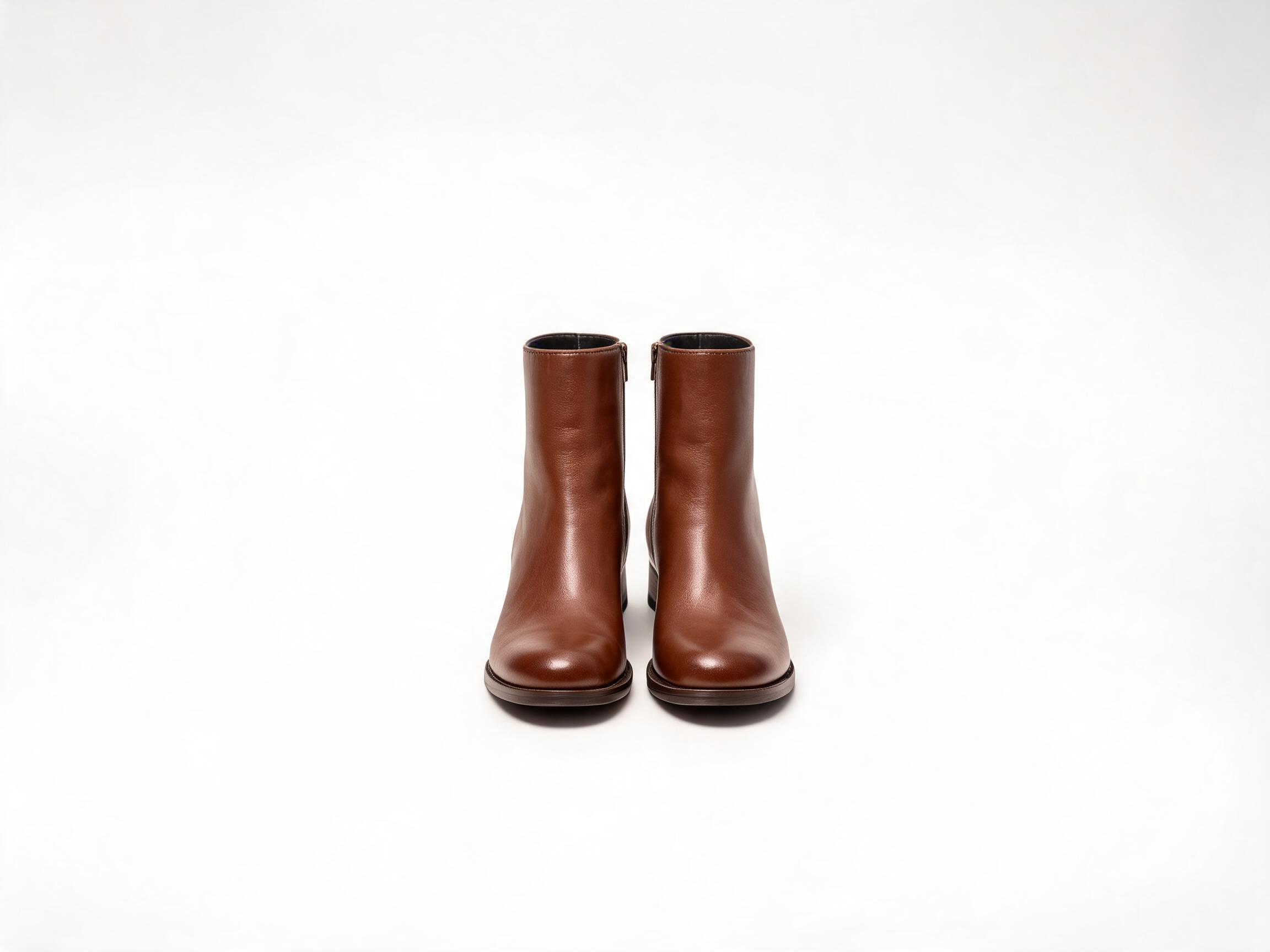
Our brown leather ankle boots use a full-grain leather upper, an approximately 6 cm block heel, a warm lining, and EU 35–41 sizing with side-zipper construction. That product is an ankle boot rather than a Chelsea, but it is the same last-and-shaft conversation: the block heel changes the stance, and the warm lining changes the internal volume that the last must accommodate. On a custom Chelsea build we would match the last and shaft height to the buyer’s size range and lining choice before pattern making.
Rounded vs almond: what changes downstream
| Decision | Rounded toe | Almond toe |
|---|---|---|
| Market reading | Workwear, casual, country | Dress, fashion, tailored |
| Fit tolerance | More forgiving across insteps and widths | Requires closer fit-model review |
| Upper consumption | Higher yield from a hide | More careful nesting; tighter cutting |
| Finish visibility | Burnished toe reads strongly | Burnishing must be restrained to keep the shape clean |
3. Leather choice, Pantone matching, and lining
Upper leather and lining should be specified as a pair. The upper carries the visual identity; the lining carries the fit, the season, and much of the comfort.
Upper leather
Full-grain leather is the default for a custom Chelsea program because the grain is intact and takes finish and burnishing predictably. For colour, buyers can supply a Pantone reference and we match against it during sampling. Pantone matching is a sample-stage exercise: the tannery’s base crust, the finish coat, and the hand-burnishing all move the final colour, so the approved standard should be a physical swatch or a confirmed sample boot rather than a screen colour.
Hand-burnished edges are part of the finishing conversation. Burnishing darkens and polishes the cut edges of the upper and the sole edge; on a Chelsea it is most visible at the topline, the gore binding, and the sole edge. Because burnishing is done by hand, the buyer should expect slight variation between pairs and approve a finish standard on the sample.
Lining options
- Leather lining. Smooth, breathable, and appropriate for dress and fashion programs. It adds structure and is the common choice when the boot is worn with thin socks.
- Textile lining. Lighter and often used for warm-weather or unlined-feel programs. It changes the internal volume slightly, so the last should be confirmed with the lining in place.
- Warm lining. Our brown ankle boot uses a warm lining for cold-weather wear. A warm lining reduces internal volume; the last and size run must account for it, and the gore opening may need review because a thicker lining stiffens the topline.
Matched hides matter when the upper and any leather trim or lining come from the same tannery lot. On a two-tone or contrast-gore build, confirm whether the gore, binding, and pull tab are supplied in the same colour family as the upper or as a deliberate contrast.
How the three decisions fit into OEM/ODM development
For buyers running an OEM or ODM program, the three specification decisions are the brief. We work from that brief through sampling: last and shaft height confirmed, gore and tab placement confirmed on a fit sample, upper and lining leathers matched and Pantone reference approved, then logo and packaging specified. Branding can include logo application on the upper, insole, or packaging, and packaging can be specified to the buyer’s requirement.
Because Chelsea-style construction is produced through our customization program after sample confirmation, the first deliverable is a confirmed sample, not a catalogue page. That is also where the honest unknowns sit: gore dimensions, exact shaft height, and the final Pantone match are all sample-stage values. MOQ and lead time should be confirmed with the sales team before ordering, as they depend on the confirmed build, leather availability, and order quantity.
FAQ
- Do you have a standard Chelsea boot SKU?
- No published Chelsea SKU. Chelsea-style builds are produced through our customization program after sample confirmation. Our reference ankle-boot experience is in side-zip and pull-on construction.
- Can you match a Pantone colour?
- Yes, Pantone references are matched during sampling. The approved standard should be a physical swatch or a confirmed sample boot, because finishing and hand-burnishing shift the final colour.
- Should the gore size be fixed in advance?
- Gore dimensions are derived from the last and upper pattern for each program. They are confirmed on the fit sample rather than specified as a fixed number in advance.
- Can a side zip be added to a Chelsea build?
- It can be discussed. A side zip changes the upper pattern and topline reinforcement, so it should be confirmed at sampling. On a pure pull-on Chelsea, entry comfort is normally handled through the gore and pull tab.
- What sizes are available?
- Our brown ankle boot reference runs EU 35–41. The size run for a custom Chelsea build is confirmed with the last and sizing specification at sampling.
- What should a buyer send to start?
- A brief covering target market, rounded or almond last preference, shaft height, Pantone reference for the upper, lining choice, size range, logo and packaging requirements.
Next step
If you are specifying a custom Chelsea boot, send the brief above and we will review it against our ankle-boot construction experience and confirm the sampling route. MOQ and lead time are confirmed with the sales team before ordering.