
A practical framework for brand owners evaluating private label shoe partners, from design and leather sourcing to sampling discipline and the path to mass production.
Supplier Evaluation Guide
Choosing a private label shoe company is less about finding a factory that can make shoes and more about finding one whose working method matches yours. The company you pick will handle your designs, your leather, your quality checks, and your delivery schedule. If any of those four areas is weak, the problem usually appears late—after your brand name is already on the product. This article sets out how to evaluate a private label shoe company across design and sampling, leather sourcing, quality control, and communication, and how to read what happens during sampling as a signal for mass production.
Why the selection process needs its own framework
Most brand owners start with a product idea and a target price. Those are necessary inputs, but they do not tell you whether a supplier can repeat the same shoe across multiple orders, keep the leather consistent, or flag a problem before it becomes a shipment. A private label shoe company is a production partner, and the evaluation should test the partner's process, not just the sample it sends.
A useful way to structure the evaluation is to score candidates on four dimensions that map directly to what you will rely on after the order is placed:
| Dimension | What you are really testing | Evidence to ask for |
|---|---|---|
| Design and sampling capability | Can they interpret your design and turn it into a wearable sample without losing key details? | In-house design and sampling staff, sample revision process, pattern-making turnaround |
| Leather sourcing | Can they secure the leather you specify and keep it consistent across orders? | Leather source options, how they handle grain and color variation, sourcing lead time |
| Quality control | Do they catch defects before packing, or do you find them on arrival? | QC stages, inspection points, defect classification and reporting |
| Communication | Will you know the status of your order without chasing? | Single point of contact, reporting cadence, how changes are documented |
Each dimension is worth testing with a concrete question rather than a general one. “Do you have good quality control?” invites a yes. “At which stages do you inspect, and what happens to a rejected pair?” produces a process description you can compare across suppliers.
Design and sampling capability
Private label work begins with your design intent. Some companies can only produce from an existing last and pattern; others can develop a new shape from a technical drawing or a reference shoe. The difference shows up in how many revisions you need before the sample is wearable.
Ask whether design and sampling are handled in-house. A company with its own design and sampling team can usually shorten the loop between your feedback and the next sample, because the pattern maker and the sample room are in the same place. Aurevia Footwear Co., Ltd., for example, has operated from Quanzhou, China since 2011 with roughly 260 staff and maintains in-house design and sampling, which means design changes and sample revisions are handled by the same team rather than subcontracted.
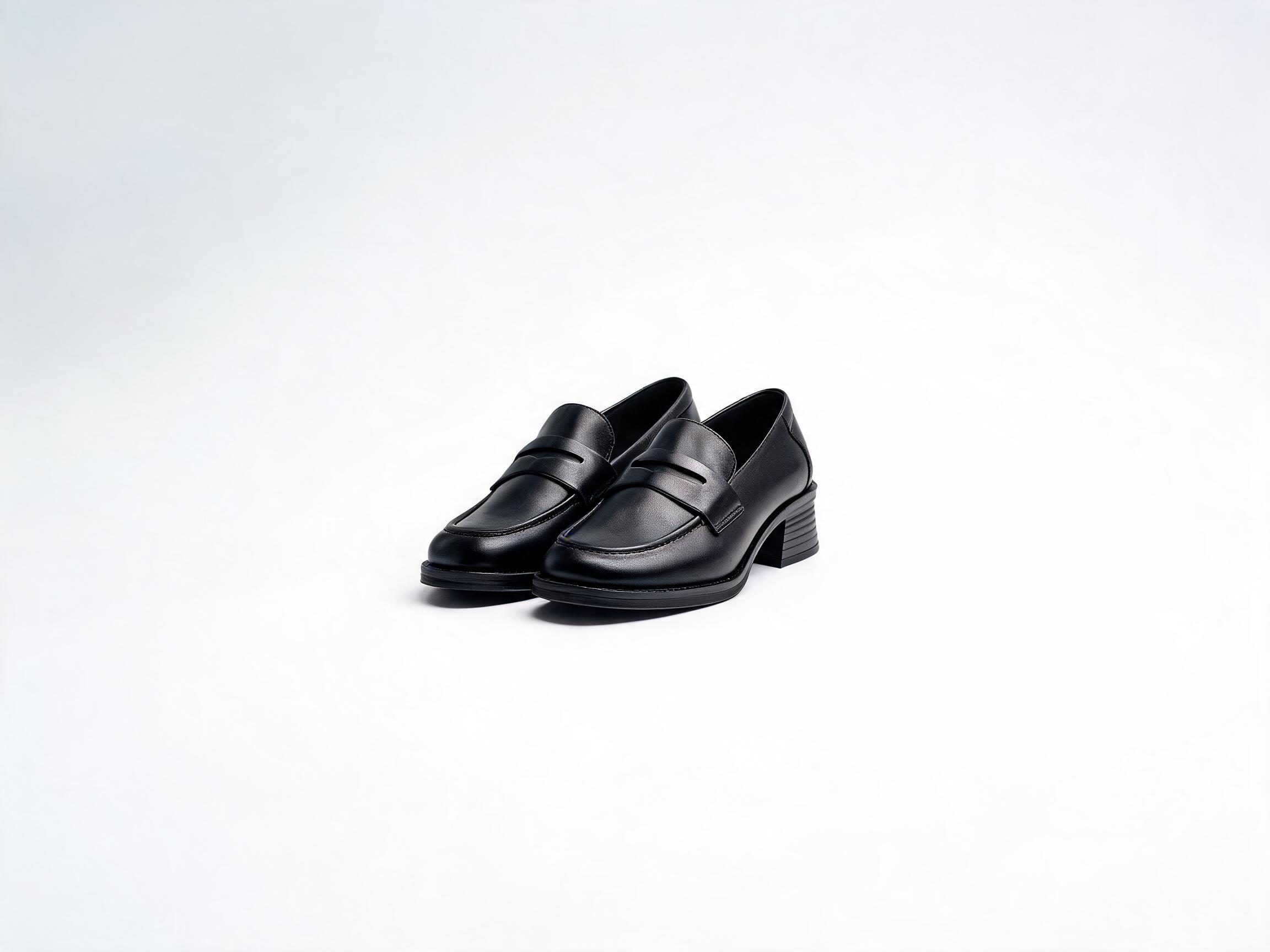
During evaluation, request a sample of a style close to what you plan to order, not a generic showroom sample. A black leather loafer with a 3 cm block heel and almond toe, for instance, tests the company's ability to hold a clean toe shape, set a heel height, and finish the leather edge—details that are easy to describe and hard to execute consistently. The women's black leather loafers shown on our site are an example of a style a brand could badge under private label, and asking for a comparable sample tells you more about sampling capability than a catalog photo.
What a healthy sampling process looks like
A sampling process that will scale has a few visible markers:
- Written comments, not just verbal feedback. Each revision should reference specific changes: toe shape, heel height, leather finish, stitching. This record becomes the reference for production.
- A confirmed sample before production. The approved sample is the standard against which bulk pairs are checked. If a company treats the sample as a rough guide rather than a reference, expect variation later.
- Realistic material behavior. Leather moves, stretches, and varies in grain. A sample that looks perfect only because it was made from a hand-picked piece of leather is not a reliable indicator of production.
- Feedback on feasibility. A good sampling partner will tell you when a design detail will not hold in production, rather than agreeing to everything and fixing it later.
Leather sourcing: consistency before cost
Leather is the component most likely to change between orders. Two shipments can meet the same specification and still differ in grain, color depth, or hand feel. The evaluation question is not “can you source leather?” but “how do you keep leather consistent, and what do you do when a batch varies?”
Ask where the leather comes from and whether the company can work with your nominated source or needs to source on your behalf. Aurevia works with genuine leather sourcing, and the relevant follow-up is how they handle color matching across batches and what tolerance they accept before rejecting a lot. A company that can explain this in concrete terms—how they compare batches, what they do with off-color leather—is easier to hold to a standard than one that simply says the leather is genuine.
If your brand has a leather specification, share it during evaluation. The supplier's response will tell you whether they can work within your constraints or will try to substitute a more convenient material.
Quality control: three stages, not one final check
A single final inspection catches defects but does not prevent them. The more useful question is where in the process the checks happen. Aurevia, for example, applies three-stage quality control, which typically means inspection at incoming materials, during production, and before packing. The exact checkpoints matter less than whether they exist and are documented.
Ask for the inspection points and what is checked at each:
- Incoming materials: leather grade, color, thickness, and hardware.
- In-process: stitching alignment, sole attachment, heel setting, symmetry.
- Pre-packing: final appearance, sizing, pairing, and packaging.
Also ask how defects are classified and what happens to a rejected pair. A supplier that can describe the rejection path—repair, rework, or scrap—has a working QC system. One that answers only with a pass rate has a number, not a process.
Communication: the dimension that decides the rest
Design, leather, and QC all depend on information moving accurately between you and the factory. Evaluate communication the same way you evaluate the product: with specific expectations.
Ask who your contact will be, how often you will receive updates, and how changes are confirmed in writing. A private label order involves many small decisions—leather color approval, logo placement, packaging, size breakdown—and each one needs a record. If the company cannot describe a clear channel for these decisions, the risk shifts to you to track them.
Time zone and language matter, but they are secondary to whether the company answers questions with specifics. A supplier that replies with a clear “yes, we can do that, here is how” is easier to work with than one that replies quickly with vague reassurance.
From sample to scale-up
The sampling stage is a preview of production, not a separate phase. The way a company handles sampling tells you how it will handle a bulk order:
- If sampling produces a written record of changes, production is more likely to follow the approved standard.
- If sampling reveals material limitations early, bulk leather sourcing is less likely to surprise you.
- If QC checkpoints are defined during sampling, they can be applied to the production run.
Before moving to mass production, confirm the approved sample, the leather specification, the QC checkpoints, and the communication schedule in writing. These four documents are the working basis for the order. A private label shoe company that supports this step is one you can scale with; one that treats it as paperwork is a risk you will manage yourself.
Frequently asked questions
Should I evaluate a private label shoe company on price first?
Price matters, but it is an output of the process. A company that quotes low but cannot hold leather consistency or document QC will cost more in rework and returns. Evaluate the four dimensions first, then compare quotes on the same specification.
How many sample revisions are normal?
It depends on how far the design is from the company's existing patterns. A style close to their current work may need one or two revisions; a new shape may need more. What matters is whether each revision is documented and whether the company gives feasibility feedback along the way.
Can a company with in-house design and sampling still use my leather source?
That is a sourcing question to ask directly. Aurevia works with genuine leather sourcing and can discuss nominated sources during evaluation; confirm the arrangement before sampling so the sample reflects the leather you will use in production.
This article is a buyer's evaluation framework. For specific capabilities, request a sample and a written process description from the supplier you are considering.