
A range-planning guide for buyers building a private-label women's footwear collection: how pumps, block heels and flats divide roles across a range, how heel height and fit interact, and what a ladies footwear manufacturer must control on sizing and QC when several categories ship under one label.
A private-label women's range is rarely one shoe. It is a small system: something formal, something built for a full day on foot, something for everyday wear. Buyers who plan the system before they choose styles spend less time correcting fit complaints and more time repeating what sells. This guide covers how the three core categories divide roles, how heel height and fit interact, and what a ladies footwear manufacturer has to control when several categories carry one label.
- Build the range around one repeat-core style per category, then add variants — not the other way round.
- Heel height is a stability and fit decision, not just a look. A reinforced heel core matters more as the heel narrows.
- Size ranges differ by construction: the pump and block heel run EU 34-41, the ballet flat EU 35-41. A single size chart has to reconcile that.
- Color and material consistency across categories is a supplier capability question (Pantone matching, shared materials), not a catalog question.
- QC on women's footwear is category-specific: heel attachment for heels, topline and outsole bonding for flats.
Why a range needs a repeat-core logic
Most first-time private-label ranges fail at the boring stage: too many SKUs, each one built on a slightly different last, insole and heel construction. The buyer ends up with eight styles that share a label but not a fit, and the returns data reads like random noise.
The alternative is repeat-core logic. Pick one style per category as the anchor, get the fit and materials signed off once, and treat every additional style as a controlled variation — a different toe shape, a different upper color, a different heel height. The anchor absorbs the development risk; the variants ride on the approved last and sizing.
This is where a ladies footwear manufacturer's structure matters. Aurevia Footwear Co., Ltd. runs dedicated women's heel lines and flats lines, which means the heel categories and the flat category are not fighting for the same production attention. For private-label development there is an in-house design team, so a buyer can bring a target look and work from an existing last rather than starting from a blank page.
Category roles: what each style actually does in a range
Three categories cover most women's private-label demand. They are not interchangeable, and each one should carry a clear job in the line plan.
Pumps: the formal anchor
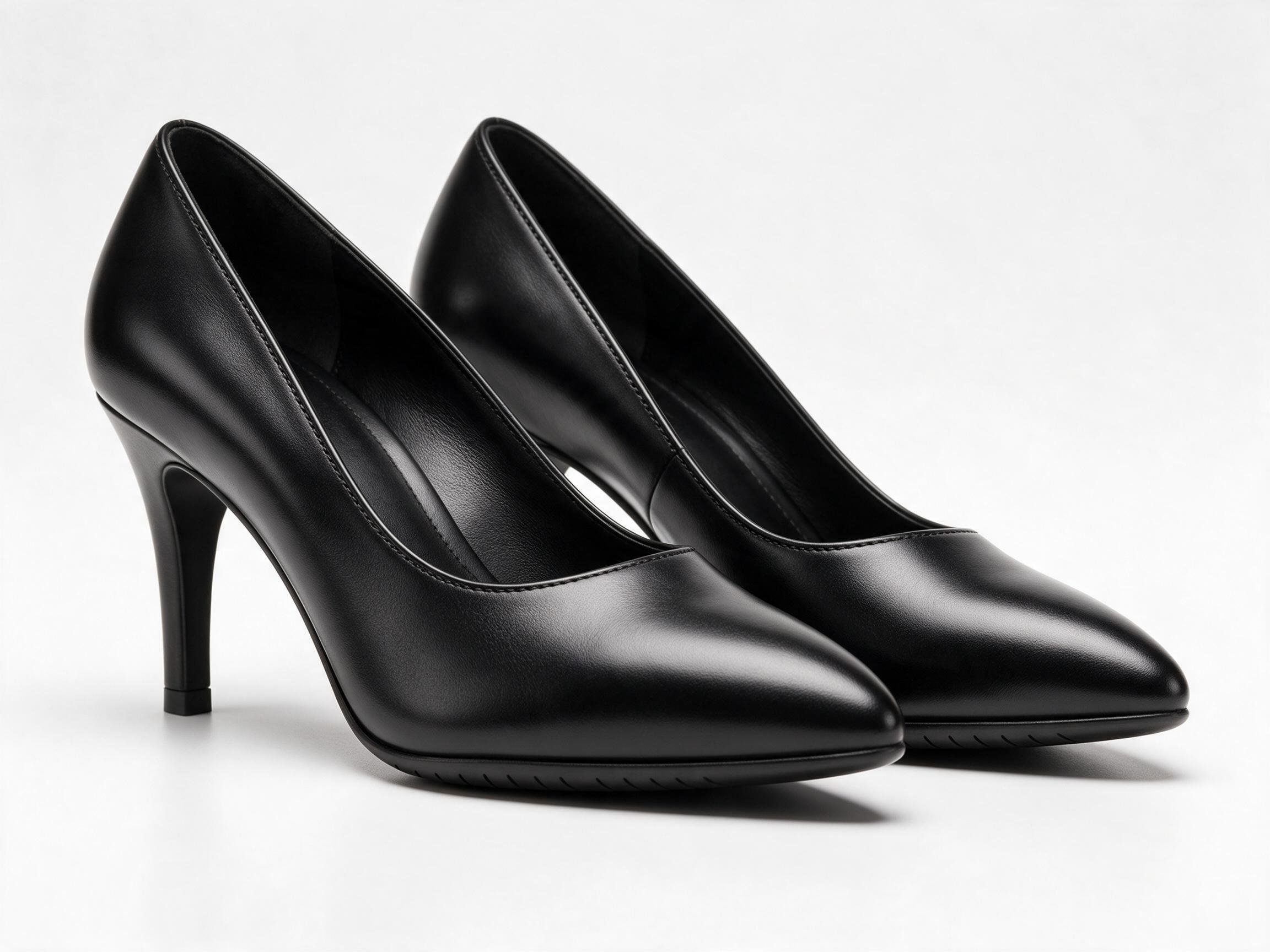
A pointed-toe pump sets the formality ceiling of the range. The black leather classic pumps use smooth leather on a pointed toe with an approximately 7 cm stiletto heel built on a reinforced core, a rubber anti-slip outsole, and sizing across EU 34-41 / US 4-10. Buyers with wider feet may size up half a size.
That 7 cm heel is the practical upper end for a style that still has to be wearable at an evening event. It also concentrates load on a small area, which is why the reinforced core and the heel attachment check in production are the two things that decide whether the style survives a season.
Block heels: the all-day volume style
The nude block-heel shoes sit at approximately 5 cm, with soft kid leather, a rounded toe, a padded insole and a reinforced heel core, in EU 34-41 at standard B width. The block heel spreads the same height over a wider footprint than a stiletto — that is the whole point of the category. It is the style most buyers expect to sell in volume across office and occasion use.
Flats: the everyday base layer
The nude leather ballet flats use soft nappa leather with an elasticated topline, a cushioned insole and a flexible rubber outsole. Sizing runs EU 35-41 / US 5-10, and buyers who fall between sizes usually take the smaller one.
The flat is the style that gets worn most often and inspected least carefully at buying stage — which is a mistake, because the elasticated topline and the outsole bond are exactly where a cheap flat fails first.
One comparison basis across the three categories
To plan a range you need the three styles on a single basis. The table below uses construction, heel platform, sizing and fit behavior — the four things that stay consistent no matter which category a buyer is ordering.
| Basis | Classic pump | Block heel | Ballet flat |
|---|---|---|---|
| Range role | Formal anchor | All-day volume | Everyday base |
| Upper material | Smooth leather | Soft kid leather | Soft nappa leather |
| Toe shape | Pointed | Rounded | Rounded |
| Heel | Approx. 7 cm stiletto, reinforced core | Approx. 5 cm block, reinforced core | None |
| Insole | Not stated in current spec | Padded | Cushioned |
| Outsole | Rubber, anti-slip | Not stated in current spec | Flexible rubber |
| EU sizing | 34-41 | 34-41 | 35-41 |
| US sizing | 4-10 | Not stated in current spec | 5-10 |
| Fit note | Wider feet may size up half a size | Standard B width | Between sizes: take the smaller |
The qualification matters as much as the filled cells. "Not stated in current spec" means the item is missing from the product specification sheet, not that the shoe lacks the part — treat it as a question to resolve with the supplier per model, and keep "None" (the flat's heel) distinct as a real construction attribute. If a buyer wants a single published size chart across all three, those gaps have to be resolved per model with the supplier before the chart is finalized — not assumed from the neighboring category.
Heel height and stability: the trade-off to decide early
Heel height choices get made on look and then argued about on returns. A more useful sequence is to decide the height range first, then let the look follow.
- 7 cm stiletto (pump): the formality lever. Narrow contact area, higher load per square centimeter, so the reinforced core and heel attachment check do the structural work. Best used as the range's dress style rather than its volume driver.
- 5 cm block (block heel): roughly the same visual lift with a wider footprint. Better suited to buyers whose customers wear the shoe standing or walking for long periods.
- Flat: no heel structure to stabilize, so the integrity question moves to the topline elasticity and the outsole bond.
A common range mistake is ordering the 7 cm pump in the same color count and depth as the 5 cm block. The two styles have different risk profiles, and the depth plan should reflect that rather than treating height as a cosmetic variation.
Sizing and fit across EU 34-41
The three styles do not share a size range. The pump and block heel start at EU 34; the flat starts at EU 35. If the range is sold as one collection under one label, that discrepancy has to be handled deliberately — either publish category-specific size charts, or state the collection range as EU 35-41 and treat EU 34 as a heel-only extension.
Fit notes also differ by construction, and these are the details that reduce returns:
- Pump: pointed toe and a firm leather upper — wider feet may size up half a size. This is a fit note, not a grading change.
- Block heel: standard B width. Buyers serving a wider-foot customer base should raise the width question at development stage rather than mid-production.
- Flat: elasticated topline holds the shoe on the foot, and between-size buyers usually take the smaller size.
Sizing is where a women's shoes OEM relationship is tested most. The last, the grading and the insole all have to be consistent within a style, and the buyer's size chart has to match what the factory actually ships. Aurevia's private-label options include insole branding, which makes the insole a branding surface but also means the insole spec is fixed per style and cannot be swapped casually between categories.
Color and material consistency across a range
A range reads as a range when the nude in the flat matches the nude in the block heel. That is harder than it sounds, because kid leather, nappa leather and smooth leather take dye differently even from the same reference.
The practical control is a single color reference across every style in the collection. Aurevia's OEM options include leather color matching to a buyer Pantone reference, which allows one Pantone target to be applied to the pump, the block heel and the flat rather than three separately approved colors. Buyers should still approve each material's matched swatch, because the same Pantone on nappa and on smooth leather will not read identically under retail lighting.
Material consistency runs in parallel: keep the flat on nappa and the block heel on kid leather as specified, and avoid substituting between them to chase a color. A substitution changes the hand-feel of the range, which customers notice even when the color matches.
QC points specific to women's heels and flats
Inspection on women's footwear is not one checklist. The failure modes differ by category.
- Heels (pump and block): heel attachment is the critical check — the heel must be secure under load, and the reinforced core is only useful if it is correctly seated. Aurevia runs a three-stage inspection that includes heel attachment checks, and third-party inspection is welcome.
- Block heel specifics: the padded insole has to sit flat without wrinkling, and the block itself must be aligned so the wearer's weight lands centrally rather than on an edge.
- Flats: the elasticated topline must return to shape after stretching, and the outsole bond must be complete around the full perimeter — a flexible rubber outsole is only an advantage if the bond holds.
- Across all three: color match against the approved Pantone swatch, size verification at both ends of the declared range, and labeling and packaging consistency under the private label.
Private-label boxes and hangtags are handled as part of the same order, which keeps the packaging check on the same inspection sheet as the shoe rather than as a separate late-stage surprise.
Sampling and trade terms
Existing samples ship in 3-5 days; customized samples take about 7-12 days. For a multi-category range, that gap is worth planning around: request existing samples first to confirm the base fit on each anchor style, then move to customized samples once the color and branding direction is set. Aurevia was founded in 2011 in Quanzhou, China, works with a 260-person team, and exports to Europe, North America and the Middle East. Trade terms are EXW, FOB or CIF.
Order quantities and production schedules are confirmed per model with the supplier, since the three categories run on different lines and different constructions.
FAQ
- Can the pump, block heel and flat share one last for fit consistency?
- Construction differs — pointed toe with a 7 cm stiletto versus a rounded toe with a 5 cm block versus a flat with an elasticated topline — so fit behavior will not be identical. Raise last compatibility with the supplier at development stage; the design team can advise what can be shared and what cannot.
- Why does the flat start at EU 35 when the heels start at EU 34?
- That is how the two product ranges are specified. If the collection needs a consistent EU 34-41 story, confirm with the supplier whether a smaller flat size is feasible before publishing the chart.
- Is the heel core the same on the 7 cm pump and the 5 cm block?
- Both are specified with a reinforced core, but the geometries differ. Heel attachment checks apply to both, and the check should be matched to the specific heel, not applied generically.
- Can all three styles be color-matched to one Pantone reference?
- Leather color matching to a buyer Pantone reference is available as a private-label option. Approve a matched swatch per material, because kid, nappa and smooth leather will not render the same reference identically.
- Is third-party inspection accepted?
- Yes. Third-party inspection is welcome alongside the supplier's own three-stage inspection.
If you are planning a women's private-label range across heels and flats, start with the three anchor styles — the pump, the block heel and the flat — and confirm fit, size chart and color reference on samples before committing to variants.