
A procurement guide for brands and retailers on developing a private label leather court shoe line. Learn what defines a court silhouette, key leather and sole decisions, branding touchpoints, sampling steps, and quality checks to demand before bulk production.
So you're planning a private label tennis shoe range: a leather court sneaker with your brand on it. Whether you're a footwear brand, an importer, or a retail chain, the brief you hand to a factory determines everyone's result. The difference between a line that sells season after season and one that stalls lies in decisions you make before the first sample: silhouette, upper leather, sole construction, and branding. This guide covers each, then explains what to verify during sampling and before bulk.
Key takeaways
- Court silhouette: Clean lines, low profile, minimal paneling, cupsole or vulcanized-style outsole.
- Leather upper: Full-grain for durability and patina; choice affects price and break-in.
- Sole construction: Cupsole for structure and stability; vulcanized-style for flexibility and a classic look.
- Branding: Insole, box, hangtag, and optional sidewall or heel logo.
- Sampling and QC: Confirm fit, leather color, sole adhesion, flex, and color fastness before bulk.
What defines a court or tennis silhouette
Court shoes trace back to tennis, but the term now covers a style of sneaker: low-top, clean upper, often with a perforated toe or side panel, and a flat or slightly raised sole. The shape is versatile; it works for casual wear, smart-casual, and even uniform programs.
A note on scope: in this guide, “tennis shoes” refers to the court-style sneaker silhouette that grew out of tennis footwear. The models referenced here are lifestyle and smart-casual products for everyday and uniform programs — they are not performance footwear for playing tennis, and no athletic-performance claims are made for them. If your program needs sports-performance tennis shoes, raise that as a separate technical brief at the sampling stage.
Key design elements to specify in your brief:
- Last shape: Rounded toe box, standard D width, half sizes and width options may be available after sample confirmation.
- Upper pattern: Minimal overlays; often a toe cap, eyestay, and heel counter. Panel layout defines the look.
- Collar: Padded for comfort; high-top versions add ankle coverage.
- Lacing: Standard lace-up; some styles add a side zipper for ease.
- Sole profile: Flat cupsole with a thin midsole, or a vulcanized-style outsole with a textured sidewall.
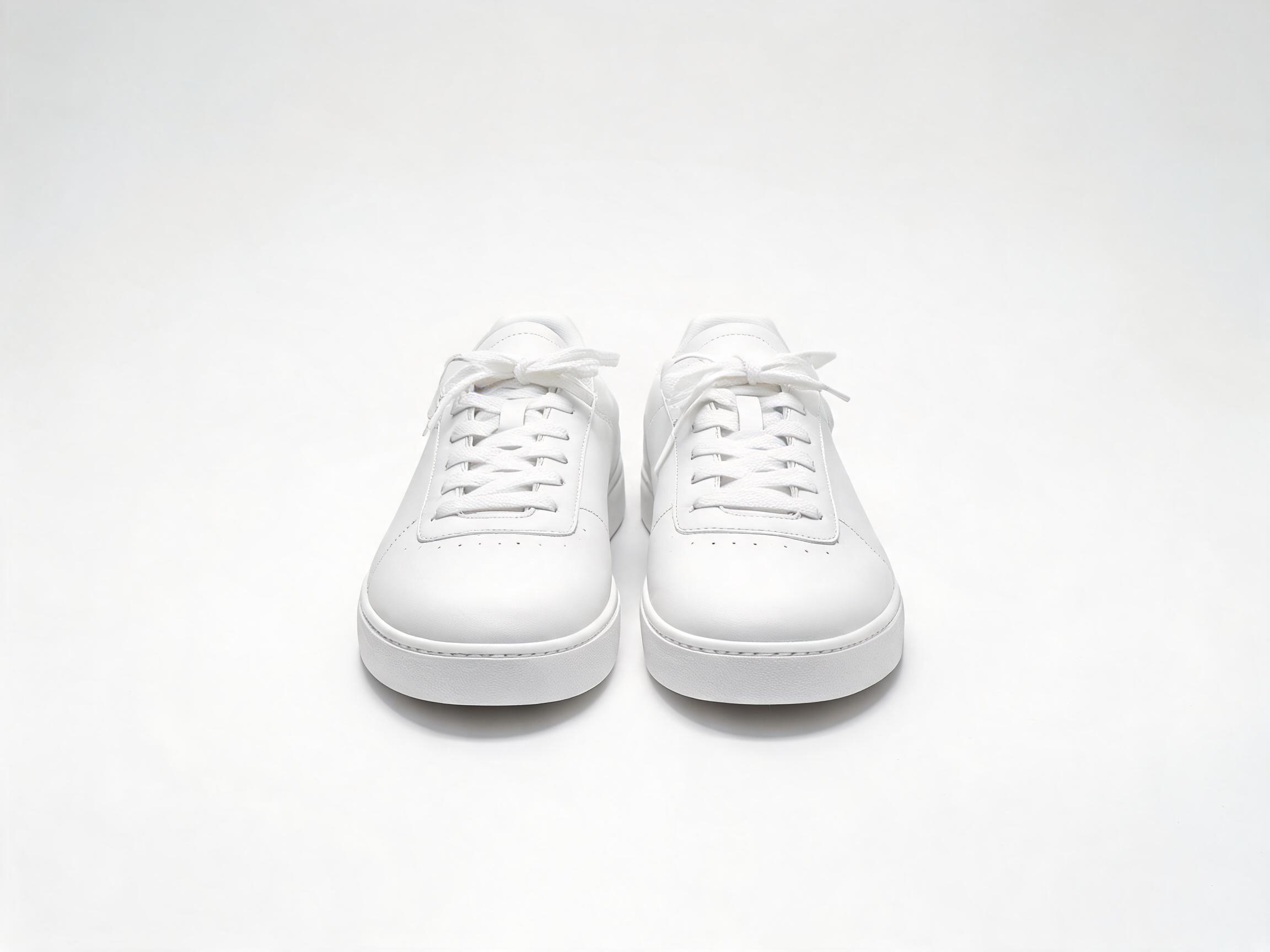
For a classic court look, a white leather low-top with a cupsole is a common starting point. For a more fashion-forward or seasonal variant, a black leather high-top with a vulcanized-style outsole and optional side zipper provides a different silhouette in the same family.
Leather and sole decisions
These two components drive cost, durability, and the feel of the shoe. Decide early because they affect tooling and sampling.
Leather upper choices
Full-grain leather is the top choice for court sneakers: it wears well, develops character, and holds shape. It also accepts color matching; we offer Pantone leather color matching to align with your brand palette. Other options include top-grain (slightly more uniform, lower cost) and corrected-grain (most uniform, lowest cost). For a leather court line, full-grain is typical for mainline products; top-grain can serve entry price points.
Lining matters for comfort and breathability. A breathable textile lining is common and helps manage moisture. For the footbed, a cushioned footbed with a lightweight EVA midsole provides comfort without excess weight. For example, our white leather low-top sneakers combine a full-grain leather upper with a breathable textile lining, cushioned footbed, lightweight EVA midsole, and rubber cupsole, cemented construction, lace-up, EU 39-45, true to standard D width.
Cupsole vs vulcanized-style outsole
Cupsole construction: the outsole is a single molded cup that wraps up around the upper, usually cemented. It gives a clean, stable platform and a modern look. It works well for low-tops and provides good structure.
Vulcanized-style: the outsole is molded and then attached with heat and pressure, often with a textured sidewall. It offers flexibility and a classic, slightly retro aesthetic. It's often used on high-tops and skate-inspired court shoes.
Both are valid; the choice depends on your target market and design intent. Consider:
| Factor | Cupsole | Vulcanized-style |
|---|---|---|
| Look | Clean, modern, low-profile | Classic, textured sidewall |
| Feel | Stable, structured | Flexible, broken-in feel |
| Durability | Good abrasion resistance | Good, but sidewall can scuff |
| Common use | Low-top court shoes | High-tops, vintage styles |
Our black leather high-top sneakers use a vulcanized-style rubber outsole, with a padded collar and optional side zipper, in EU 39-45. That illustrates how sole choice pairs with silhouette.
Branding touchpoints
Your logo placement should be planned from the start; it affects pattern making and material selection.
- Insole branding: Printed or embossed logo on the insole. This is visible when the shoe is tried on and adds a premium touch.
- Box branding: Your logo on the shoe box. Can be printed or labeled. Consider box quality to match your brand positioning.
- Hangtag: A branded hangtag attached to the shoe; a low-cost way to add brand presence.
- Upper branding: Optional logo on the sidewall, heel, or tongue. Requires custom tooling or printing; confirm feasibility and cost.
We offer logo placement on insole, box, and hangtag as standard branding options. For upper branding, discuss with the factory early because it may require new molds or embroidery programs.
Sampling and QC to demand
Sampling is your first physical checkpoint. At Aurevia Footwear Co., Ltd., existing samples ship in 3-5 days, and customized samples take 7-12 days. Use that time to evaluate:
- Fit and sizing: Try on the sample, check toe box room, heel slip, and overall comfort. Our white low-top is true to standard D width; half sizes and width options can be arranged after sample confirmation.
- Leather quality and color: Compare against your Pantone reference under different lighting. Check for scars, uneven grain, or color inconsistency.
- Sole adhesion: Inspect the bond between upper and sole; ensure no gaps or excess adhesive.
- Flex test: Bend the shoe at the forefoot; it should flex naturally without cracking or separation.
- Color fastness: Rub a damp white cloth on the leather to check for color transfer, especially on dark colors.
- Stitching and finishing: Check stitch density, evenness, and trimmed threads.
During production, we apply a three-stage inspection: incoming material, in-line, and final finished-shoe inspection, covering forefoot flex, color fastness, and sole adhesion checks. We back our shoes with a 6-month quality warranty and respond to after-sales inquiries within 48 hours.
How to brief the factory
A clear brief reduces back-and-forth and ensures the sample matches your vision. Include:
- Silhouette references: Photos or sketches of the desired shape (low-top vs high-top, toe shape, collar height).
- Leather specification: Type (full-grain, top-grain), color (Pantone), finish (smooth, matte, etc.).
- Sole construction: Cupsole or vulcanized-style; sole color and texture.
- Sizing range: EU sizes needed (e.g., 39-45) and width requirements; mention if half sizes are needed.
- Branding: Logo files, placement (insole, box, hangtag, upper), and any special packaging.
- Target price: Be transparent about your target FOB to guide material choices.
- Compliance requirements: Any labeling or testing needed for your market.
Share references for look and feel, but be open to factory suggestions on construction for manufacturability. We've been producing footwear since 2011 in Quanzhou, China, with a 260-person team, and we export to Europe, North America, and the Middle East.
Next steps
Building a private label tennis shoe line starts with a clear brief and a factory that can execute it. If you have a silhouette in mind, we can develop samples based on your specs. Review our white leather low-top and black leather high-top as starting points, then contact us with your requirements to discuss customization.