
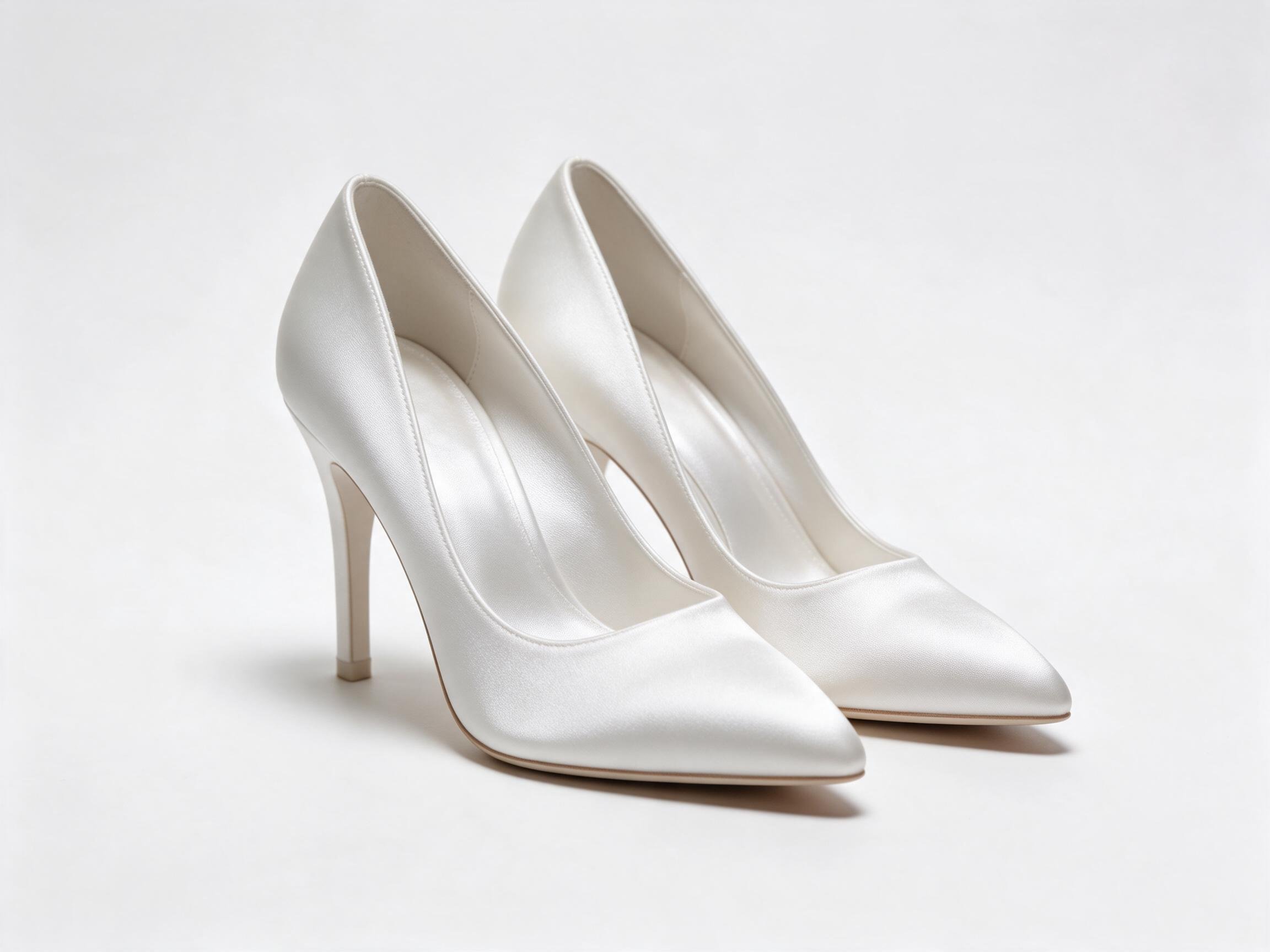
A wholesale buyer's guide to satin footwear: how to distinguish satin fabric grades, manage dye lot consistency across repeat orders, and communicate low-volume requirements with a supplier — grounded in the White Satin Wedding Heels specification.
Satin footwear is one of the easier categories to buy badly: the upper looks right in a sample photo, then the repeat order arrives a shade off, and a 100-pair minimum feels like a wall. This guide is for buyers sourcing satin shoes wholesale. It covers how to read satin fabric grades, how to control dye lot consistency across orders, and how to frame a low-volume requirement so the supplier can price and schedule it accurately.
The reference product throughout is our White Satin Wedding Heels, a pointed-toe stiletto with a duchess satin upper. Its listed specifications make several of these points concrete: EU 34–41 / US 4–10, a stiletto heel of approximately 8 cm with a reinforced heel core, a soft synthetic lining, padded insole, slip-resistant rubber outsole, white/ivory/pink plus custom colors, Pantone matching, and an MOQ of 100 pairs per color. Confirm current MOQ and lead time with the sales team before ordering.
What this guide covers
- Satin fabric grades and why the distinction matters at wholesale
- Dye lot consistency: what to ask for and what to record
- Small orders: communicating volume, color and timing
- What to put in an RFQ for satin footwear
- Acceptance and follow-up
Satin fabric grades: the first thing a sample photo cannot show
“Satin” describes a weave structure, not one fabric. A high-gloss polyester satin, a matte crepe-back satin, a heavier duchess satin and a stretch satin all photograph differently and drape differently. For a heel, the upper needs enough body to hold a pointed-toe shape and enough stability that it does not crease sharply across the vamp after a few wears.
The White Satin Wedding Heels use a duchess satin upper. Duchess satin is typically a heavier, denser satin with a firm hand — the sort of face that holds structure rather than collapsing into the last. That is a useful benchmark when you are comparing quotations: if one supplier is significantly cheaper and the other is showing you duchess satin, ask which grade the cheaper offer uses. If the answer is “satin,” ask for the specific construction.
Questions that separate grades without overclaiming
- Construction name. Ask for the fabric’s trade or construction name (duchess, crepe-back, stretch, etc.), not just the color.
- Face and back. A duchess satin face should read smooth and dense; ask what the back is like, since lining and interlining choices affect how the upper holds shape.
- Colorfastness. Our production includes color fastness testing. Ask what testing the supplier applies to the satin you are ordering and whether it is done on the finished upper or on the roll.
- Lining and insole. The reference shoe uses a soft synthetic lining and padded insole. Lining grade affects comfort perception and how the satin sits against the foot; confirm it is specified, not left to the factory default.
- Heel and outsole. An 8 cm stiletto with a reinforced heel core and a slip-resistant rubber outsole is a specification you can state and inspect. Ask whether these are standard or options.
None of these questions requires the supplier to disclose proprietary sourcing. They are the minimum needed to compare two quotations as if they were for the same product.
Dye lot consistency: the part that bites on the repeat order
Satin shows color differences more than most upper materials because the weave reflects light directionally. Two batches dyed to the same recipe can still read slightly differently under retail lighting, and if you split an order across two production runs, the seam between them becomes visible on a shelf. This is the dye lot problem, and it is a process question, not a color question.
What “Pantone matching” actually covers
Our White Satin Wedding Heels list white, ivory and pink as standard colors, with custom colors available and Pantone color matching supported. Read that precisely: Pantone matching means the supplier can target a specified Pantone reference. It does not mean every future batch will be visually identical to the first, because dyeing is a physical process and lighting, fabric base and machine conditions vary.
What you can do as a buyer is make the standard explicit and keep a physical reference. A practical routine:
- Approve a physical swatch, not a screen. Get a dyed satin swatch or an approved sample pair and keep it. Digital color on a monitor is not a reference.
- Record the reference on the PO. State the Pantone number (if used) and attach the approved swatch reference or sample ID.
- Ask for the dye lot to be recorded on the packing list. Then you can trace which batch went to which store or marketplace listing.
- Keep repeat orders together where possible. If you can, place the full season’s quantity in one production run rather than splitting it. This is the most reliable way to reduce shade variation between shipments.
- Test before you commit a full run. For a new color, request a sample in that color first. Our sample lead time is 3–5 days for standard samples and 7–12 days for custom samples; confirm current MOQ and lead time with the sales team before ordering.
Small orders: how to communicate low volume so it gets quoted
A 100-pair-per-color minimum is workable for a boutique or a marketplace seller testing a style, but it changes how you should structure the order. The mistake buyers make is sending “we need a small trial order” and expecting a price. That gives the supplier nothing to schedule against, and it often produces either a slow reply or a quote that quietly assumes a larger run.
State the order in the supplier’s units
Our MOQ on this style is stated per color, not per style. That means four colors is four minimums. If your plan needs white, ivory and pink, say so explicitly and ask whether the colors can be combined into one production run — the answer affects both scheduling and shade consistency. Confirm current MOQ and lead time with the sales team before ordering.
A useful small-order message contains:
- Style and color breakdown — quantities per color, per size, if size curves matter to you.
- Size range — this style runs EU 34–41 / US 4–10; tell the supplier if your market needs a different size distribution within that range.
- Whether it is a trial or a repeat — a first order to test a market is treated differently from a replenishment.
- Target ship window — our listed lead time is 25–35 days (specification-sheet figure); confirm current MOQ and lead time with the sales team before ordering.
- Incoterm — EXW, FOB or CIF. Choosing one up front removes a common source of back-and-forth.
- Branding needs — private label or OEM/ODM, and whether you need custom packaging.
What the supplier needs to be able to say yes
A small order is easier to accept when it fits an existing production slot, uses standard colors, and does not require new tooling. It is harder when it introduces a custom color, a new outsole, or custom packaging in the same run. If you are testing a market, standard colors and the listed size range keep the request simple. If you need something outside that, say so and expect the supplier to quote it as a separate setup rather than folding it into a standard price.
What to put in an RFQ for satin footwear
A short, specific RFQ gets a more comparable answer. The table below shows the fields that matter for satin shoes wholesale.
| Field | What to state | Why it matters |
|---|---|---|
| Upper fabric | Duchess satin (or named alternative) | Grade determines structure and price |
| Lining / insole | Soft synthetic lining, padded insole | Comfort and consistency across sizes |
| Outsole / heel | Slip-resistant rubber outsole; ~8 cm stiletto, reinforced heel core | Safety and durability claims you can verify |
| Toe shape | Pointed | Affects last and fit |
| Sizes | EU 34–41 / US 4–10 | Size curve planning |
| Colors | White / ivory / pink; custom colors with Pantone matching | Dye lot control and MOQ per color |
| MOQ | 100 pairs per color (listed) | Whether the order is viable as planned |
| Lead time | 25–35 days (listed) | Launch timing |
| Incoterm | EXW / FOB / CIF | Landed cost comparison |
Acceptance and follow-up
Three-stage inspection and color fastness testing are part of our production process, and the reference shoe carries a 6-month warranty. Those are supplier-side controls. As a buyer, your acceptance step is separate: check the delivered lot against the approved swatch under the lighting you will sell in, check the size run against the PO, and check the heel and outsole on a sample of pairs. If something is off, raise it with the lot reference recorded on the packing list.
For repeat orders, the simplest control is to keep the same approved swatch and the same color references on file. If you change any input — lining, outsole, or satin base — expect the shade to be re-approved rather than assumed to match.
FAQ
- Can I order fewer than 100 pairs per color?
- The listed MOQ is 100 pairs per color. Ask the sales team whether a smaller trial is possible for standard colors; any exception needs to be confirmed in writing before you plan a launch.
- Does Pantone matching guarantee identical color across orders?
- It means the supplier can target a specified Pantone reference. Because dyeing varies by lot, keep a physical approved swatch and state it on the PO so each order is checked against the same reference.
- How long do samples take?
- Standard samples are listed at 3–5 days and custom samples at 7–12 days. Confirm current MOQ and lead time with the sales team before ordering.
- What terms are available?
- EXW, FOB and CIF. Choose the one that matches how you will compare landed cost.
Satin shoes wholesale comes down to three conversations: which satin you are actually buying, what reference the color is checked against on every lot, and whether your volume fits the supplier’s standard run. Get those in writing, and the repeat order is a scheduling exercise rather than a color gamble.