
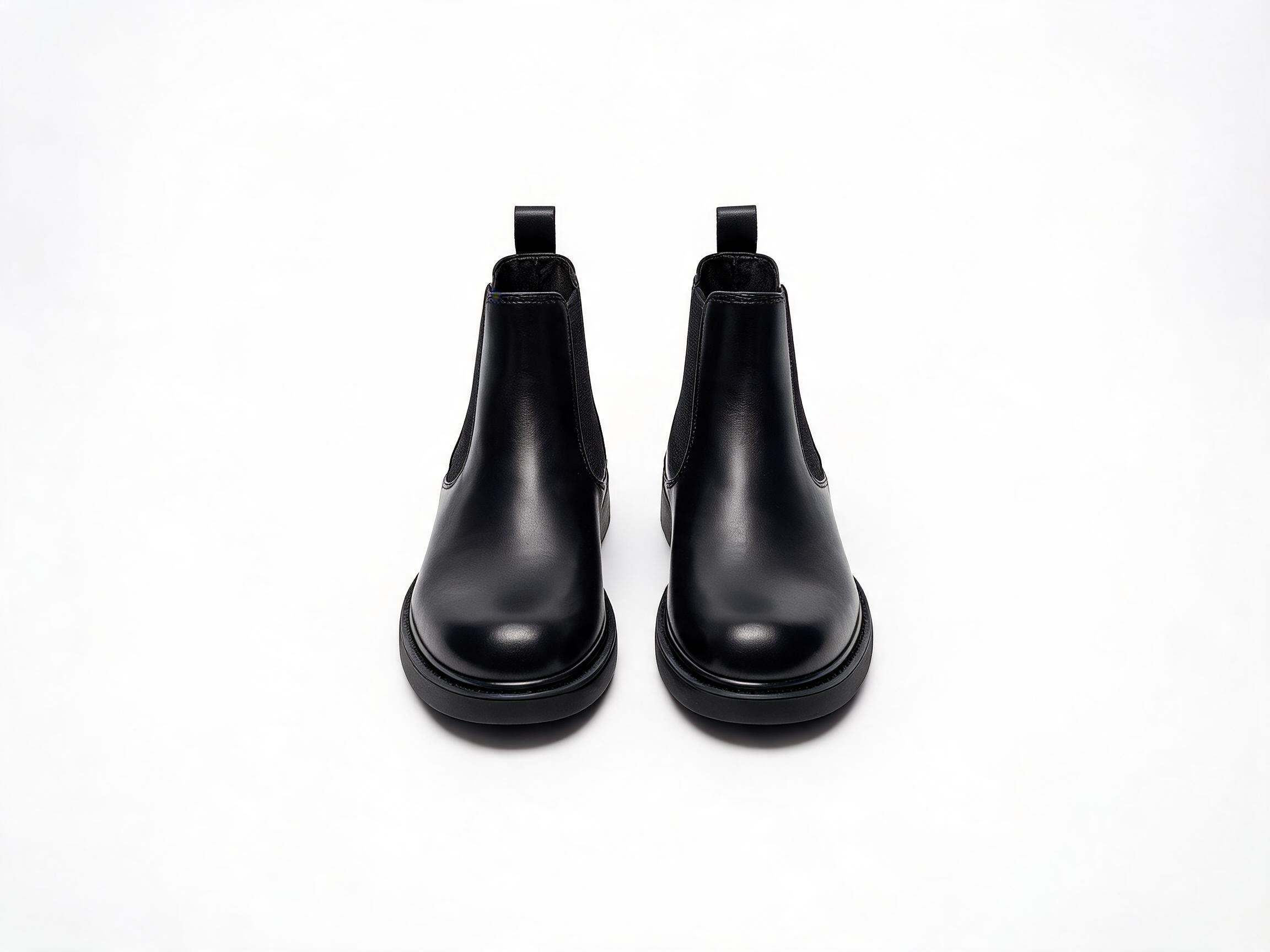
Chelsea boots can look nearly identical in photos while sitting at very different cost levels. This article breaks down the factors that actually move a quote — leather grade, elastic side panels, lining, outsole, construction method and order size — so buyers can read a quotation and understand what each line is paying for. No currency figures are quoted here; the goal is to help you ask the right questions before you request prices.
Two Chelsea boots can look the same on a product photo and still land at very different cost levels. The difference is rarely one big item — it is a stack of small decisions about leather, elastic, lining, outsole, how the boot is put together, and how many pairs you order. This breakdown explains what moves a quote, so you can read a supplier's pricing with some context instead of comparing a single bottom-line number.
Key takeaways
- Cost is driven by a chain of components, not a single “quality” label.
- Leather grade, elastic side-panel quality, lining and outsole are the four most visible cost levers in a Chelsea boot.
- Construction method affects both labour time and how the boot can be repaired.
- Order size spreads fixed setup costs across fewer or more pairs.
- No prices are quoted in this article — ask the supplier for a line-by-line quotation against your specification.
Why the same silhouette can cost differently
A Chelsea boot is a simple-looking shape: a closed upper, two elastic side panels, a pull tab, a shaft, and a sole. Because the shape is fixed, buyers reasonably assume the cost should be fixed too. In practice, almost every visible and hidden element of that shape is a decision point, and each decision sits somewhere on a cost spectrum.
The useful way to think about “how much do Chelsea boots cost” is not as one number but as a set of cost drivers that you can rank by importance for your own program. A fashion label ordering a soft, unlined boot for a short season is optimizing for a different set of trade-offs than a wholesaler ordering a lined, resolable boot intended for repeat wear. Both are legitimate; they simply allocate cost differently.
The sections below take each driver in turn and explain what it changes, and what you should ask about when you request a quote.
Leather grade and how it is cut
Leather is usually the largest single material cost in a leather Chelsea boot, and the phrase “genuine leather” covers a wide range. Three things matter when you compare quotes:
- Grade and finish. Full-grain leather keeps the outer surface of the hide and typically carries a different cost position from corrected-grain or split leather, where the surface is sanded or coated. The finish also affects how the boot ages and how visible creasing becomes.
- Hide selection and cutting yield. A factory cutting around scars, stretch marks and thin areas uses more square metres per pair than one cutting to a looser standard. Higher yield pressure shows up as more joins, more mismatched panels, or panels placed where the boot flexes.
- Panel matching. Matching left and right boots, and matching panels within a boot, adds cutting time and waste. It is a real cost line even though it is invisible on a spec sheet.
When a quote seems low for a leather boot, the first question to ask is which grade and which part of the hide the visible upper panels come from. The answer tells you more than the word “leather” ever will.
Elastic side panels
The elastic gusset is the defining functional part of a Chelsea boot, and it is also a common place to economise. The panel has to stretch enough for the foot to enter, then recover and hold the shaft against the ankle over many wear cycles.
- Elastic quality. Elastic compositions differ in recovery and in how they behave after repeated stretching. A panel that loses tension makes the boot feel loose at the ankle long before the upper or sole wears out.
- Panel size and stitching. Larger panels use more elastic and need more stitching. The stitch pattern around the gusset is also a visible quality signal, because it has to be consistent on both sides of both boots.
- Colour and weave. Woven elastic in a specific colour or weave, rather than a standard black, affects sourcing and minimum quantities at the elastic supplier — which in turn affects the boot's material cost.
Lining and internal components
Lining is largely invisible in product photos, which is exactly why it deserves attention in a quotation. An unlined boot uses less material and less labour; a lined boot adds a full inner layer, plus the stitching and skiving to keep it tidy at the topline and around the gusset.
Beyond the lining itself, the internal build includes the toe puff, the counter at the heel, and any shank or reinforcement in the waist. Each of these is a separate material choice with its own cost position, and each affects how the boot holds its shape. A boot that collapses at the heel after a few weeks usually had a lighter counter, not a lighter upper.
Ask which internal components are included as standard and which are optional. This is one of the clearest ways to compare two quotes that look identical on the outside.
Outsole and heel
The sole assembly is the second major material line after the upper. Cost differences come from:
- Compound and density. Different rubber or synthetic compounds behave differently in abrasion and flex, and are priced differently.
- Sole construction. A moulded unit sole, a stitched-on sole, and a welted sole involve different tooling, different labour time and different repairability. Tooling in particular is a fixed cost that behaves very differently at 100 pairs than at several thousand.
- Heel build. A stacked or wrapped heel takes more assembly time than a moulded block. The reference boot below uses a heel of approximately 3 cm, which is a modest height that keeps the sole assembly simpler than a tall block heel.
Construction method
Construction is where labour time concentrates, and labour time is a large share of footwear cost. The main methods differ in how the upper is attached to the sole, and each has consequences beyond price:
| Method | What it typically involves | What it changes for the buyer |
|---|---|---|
| Cemented | Upper bonded to the sole with adhesive | Fewer operations and lower labour time; resoling depends on the sole and the bond |
| Stitched / Blake-type | Upper stitched through to the sole | More stitching time; generally more amenable to resoling than a purely bonded build |
| Welted | Rib or welt stitched to the upper and then to the sole | Most operations and skilled labour; strongest repairability story, highest labour cost |
Method naming and construction details vary between factories. Ask the supplier to describe the actual sequence used for your boot rather than relying on a label.
For a Chelsea boot, construction also interacts with the elastic gusset. The gusset has to be stitched into the upper before the upper is closed, and the shaft has to hold its shape through lasting. A taller shaft gives more material and more lasting area; the reference boot listed below has a shaft of approximately 15 cm, which is a standard ankle-height proportion.
Order size and how it changes unit cost
This is the driver buyers most often underestimate. A factory quote for footwear is not purely a materials-plus-labour sum; it also has to recover fixed and semi-fixed costs:
- Pattern and sample development. Making a pattern, a fitting sample and a confirmed size set is a one-off effort.
- Sole tooling and moulds, if new. A new outsole mould is a substantial fixed outlay that makes sense only across a large run.
- Line setup and changeover. Setting up a line, matching leather lots and training operators on a new style takes time before the first sellable pair comes off.
- Material minimums. Leather, elastic and lining are bought in lots. A small order may have to absorb supplier minimums for materials that could otherwise be shared across a larger run.
- Size-curve efficiency. Cutting a balanced size curve across a full range is more efficient than cutting a narrow set of sizes.
The practical consequence: the same boot specification usually has a different unit cost at 100 pairs than at a much larger volume, because the fixed block is spread across more units. That relationship is not linear, and the shape of the curve depends on whether new tooling is needed. Ask your supplier to quote your specification at more than one quantity so you can see how the fixed cost behaves.
How to read a Chelsea boot quotation
Once you know the drivers, a quotation becomes readable. Rather than comparing bottom lines, compare what each price actually covers. A short checklist for your enquiry:
- Specify the upper material by grade, not just “leather”, and ask which panels use which part of the hide.
- State the elastic specification — colour, weave and approximate panel size — or ask what is standard.
- Ask whether the boot is lined and which internal components are included at the quoted price.
- Name the construction method you want, or ask the supplier to state which method the quote assumes.
- Give your size range and size curve so cutting efficiency can be priced in.
- Request the quote at more than one quantity to see how the fixed cost is being recovered.
- Confirm current MOQ and lead time with the sales team before ordering — published figures are a starting point, not a guarantee for every specification.
A reference specification
To make the discussion concrete, here is a documented example from our own range. Aurevia Footwear Co., Ltd. is a genuine-leather footwear OEM/ODM exporter founded in 2011, with about 260 staff, supplying markets in Europe, North America and the Middle East. Our Black Chelsea Boot Shoes are built with the following listed specification:
| Specification | Listed value |
|---|---|
| Upper | Full-grain leather |
| Side panels | Elastic side panels |
| Shaft height | Approx. 15 cm |
| Heel height | Approx. 3 cm |
| Size range | EU 39–45 |
| MOQ | 100 pairs — confirm current MOQ and lead time with the sales team before ordering |
| Lead time | 30–40 days — confirm current MOQ and lead time with the sales team before ordering |
Used as a reference point, this specification shows how the driver discussion maps onto a real product. Full-grain leather upper, elastic gussets and a modestly heeled sole describe a construction where the leather grade and the gusset quality are the levers most worth discussing. The stated MOQ of 100 pairs and lead time of 30–40 days reflect the standard program; a different upper, a new sole tooling or a different construction method would change both the costing structure and the schedule, so confirm current MOQ and lead time with the sales team before ordering.
If you are currently collecting quotations, send the specification above as a starting baseline and ask each supplier to mark clearly where their offer differs — leather grade, lining, construction or sole tooling. That comparison will tell you more about “how much Chelsea boots cost” for your program than any single headline number could.