
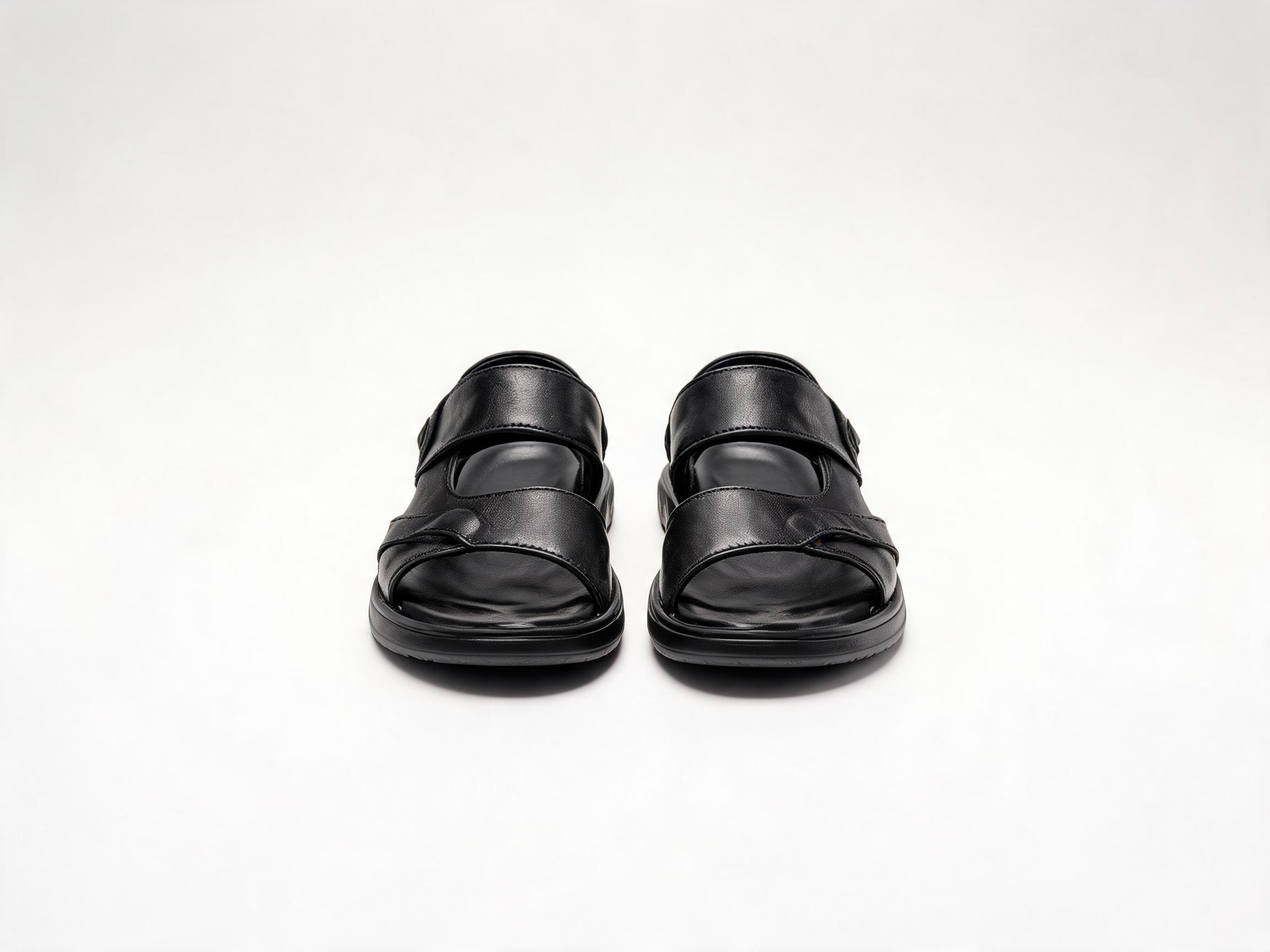
A buyer's checklist for sourcing men's leather sandals from wholesale sandals suppliers, covering buckle and hardware construction, footbed and comfort, leather consistency, and summer replenishment timing. Includes product-specific lead time and MOQ details from our catalog.
B2B Sourcing Guide
Men's leather sandals sit at the intersection of durability and seasonal demand. For buyers, the sourcing challenge is not finding a supplier who lists sandals—it is finding one whose buckles, footbeds, leather panels, and delivery schedule hold up to the scrutiny of a retail program. This guide outlines the checks that matter when you evaluate wholesale sandals suppliers for a men's leather sandal line, with reference to our Black Leather Casual Sandals as a concrete example of what to confirm.
Key takeaways:
- Buckle and hardware construction determines whether a sandal stays closed and comfortable over a season.
- Footbed material and shape affect repeat purchase and return rates—ask for construction details, not just photos.
- Leather consistency across dye lots and panels is a common source of buyer claims; specify your tolerance upfront.
- Summer replenishment windows are tight; confirm MOQ and lead time early. For our Black Leather Casual Sandals, MOQ is 100 pairs per color and lead time is 25–35 days—confirm current terms with the sales team before ordering.
What this guide covers
- Buckle and hardware structure
- Footbed and comfort checks
- Leather consistency and panel matching
- Summer replenishment planning
- Supplier evaluation checklist
Why men's leather sandals need a different sourcing approach
Men's leather sandals are often worn daily through warm months, which puts stress on buckles, stitching, and footbed foam. A sandal that looks correct on a sample table can still generate returns if the buckle slips, the footbed compresses unevenly, or leather panels vary in shade between left and right. When you screen mens leather sandals wholesale suppliers, the questions you ask should target these wear points rather than general catalog claims.
This article focuses on men's lines; women's sandal assumptions (different lasts, strap widths, or embellishment norms) do not transfer directly. If a supplier offers both, ask for separate construction details for each line.
1. Buckle and hardware structure
Buckles are the most user-interacted component on a sandal. A buckle that is too thin can bend; a pin that is too short can slip out of the hole; a finish that is poorly applied can corrode or discolor with sweat. Ask suppliers to specify:
- Buckle material and finish: Is it stamped steel, zinc alloy, or another base metal? What plating or coating is used, and is it rated for salt or chlorinated water exposure if your market includes beach or pool use?
- Pin length and hole spacing: Does the pin fully engage the strap hole with margin? Are holes spaced to accommodate the foot widths your target market expects?
- Strap attachment: Are straps stitched, riveted, or both? A rivet adds a mechanical backup but introduces a metal-to-leather contact point that can wear through if improperly set.
- Adjustability range: For a two-buckle sandal, confirm the total adjustment range so the sandal fits the intended size run without requiring extra SKUs.
For our Black Leather Casual Sandals, the buckle and strap configuration is part of the product specification. Request a construction sheet or sample if your program requires verification beyond the product page.
2. Footbed and comfort checks
Comfort is subjective, but construction is not. The footbed determines how weight is distributed and how the sandal feels after weeks of wear. Ask about:
- Footbed material: Is it leather-covered foam, EVA, latex, or another base? Leather-covered footbeds can feel cooler but may need a break-in period; foam footbeds vary widely in density.
- Thickness and density: A thicker footbed is not automatically better; density affects compression over time. Ask for the specified thickness and, if available, compression data.
- Arch support and contour: Does the footbed have a molded arch, or is it flat? For men's casual sandals, a contoured footbed can reduce fatigue, but the shape must match your target customer's foot profile.
- Lining and edge finish: Rough edges or exposed foam can cause blisters. Check that the footbed edge is sealed or wrapped.
If you cannot evaluate comfort from a description, request a wear trial with a small group before committing to a bulk order. The cost of a trial is small compared with the cost of a return-heavy season.
3. Leather consistency and panel matching
Leather is a natural material, and variation is expected—but unmanaged variation becomes a quality complaint. For men's leather sandals, the visible panels (straps, footbed cover) should be matched for shade, grain, and thickness. Checks include:
- Dye lot control: Ask whether the supplier cuts from a single dye lot for a given order and whether they can hold a dye lot for replenishment orders.
- Grain and finish: Is the leather full-grain, top-grain, or corrected-grain? Is the finish smooth, pebbled, or oiled? Consistency in finish matters more than the label if your customers expect a specific look.
- Thickness tolerance: Straps that are too thick can feel stiff; too thin can stretch. Ask for the specified thickness range and how the supplier checks it.
- Colorfastness: Will the leather rub off on socks or skin? Ask for rub-fastness test data if available, or request a simple crock test on a sample.
Our Black Leather Casual Sandals use black leather; confirm with the sales team how leather parameters are specified for your order, including acceptable variation.
4. Summer replenishment windows
Summer sandal demand is seasonal and concentrated. A late shipment can miss the selling window entirely. When evaluating wholesale sandals suppliers, map their lead time against your retail calendar:
- MOQ and color minimums: For our Black Leather Casual Sandals, MOQ is 100 pairs per color. If you plan multiple colors or sizes, calculate total units and confirm whether size assortments count toward the color minimum.
- Lead time: Our listed lead time is 25–35 days. This is production time; add transit and customs clearance to get the total replenishment cycle.
- Reorder windows: If you need a mid-season replenishment, ask how far in advance you must place the order and whether the supplier can hold materials or finished goods.
- Capacity constraints: Peak season can strain any factory. Ask whether the lead time quoted is valid for orders placed during your target window, and confirm current MOQ and lead time with the sales team before ordering.
A practical approach is to work backward from your desired in-store date: subtract transit time, subtract lead time, and subtract your internal QC and distribution time. The result is your latest order date. Build in buffer for delays.
5. Supplier evaluation checklist
Use this table to structure your comparison. The right-hand column lists what to request from each supplier; the middle column explains why it matters.
| Check | Why it matters | What to request |
|---|---|---|
| Buckle material and finish | Corrosion or bending leads to returns | Material spec, plating type, salt-spray data if available |
| Strap attachment method | Stitching vs. riveting affects durability and repairability | Construction description or close-up photos |
| Footbed construction | Comfort and compression affect repeat purchase | Material, thickness, density or compression data |
| Leather specification | Consistency determines visual quality and customer satisfaction | Grade, finish, thickness range, dye lot policy |
| MOQ and lead time | Determines order feasibility and cash flow | Current MOQ per color, lead time, reorder policy |
| Size range and fit | Fit drives returns; men's lasts vary | Size chart, measurement method, fit comments |
FAQ
What is the MOQ for your Black Leather Casual Sandals?
The listed MOQ is 100 pairs per color. Confirm current MOQ with the sales team before placing an order, as terms may vary by season or order volume.
How long does production take?
The stated lead time is 25–35 days. This is production time; shipping and customs clearance add to the total. Confirm current lead time with the sales team.
Can I order multiple colors or sizes?
Yes, subject to the per-color MOQ. Contact the sales team to discuss size assortments and color combinations.
Do you provide samples?
Sample policy is not listed on the product page. Ask the sales team about sample availability and cost.
For full product details, see the Black Leather Casual Sandals page. To discuss your order, contact our sales team.