
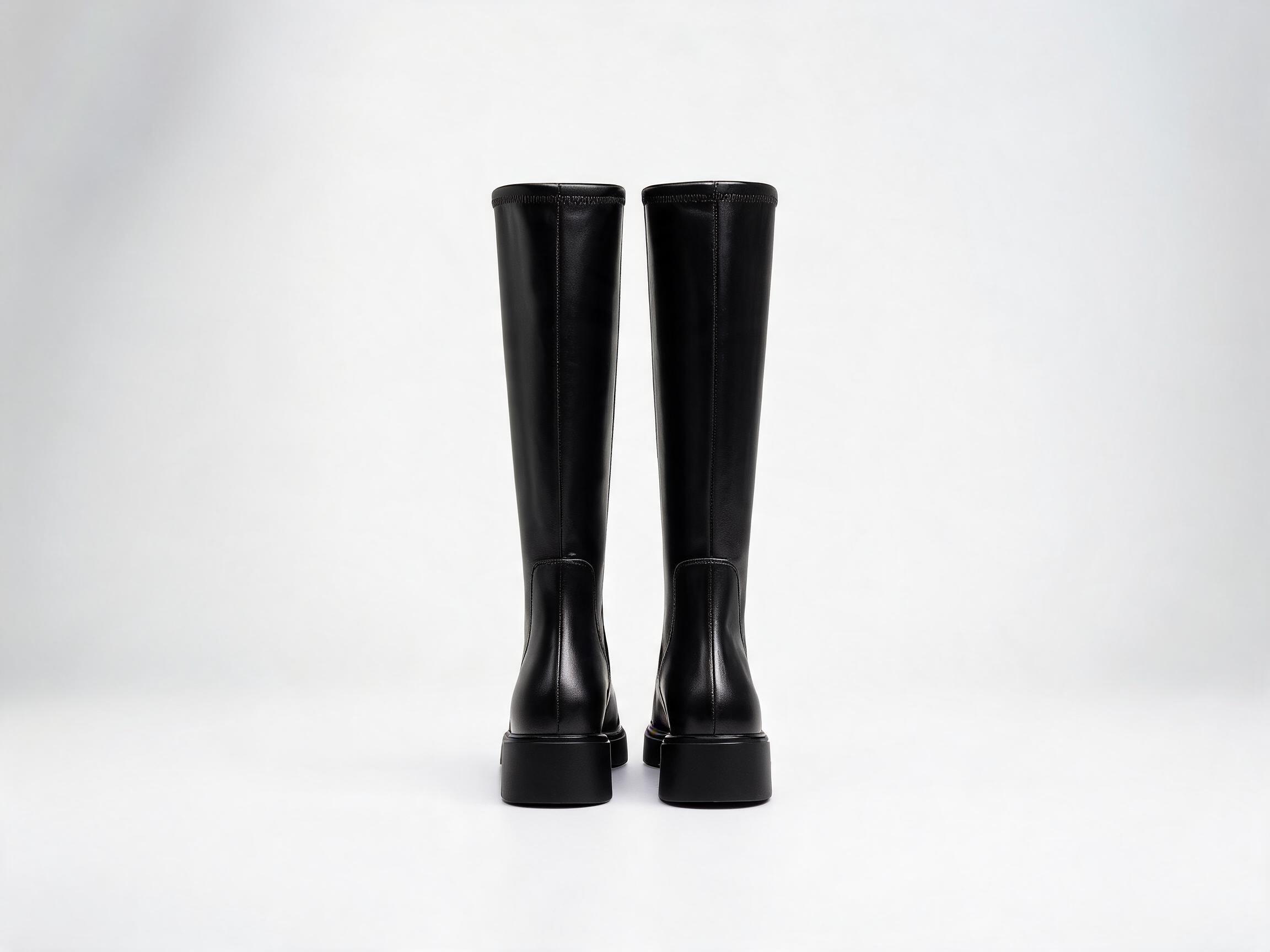
Moving a tall-boot program from knee-high to thigh-high changes more than shaft length. This guide covers shaft-height grading, thigh-circumference fit, top-line stay-up structure, long-shaft zipper function, and the checks to lock at sampling before bulk production.
A knee-high boot and a thigh-high boot can share a last, a hide and an outsole, yet behave very differently in a bulk shipment. The extra shaft height adds measurement points, a new fit dimension at the thigh and a structural load at the top of the boot that a knee-high style never carries. If you are building a tall-boot program from an existing knee-high reference, these are the variables to control before you release a purchase order.
- Shaft height needs a grading rule, not a single spec.
- Thigh circumference replaces calf width as the tightest fit constraint.
- The top line needs its own stay-up structure.
- A longer inside zipper means more slider travel and more flex cycles.
- Sampling must lock measurement points, tolerance and QC criteria.
Start from your knee-high reference
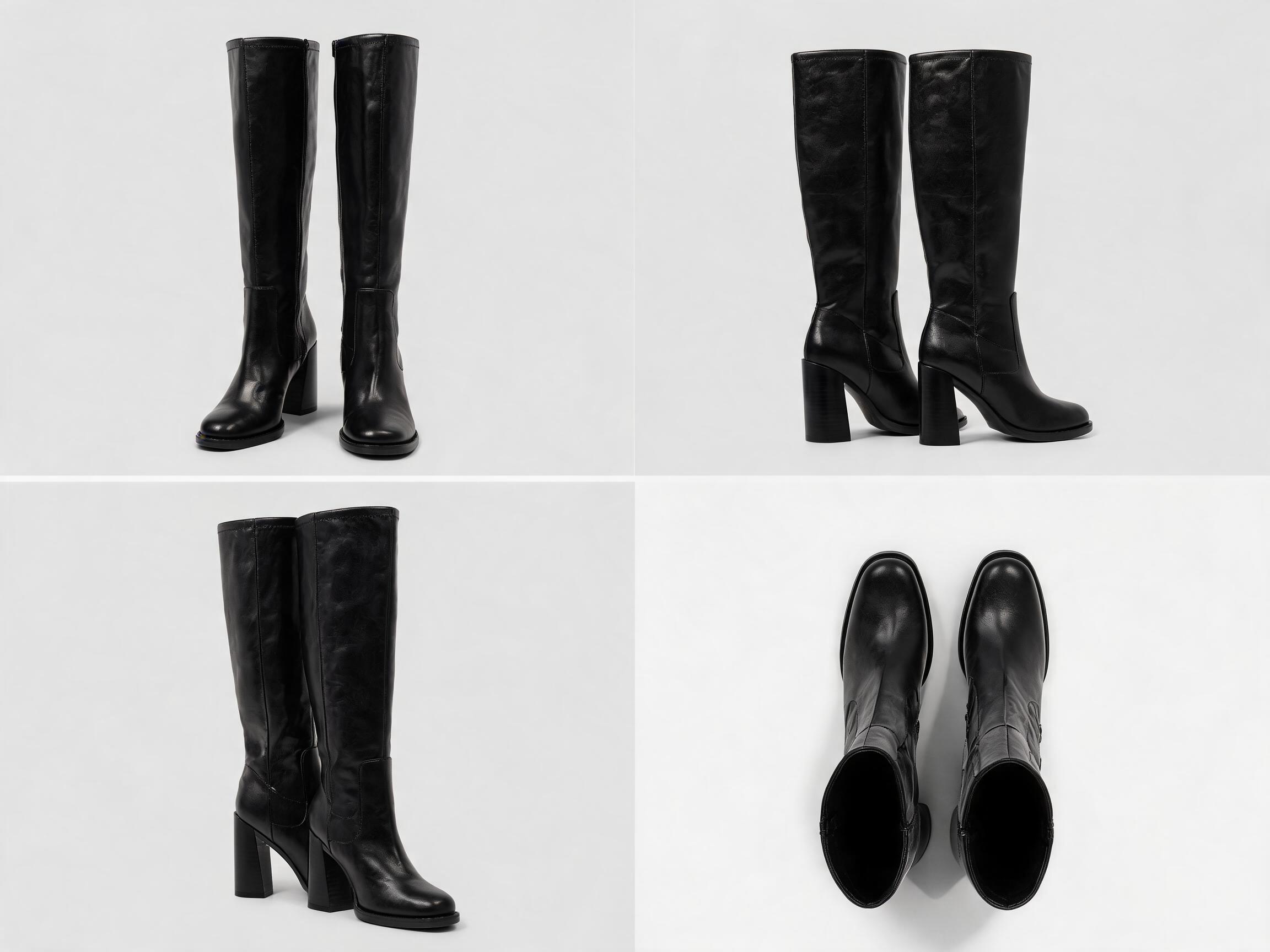
A useful anchor is an existing knee-high style rather than a spec sheet drawn from scratch. Aurevia Footwear's black leather knee-high boots give a concrete baseline: smooth black leather, full inside zipper, shaft approximately 38 cm, shaft shaped on a form, upper panels cut from matched hides, cemented construction, rubber anti-slip outsole, EU 35–41, with a warm lining option. The short end of the range is a brown leather ankle boot with a side zipper and a shaft of roughly 12 cm, EU 35–41.
Those three heights matter because they stress different parts of the pattern. On a 12 cm ankle boot, shaft height is almost a fixed value. On the 38 cm knee-high, height interacts with calf width. On a thigh-high, height also has to reconcile with the largest circumference in the leg column and with the way the top of the shaft stays in place.
Shaft-height grading: one spec is not enough
When a knee-high reference lists "approx. 38 cm," that figure usually describes one size — commonly the middle of the range. A thigh-high program needs a decision about what happens to shaft height across EU 35–41. There are two workable approaches:
- Fixed shaft height. Every size keeps the same shaft height measured along the back of the leg. Simple to specify and easy to compare in a QC report, but the top line lands at a slightly different point on different wearers.
- Graded shaft height. Shaft height increases or decreases with size, following the leg column. Fit improves across the range, but each size needs its own measurement on the specification sheet and its own sampling sign-off.
Whichever route you choose, define the measurement method before sampling. Tower height measured along the back seam versus measured along the side seam can differ by a centimetre or more on a shaped shaft, and buyers and factories can argue over a batch that both parties believe is correct. Put the method, the tape position and the tolerance in writing on the sample comment sheet.
Thigh circumference replaces calf width as the constraint
Calf width is the familiar fit variable on knee-high boots, and it is why bulk orders often offer calf-width options after sample confirmation. On a thigh-high, the critical circumference moves up the leg. A shaft that closes cleanly at the calf can still pull open at the top if the upper thigh circumference is under-sized, and that shows up as a gap at the top line, a strained zipper or a boot that will not close at all on larger sizes.
The practical response is to treat thigh circumference exactly as you would treat calf width: as a buyer-selectable fit option confirmed at sampling. If your program targets a broad size run, ask the factory to confirm whether more than one thigh circumference can be offered per size, and how that option is recorded on the order. A single thigh circumference across EU 35–41 may be acceptable for some markets and unsuitable for others; that is a commercial decision, but it must be made before bulk, not discovered at inspection.
Stay-up structure at the top of the shaft
The top of a thigh-high boot is a structural area. A 38 cm knee-high shaft sits below the knee and largely rests there. A thigh-high shaft must hold itself up against a larger circumference and a longer lever arm. How that is achieved depends on the design — a shaped top, an internal elastic panel, a drawcord, or a combination — and it should be settled at sampling.
For QC, do not grade the stay-up mechanism by eye alone. Ask what the structure is, whether it is visible or concealed, and how the factory checks it in the finished-shoe stage. If an elastic or concealed component is used, confirm how it is inspected and recorded. This is also the point to confirm with the factory which construction and components are actually specified for your style, rather than assuming from appearance.
The inside zipper over a longer shaft
A full inside zipper on a knee-high boot travels a moderate distance. On a thigh-high, the same zipper concept covers a much longer run, passes a knee bend and ends at a top line that must close tightly. Three things follow:
- Slider travel. The zipper must run the full length without catching at the knee area, where the shaft curves.
- Flex cycles. Zipper function is already part of the three-stage inspection, and a longer zipper benefits from a repeat open-close check rather than a single pass.
- Top closure. The zipper must finish at a top line that closes cleanly — a gap here is visible to the end customer and hard to correct after shipment.
What to lock at sampling, before bulk
Existing samples are typically available in 3–5 days; customized samples take approximately 7–12 days after details are confirmed. Bulk lead time is approximately 30–45 days after sample approval. That sampling window is where a thigh-high program is won or lost, because changes after approval are expensive. Use it to close the following points.
| Check | What to specify | What to record |
|---|---|---|
| Shaft measurement points | Back-seam height, side-seam height, top-line circumference | Method, tape position, tolerance per size |
| Fit grading | Fixed or graded shaft height; thigh circumference option per size | Approved values for EU 35–41 |
| Zipper endurance | Full-length travel, knee-area flex, top-line closure | Repeated open-close result at in-line and finished-shoe stages |
| Top-line stay-up | Structure type and how it is checked | Inspection criterion at finished-shoe stage |
| Material consistency | Matched hides across upper panels | Colour and grain check at incoming material |
| Construction and outsole | Cemented construction; rubber anti-slip outsole | Sole adhesion check at finished-shoe stage |
QC beyond the shaft
The three-stage inspection — incoming material, in-line construction and finished-shoe — covers zipper function, forefoot flex, sole adhesion and colour fastness. For a thigh-high style, ask that the zipper and top-line checks be explicitly listed in the finished-shoe report for each size sampled, and request the inspection report with the shipment. Third-party inspection is welcome, which is useful for first bulk orders or for a new thigh-high pattern.
Commercial points to settle alongside the tech pack
Pricing and shipping terms are quoted EXW, FOB or CIF, and shipments go to Europe, North America and the Middle East. Aurevia Footwear operates as a B2B footwear manufacturer in Quanzhou, China, with OEM/ODM and private label support. Minimum order quantities differ by style and construction, so confirm MOQ per style with the factory rather than assuming one figure applies across a thigh-high range. The product page also states that shaft-height adjustments, calf-width options and half sizes can be arranged for bulk orders after sample confirmation — which is exactly why the sample stage should be treated as the approval gate, not a formality.
Frequently asked questions
Can we order thigh-high boots based on the existing knee-high pattern?
The knee-high style is a useful reference for last, leather and construction, but the shaft height, thigh circumference and top-line structure need to be re-specified. Confirm these with the factory at sampling.
Do you offer different thigh circumferences per size?
Calf-width options are stated as available for bulk orders after sample confirmation. Ask the factory to confirm whether the same option can be extended to thigh circumference for your size run.
How long does a custom thigh-high sample take?
Customized samples take approximately 7–12 days after details are confirmed. Existing samples are typically available in 3–5 days.
What is the bulk lead time?
Approximately 30–45 days after sample approval.
Can a third party inspect the order?
Yes. Third-party inspection is welcome, and inspection reports from the three-stage QC process are available on request.
When briefing a supplier on a thigh-high program, send the measurement method, the size range, the thigh-circumference requirement and the top-line structure you expect. Those four items determine whether the sample you approve is the boot you receive in bulk.