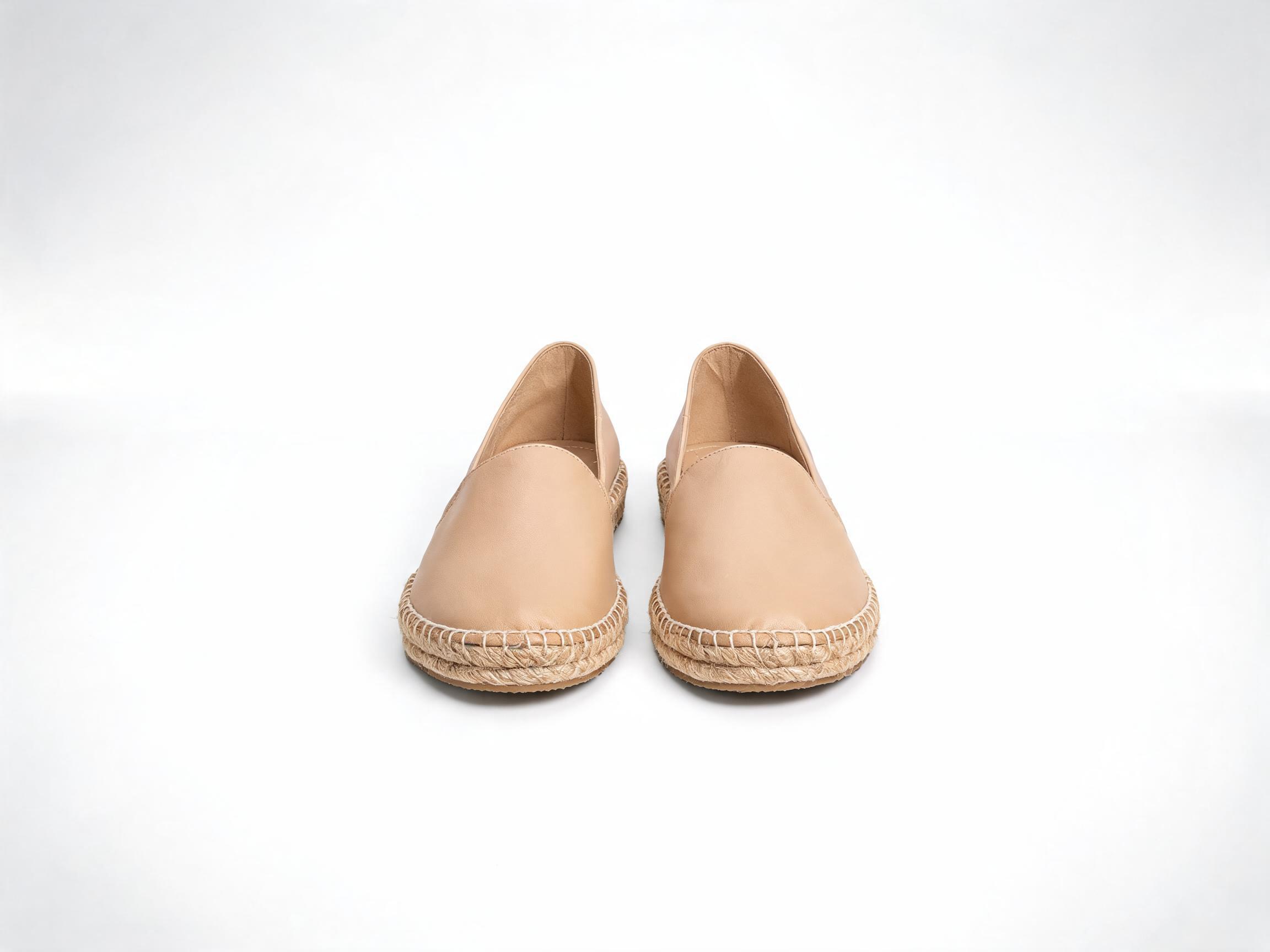
When sourcing teams search for China castaner wedges Customized, they usually are not asking for a literal licensed copy of a Spanish heritage brand. They are describing a construction family: a jute-braided espadrille wedge with a closed or open upper, a raised platform, and a recognizable rope-wrapped midsole. The commercial question behind the search is practical — can a China factory reproduce that look at wholesale volume, with my label, my sole spec, and my delivery window?
What Buyers Mean by "China Castaner Wedges Customized"
When sourcing teams search for China castaner wedges Customized, they usually are not asking for a literal licensed copy of a Spanish heritage brand. They are describing a construction family: a jute-braided espadrille wedge with a closed or open upper, a raised platform, and a recognizable rope-wrapped midsole. The commercial question behind the search is practical — can a China factory reproduce that look at wholesale volume, with my label, my sole spec, and my delivery window?
This article answers that question for business buyers running seasonal bulk programs. It covers braiding methods, platform construction, tooling decisions, seasonal timing, and the verification steps that separate a reliable factory from a sample-only supplier.
Braiding: The Part That Decides Perceived Quality
The braided jute band is the visual signature of an espadrille wedge. In mass production, factories use three broad approaches:
Machine-braided jute tape. Consistent width and tension, fast to apply, and the most affordable at volume. The braid pattern is uniform, which reads as clean but slightly mechanical. This is the standard choice for mid-market programs above roughly 1,000 pairs per style.
Hand-braided or hand-wrapped soles. Higher labor content, more variation between pairs, and a softer, artisan look. Suitable for premium positioning and smaller runs. Expect longer lead times because braiding capacity limits output.
Braided-look synthetic wrap. Lower cost and more uniform, but buyers should test abrasion and check how it takes dye. It can look correct in a photo and flat in person.
For any braided element, specify three things in the tech pack: yarn composition and origin, braid width in millimeters with tolerance, and the attachment method (stitched through the sole, cemented, or both). Stitching through the braid into the sole platform is the more durable option and is worth the extra cost on wedges that will be worn on pavement.
Buyers should also ask what happens at the seam where the braid meets the upper. This junction fails first when the adhesive is thin or the braid is not anchored. Request a cross-section photo of a cut sample rather than a finished glamour shot.
Platform and Wedge Construction: Where Specs Get Vague
Espadrille wedges carry a compound midsole — typically a jute-wrapped core over a structural foam, cork, or EVA base, topped with a footbed. Buyers who specify only total heel height often receive a wedge that photographs well but feels unstable.
Specify these parameters separately:
- Heel height at the back and platform height under the ball of the foot. The difference determines the effective pitch and how the wearer walks.
- Wedge profile — straight, tapered, or sculpted — with a side-view drawing, not a reference photo.
- Base material and density. Softer foams compress and the wedge can appear to lean after a season of wear. Ask for the density figure and a compression test result.
- Footbed construction. Board lasting on a molded footbed is common; a stitched-in sock adds cost and durability.
- Outsole. Many espadrille wedges ship with a thin rubber or TPR patch at the heel and forefoot. Clarify whether the outsole is full-length or partial, and request a slip-resistance test if the retail market requires it.
A useful comparison criterion is weight per pair in the finished size run. A heavy jute-and-cork wedge is not automatically better, but unexplained weight differences between your approved sample and bulk often signal a substituted core material.
Tooling, Molds, and What You Pay Up Front
Customization in this category usually involves: a custom jute or braid color, a proprietary upper pattern, a molded footbed with your logo, and branded packaging. Each has a cost and a lead-time impact.
- Upper patterns require a last. If the factory already runs a similar last, you may avoid a new mold; if not, budget for tooling and a fit sample round.
- Molded footbeds and outsoles require tooling that is typically amortized or invoiced separately. Tooling ownership should be stated in the purchase agreement — who holds it, and whether it transfers if you move suppliers.
- Logo application can be debossed, printed, or a woven label. Debossing into a molded footbed is durable; printed logos on jute wear away quickly.
- Packaging — custom boxes and tissue — usually has its own minimum order quantity, often higher than the shoe MOQ.
A realistic sequence is: concept and reference review, tech pack, quote with tooling breakdown, fit sample, revision, sales sample approval, then bulk. Skipping the fit sample to save four weeks usually costs more in bulk corrections.
Braiding, Platforms, and Seasonal Bulk Runs: Planning the Calendar
Espadrille programs are seasonal, and braiding capacity is the bottleneck. Factories that produce jute braid in-house control their calendar better than those buying braid on the open market, where prices and availability swing with the harvest.
Plan backwards from your in-store date:
- Design freeze — 4 to 6 weeks before sample submission.
- Sample rounds — 2 to 4 weeks per round, with at least one revision round budgeted.
- Material booking — braid, jute wrap, and footbed materials reserved before peak season, not during it.
- Bulk production — commonly 30 to 60 days after approved samples and deposit, longer at peak.
- Inspection and shipping — add time for third-party inspection, packing, and ocean or air freight.
If you need delivery before a spring season, the material booking conversation should happen in the preceding autumn. Buyers who start in January for an April launch are competing for the same braiding lines as everyone else, and the usual outcome is air freight or a split shipment.
For a China castaner wedges Customized program, ask early whether braiding is in-house and what your reserved weekly capacity is. A written capacity reservation for your style is more useful than a general lead-time statement.
Quality Checks That Actually Predict Bulk Performance
Request these from the sample and inspect them at pre-production:
- Braid adhesion — flex the wedge repeatedly at the braid-upper junction and look for lifting.
- Wedge alignment — place the pair on a flat surface and check for lean or wobble.
- Color consistency — compare braid, upper, and footbed under daylight, not just studio light. Natural jute varies by lot, so agree on an acceptable range.
- Stitch density on any stitched upper, plus reinforcement at strap anchors.
- Adhesive and odor — solvent smell that lingers after unpacking can indicate curing problems.
- Sizing consistency across the run, not just in one sample size.
During bulk, a mid-production inspection catches braid lot changes and sole substitution before the whole order is finished. This is the single most cost-effective check in an espadrille program.
Common Risks and How to Reduce Them
The most frequent failures in this category are not dramatic. They are quiet substitutions: a thinner braid, a lower-density wedge core, a printed logo instead of debossed, or a partial outsole instead of full-length. Each saves the factory money and each is hard to prove after shipment.
Reduce the risk by naming materials and tolerances in the purchase order, approving a sealed golden sample that stays with both parties, and stating that bulk must match the sealed sample. Add a substitution clause that requires written approval before any material change.
Minimum order quantities, tooling amortization, payment terms, and inspection rights should all be settled before the first deposit. If a supplier resists documenting these, that is itself useful information.
Next Steps for Your Sourcing Program
If you are building a China castaner wedges Customized line, start with a tech pack that specifies braid width and attachment, heel and platform heights separately, wedge core density, and outsole coverage. Ask for in-house braiding capacity, tooling costs with ownership terms, and a sample schedule with a revision round included. Then request a fit sample and a quoted calendar before committing to bulk.
Send your reference images, target retail price, size run, and required in-store date to qualified factories and compare responses on specificity, not on the lowest unit price. Suppliers who answer the detail questions clearly are the ones most likely to deliver a seasonal run on time.