
A buyer's guide to planning open-back mules and closed-back slip-ons with one leather mule shoes manufacturer, covering fit validation, size grading, leather colour control, inspection points and private-label options.
A slip-on range looks simple on paper: no laces, no buckles, fewer components to source. In bulk production that same simplicity moves the risk somewhere else, into the topline, the heel grip and the last. Buying teams that treat a leather mule shoes manufacturer as a supplier of one style, rather than a partner in one construction, usually meet that risk three weeks before a launch.
This guide is written for buyers planning open-back mules and closed-back slip-ons as a single capsule. The two silhouettes share a factory line, a leather library and a size grid, yet a leather mule shoes manufacturer has to control them with different checks. Aurevia Footwear Co., Ltd. builds both shapes in Quanzhou, and the notes below follow what actually changes between the two.
Open-back mules and closed-back slip-ons fail in different places
A closed-back slip-on holds the foot with a heel counter and a topline that wraps the instep. An open-back mule has no counter at all, so the grip comes from the footbed contour and the tension of the top opening. That single difference explains why a mule that feels secure in a size 37 sample can feel loose in a size 41 production pair.
For the buying team, the consequence is that a mule needs fit validated across the full size run, not at one size. A loafer needs its heel grip checked pair by pair, because a counter that slips becomes a return rather than a fit preference. Both shapes still depend on one shared variable: the last, and how consistently the lasts are used on the line.
| Control point | Open-back mule | Closed-back slip-on |
|---|---|---|
| Main hold | Topline tension and footbed contour | Heel counter and instep fit |
| Typical bulk risk | Opening stretch and toe-box collapse | Heel slip and counter creasing |
| Where to inspect | Topline seam and forefoot flex | Counter attachment and heel seat |
| Fit check | Step-in hold at the smallest and largest size | Walking heel grip across the run |
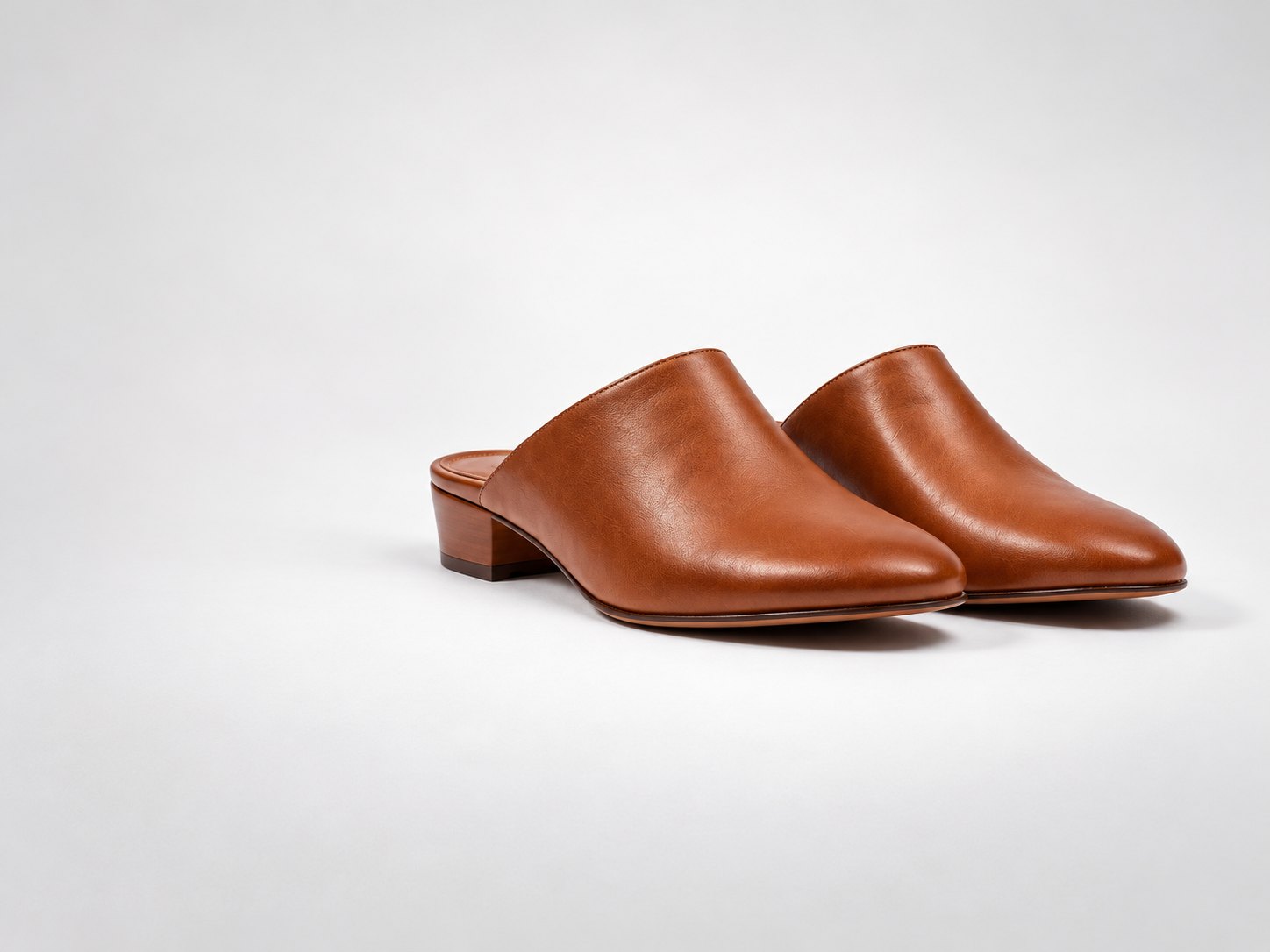
Aurevia's published product pages show both shapes side by side. The Cognac Leather Mule Shoes are an open-back mule in polished calf leather with a pointed toe and a low block heel, built on a leather-lined footbed. The Women's Black Leather Loafers use a 3.5 cm block heel and an almond toe, with a cushioned insole and a rubber outsole. Reading those two spec sheets together already shows a buyer where the tooling budget will go.
Size grading and half sizes decide the sample plan
Both Aurevia styles run from EU 35 to 41, and half sizes plus width options can be arranged for bulk orders after sample confirmation. Buyers should confirm the target market's size expectations before sampling, because a mule graded on a European last does not read the same on a US or UK size chart. Aurevia can also grade the pattern against a buyer's own size grid.
For an open-back shape the two sizes that matter most are the smallest and the largest. The smallest shows whether the opening grips without pinching; the largest shows whether the foot slides forward and drops the heel. Sampling only the middle size hides both failure modes, which is why a leather mule shoes manufacturer should be asked for an end-of-run sample set.
Leather selection and colour consistency across dye lots
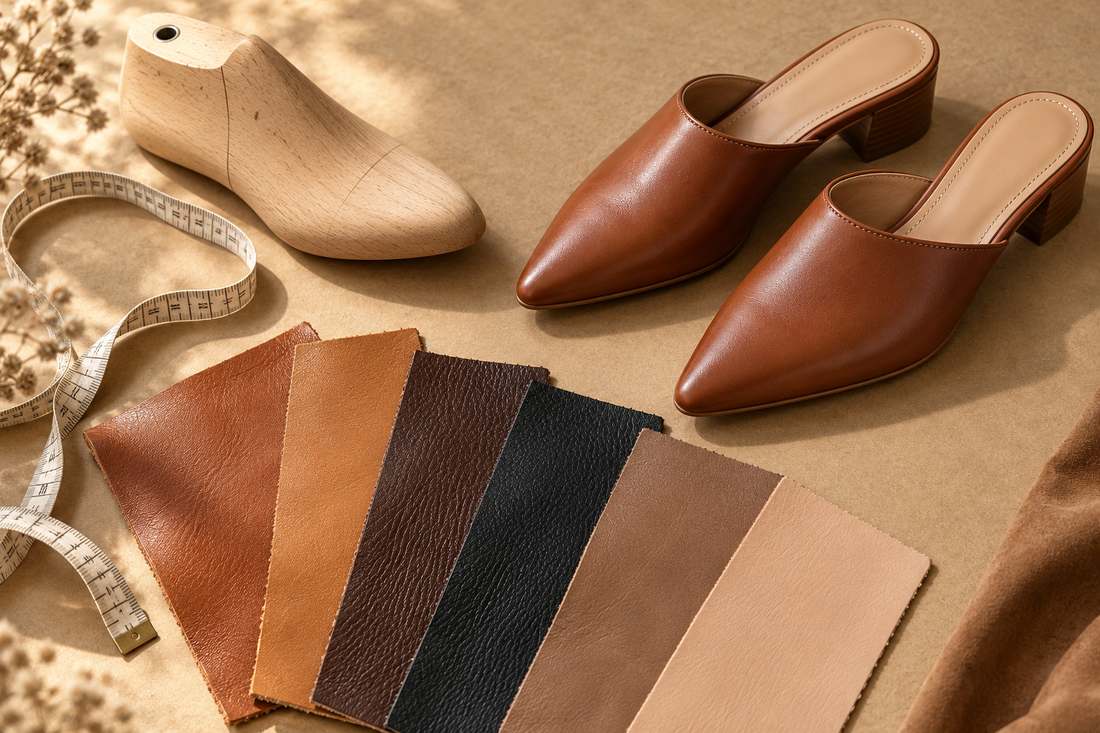
Most slip-on programs mix two finishes: a smooth polished calf for the dress side and a suede or nubuck for the casual side. Colour is where these programs break. A Pantone reference gives the tannery a target, but each dye lot can drift, so pair-to-pair matching matters more than the lab dip. Aurevia cuts left and right panels from matched hides so grain direction and shade stay aligned.
An open-back mule carries one extra visible surface: the footbed. That footbed is fully exposed and takes rubbing that a closed shoe hides, so buyers should specify its lining grade separately and inspect it at final check. The women's leather shoes collection shows how Aurevia presents these leather and finish differences across styles.
What to lock in the tech pack before the first sample
Aurevia's standard flow runs pattern grading, leather cutting, upper stitching, lasting, heel attachment, sole pressing, cooling, de-lasting, inspection and packing. Each step has inputs a buyer can still change cheaply before sampling and cannot change cheaply afterwards: last dimensions, topline tension, heel height, sole treatment, insole branding and packing format.
Existing samples ship in three to five days, while a bespoke sample built from a sketch, reference photo or tech pack takes about seven to twelve days after details are confirmed. That gap is short enough to make a vague brief expensive. A leather mule shoes manufacturer that receives a finished tech pack can quote and sample in one pass, which usually costs less than three rounds of correction.
Inspection points that catch slip-on failures
Every Aurevia bulk order passes three stages: incoming checks on leather thickness, colour and grain; in-line checks during stitching and lasting; and a finished-shoe inspection covering symmetry, bonding strength, cleanliness and packing accuracy. Random pairs are flex-tested at the forefoot and checked for colour fastness and heel attachment before shipment, and third-party inspection is welcome.
Buyers can add two slip-on specific checks. On mules, pull the topline gently and watch whether it returns to shape, because a stretched opening cannot be fixed by packing. On closed-back styles, flex the counter and confirm the heel seat stays bonded. Both checks take seconds and catch the returns that a general inspection misses.
Packaging, weights and trade terms
Aurevia's slip-on styles ship at roughly 0.55 to 0.6 kg per pair, in individual boxes carrying the buyer's logo, consolidated into export cartons of about twenty pairs. Terms can be quoted EXW, FOB or CIF, with shipments to Europe, North America and the Middle East. Carton counts and inner packing move landed cost more than unit price does, so buyers should settle the packing format before the price is fixed.
Private-label options worth specifying early
Aurevia supports OEM and ODM programs on both shapes: leather colour matched to a Pantone reference, heel height changes, insole branding, sole material changes, metal or fabric trims, private-label boxes and hangtags. Raising these points early with a leather mule shoes manufacturer matters because a heel height change moves the last and a sole change moves the press tooling.
The in-house design team turns a sketch, reference photo or tech pack into a production-ready sample in about seven to twelve days. For buyers building a capsule, the women's flats collection and the men's leather shoes collection show neighbouring shapes that share the same leather library, which helps when a range needs one consistent finish across several silhouettes.
Buyer questions that decide the order
Should a first order include both mules and loafers? Yes, when the two share a leather and a last family. A shared last halves the tooling cost, and a shared leather library keeps colours consistent across the range.
How many sizes should be sampled? At least three: the smallest, the middle and the largest of the run. For open-back mules the largest size is the one that exposes heel drop.
Which specification matters most? Topline tension on mules and the heel counter on closed-back styles. Neither is visible in a photo, and both decide whether the shoe stays on the foot.
Can a suede mule use the same last as a leather loafer? Yes, if lining thickness is adjusted. Suede and calf behave differently over the last, so the pattern allowance has to be confirmed at sampling.
Plan the slip-on range with Aurevia
Send the target market, the size run, quantities per colour, any half-size or width requirements, plus the packing and delivery terms the program needs. Aurevia Footwear Co., Ltd. confirms the specifications that apply to the order and quotes against them, working as a leather mule shoes manufacturer from either the cognac leather mule or the black leather loafer as the base style.