Vegan sandals OEM projects stall when buyer and factory use the same word for different claim scopes. This guide covers claim definition, non-leather material selection, the six-stage sampling path and the real MOQ stack.
Define "Vegan" Before You Define the Sandal
Vegan sandals OEM projects often stall in the second or third sample round because the buyer and the factory were using the same word to mean different things. Before any material is quoted, write down exactly what your claim covers: upper, lining, footbed, outsole, adhesives, dyes, thread, trims, and packaging. A sandal can use a plant-fibre upper and still fail your own standard because the cement, edge paint, or footbed foam contains an animal-derived additive.
Then state where the claim will be used. A European retailer, a North American direct-to-consumer brand, and a marketplace seller each apply different scrutiny. Ask the factory to confirm in writing which materials are free of animal-derived content and which are not — and to flag any component where it cannot confirm. That gap list is more useful at the start than a clean-looking summary.
Material Selection: Where Non-Leather Projects Are Won or Lost
Upper and footbed materials drive most of the cost and most of the claim questions. Ask any supplier which of these they genuinely produce at volume — and for which ones they only broker.
Textile uppers. Canvas and knitted fabrics are the workhorses of non-leather footwear. They take colour and print well and keep weight low, but stretch recovery and edge fraying on straps must be checked on physical swatches, not on a screen.
Jute and braided-fibre soles. Braided jute-wrapped soles are common on summer and espadrille constructions. Confirm how the braid is attached, what the base sole is made of, and how the edge behaves after repeated flexing and moisture exposure.
Knitted uppers with EVA midsoles. For sport-leaning silhouettes, a breathable knit upper over an EVA midsole is an established non-leather combination. Ask how the knit is sourced, how colour consistency between dye lots is controlled, and what density of EVA the footbed uses.
Two components get overlooked. Adhesives are the most common failure point in a vegan claim — water-based and hot-melt options exist, but they can change bond strength and cure time, which affects the production schedule. Packaging — inks, box glues, and any leather-look hangtag — is often left out of the brief and then flagged at review.
Cross-contamination matters if the same line also runs leather. Ask how the factory separates cutting, skiving, and stitching for non-leather orders, and whether it cleans down equipment or uses dedicated tables.
Matching the Spec to European and North American Requirements
You do not need a certification to sell vegan sandals, but you do need to satisfy the rules of the market you are entering. In the EU, restricted-substances and packaging rules apply regardless of the vegan claim. In the US, children's sandals fall under separate safety rules, and state-level chemical warning requirements may apply. Confirm the current scope with your own compliance or legal advisor — the practical point is to hand the factory a written testing scope early rather than after sampling.
Verification steps that hold up in a review:
- Request material declarations per component, not one blanket statement.
- Ask which third-party lab the factory uses and who pays for testing.
- Confirm the test standard and the specific parameters shown on the report.
- Check that the report matches the exact material and colour you intend to buy.
If a supplier cannot show animal-derived-content documentation for a component, treat that as unknown rather than assuming it is vegan — and record the gap in the tech pack.
The Sampling Process, Step by Step
A predictable sampling path has six stages.
- Brief and tech pack. Include the last or foot form, size range, strap widths, hardware, logo placement, packaging, and the vegan scope defined earlier.
- Material swatches. Approve colour, thickness, and hand feel physically, not from a screen.
- Prototype. A first sample to test construction and proportion.
- Fit sample. Worn in the correct size on real feet, checked for strap rub at the toe post, arch position, and heel hold.
- Sales or confirmation sample. The version shown to your buyers, in final colour and finish.
- Size grading and pre-production sample. Confirms the pattern holds across the full size run before bulk cutting.
Each round needs a written deadline and a named decision-maker on your side. The most common cause of delay is not the factory — it is the buyer approving a swatch late and then asking for an unchanged ship date.
MOQ: What Actually Drives the Number
MOQ on vegan sandals OEM orders is rarely a single figure. It is a stack:
- Material MOQ from the mill or non-leather material supplier, often quoted in metres or rolls and usually higher for custom colours.
- Colour MOQ per dye lot. Three colours can mean three commitments.
- Sole and tooling MOQ, if you need a new outsole, midsole, or embossed logo.
- Packaging MOQ, which is frequently the hidden ceiling on a small first order.
A factory may quote a style MOQ, a per-colour MOQ, and a total order MOQ. Confirm all three in writing. If your launch quantity sits below the material MOQ, ask about stock colours, existing lasts, or a shared material that keeps the first run small without changing the design. Expect a higher unit price at lower volume — that is normal, not a negotiating failure.
Cost Drivers and Avoidable Traps
The assumption that non-leather always costs less is the most expensive mistake in this category. A well-specified textile with reliable backing, a tested adhesive, and a consistent footbed foam can price close to mid-grade leather. Where you gain is in design freedom and consistency, not automatically in unit cost.
Other traps to watch:
- Colour drift between swatch and bulk. Approve against a physical standard and keep a retained sample.
- Tooling amortisation. Clarify whether a new sole mould is a one-time charge, a per-order charge, or amortised into the unit price.
- Substitution without notice. State in the purchase order that no material may be swapped without written approval.
- Claim inflation. Do not let marketing language promise a standard your bill of materials cannot support.
Verification Before You Commit to Bulk
- Freeze an approved sample and label it as the reference for production.
- Agree an inspection standard and sampling plan inside the purchase order.
- Confirm who inspects, at which stage, and what happens on a fail.
- Obtain the bill of materials in writing, with supplier names for the claim-critical components.
- Check labelling artwork against the claims you can actually substantiate.
Do not accept "vegan" as a verbal assurance in a chat thread. It needs to sit in the specification document both sides sign.
Questions to Ask Any Vegan Sandals OEM Supplier
Ask how they handle adhesives, how they separate leather and non-leather production, which lab they work with, what their per-colour MOQ is, how long a sampling round normally takes for your material set, and whether they will share a completed bill of materials. The answers tell you more than a product catalogue.
How Aurevia Approaches Non-Leather Programs
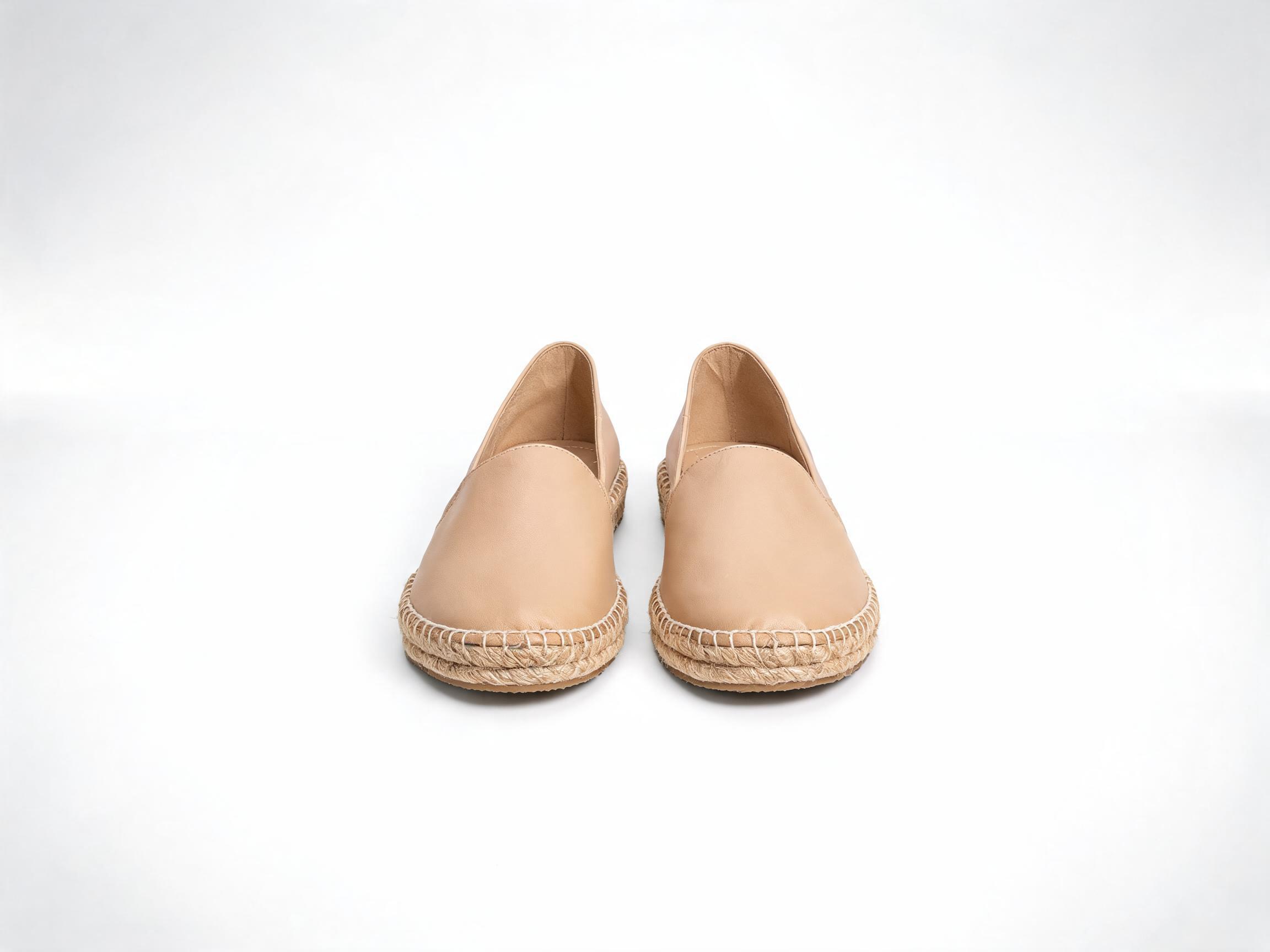
Aurevia Footwear Co., Ltd. is known for genuine leather craftsmanship, and the same OEM/ODM discipline carries into non-leather constructions the factory already produces — for example the beige espadrille flats with a lightweight canvas upper and braided jute-style sole, and the grey knit running sneakers pairing a breathable knit upper with an EVA midsole. For a vegan sandals OEM program, the team can review your claim scope, recommend which of these material systems fits your design, and quote with the style, colour and packaging MOQ broken out separately.
Next Step
Send your tech pack, target market, size range, and expected first-order quantity. Ask for a material recommendation, a sampling schedule with dated milestones, and a written MOQ breakdown by style, colour, and packaging. Compare two or three suppliers on those documents before you compare price.