
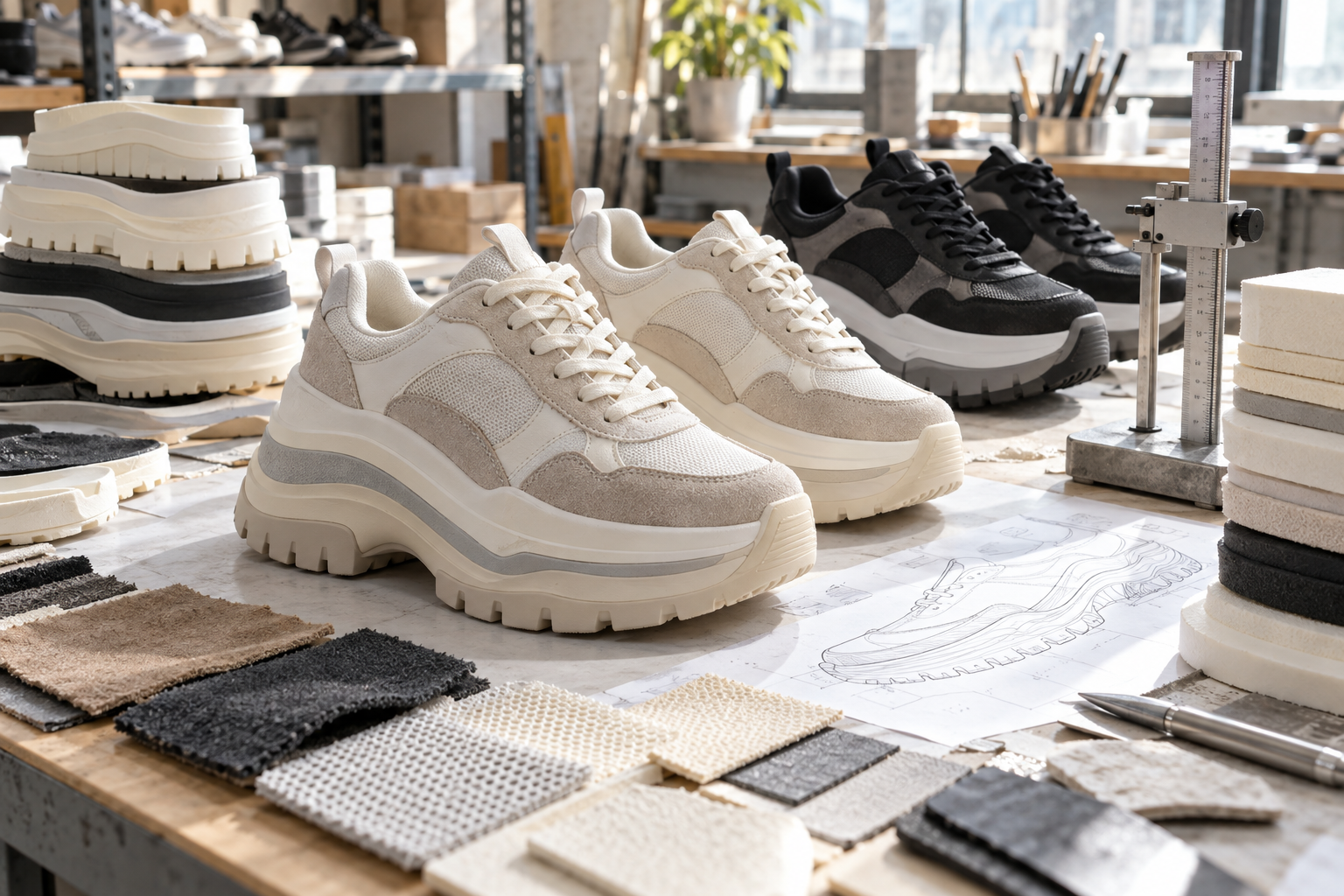
Platform Trainers: Sole Stacks Engineered, Not Stacked Up
Platform trainers with engineered sole stacks: layered platform units bonded and flex-tested so extra height keeps the flexibility buyers expect, from 200 pairs per color with spec sheets shared before deposit.
Discuss this solutionProgram facts you can verify
- OEM/ODM scope confirmed in writing before bulk production
- Private label support: logo, packaging and size grading
- Material, construction and finished-shoe inspection before shipment
- Confirmed ship dates stated in writing per order
Purchase decision helper
Select your requirements — we match them against our current published products and program rules.
Select options above to see matching products.
Matches are based on our current published catalog only.
Buyer pain points & our technical solution
The pain: platforms that look right on the shelf and fail on the foot
Platform trainers sell on height and silhouette, but the recurring buyer complaint is mechanical: a thick sole unit that was simply stacked — not bonded and flex-tested — separates at the layer lines, or turns every step into a rigid board. Returns follow the first rainy week, and the style that was supposed to carry the season becomes a discount item.
Our platform program treats the sole stack as an engineered part. Layered EVA platform units are bonded with specified adhesives, flex-tested per batch, and the stack height and density are written into the spec sheet you receive before bulk. Uppers are matched from our existing material library — suede, leather and knit combinations already validated on the platform last. The buyer value: a platform style with a documented sole system, not a showroom experiment.
Customer cases
Case — a North American streetwear label scaled its first platform style
Who: a streetwear label in North America launching its first platform style. What we delivered: suede-and-mesh platform trainers on a 4.5 cm layered stack with flex-test records. Problem solved: a supplier sample that separated at the layer line. Before: a rejected development pair after three weeks of wear. After: no layer-separation claims across 8,500 pairs in the launch program, per the label’s claim file. Data source: buyer claim file and flex-test records.
Case — a European multi-brand retailer avoided the rigid-sole return wave
Who: a European multi-brand retailer buying platform trainers for spring. What we delivered: leather platform trainers with a flex-grooved platform unit. Problem solved: customer complaints about stiff platform soles on a previous brand. Before: comfort-driven returns around 4% on the category. After: returns fell to about 1.5% across two seasons, per the retailer’s returns report. Data source: retailer returns report, shared with permission.
Case — a Middle East distributor spec-tested heat on platform units
Who: a distributor in the Middle East. What we delivered: platform trainers with a heat-check on bonded stacks per batch. Problem solved: adhesive softening in hot storage. Before: bonded units softening in one warehouse the prior year. After: no bond-related returns across two hot-season programs, per the distributor’s return records. Data source: distributor return records and per-batch test log.
Reviews & ratings
★★★★★
Scene: a label owner scaling a first platform style into repeat seasons
Verdict (record excerpt): The flex-test record per batch is the reason I stopped worrying about layer separation on reorders.
Verifiable result: no layer-separation claims across 8,500 pairs, per the claim file.
Source: buyer claim file (Michael, Procurement Lead, European retail chain), Aurevia partner archive
★★★★☆
Scene: a retailer buyer replacing a failed platform brand
Verdict (record excerpt): Stack height and density arriving as a written spec changed how our team compares platform suppliers.
Verifiable result: category returns fell from about 4% to about 1.5% across two seasons, per the returns report.
Source: retailer returns report (Sarah, Boutique Buyer, North America), Aurevia partner archive
Related products

Company strength
- Founded: 2011, based at No. 88 Jinjiang Industrial Zone, Quanzhou, Fujian, China.
- Team & factory: a 260-person team running cutting, stitching, lasting and QC from a modern footwear production workshop; minimum order is per color and confirmed per program.
- Capacity: roughly 120,000 pairs per month, with platform programs run on dedicated sole-bonding stations.
- Development: in-house sample room validates stack height, density and flex behavior before bulk on every new platform style.
- Export markets: programs shipped to buyers across Europe, North America and the Middle East; destination-specific packaging and labeling are handled per order.
Certificates & quality evidence
- Recorded checks: every platform trainers order passes per-stage production checks plus finished-shoe checks against international quality standards; platform bond and flex-test records are kept per batch in the certificate archive.
- Verifiable on request: the check list, flex-test records and spec sheets behind published lines can be requested before signing; we provide what exists and state clearly what does not.
- Honest boundary: we list only the checks recorded on this program; we do not claim certifications we do not hold, and we will confirm in writing what is on file before signing.
FAQ
What stack heights are available for platform trainers?
Validated stacks cover roughly 3.5–5 cm; the exact height, density and flex behavior are written into the spec sheet before bulk.
Can we supply our own platform design?
Yes — your sole drawing is reviewed for bond and flex feasibility; any required rework is quoted before development starts.
What is the MOQ for a platform program?
Programs start from 200 pairs per color; platform tooling or molds, if needed, are quoted separately before development.
How is the platform bond checked in bulk?
Bond strength and flex behavior are checked per batch, with records kept per production run.
Can buyers visit the sole-bonding stations?
Yes — line walks including the sole-bonding and QC stations can be arranged for serious programs.
Request a solution quotation
This inquiry carries the current solution page context, so our team can answer with the right program details.