
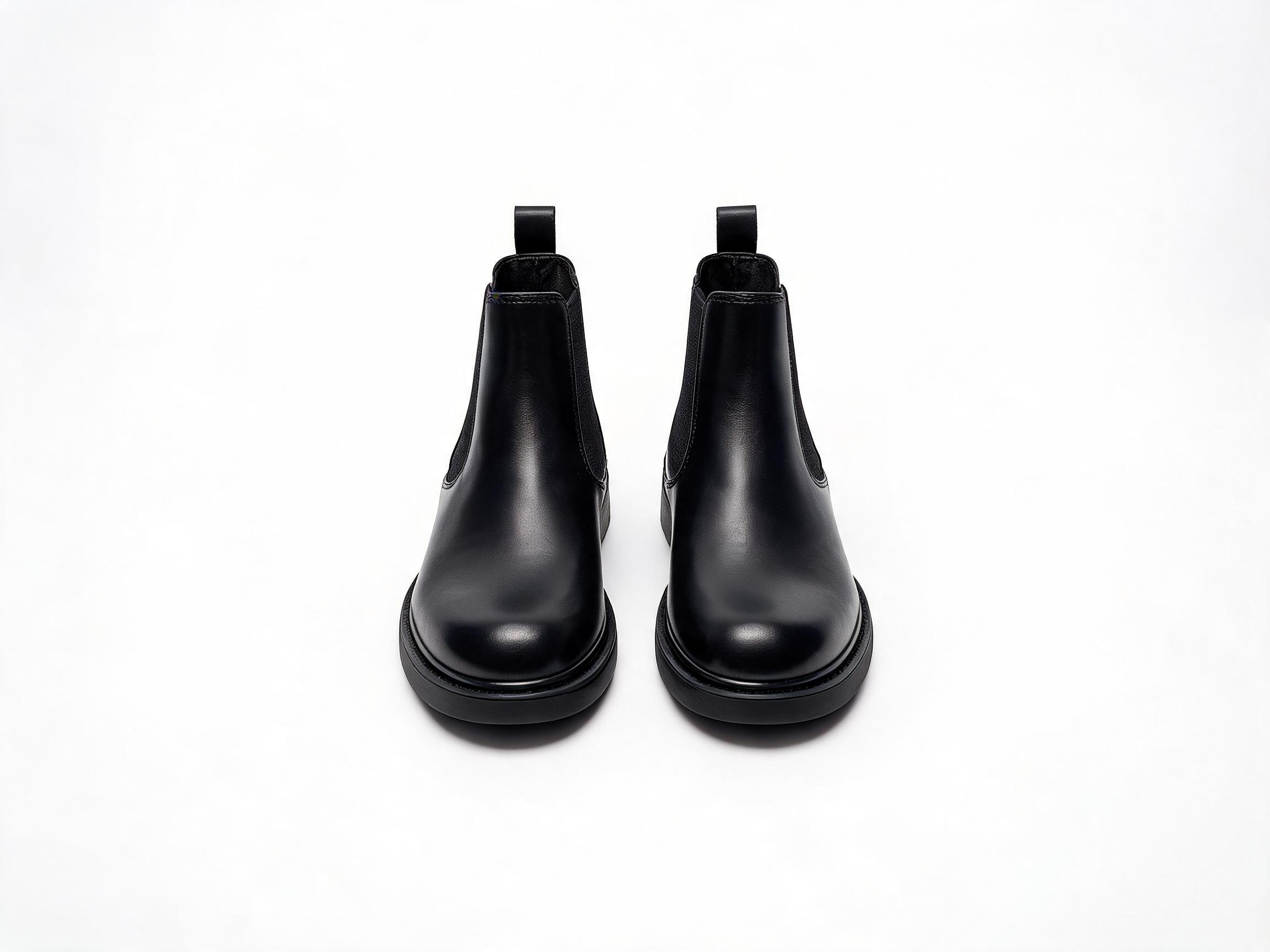
A Chelsea boot is defined by its elastic side gore, not its ankle height, so wholesale buyers need to inspect gore width, placement, stitch reinforcement and stretch recovery before approving a bulk run. This guide walks through leather upper cutting, lining choices, wear-level details, a Chelsea-specific QC checklist and the specifications to lock down before placing an order, using Aurevia's Black Chelsea Boot Shoes as a working example.
A Chelsea boot is not an ankle boot with an elastic panel added as an afterthought. The gore is the structure that lets the foot in and holds the ankle afterwards, and it is where most bulk-order problems show up first. Buyers sourcing Chelsea boots wholesale should treat the gore, the upper leather and the gusset stitching as the primary spec, not as details to be confirmed after the purchase order goes out.
What this guide covers
- How gore width, placement and gusset stitching decide entry ease and ankle hold.
- Why full-grain uppers are cut in matched pairs, and how to check grain direction and shade.
- Leather lining versus warm fabric lining for cold-season programs.
- A Chelsea-specific bulk QC checklist: gore recovery, gusset stitching, shaft height, sole bonding and forefoot flex.
- The three specifications to lock down before ordering: lining type, elastic color, size grid.
Aurevia Footwear Co., Ltd. is a B2B footwear manufacturer and exporter founded in 2011 in Quanzhou, China, working with a 260-person team on OEM, ODM and private-label programs. The Black Chelsea Boot Shoes model is used throughout this article as a running example: full-grain leather upper, twin elastic side gussets stitched with reinforced thread, a pull tab at the heel, leather or warm fabric lining, cushioned footbed and a stitched rubber outsole in a stitched-and-cemented build, offered in EU sizes 39-45 in black, brown or custom colors.
Elastic gore construction decides entry ease and ankle hold
The twin side gore is the functional core of a Chelsea boot. Everything else — the pull tab, the shaft height, the sole — supports a design whose basic proposition is that the boot goes on without laces and stays put once it is on. Two variables control whether that works.
The first is gore width. A wider elastic panel opens further, which makes the boot easier to put on and easier to fit across a broader range of insteps and ankle volumes. A narrower panel gives a tighter, more defined silhouette and a firmer hold, but it leaves less margin for error in the lasting and in the customer's fit. Because the gore is stitched to both the vamp and the back quarter, its width also has to be consistent from the left boot to the right; a pair where one gore is visibly wider than the other reads as a defect at retail even if both boots are technically wearable.
The second variable is placement. The gore sits between the vamp and the back quarter, and the seam positions determine how the boot flexes during entry. Gore set too far forward can bunch under the instep; set too far back it pulls against the heel counter. Buyers reviewing a sample should put the boot on and take it off several times rather than judging the gore from a photo, because entry resistance is a function of the whole opening, not the panel alone.
Reinforced stitching at the gusset edges is what keeps the elastic attached under repeated stretch. On the Black Chelsea Boot Shoes, the twin gussets are stitched with reinforced thread — ask specifically whether the stitching is reinforced at both the vamp seam and the back quarter seam, since stress concentrates at those two junctions.
Elastic color matching is a customization lever worth raising early. Black elastic on black leather reads as a technical, uniform-friendly boot; a contrasting gore turns the same pattern into a fashion item. Because the elastic is a purchased component, the color is a separate specification from the leather color, and it should be confirmed on the sample rather than assumed from the color name.
Finally, stretch recovery. Elastic that has lost its memory will not hold the ankle, and a boot that sags at the topline after a few weeks of wear is a return, not a fit preference. The practical sample test is simple: stretch the gore by hand several times, release it, and watch whether the panel returns to its original dimension and whether the topline stays flat. Repeat across both boots in the pair.
Leather uppers: cutting matched pairs, not matching panels
Full-grain leather keeps the outermost layer of the hide, so the surface is the grain itself rather than a corrected or coated finish. It takes a polish, creases into a visible roll across the forefoot, and ages in a way buyers of leather footwear expect. It is also a natural material, which is why the upper is the second place bulk orders diverge.
The sourcing question that matters is not whether a swatch says full-grain, but how the same hide behaves across a whole bulk run. Leather varies from hide to hide and from batch to batch, so the practical checks are cutting discipline and shade control rather than the name on the specification sheet.
First, matched-pair cutting. The left and right boot of a pair should be cut from compatible areas of the same hide, or from hides selected together, so that grain direction and shade agree when the pair sits side by side in daylight. Ask the factory to confirm in writing how pairs are matched. A single mismatched pair is easy to fix at sample stage; across a bulk run it becomes a rework and returns problem.
Second, grain direction. On a Chelsea boot the panels around the gore and the heel counter are small and oddly shaped, which makes grain direction easy to get wrong. When grain runs in different directions across the two boots of a pair, they can polish and crease differently over months of wear. On the sample, compare the two boots under a raking light and look at how the surface reflects.
Third, batch shade control. A bulk order usually draws from more than one leather batch, so ask how the factory keeps shade consistent between the first carton and the last: how many batches go into a single order, whether uppers are sorted by shade before assembly, and what the color is approved against. A physical approved swatch, not a screen, should be the standard on both sides.
Lining options for cold-season and year-round programs
The Black Chelsea Boot Shoes can be built with a leather lining or a warm fabric lining, and that choice shapes who the boot sells to. The trade-offs run in opposite directions, so decide the lining before the sample rather than after.
| Lining option | What it delivers | Where it fits best |
|---|---|---|
| Leather lining | Breathable interior, premium hand-feel, consistent with a genuine-leather story on the label | Year-round and dressier Chelsea programs, upper-tier retail |
| Warm fabric lining | Insulation for cold-weather wear, softer first touch, a different material cost tier | Autumn/winter collections and colder markets such as northern Europe and North America |
One caution: a warm lining changes the interior volume of the boot, so the same last can fit differently with each lining. If you plan to offer both versions, ask for both to be sampled on the same last and confirm the fit of each before approving bulk.
Wear-level details buyers should still check
Two details look minor and are not. The pull tab at the heel is the first thing a customer uses and the first thing to tear off if the anchoring is weak. On the sample, pull the tab firmly a few times and check that the anchoring stitches sit inside the topline seam rather than on top of it. Second, the sole. A stitched rubber outsole, as on the running example, gives a visible stitch row at the sole edge and a better chance of resoling later; check that the stitching is even all the way around and does not cut into the upper, and that the bond between sole and upper shows no gaps at the toe or heel.
A Chelsea-specific bulk QC checklist
Generic boot inspection covers most of it, but five checkpoints are specific to how a Chelsea boot is built and fail:
- Gore stretch and recovery. Stretch both gussets by hand several times and confirm the elastic returns to its original width and the topline stays flat. Do it on both boots, because one tired elastic panel is enough to reject a pair.
- Gusset stitching. Inspect the stitching at both ends of each gore — the vamp seam and the back-quarter seam — for skipped or loose stitches. These are the two stress points.
- Shaft height consistency. Compare the topline height across several pairs from the same carton. Small last or pattern differences show up as a batch that sits at slightly different heights, which is obvious on a retail shelf.
- Sole bonding. On a stitched-and-cemented build, check the full sole edge for even stitching and a continuous bond line, paying attention to the toe and heel where stress concentrates.
- Forefoot flex. Flex each boot along the natural ball line. The stitched sole and the upper should move together without a hard crease or cracking at the vamp.
Run the same checklist the same way at the sample stage and at final inspection. If your team works to a written specification, share it with the factory before production starts so both sides measure the same things.
What to specify before placing the order
Three specifications decide most Chelsea boot programs, and all three are cheaper to fix on paper than in production. Lining type: leather or warm fabric, because it changes fit, cost tier and the season the boot sells in. Elastic color: confirm it on the sample, since it is a purchased component with its own lead time and reads differently against the leather color. Size grid: give the factory the market and the size range you sell — the running example runs EU 39-45 with US and UK conversions on request — so the pattern is graded for your market rather than assumed.
With those three locked, send your reference boot or technical drawings, the branding requirements, and your quality expectations in writing. A factory running staged inspection — incoming material, in-line and finished-shoe checks, with reports shared on request and third-party inspection welcome — can then be judged on evidence rather than promises, which is the fastest route to a Chelsea boot program that reorders instead of returns.