A supplier-evaluation checklist for wholesale and private-label buyers sourcing braided espadrille wedges from China. Covers braid alignment, wedge structure and sole construction, sizing, sampling and lead times, plus the trade terms that decide whether a factory can carry a repeat program.
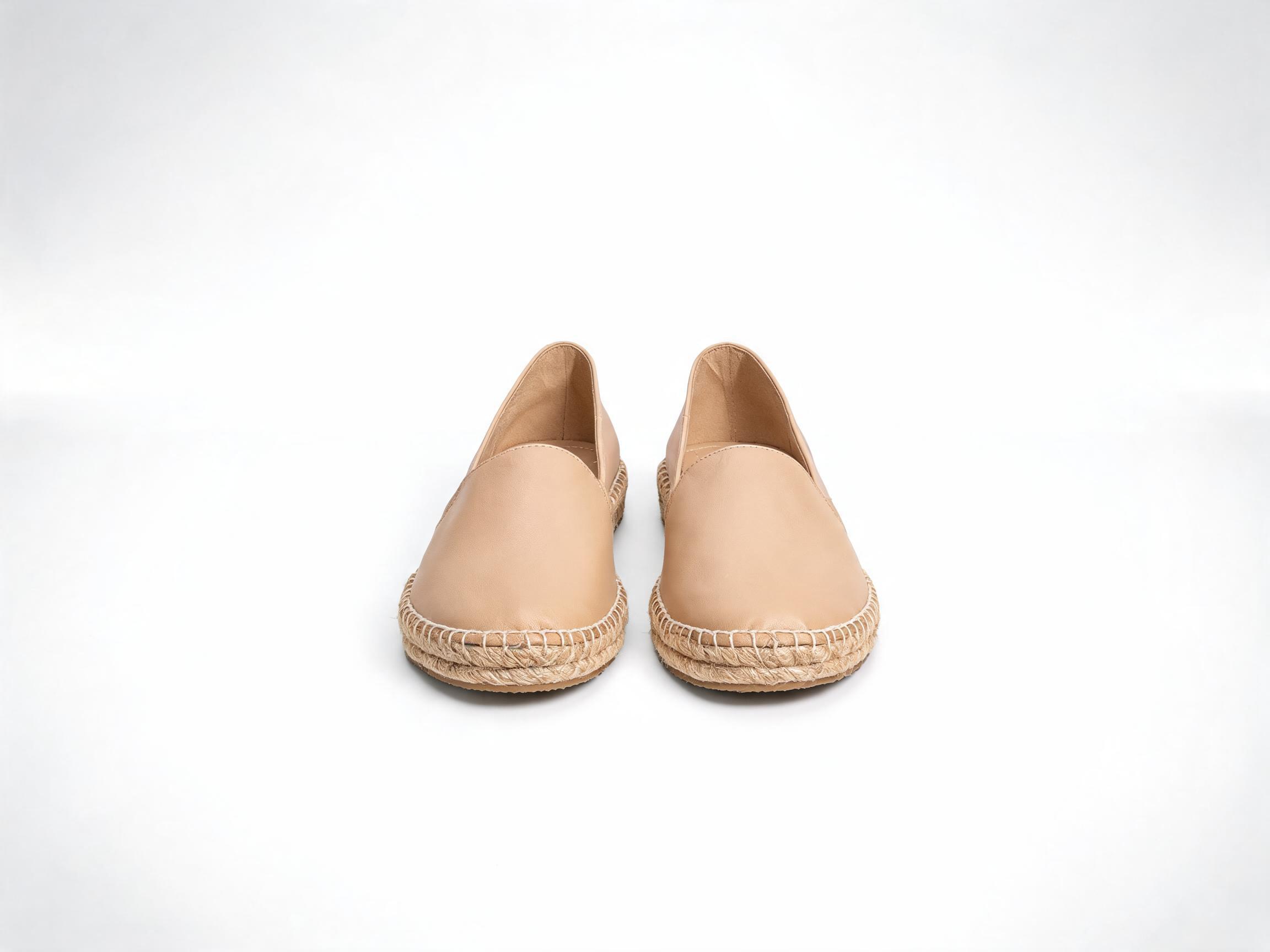
Braided wedges look simple in a product photo and behave differently on a production line. The braid has to stay level around a curved edge, the wedge has to hold its shape under the ball of the foot, and the factory has to be able to repeat both when your reorder lands in the middle of peak season. This guide sets out what wholesale and private-label buyers can actually check before placing an order with a Chinese espadrille wedge factory, using our own beige espadrille flats construction as the reference point for how these details are built and inspected.
What this evaluation covers
- Reading a braided wedge sample properly
- Braid consistency along the edge
- Wedge and sole structure
- Upper material and sizing
- Seasonal capacity and order timing
- Trade terms and export coverage
- Questions to send before you confirm
Start with the sample, not the catalogue
A braided-wedge program lives or dies on the sample stage. Catalogue images are usually shot on one perfect pair, and factories across the category can produce a convincing hero photo. What matters is whether the pair in your hands shows the same braid tension on the left and right shoe, whether the wedge sits level when you place it on a flat surface, and whether the forefoot bends without the sole edge separating from the upper.
Our espadrille lines run on a sample window of 7–12 days. That is long enough for a factory to build the pair on the actual last and the actual braid specification rather than pulling something from stock. When you receive the sample, work through it in this order: braid, then wedge geometry, then upper and lining, then flex and adhesion.
Braid consistency: what to look at
The braid edge on an espadrille wedge is the visible quality signal for the whole product, and it is also the hardest element to keep uniform. On our beige espadrille flats, the braid edge is hand-aligned to the jute-wrapped sole. Hand alignment is what allows the braid to follow the curve of a wedge profile without pulling tight on the outside of the curve and loose on the inside.
When assessing a sample, check the braid for:
- Even pitch — the gap between successive braid turns should be consistent around the entire edge, including the tight radius at the toe and the heel curve.
- Consistent tension — the braid should sit flat against the sole without lifting at the sides or creating puckers where the turn radius changes.
- Matched left and right — place both shoes side by side. The braid row count and the position where the braid meets the sole should mirror each other.
- Clean terminations — look at where the braid starts and finishes. Loose or glued-down ends tend to fail first.
A factory that hand-aligns braid per pair has to train for this. It is fair to ask how the edge is aligned, whether the same operator group handles the espadrille line, and whether you can see braid from the first production run rather than only the pre-production sample.
Wedge and sole structure
The structural story sits under the braid. Our beige espadrille flats use a jute-wrapped sole with a rubber base, joined by cemented construction. Those three elements do different jobs:
| Component | Function in the product | What buyers typically verify |
|---|---|---|
| Jute-wrapped sole | Carries the braid and gives the espadrille edge | Wrap tightness, even coverage, no gaps under the braid |
| Rubber base | Provides the ground-contact layer | Bond line to the jute layer, edge cleanliness |
| Cemented construction | Joins upper and sole assembly | Sole adhesion under flex, no separation at the ball |
Cemented construction is common across the category, and its failure mode is predictable: the sole starts to lift at the forefoot, where the shoe flexes most. That is why a forefoot flex check belongs in your inspection list, not only a visual pass. Our three-stage inspection includes a forefoot flex test and a sole adhesion check, and if you are building your own QC plan, those two are the checks worth replicating on your side.
Ask whether the wedge height is built on a dedicated mould or last, and whether the factory keeps tooling per size. A wedge that looks correct at EU 37 can look compressed at EU 41 if the tooling is not graded.
Upper material and sizing
The upper on our beige espadrille flats is pre-shrunk canvas. Pre-shrinking matters for a repeat program because it reduces the chance that the upper changes dimension between sample approval and bulk production, which would otherwise show up as a fit complaint after the goods ship.
Sizing runs EU 35–41 on this style. For EU, North American and Middle East accounts, the practical point is whether the factory can hold the size set you actually sell. Confirm the size breakdown per colour before you confirm the order, and ask how the factory handles half sizes or size runs if your market needs them. Compare the sample at the smallest and largest sizes in your range, not only at the mid size.
Seasonal capacity and order timing
Espadrille and braided wedges are a seasonal category. Buying calendars in Europe, North America and the Middle East do not peak at the same time, and a factory's capacity in March is not the same as its capacity in June. The useful question is not "what is your capacity?" but "what does your schedule look like for my delivery window?"
For reference, our quoted lead time is 25–35 days after order confirmation, following a 7–12 day sample stage. Build your calendar backwards from that: sample approval, order confirmation, production, and shipping terms all consume different amounts of time.
Timing checklist for a seasonal wedge program
- Book the sample stage with enough room to request one revision — braid alignment and fit are the two things most often adjusted.
- Confirm the production slot before your buying window closes, not after.
- Ask what happens if the sample is approved late; the slot may or may not move.
- Request the braid and flex checks at the start of production, not only at final inspection.
Trade terms and export coverage
Our trade terms are EXW, FOB and CIF, and we export to Europe, North America and the Middle East. Which term you choose affects where your risk and cost sit rather than the product itself, so it is worth agreeing on the term at quotation stage, alongside the size and colour breakdown.
If you are also developing custom runs, the custom espadrille program is handled separately from the stock-construction styles described here. This article is about evaluating the factory and the base construction; custom development adds its own set of questions.
Questions to send before you confirm
A short, targeted list gets a more useful reply than a long one. These are the points that most often change a buying decision on braided wedges:
- How is the braid edge aligned, and is it matched left to right?
- Can I see braid from the first production run?
- What forefoot flex and sole adhesion checks does your inspection include?
- Which size set and colour breakdown can you hold for my delivery window?
- What is the MOQ for this style and colour — confirm MOQ with the factory per style, as it varies by construction and colour.
- Which trade term are you quoting?
MOQ is not a fixed number across styles. Because it changes with construction and colourway, treat it as a per-style confirmation rather than a published figure.
The bottom line
Evaluating a braided-wedge factory comes down to three repeatable questions: can the braid be held level around a curved edge, is the wedge and sole assembly checked where it actually fails, and can the factory deliver inside your season. Everything else — trade terms, sizing, packaging — can be settled around those three answers. Start with a sample, inspect the forefoot flex and the braid alignment yourself, and confirm MOQ per style before you commit to a program.