
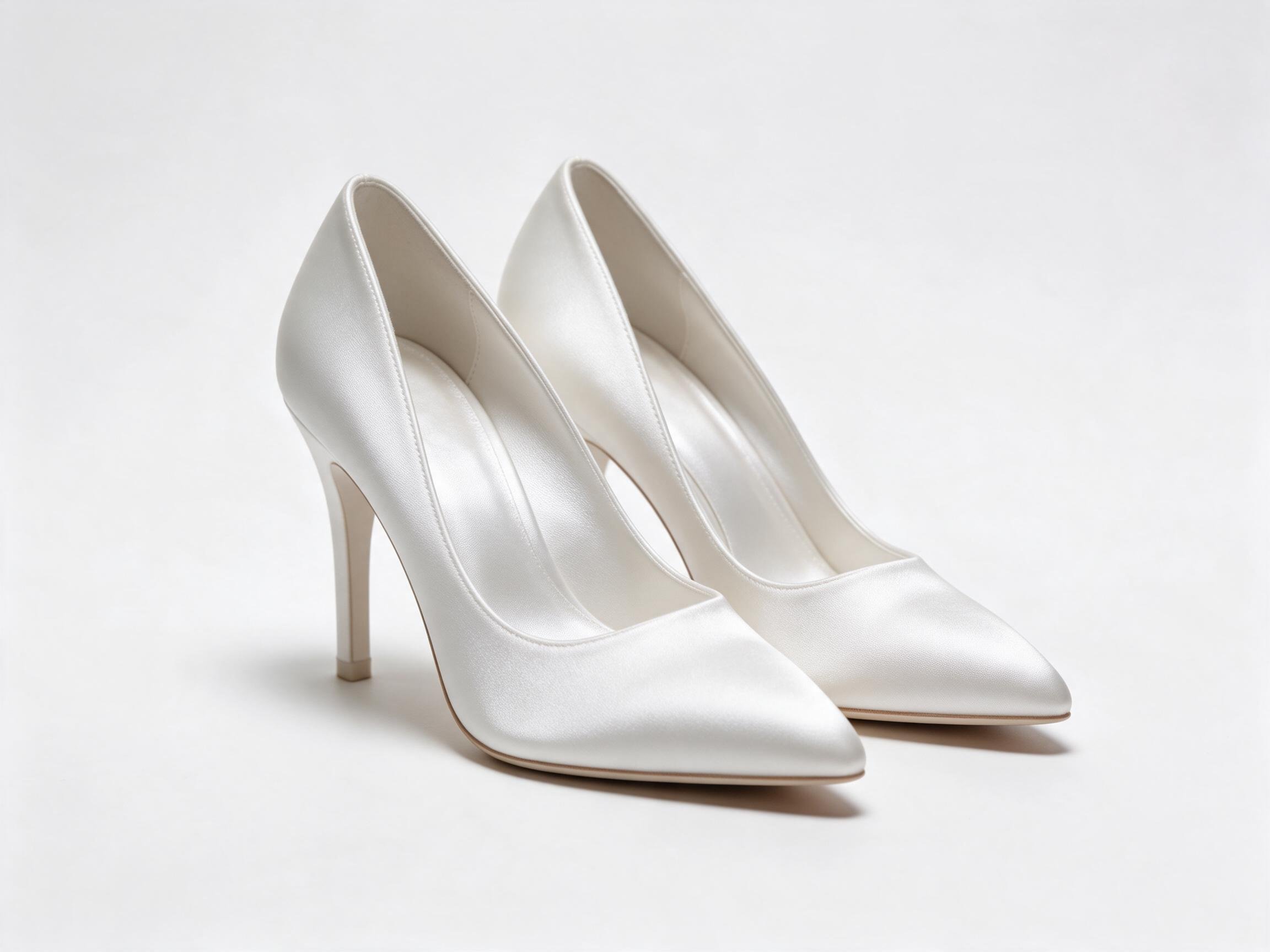
A buyer's evaluation framework for wedding shoes manufacturers, covering satin handling checkpoints, small-batch colorway and Pantone matching, the OEM sampling flow with realistic timing, and how to sanity-check MOQ and lead time before placing a first order.
Bridal and occasion-wear buyers usually start their search for a wedding shoes manufacturer by looking at photos. That is also where most evaluation mistakes begin. Photos do not show how a satin vamp behaves after lasting, whether a shade can be repeated across a 100-pair run, or how long a customized sample actually takes. This article sets out the checkpoints worth putting in front of a supplier before you place a first order.
Key takeaways
- Satin is the hardest material to keep consistent on a wedding shoe. Ask specifically how panels are matched and how tension is set during lasting.
- Small-batch colorways depend on a Pantone-based reference system, not on photos or verbal shade names.
- Existing samples and customized samples run on different clocks: roughly 3-5 days versus 7-12 days after details are confirmed.
- Treat published MOQ and lead time as spec-sheet figures and reconfirm both with the sales team before you commit.
Why satin makes the manufacturer choice matter more than the design brief
Most wedding shoe designs are simple: a pointed toe, a slim heel, a clean vamp. What separates one finished pair from another is not the sketch, it is how the factory handles the upper material.
Satin reflects light directionally. Two panels cut from the same roll can read as different shades when they are turned at different angles, and a shoe that looked correct in a tabletop photo can look uneven on a bride's foot under event lighting. A stiletto heel also places tension across the vamp that a flat-lasted shoe never sees, so the way the upper is pulled and fixed matters to whether the toe line stays smooth.
That is why the manufacturing question is not "can you make this design?" but "how do you control these two variables?" Any factory can cut satin. Fewer can tell you, in concrete terms, what they do so the left and right shoe match and the vamp does not ripple.
Satin handling: four checkpoints worth asking about directly
1. Panel matching across the pair
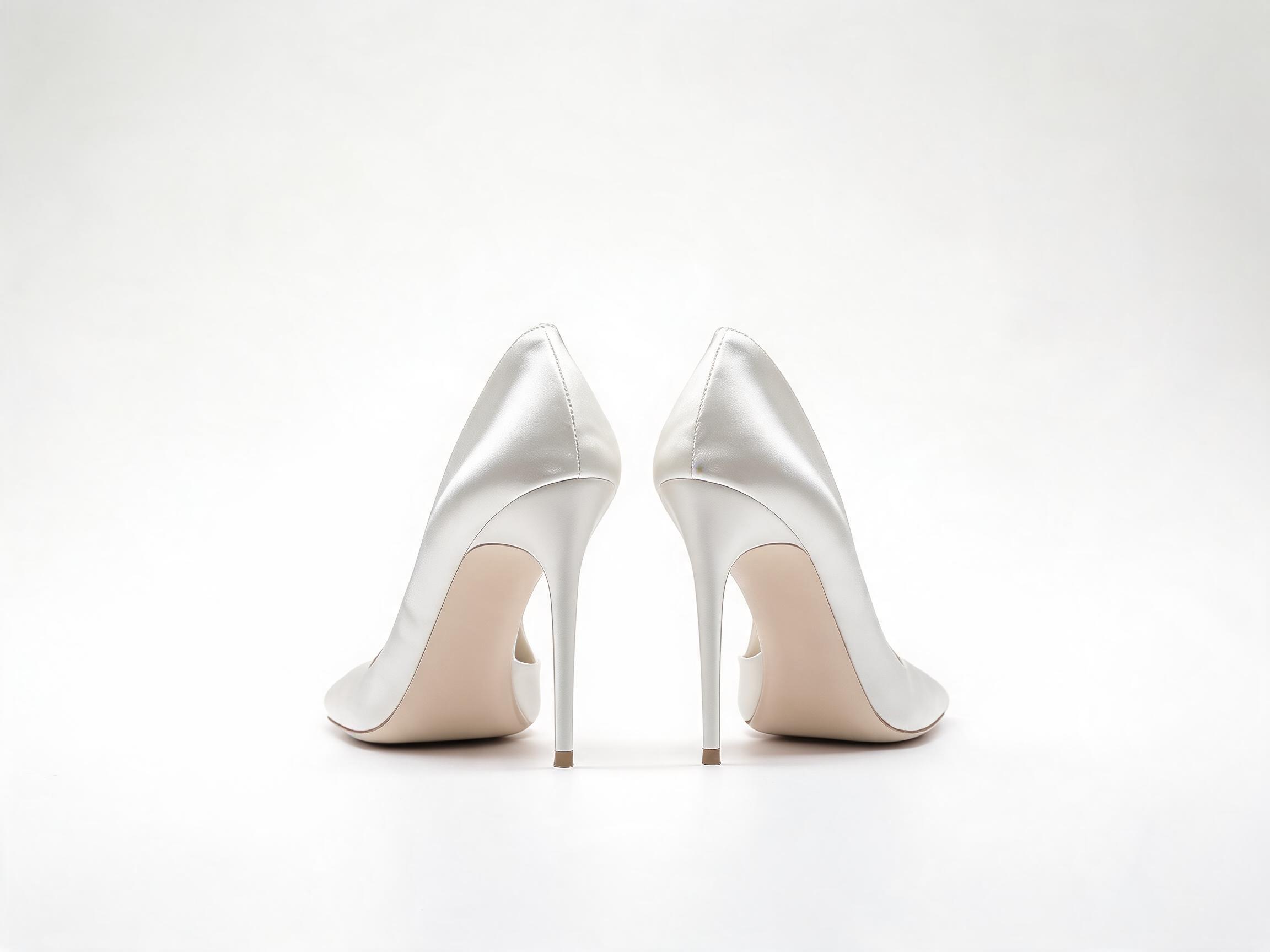
Ask whether satin panels for a single pair are cut from matched material so that the left and right shoe share the same sheen and shade. This is a cutting-room discipline, not a finishing step — once the upper is closed, uneven sheen cannot be corrected without remaking the pair. On a reference product such as Aurevia's white satin wedding heels, which use a Duchess satin upper, this matching is stated as part of the construction rather than left to batch luck.
When you visit or audit, ask to see the cutting process rather than the finished shoe. Whether panels are laid, nested and marked as pair sets tells you more than any sample photograph.
2. Lasting tension set by hand
The vamp line is where cheap construction shows. If the upper is pulled too loosely, the satin wrinkles above the toe; if it is over-pulled, the toe box distorts and the heel seat may not sit cleanly. Lasting operators on heel lines typically adjust tension by hand to bring the upper into a smooth vamp line — this is the step that absorbs the natural variation in satin's stretch behaviour.
Practical question for a supplier: who lasts your satin styles, how long have they been on the line, and is lasting tension adjusted per pair or set once per batch? A factory running dedicated women's heel lines will have a concrete answer on hand: ask to see the lasting stations for heel styles in production and how tension is recorded per pair on your reference style.
3. The heel as a structural component, not a styling detail
Bridal heels at bridal heights carry a bending load that a lower heel does not. Check whether the heel has a reinforced core inside it, and check the outsole detail at the heel tip — a rubber-tipped anti-slip outsole is the difference between a shoe a bride can walk in on polished floors and one she cannot. On the white satin reference style, the heel is approximately 8 cm with a reinforced core and a rubber-tipped anti-slip outsole.
4. Sizing and conversion support
Bridal retail usually needs more size coverage at both ends than everyday fashion. Confirm the size range up front. The reference style runs EU 34-41 / US 4-10, with US/UK conversions available on request — a small detail that saves your retail partners a lot of fitting complaints.
Small-batch colorways: how the shade gets agreed, not just chosen
Wedding and occasion-wear collections rarely ship in one color. White, ivory and blush are the baseline, with custom shades layered on top for seasonal or retailer-specific ranges. The commercial risk is not choosing a color; it is agreeing on a color in a way both sides can reproduce next season.
Ask the manufacturer how colors are specified. A workable answer names a reference system — satin color matching to a Pantone reference, for example — rather than describe the shade as "soft white" or send a photo taken on a phone. Photo-based shade approval fails because camera white balance, screen calibration and studio lighting each move the result.
| What to establish | What a clear answer looks like |
|---|---|
| Standard shades offered | Named base colors — white, ivory, blush — plus a defined custom shade route |
| How a custom shade is specified | A Pantone reference agreed in writing before sampling |
| What the buyer approves | A physical swatch or sample shoe, not a photograph |
| Per-color order threshold | A stated MOQ per color, confirmed against your own buy plan |
The fourth row matters commercially. On the reference spec sheet, the MOQ is 100 pairs per color — so each colorway must reach that threshold on its own, and a five-color program means five separate per-color minimums, one for every shade you carry. Plan your color count against your buy quantities before you ask for pricing, not after.
OEM sampling: two different clocks
Sampling is where most first orders lose time, and usually because buyer and supplier were working from different timelines. There are two distinct sample paths, and they should be discussed separately.
Existing samples
If the factory already produces a suitable style, existing samples can typically ship within 3-5 days. This is the fastest way to assess construction quality — satin sheen, vamp line, heel balance, insole padding — before you invest in customization.
Customized samples
When you need a custom shade, a different heel height, insole branding, logo boxes or hangtags, the sample has to be built. In this flow, customized samples are ready in about 7-12 days after details are confirmed. The phrase "after details are confirmed" does the heavy lifting: the clock starts when the Pantone reference, the specification and the branding artwork are all agreed, not when the enquiry is sent.
- Send the spec. Style, Pantone reference, size run, heel height change if any, branding requirements.
- Confirm details in writing. Both sides sign off on exactly what the sample will be.
- Sample build. About 7-12 days in the customized path.
- Physical review. Approve the sample in hand, and keep it as the production reference.
One discipline worth adopting: keep the approved sample sealed and treat it as the contractual reference. It resolves far more disputes than any written description of a shade.
MOQ and lead time: the numbers to reconfirm
Published figures are a starting point for planning, not a quotation. The spec sheet for the white satin wedding heel lists an MOQ of 100 pairs per color and a lead time of 25-35 days after order confirmation. Those are the numbers to build a plan around, and the figures to put in front of the sales team when you request pricing.
Two practical notes. First, the MOQ is per color, so your total order volume depends on how many colorways you carry. Second, lead time is measured from order confirmation — which includes deposit, approved sample and confirmed spec. If any of those is still open, the clock has not started.
Because production scheduling and material availability change, confirm current MOQ and lead time with the sales team before you place the order rather than relying on any published table, including the one on this page.
| Item | Spec-sheet figure |
|---|---|
| MOQ | 100 pairs per color |
| Lead time | 25-35 days after order confirmation |
| Existing sample dispatch | 3-5 days |
| Customized sample | About 7-12 days after details are confirmed |
| Packaging | Gift box plus export carton |
Putting the checklist together
For a bridal or occasion-wear buyer, a wedding shoes manufacturer is worth shortlisting when it can answer four things without hedging: how satin panels are matched across a pair, how lasting tension is controlled on heel styles, how a custom shade is specified against a reference system, and what the realistic sampling timeline looks like for a customized build.
Aurevia Footwear Co., Ltd. has been based in Quanzhou since 2011, with a 260-person team and export experience across Europe, North America and the Middle East. The company runs dedicated women's heel lines, and the white satin wedding heel style referenced throughout this article is a useful starting point for evaluating construction, colorway and sampling in one conversation — see the white satin wedding heels product page for its full specification.
If you are building a first bridal range, the most useful next step is a short written brief: target colorways, Pantone references where you have them, size run, branding needs and your expected quantities per color. That lets the sampling question — existing sample or customized build — be answered precisely, and gives you a concrete basis for confirming current MOQ and lead time.