A stage-by-stage walkthrough of what a custom shoes manufacturer actually does between receiving your tech pack and signing off the production sample. Using real men's dress-shoe constructions—cap-toe oxfords, double monk straps, and derby open lacing—we show what must be decided, documented, and approved at each handoff.
When a buyer sends a tech pack to a custom shoes manufacturer, the factory does not simply "make the shoe." It translates a document into a last, a pattern, a material order, and a series of samples. Each stage decides something the next stage depends on. Skip or blur a stage, and the approved production sample will not match what you thought you ordered.
This article walks through that sequence for men's dress shoes, using three constructions that behave differently at each handoff: a black cap-toe oxford, a tan double monk strap, and brown derby dress shoes. The point is not to prescribe one factory's process but to show what a capable custom shoe manufacturing partner should be able to confirm at every step.
Key takeaways
- A tech pack must specify construction type, last dimensions, material references, hardware, branding placement, and size range—not just a sketch.
- Pattern and last confirmation come before any upper is cut; a change here resets the sample clock.
- Material and hardware selection includes color matching to your Pantone reference and, for monk straps, buckle corrosion testing.
- Sample rounds are for locking details, not for discovering missing information.
- Style-specific construction details—cap-toe seam, derby open lacing, double buckle straps—must be called out explicitly because they change the pattern, the fit range, and the QC checklist.
What a tech pack must contain
A tech pack is the buyer's instruction set. For dress shoes, a pack that a factory can actually build from includes:
- Construction type: oxford (closed lacing), derby (open lacing), monk strap, loafer, or boot. This is not a style preference—it determines the pattern blocking and the fit range.
- Last reference or dimensions: if you have a last, provide its measurements; if not, specify target fit (e.g., standard D width) and the factory will propose a last for confirmation.
- Upper material: leather type (full-grain, corrected-grain, suede), finish (polished, burnished), and color reference. A Pantone code is the clearest way to communicate color.
- Lining and footbed: leather lining, cushioned leather footbed, or synthetic alternatives, with branding placement if any.
- Sole: leather, rubber, or combination; stitched or cemented; heel height (e.g., approx 3 cm).
- Hardware and trims: buckle type and finish for monk straps, eyelets, laces, metal or fabric trims.
- Branding: insole logo, outsole stamp, hangtag, private-label box.
- Size range: e.g., EU 39–45 / US 6.5–12, with any width variations.
If any of these are missing, the factory will either ask or assume. Assumptions are where sample rounds multiply. A well-prepared pack does not need to be long, but it must be specific enough that two pattern makers would read it the same way.
Pattern and last confirmation
The last is the foot form around which the shoe is built. The pattern is the set of cut shapes that become the upper. Both must be confirmed before any upper leather is cut.
For a cap-toe oxford, the cap-toe seam position is a pattern decision. It affects the visual balance of the shoe and, because the seam is stitched by hand on models like the black cap-toe oxford, it also affects how the upper is assembled. The factory should provide a drawing or a trial upper showing the seam line before proceeding.
For a derby, the open-lacing construction means the quarters sit on top of the vamp. This changes the pattern blocking compared with an oxford and also gives a wider fit range, which is why derbies are often chosen for buyers who need to accommodate more foot shapes. The last still needs confirmation, but the pattern will differ from an oxford on the same last.
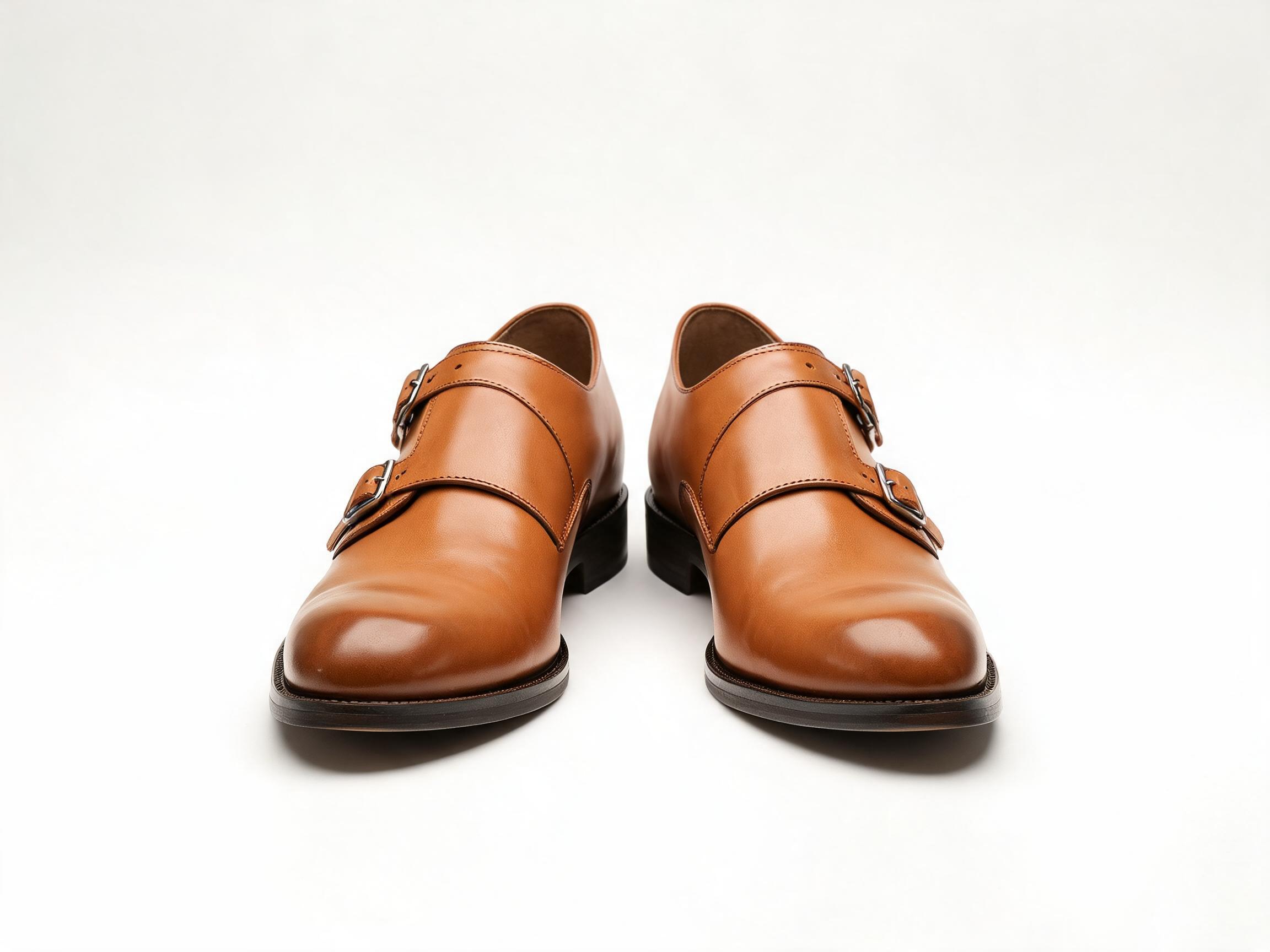
For a double monk strap, the pattern must account for the strap placement and the buckle anchors. The straps cross the instep, so their length and the position of the buckle holes are set at this stage. If the straps are patterned after the upper is closed, the sample will not sit correctly.
At the end of this stage, the buyer should have:
- A confirmed last (or a last specification sheet).
- Pattern drawings or a trial upper showing seam lines and strap positions.
- Written confirmation of the fit range and any width options.
Changes after this point usually require a new pattern and a new sample round.
Material and hardware selection
Material selection is where color and hand-feel are locked. A custom shoes manufacturer should be able to match leather color to your Pantone reference, but the match is to a reference, not a guarantee of an exact spectral match under all lighting. The factory should show you a physical swatch or a sample cutting for approval before bulk leather is ordered.
For the tan double monk strap, the burnished full-grain leather has a two-tone effect that depends on the finishing process. The burnishing is done on the finished upper, so the base leather color and the burnish intensity both need to be confirmed. The buckle hardware is a separate decision: the double buckle straps use metal buckles, and the factory should confirm that the buckle hardware has been tested for corrosion resistance. This is a functional requirement, not only a cosmetic one—buckles that corrode will fail in the field.
For the black cap-toe oxford, the polished full-grain leather and the leather lining are the main material decisions. The sole is stitched leather/rubber with a rubber insert, so the sole material and the stitching specification should be confirmed here. The cushioned leather footbed is also specified at this stage, including any branding.
For the brown derby dress shoes, the polished full-grain leather and stitched rubber sole are the key selections. The derby's open lacing means the eyelet facings are on top, so the eyelet type and finish are visible and should be chosen with the laces.
OEM options at this stage typically include leather color matching to your Pantone reference, sole material changes, insole branding, metal or fabric trims, and private-label boxes and hangtags. These should be listed in the sample request so they are included in the first round.
Sample rounds and what to lock at approval
Sampling is not a single event. It is a sequence of approvals, and each round should have a defined purpose.
Existing samples (models the factory already makes) are typically available in 3–5 days. Customized samples, where the factory builds from your tech pack, take about 7–12 days after details are confirmed. The difference is the pattern and material preparation.
A sensible sample plan for a dress-shoe program looks like this:
| Round | Purpose | What to lock |
|---|---|---|
| 1st sample | Confirm construction and fit on the confirmed last | Last fit, pattern lines (cap-toe seam, strap position), overall silhouette |
| 2nd sample | Confirm materials and hardware | Leather color against Pantone, burnish level, buckle finish and corrosion test report, sole material, lining |
| Production sample | Confirm all details as they will be made in bulk | Branding placement, stitching, hardware, packaging, size grading |
At approval, the signed production sample becomes the reference for bulk. Any deviation in bulk—different leather batch, different buckle supplier, different stitching density—is a deviation from the approved sample. The factory's QC should check against that sample, not against a general standard.
Construction details that differ by style
The three constructions in this article differ in ways that affect sampling and QC. These differences should be called out in the tech pack, because a factory that makes all three will still need to know which details matter to you.
Cap-toe seam (oxford)
The cap-toe seam on the black cap-toe oxford is stitched by hand. Hand stitching introduces natural variation in stitch length and tension. The approved sample should define the acceptable range—for example, stitches per inch and thread color. QC then checks against that range. If the tech pack does not specify, the factory will use its own standard, which may not match your expectation.
Open lacing (derby)
The brown derby dress shoes use open-lacing construction. This means the quarters are sewn on top of the vamp, and the lacing opens wider than an oxford. The fit range is wider, but the pattern is different. If you are developing both an oxford and a derby on the same last, expect two patterns and two sample approvals. The derby's open lacing also means the eyelet facings are more visible, so eyelet finish and stitching are more prominent in QC.
Double buckle straps (monk)
The tan double monk strap shoes have two buckle straps crossing the instep. The straps are functional—they adjust fit—and decorative. The buckle hardware must be tested for corrosion resistance, and the strap length and hole positions must be confirmed on the sample. A monk strap with straps that are too short or too long will not close properly, and this is a pattern issue, not a finishing issue.
These details are not interchangeable between styles. A factory that treats them as cosmetic variations will produce samples that look right in photos but fail in wear testing or bulk QC.
QC handover to bulk
The production sample is the handover document from sampling to bulk. A custom shoes manufacturer should have a defined QC process that uses the approved sample as the reference. Aurevia Footwear Co., Ltd., for example, uses a three-stage inspection process and welcomes third-party inspection. The specific stages and checkpoints should be confirmed with the supplier, but the principle is that the approved sample travels with the order.
For dress shoes, QC checkpoints typically include:
- Leather color and finish against the approved swatch.
- Stitching (cap-toe seam, upper seams, sole stitching) against the approved sample.
- Hardware function and finish (buckles, eyelets).
- Last fit and size grading across the range (e.g., EU 39–45).
- Branding placement (insole, outsole, hangtag, box).
- Heel height and sole attachment (approx 3 cm heel, stitched sole).
Order quantities and production schedules are confirmed per model with the supplier, because they depend on material availability and the factory's current loading. The sampling windows above (3–5 days for existing samples, 7–12 days for customized samples) are the only lead times that should be treated as standard.
FAQ
A tech pack is the full specification (construction, last, materials, hardware, branding, sizes). A sample request is the instruction to build a sample from that pack, including which options you want to see. Sending a sample request without a tech pack usually leads to assumptions.
You can, but the pattern will differ because the derby has open lacing. Expect separate pattern development and separate sample approvals even if the last is shared.
Provide a Pantone reference and ask for a physical swatch or sample cutting for approval. Burnished finishes (like the tan double monk strap) also need the burnish level confirmed.
For monk straps, ask the factory to confirm that the buckle hardware has been tested for corrosion resistance. This is a functional requirement for metal hardware that contacts the foot environment.
Existing samples are typically available in 3–5 days. Customized samples take about 7–12 days after details are confirmed. The clock starts when the tech pack is complete and the last and materials are confirmed.
OEM options include insole branding, private-label boxes, and hangtags. These should be specified in the tech pack so they are included in the production sample.
Aurevia Footwear Co., Ltd. was founded in 2011 in Quanzhou, China, and has a 260-person team. Its in-house design and pattern teams turn buyer sketches, reference photos, or tech packs into production-ready samples. Trade terms include EXW, FOB, and CIF. Third-party inspection is welcome.