
A practical screening guide for buyers sourcing Goodyear welted footwear. Learn what welted construction involves, how to verify a factory's machinery, operators and sample quality, and which questions separate genuine capability from marketing claims. Includes a note on Aurevia's current stitched-and-cemented dress shoe line.
Buyer’s Guide
Key Takeaways
- Goodyear welting is a construction, not a label. It requires specific machinery (welt stitcher, inseamer), trained operators, and a confirmed process flow. A factory that cannot show you these is not a reliable source for welted programs.
- Ask for evidence at each stage: machine list with welt-specific equipment, operator tenure on those machines, and a sample you can inspect for welt stitch density and inseam integrity.
- Do not treat “Goodyear” as a generic quality word. Ask how the factory defines the construction, then check the sample against that definition.
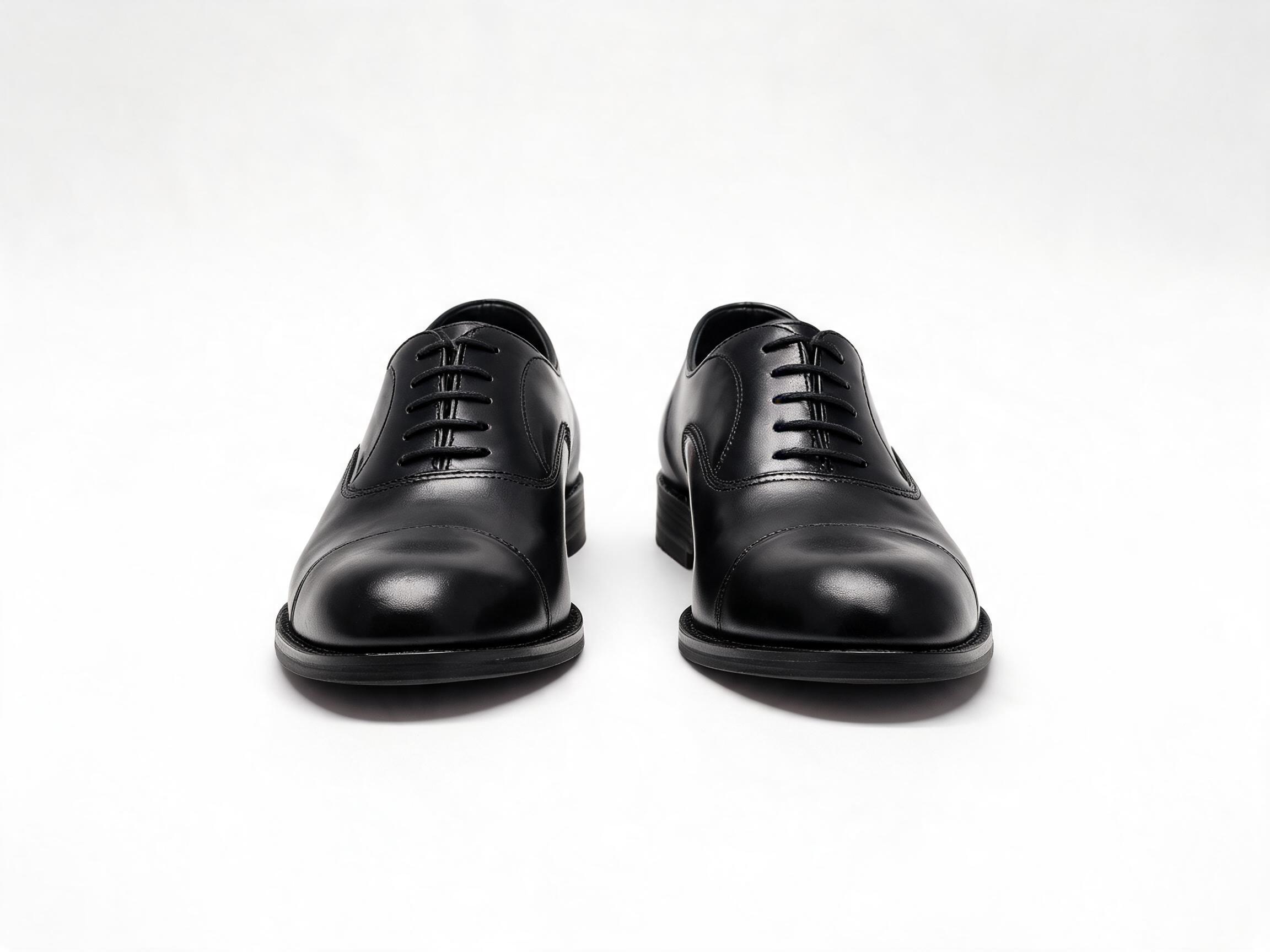
- Aurevia’s current published catalog uses stitched-and-cemented construction, not Goodyear welting. Our Black Cap-Toe Oxford is a structured dress shoe with a stitched leather/rubber sole; we can discuss construction requirements with buyers but do not claim welted capability today.
- Confirm all commercial terms before ordering. MOQ, lead time, and sample timing vary by construction and specification; always confirm current figures with the sales team.
In This Article
What Goodyear welted construction involves
Goodyear welting is a shoemaking method that joins the upper, insole, and sole with a lockstitch running through a strip of leather called the welt. The welt is stitched to the upper and insole rib (the inseam), and a second stitch attaches the welt to the outsole. This creates a durable mechanical bond that allows the sole to be replaced during resoling, which is one reason the construction is associated with repairable dress and casual footwear.
The process requires more than a standard sewing line. At minimum, a factory needs:
- A welt stitcher capable of consistent stitch length and tension through the welt, upper, and insole rib.
- An inseaming machine or a hand-inseaming station with operators trained to hold the rib and welt alignment.
- Lasting equipment that prepares the upper and insole for the welt operation without distorting the shape.
- A finishing line that can attach the outsole and heel while preserving the welt channel and stitch visibility.
Each of these steps has its own failure modes: uneven stitch density, a loose inseam, or a welt that is cut too short will show up in the finished shoe. That is why screening a goodyear welted shoes factory means verifying the process, not just the product name.
Why buyers ask for welted shoes
Buyers typically request welted construction for dress and smart-casual ranges where repairability, shape retention, and a traditional leather-sole appearance are part of the value proposition. The construction also communicates a certain level of workshop capability to end customers, which can support pricing and brand positioning.
However, welted construction is not the right answer for every program. It adds process steps and cost, and it requires a factory with the right equipment and trained staff. If your range is primarily fashion-led and price-sensitive, a stitched-and-cemented construction may be a better fit. The key is to match the construction to the product’s intended use and your target price, not to request welted construction by default.
How to verify a factory can genuinely deliver it
Claims of welted capability are easy to make. Verification should focus on three areas: machinery, operators, and sample review.
1. Machinery and process flow
Ask for a machine list that specifically identifies welt stitchers, inseaming equipment, and any hand-inseaming stations. A general “sewing machines” list is not enough. Request a brief process flow showing where the welt and inseam steps occur and how the upper is lasted before welting. If the factory cannot describe the sequence, it likely does not run the process regularly.
2. Operator experience
Welted construction depends on operator skill, especially at the inseaming and welt-stitching stages. Ask how many operators are trained on those machines and how long they have been running them. High turnover in these roles is a risk factor for inconsistent quality. You can also ask whether the factory uses a hand-inseaming method or a machine inseam, and how it controls stitch tension.
3. Sample review
The sample is your most reliable evidence. When you receive a welted sample, inspect:
- Welt stitch density and consistency: stitches should be evenly spaced and tensioned around the welt.
- Inseam integrity: the welt should be firmly attached to the upper and insole with no gaps or loose threads.
- Sole attachment: the outsole stitch should align with the welt and show no skipped stitches.
- Shape and symmetry: the lasting should not distort the upper, and left/right pairs should match.
A single sample shows what the factory can produce under observation; it does not guarantee production consistency. That is why sample review should be paired with questions about in-line inspection and final checks. Ask what inspection steps apply specifically to welted lines.
Questions to ask before you commit
Use the following checklist to structure your factory screening. The answers will help you separate genuine capability from marketing language.
| Area | Question to ask | What a useful answer looks like |
|---|---|---|
| Machinery | Which machines do you use for welt stitching and inseaming? Can you share the make/model and how often they are serviced? | Specific machine types or models, with a maintenance schedule. Vague answers or “we outsource that step” are red flags. |
| Process | Can you describe the step-by-step process for a welted shoe, from lasting to sole attachment? | A clear sequence that matches standard welted construction, with inspection points identified. |
| Operators | How many operators are trained on welt stitching and inseaming? How long have they been in those roles? | Named roles or counts, with tenure. If the factory relies on one person, ask about backup capacity. |
| Sample | Can you provide a welted sample in our target style and size range for inspection? | A sample you can physically check for stitch density, inseam integrity, and sole alignment. |
| Quality control | What inspection steps apply to welted lines specifically? | Defined checks at the welt stage and final inspection, not just a general “three-stage inspection.” |
| Commercial | What is the MOQ and lead time for a welted program? What is the sample lead time? | Figures you can confirm with the sales team. Always confirm current MOQ and lead time before ordering. |
Do not accept a single “yes” to “can you make Goodyear welted shoes?” as sufficient. Ask for the evidence behind the answer. A factory that genuinely runs the process will be able to describe the machinery, the operators, and the inspection points without hesitation.
A note on Aurevia’s current construction
Aurevia’s current published catalog, including the Black Cap-Toe Oxford Shoes, uses stitched-and-cemented construction. We do not claim Goodyear welted capability for our current dress shoe line.
What we can confirm from our product detail: the Black Cap-Toe Oxford has a polished full-grain leather upper, leather lining, cushioned insole, stitched leather/rubber sole, and a heel of approximately 3 cm. It is available in black, EU 39–45, with an MOQ of 100 pairs and a lead time of 30–40 days as listed on the specification sheet. These figures are from our published product detail; confirm current MOQ and lead time with the sales team before ordering.
Our factory, founded in 2011 in Quanzhou, runs OEM/ODM and private label programs with approximately 260 staff and exports to Europe, North America, and the Middle East. We operate a three-stage inspection process, including flex, color fastness, and heel-attachment testing, and offer a 6-month warranty. Samples are typically 3–5 days for stock styles and 7–12 days for custom samples. We quote EXW, FOB, and CIF.
If your program requires welted construction, we are not the right factory for that specific requirement today. However, if you are sourcing structured dress shoes in stitched-and-cemented construction and want to discuss how construction requirements fit your range, our sales team can review your specification with you.
Next steps for buyers
Before you commit to a welted program, complete the screening steps above and review a physical sample against your construction requirements. If a factory cannot provide the machinery list, operator information, or a sample that passes inspection, treat the capability as unconfirmed.
For buyers sourcing structured dress shoes in stitched-and-cemented construction, Aurevia can discuss your specification and provide samples. Start with our Black Cap-Toe Oxford Shoes detail page for the current published specification, then contact our sales team to confirm MOQ, lead time, and sampling for your program.
We respond to inquiries within 48 hours.