
When comparing leather shoe wholesalers, the price differences often come down to three build details: the grade of leather, the workmanship in the upper, and how the sole is attached. This article explains what to look for in each area and provides a practical inspection checklist to use before placing an order.
Sourcing Guide for Leather Shoe Wholesalers
When you shortlist leather shoe wholesalers, the quotes you receive can vary widely for what looks like the same style. The difference rarely comes down to the country of origin or the size range. It is in the build: the grade of leather that goes into the upper, the amount of handwork in the stitching and finishing, and the way the sole is attached to the upper. These three areas account for most of the gap between a low quote and a high one.
This article breaks down each area in plain buyer language, explains why they matter for your order, and gives you a concrete inspection checklist to use on samples or pre-production pairs before you commit.
Key Takeaways
- Leather grade is the starting point: full-grain leather keeps the outer surface intact, while corrected-grain or split leathers have been sanded or reconstructed. The grade affects both appearance and how the shoe ages.
- Upper craft covers the cutting, matching, stitching and finishing. Hand-stitched seams and matched hides take more time and skill than machine-only assembly.
- Sole construction is not just about the material; it is about how the sole is joined to the upper. Stitched-and-cemented builds involve more steps than cemented-only builds.
- Inspection mindset: look at grain direction and shade under good light, check stitch density and alignment, flex the sole, and examine the sole edge finish.
In this article
1. Leather Grade: What the Label Doesn’t Tell You
“Full-grain leather” is a term you will see from many leather shoe wholesalers. In simple terms, full-grain means the outermost layer of the hide is left intact. The grain pattern you see is the natural surface, not a stamped or sanded one. This matters because the outer layer is the densest and most durable part of the hide. It also takes polish and patina differently from corrected-grain leathers.
Corrected-grain leather has had the surface sanded to remove imperfections, then usually embossed with a pattern. Split leather comes from the lower layers of the hide and may be coated or laminated. Both can be used in footwear, but they are different starting points. A quote based on full-grain leather and a quote based on corrected-grain or split leather are not comparing the same material.
For buyers, the key is to ask the supplier what grade they are quoting and to inspect a sample under natural light. Look at the grain: natural full-grain will show subtle variations in pore size and pattern across the hide. If the grain looks perfectly uniform and repetitive, it may be embossed. Also check the edges of the upper panels; on full-grain leather, the cut edge shows the tight, dense structure of the outer layer.
One more point: matching matters. Hides vary in shade and grain. A supplier that cuts left and right panels from matched hides will produce pairs that look consistent. A supplier that does not may deliver pairs with visible differences. This is a labor and material cost that shows up in the wholesale price.
2. Upper Craft: Stitching, Matching and Finishing
Upper craft is where handwork becomes visible. Two suppliers can use the same grade of leather and still deliver very different uppers depending on how the panels are cut, stitched and finished.
Cutting and matching
As mentioned, matched hides help ensure that left and right shoes share grain direction and shade. This is especially important on styles with large visible panels, like cap-toe oxfords or full brogues. The cutting process also affects how the shoe holds its shape. Panels cut in a consistent direction relative to the hide’s stretch will behave more predictably over time.
Stitching
Stitch density, tension and alignment are easy to inspect. On a good upper, stitches are evenly spaced, sit consistently on the seam line, and do not pucker the leather. Hand-stitched details, such as a cap-toe line or brogue perforations, take more time than machine-only work. They also add character: a hand-stitched cap-toe line may have slight, intentional variations that a machine cannot replicate.
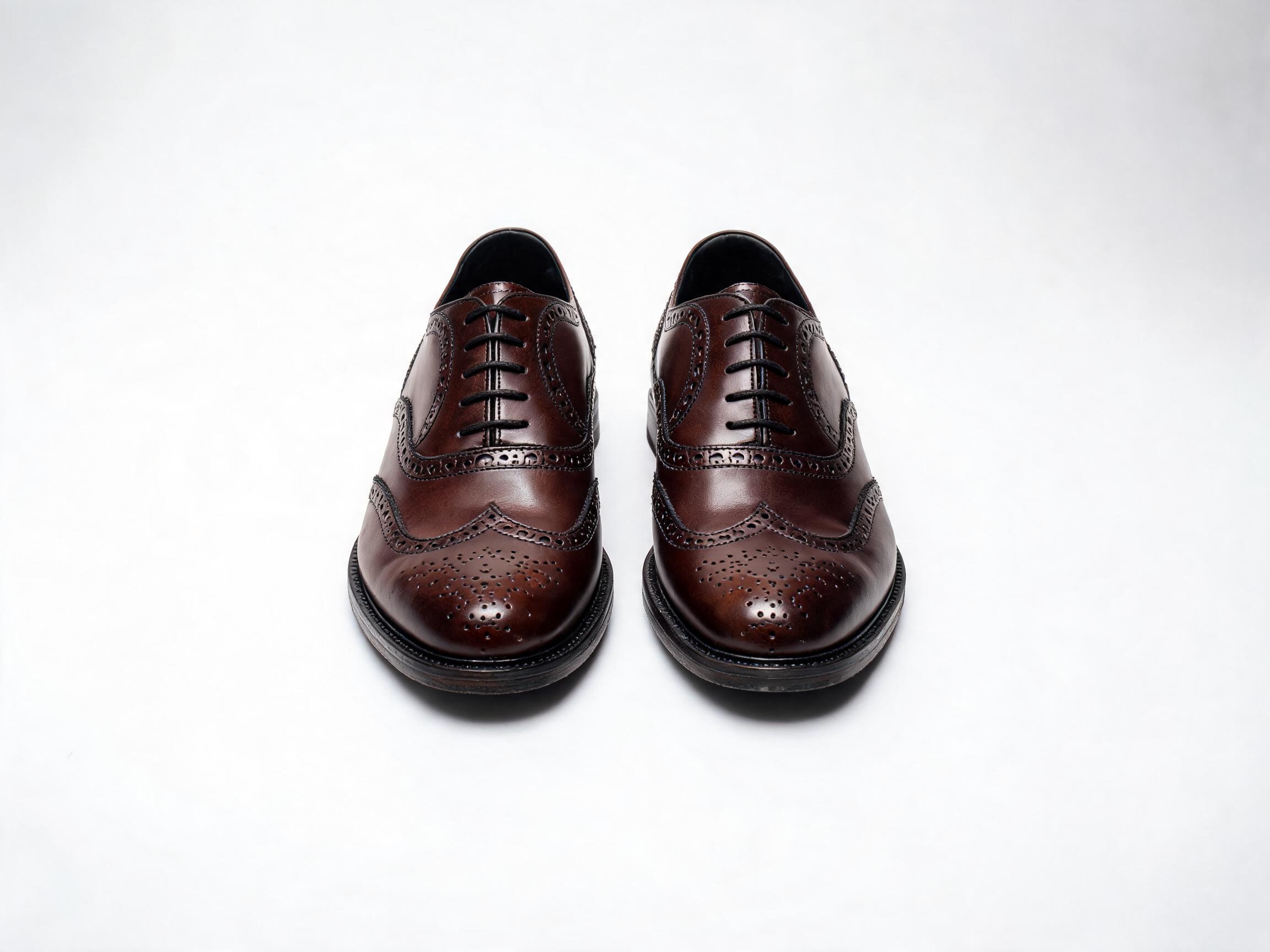
Brogue perforations are another tell. On a full brogue, the wingtip pattern and medallion are punched by hand. This requires skill and adds cost. Inspect the holes for clean edges and consistent spacing. If the perforations look torn or uneven, the punching was rushed.
Finishing
Finishing includes edge burnishing, polishing and lining. Leather lining is a sign of a higher-grade build; it adds comfort and helps the shoe hold its shape. A cushioned leather footbed is another detail that adds material cost. On the outside, look at how the upper meets the sole and how the edges are treated. These finishing steps are labor-intensive and contribute to the price gap.
3. Sole Construction: Stitched vs. Cemented
Sole construction is often the least visible but most important factor in both price and performance. The two main methods you will encounter are cemented and stitched-and-cemented.
Cemented construction means the sole is glued to the upper. It is a common method for many types of footwear and can be efficient to produce.
Stitched-and-cemented construction means the sole is both glued and stitched to the upper. The stitching adds a mechanical connection that does not rely solely on adhesive. This is more expensive because it requires additional steps, specialized equipment and more skilled labor. It is often used in dress shoes and boots where durability and repairability are valued.
For buyers, the difference is visible. Look at the sole edge: on a stitched construction, you will see a line of stitching running around the perimeter where the sole meets the upper. The outsole edges may also be inked and burnished, a finishing step that improves appearance and seals the edge. Flex the shoe gently; a stitched-and-cemented sole will feel different from a cemented-only sole, though the exact feel depends on the materials.
The sole material itself also matters. Leather soles are traditional for dress shoes, while rubber soles offer different properties. Some builds combine both, such as a leather sole with a rubber top piece. Each choice has a cost implication.
4. A Practical Inspection Checklist
Use this checklist when you evaluate samples or pre-production pairs from leather shoe wholesalers. It is organized by the three areas above.
| Area | What to Inspect | What to Look For |
|---|---|---|
| Leather grade | Grain pattern under natural light; cut edges of panels | Natural variation in pore size; dense, tight edge structure. Uniform, repetitive grain may indicate embossing. |
| Upper craft | Left/right matching; stitch density and alignment; hand-stitched details; brogue perforations; lining and footbed | Consistent shade and grain direction across pair; even stitches without puckering; clean, evenly spaced perforations; leather lining and cushioned footbed if specified. |
| Sole construction | Stitching around sole perimeter; sole edge finish; flex test | Visible stitching line if stitched construction; inked and burnished edges; sole feels securely attached when flexed. |
| Overall | Size range and fit; symmetry; overall finish | Sizes available (e.g., EU 39-45); left and right shoes mirror each other; no loose threads or uneven edges. |
Remember that a sample is not a guarantee of bulk production. It is a reference point. Ask the supplier how they maintain consistency across the order. A supplier that can explain their process for matching hides, monitoring stitch quality and checking sole attachment is more likely to deliver consistent results.
5. FAQ
How can I tell full-grain leather from corrected-grain?
Look at the grain under natural light. Full-grain leather shows natural variations in pore size and pattern. Corrected-grain often has a more uniform, embossed pattern. Also check the cut edges: full-grain has a tight, dense structure at the surface.
What is the difference between closed lacing and open lacing?
Closed lacing, as on an oxford, means the quarters are stitched under the vamp, so the lacing is closed. Open lacing, as on a derby, means the quarters are stitched on top of the vamp, allowing the lacing to open wider. The choice affects fit and formality, and the construction steps differ.
Is stitched-and-cemented construction always better?
It is a more involved construction that adds durability and repairability, but it is not the only valid method. The right choice depends on the shoe’s intended use and your market. What matters is that the supplier is clear about the construction and that it meets your requirements.
How do I check if the left and right shoes are properly matched?
Place both shoes side by side under natural light. The shade and grain pattern should be consistent. Check the direction of the grain; on matched hides, it should run the same way on both shoes. Also look at the stitching and panel alignment for symmetry.
Examples from our collection:
- Black Cap-Toe Oxford Shoes – polished full-grain leather upper, hand-stitched cap-toe line, leather lining, cushioned leather footbed, stitched leather/rubber sole, stitched-and-cemented build.
- Dark Brown Full Brogue Shoes – burnished full-grain leather, hand-punched wingtip perforations and medallion, leather lining, stitched sole.
- Brown Derby Dress Shoes – polished full-grain leather, open-lacing derby construction, leather lining, stitched rubber sole.
All styles available in EU 39-45.
Next Steps
When you evaluate leather shoe wholesalers, use the checklist above to compare samples side by side. Ask specific questions about leather grade, stitching methods and sole construction. If you would like to discuss your requirements or request samples, please contact us.
Aurevia Footwear Co., Ltd. is a B2B manufacturer and exporter of high-end leather footwear, offering OEM/ODM services to customers in Europe, North America and the Middle East.