
Why lower and moderate heel heights suit long events, how adjustable straps, anti-slip outsoles and padded insoles support honest comfort claims, and how mixed size runs work when ordering low heel party shoes wholesale through an OEM heel-height program.
Event staff, hotel banquet teams and occasion-wear retailers usually face the same problem: the shoe has to look right on the floor and still be wearable at hour six. Heel height is the first decision that shapes both. This article explains how lower and moderate heels work for long events, which construction details support a comfort claim you can put in writing, and how mixed size runs are handled when you order low heel party shoes wholesale through an OEM heel-height program.
- Lower and moderate heels suit long events because they change the wearer's balance and stride, not because of any measured comfort percentage.
- Adjustable ankle straps, anti-slip outsoles and padded insoles are verifiable features. Describe them as features; do not convert them into unproven endurance claims.
- Mixed size runs are planned against an agreed size curve, and the packing ratio is written into the order confirmation.
- Low-heel variants are arranged through OEM heel-height customization after sample confirmation, not pulled from a fixed stock SKU list.
On this page
- Why heel height decides long-event wearability
- Security features that support an honest comfort claim
- Mixed size runs in wholesale ordering
- OEM heel-height customization: what happens after sample confirmation
- Building a purchase checklist
- FAQ
Why heel height decides long-event wearability
At an event, the shoe is worn for hours at a time, often on hard floors, with standing, walking and occasional stairs. Heel height changes three things the wearer feels directly: the angle of the foot inside the shoe, how much body weight shifts onto the forefoot, and how stable the ankle feels when turning or stopping.
A lower heel keeps the foot closer to a natural standing angle. A moderate heel still raises the heel, but by less than a high stiletto. For buyers, the practical question is not which height is "better" but which height matches the event profile and the wearer group.
Matching heel height to the event profile
| Event profile | Typical requirement | Heel height to consider |
|---|---|---|
| Banquet service, front desk, ushering | Long standing hours, repeated walking, hard floors | Lower heels, with a secure strap and grippy outsole |
| Wedding and party guest wear | Several hours of mixed standing and dancing | Moderate heels, often with an ankle strap |
| Evening occasion retail | Look-driven purchase, shorter wear time | Moderate to higher heels, depending on the collection |
| Hospitality uniform programs | Consistent appearance across a team | One agreed height and a controlled size mix |
The table is a starting point. The final choice depends on the wearer group, floor surfaces and how the shoe will be used.
Security features that support an honest comfort claim
Comfort is a difficult claim to make in writing because it depends on the wearer. What a supplier can do honestly is describe the construction features that address common problems: the foot sliding forward, the ankle rolling, or the sole slipping on smooth floors. Three features matter most for occasion shoes.
Adjustable ankle straps
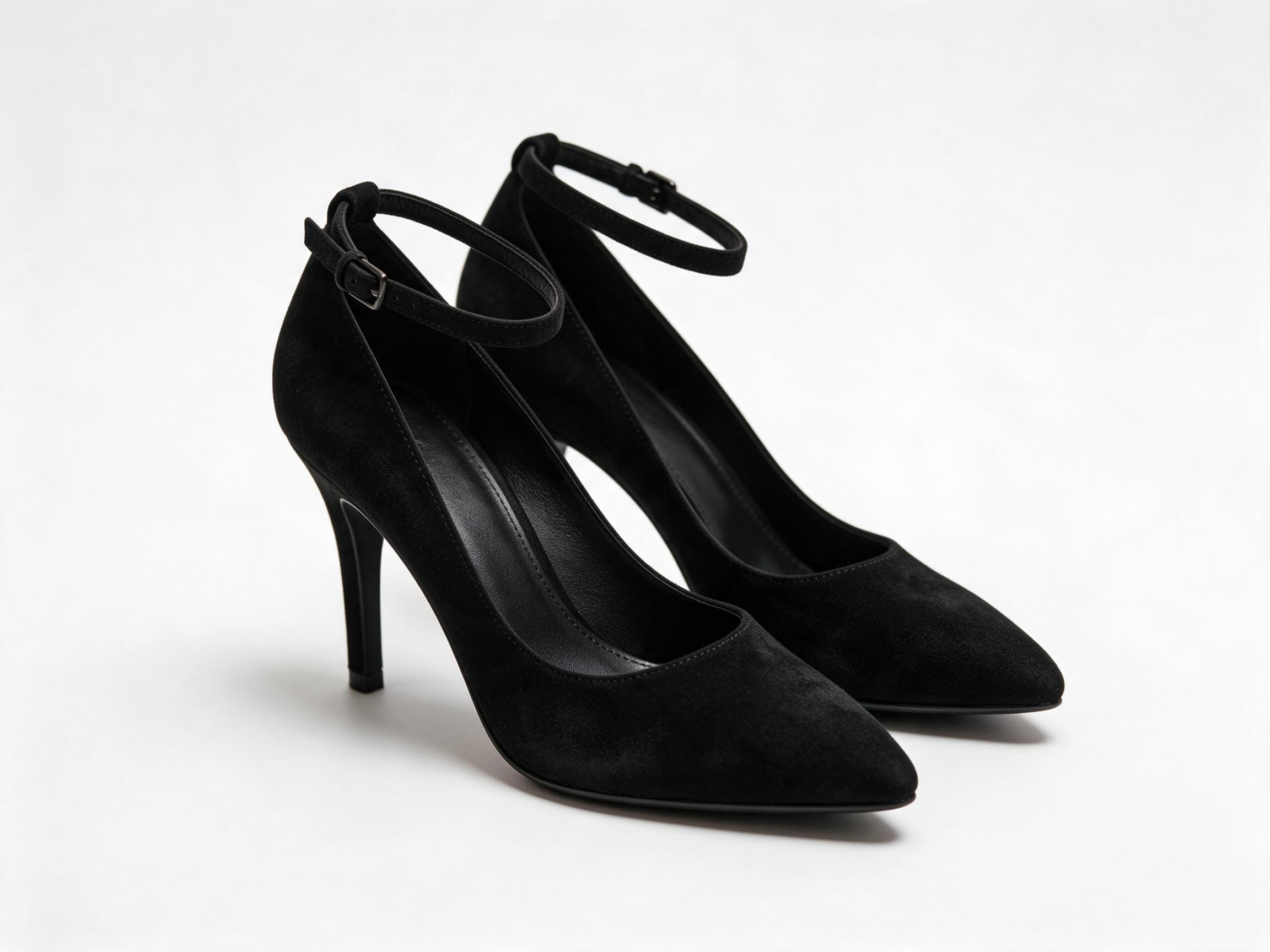
An adjustable buckle strap lets the wearer set the fit around the ankle rather than relying on a fixed circumference. That helps keep the heel in place and reduces the forward slide that pushes toes into the front of the shoe. In our line, the black suede ankle-strap heel uses an adjustable buckle strap with an 8.5 cm heel, a padded insole and an anti-slip outsole. For buyers, the honest claim is fit adjustment, not a guaranteed all-night comfort result.
Anti-slip rubber outsoles
A rubber outsole with a textured tread gives more grip on polished floors, tile and carpet edges than a smooth sole. This is a safety feature as much as a comfort feature. When specifying, ask for the outsole material and tread pattern to be confirmed on the sample, and check it on the floor surfaces your end customers actually encounter. Do not describe an outsole as "non-slip" in absolute terms; describe it as an anti-slip outsole and let the buyer test it.
Padded insoles
A padded insole adds a cushioning layer under the foot. It can soften the feel of a hard floor, but it does not change the geometry of the heel or remove the need for a good fit. Our red leather classic pump has an 8 cm stiletto heel and a padded insole. That is a factual description of the build. It is not a claim that the shoe will feel comfortable for every wearer over every duration.
When you write product copy or staff guidance, separate features from outcomes:
- Feature: adjustable buckle strap, 8.5 cm heel, padded insole, anti-slip outsole.
- Reasonable description: "Designed with an adjustable strap and padded insole for a more secure fit."
- Unsupported claim to avoid: "Guaranteed comfortable for 12-hour shifts" or any invented comfort percentage.
Mixed size runs in wholesale ordering
Occasion shoes are rarely bought in single sizes. A team uniform order, a boutique restock or a hotel procurement usually needs a spread of sizes in one style and color. That spread is the size run, and the ratio of each size inside a carton is the size curve.
How a size curve is agreed
The buyer and supplier agree a size range and a packing ratio before production. The ratio should reflect the buyer's own sales or wearer data, not a generic assumption. For example, a hospitality program may need more of the middle sizes, while a retail boutique may want a wider spread to cover walk-in demand. The agreed curve is then written into the order confirmation so both sides are checking the same numbers.
| Ordering element | What to agree | Where it appears |
|---|---|---|
| Size range | Which sizes are produced for the style | Quotation and order confirmation |
| Size curve | How many pairs of each size per carton or per order | Order confirmation |
| Packing method | Assorted sizes per carton or single-size cartons | Packing list |
| Size labeling | Size marking on the shoe, box or both | Sample approval and packing list |
| Reorders | Whether the same curve can be repeated | Discussed with the sales team |
Assorted versus single-size cartons
Assorted cartons carry a mix of sizes and suit buyers who need to distribute shoes to a team or stock a shelf quickly. Single-size cartons suit buyers who already know their demand by size and want simpler inventory counting. Neither is universally better. The choice depends on how the goods will be received, stored and issued.
Sizing systems also need to be confirmed. A size label means different things in different markets, so the buyer should state which system the order should follow and check it on the approved sample and the packing list.
OEM heel-height customization: what happens after sample confirmation
Many occasion styles are developed at a higher heel by default. If your program needs a lower heel, the route is OEM heel-height customization: the heel height is changed as part of the development process rather than selected from a fixed stock list.
The sequence matters. The buyer reviews the construction, materials, fit and finish on a sample; once the sample is confirmed, the low-heel variant is arranged against that confirmed reference. This keeps the strap position, insole and outsole consistent with what was approved. It also means low-heel variants should not be described as existing stock SKUs unless your supplier has confirmed them as such for your order.
Before requesting a low-heel variant, prepare the following:
- Target heel height range and the reason for it (event type, wearer group, floor conditions).
- Reference style or styles, with the color and material you want.
- Size range and proposed size curve.
- Any labeling, packing or presentation requirements.
MOQ, lead time and sampling schedules vary by style and order, so confirm them with the sales team before ordering. They are not fixed across the line.
Building a purchase checklist
A short checklist keeps the order comparable across suppliers and reduces surprises at delivery.
- Heel height: stated in centimeters, with the target range for your event profile.
- Upper material and color: confirmed on the sample, with any colorfastness or care instructions the supplier can provide.
- Strap and closure: adjustable or fixed, buckle type, and fit adjustment range.
- Insole: padded or flat, and the material.
- Outsole: material and tread, checked on the floor surfaces you expect.
- Size range and curve: written into the order confirmation.
- Packing: assorted or single-size cartons, and size labeling.
- Customization: whether heel height is changed through OEM and at what stage.
FAQ
Are low heel party shoes available as ready stock?
Heel height can be customized through our OEM program. Low-heel variants are arranged after sample confirmation, so they should not be treated as fixed stock SKUs unless the sales team confirms availability for your specific order.
Can you supply a mixed size run in one order?
Yes, mixed size runs are planned against an agreed size curve. The size range and packing ratio are written into the order confirmation. Confirm the details with the sales team before ordering, since the curve depends on the style and your market.
How should I describe comfort in my own marketing?
Describe the features that are actually built into the shoe: adjustable strap, padded insole, anti-slip outsole, heel height. Avoid absolute comfort guarantees and invented percentages. If you need wear-test information, ask the supplier what verified data is available for the specific style.
What is the difference between 8 cm and 8.5 cm heels in practice?
Both are moderate heights. The difference is small in absolute terms, but the feel depends on the last, the insole and the wearer. Check both on sample if the height is critical for your program.
Planning a low-heel occasion program? Send your target heel height, reference style, size range and proposed size curve. We will confirm what can be arranged through OEM customization and what needs to be checked on sample.